DRIFT AUDIO
Listen to this story
Choose a voice, then press play.
For the first time since 2005, the bag BEAMS PLUS built its reputation on has been taken apart and put back together.
Ask anyone who has spent time in a BEAMS PLUS store about the 3WAY No.1 and they will know exactly what bag is being discussed before a photo even comes out. It is the special order BEAMS PLUS has kept running with BRIEFING for two decades: a briefcase, shoulder bag, and backpack in one shell, unchanged in design or specification since it first appeared in 2005. That kind of stasis is rare in a market that reworks colorways every season, and it is exactly why the bag became a fixture rather than a trend piece.
BRIEFING itself was founded in 1998 as a Japanese luggage label built on an unusual premise: take genuine MIL-SPEC manufacturing, the kind used for military and medical equipment contracts in the United States, and translate it into bags people could carry to an office rather than a base. That premise is not marketing language layered on after the fact. BRIEFING’s bags are produced at American factories that also handle defense and medical contract work, meaning the reinforced stitching, the bar tacking at stress points, and the hardware tolerances are carried over from equipment built to survive far rougher treatment than a daily commute. The 3WAY No.1 was the clearest expression of that idea, a single sil meant to hold up in a factory audit as easily as a boardroom.
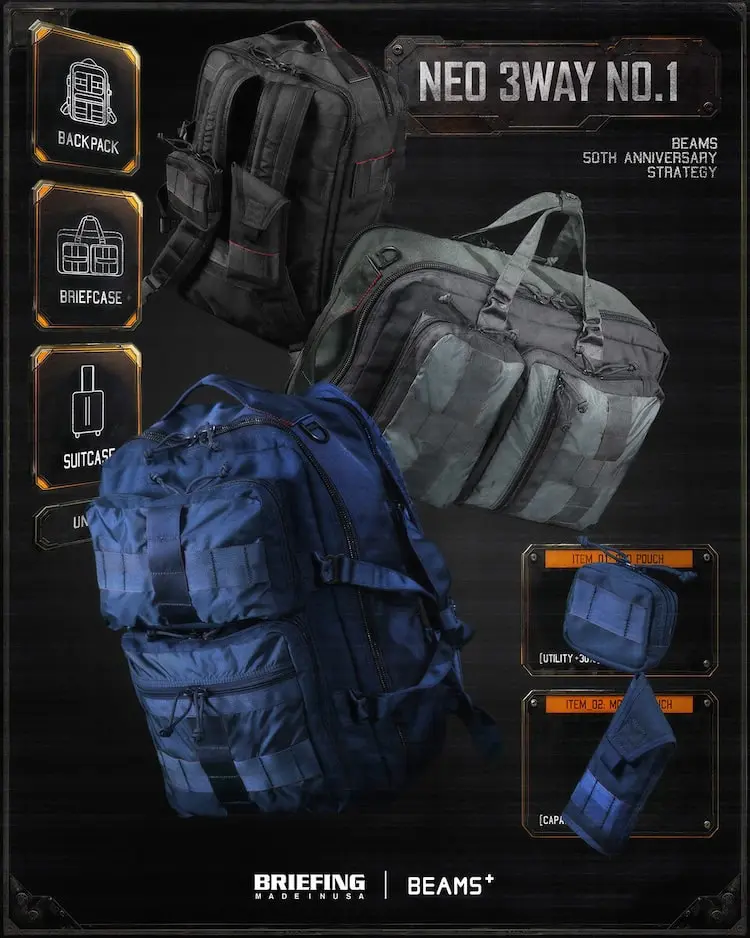
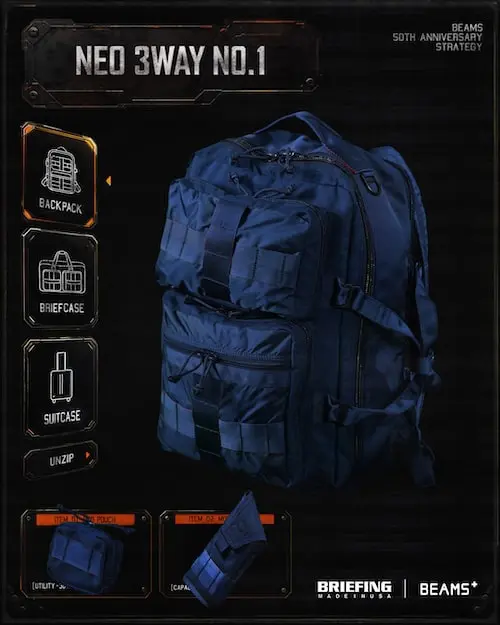
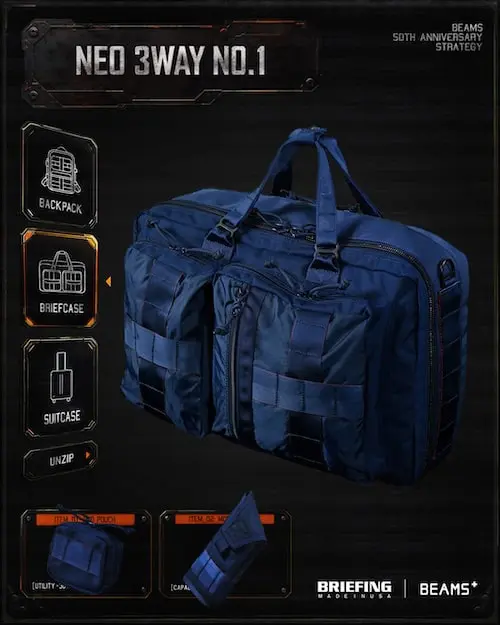
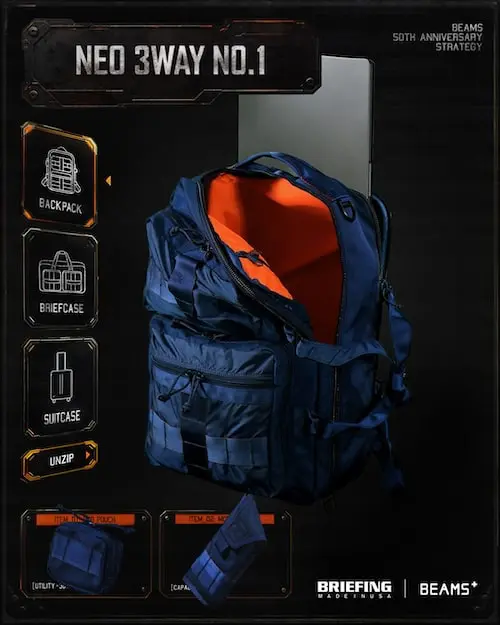
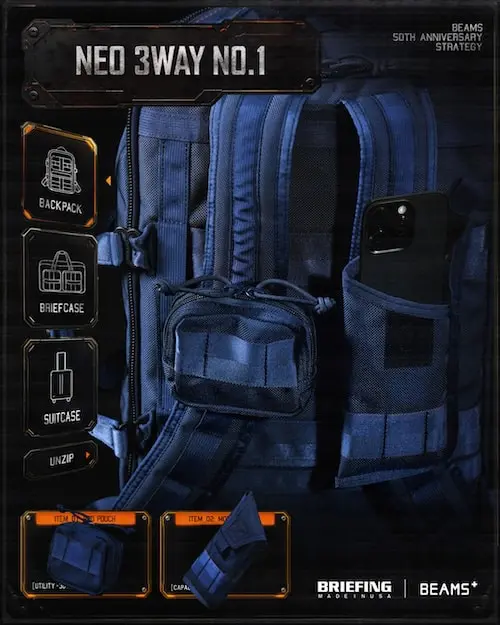
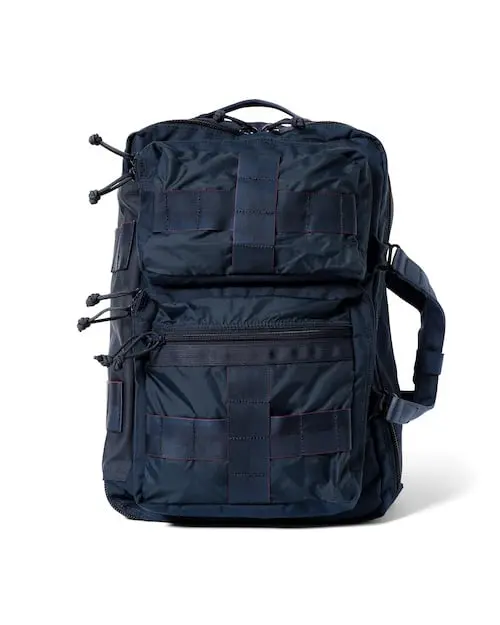
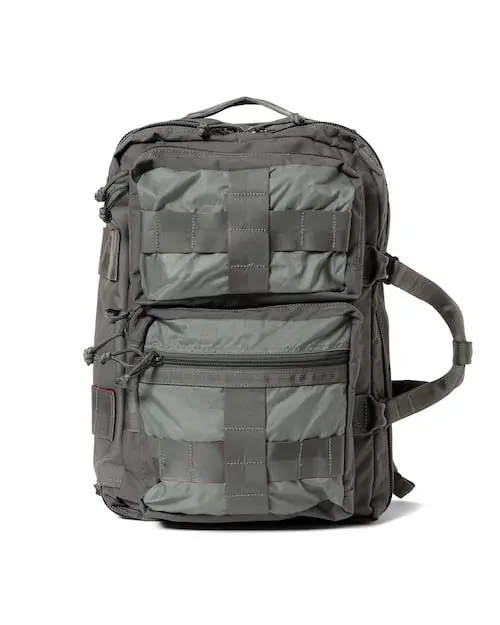
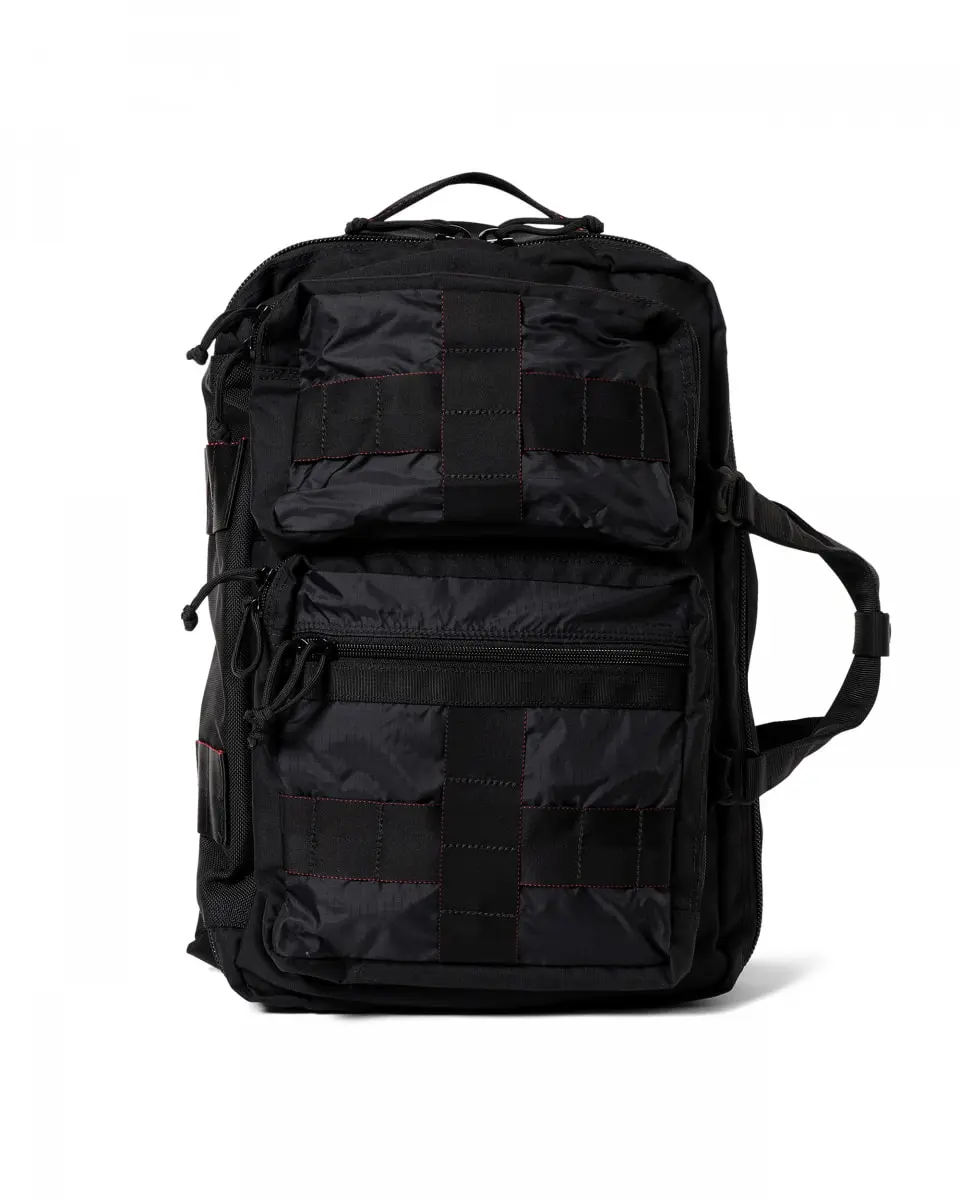
BRIEFING × BEAMS+ NEO 3WAY NO.1 shown in its three carrying modes with included utility accessories.
Now, timed to BEAMS‘ 50th anniversary (the retailer opened its first Harajuku store in 1976), BEAMS PLUS has released a version of that bag it is calling the NEO 3WAY No.1. According to BEAMS’ own product release notes, this is not a limited colorway or a fabric swap. It is a structure rethink of what the 3WAY concept is even for, built around how people actually travel now rather than how they traveled in 2005.
The frame BEAMS uses in its own release is worth pausing on. The copy describes the shift as moving the product category from “bag” to “gear,” a distinction that suggests BEAMS PLUS sees the redesign less as a seasonal refresh and more as a repositioning of what the item is supposed to do for the person carrying it. Anniversary collide tend to lean on nostalgia, reissuing an old sil in a commemorative colorway and calling it a tribute. BEAMS PLUS took the opposite approach here, treating the milestone as license to open up a design most customers assumed was untouchable.
build
The original 3WAY No.1 promised three carrying modes: hand carry, shoulder, and backpack. BEAMS PLUS says its design team noticed that almost nobody used the shoulder option anymore, with most buyers treating the bag strictly as a briefcase or a backpack depending on the day. Rather than keep a strap that sat unused in most owners’ closets, the NEO 3WAY No.1 drops it from the box entirely, though the D-rings needed to attach a strap are still built into the shell for anyone who wants to source one separately.
In its place is a feature BEAMS PLUS is calling carry connect: a dedicated strap system on the back panel that lets the bag lock onto a rolling suitcase handle in either portrait or landscape orientation. It sounds like a small addition, but it reframes the entire bag. The 3WAY No.1 has always been popular with people who travel for business, and a bag that can ride hands free on top of a roller case solves a problem those travelers have quietly worked around for years, usually by looping a strap over the handle and hoping it holds.
So the three ways have shifted. Instead of hand carry, shoulder, backpack, the NEO 3WAY No.1 is built around hand carry, carry connect, and backpack: a formal two handled grip for meetings, a rolling case connection for the walk through the airport, and backpack straps for the commute in between. BEAMS PLUS frames this as the version of the bag suited to what it calls modern gear rather than a modern bag, language that signals how seriously the brand is treating the redesign.
There is a logic to dropping the shoulder option specifically. A shoulder strap on a bag this size puts weight on one side of the body over a long walk, which is precisely the kind of carry pattern that falls apart on a multi hour transit through an airport or a train station. BEAMS PLUS’s own read of its customer base found that people were already avoiding the shoulder mode in practice, defaulting to the backpack straps for exactly that reason. Removing the strap from the box, rather than continuing to include hardware nobody used, is as much an editing decision as a design one. Keeping the D-rings in place is the concession to the small group who might still want to source a strap separately, which keeps the change from being irreversible for anyone attached to the older carry style.
The backpack straps themselves have not changed in any way BEAMS has detailed publicly, which suggests the redesign was targeted rather than total. BRIEFING and BEAMS PLUS left the elements that worked alone and rebuilt only the two carrying modes that needed it: the shoulder option that had fallen out of use, and the case connection that had never existed at all.
mat
The original bag used ballistic nylon across its entire surface, a material choice that gave it durability but also weight and a fairly uniform look regardless of colorway. The NEO 3WAY No.1 splits the build across three fabrics instead of one. Ballistic nylon is kept on the panels that take the most stress, the areas that hold shape under load or take the brunt of daily wear. Everywhere else, BEAMS PLUS has swapped in Cordura nylon and ripstop nylon, both lighter and less prone to the slightly heavy, utilitarian look ballistic nylon can carry.
The result, per BEAMS’ release, is a bag that keeps BRIEFING’s structural toughness where it actually matters while cutting overall weight and giving the surface more visual variation than the earlier single fabric version. That kind of material hybridization has become more common across luggage and outdoor gear generally, but it is a notable shift for a bag that spent twenty years defined by its all ballistic nylon construction as much as by its silhouette.
Ballistic nylon earned its reputation in luggage precisely because it resists abrasion and punctures better than most woven synthetics, which is why it became the default for bags meant to survive baggage handlers and years of daily use. The tradeoff has always been weight and a fairly flat, utilitarian surface texture. Cordura nylon, developed originally for military and workwear applications and now used widely across outdoor and travel gear, offers a lighter alternative with its own abrasion resistance, while ripstop nylon’s grid weave pattern stops small tears from spreading without adding meaningful bulk. Splitting a single bag across all three, rather than picking one and building the whole shell from it, is a fairly involved manufacturing decision, since it means managing three different fabric behaviors, three different sewing tensions, and three different aging patterns within one product rather than one.
View this post on Instagram
appar
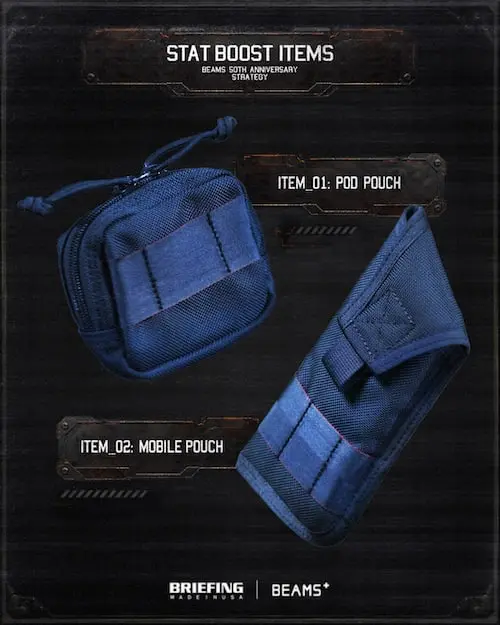
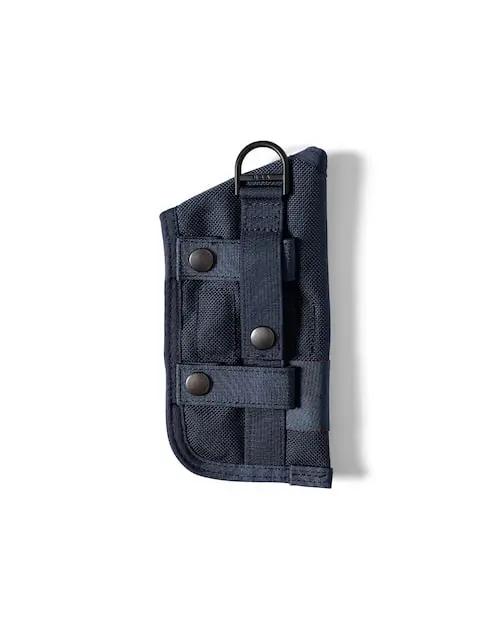
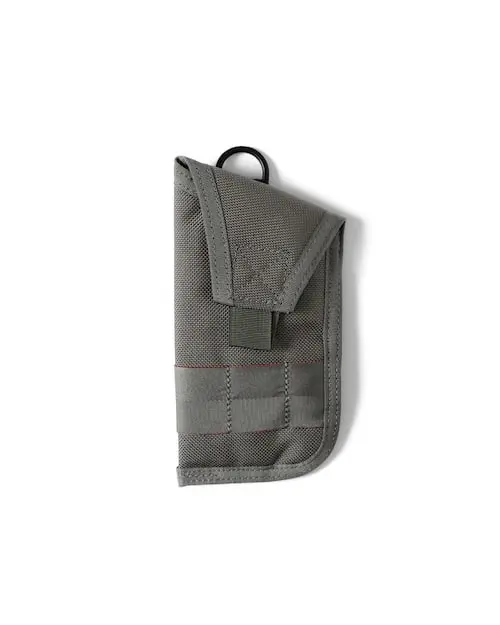
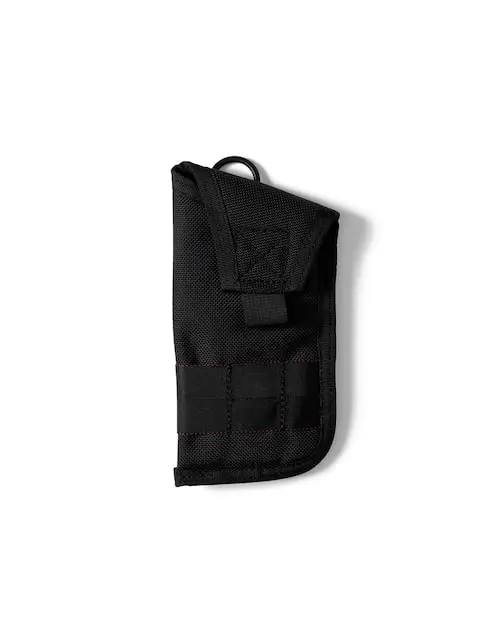
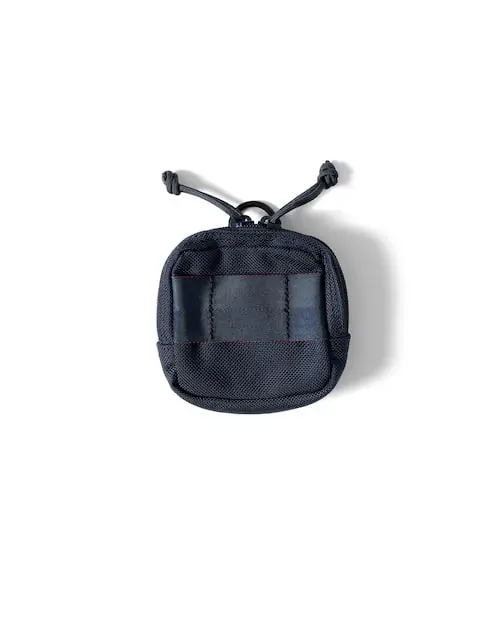
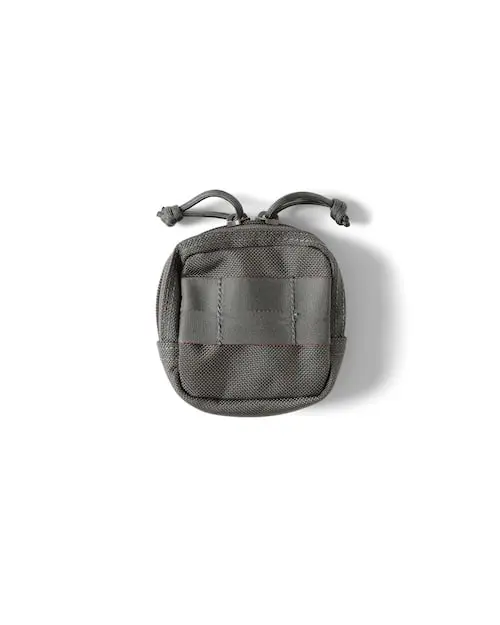
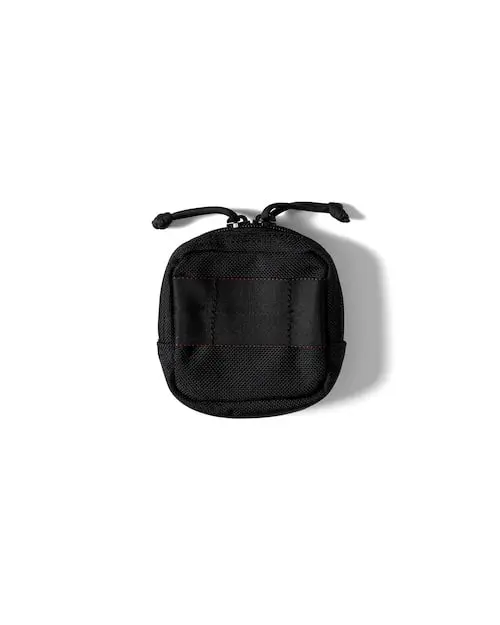
Alongside the bag itself, BEAMS PLUS is releasing two accessory pouches designed to attach directly to the bag’s harness hardware rather than function as standalone items. The Mobile Pouch is sized for current large format smartphones and priced at 15,400 yen including tax. The Pod Pouch is built for smaller items, the kind of thing that gets lost at the bottom of a bag otherwise, such as wireless earbuds, and is priced at 16,500 yen including tax.
Both pouches come in the same three colorways as the main bag and mount to the shoulder strap harness section, meaning owners can expand the bag’s organization without adding a second separate accessory that has to be carried on its own. BEAMS PLUS describes the combination of bag and pouches as pushing the release toward what it calls tactical gear territory rather than a simple bag with add ons, a framing that lines up with BRIEFING’s original military manufacturing pitch from 1998.
That modular approach mirrors a broader shift in how outdoor and military inspired brands have been building accessories over the past few years, moving away from bags with fixed internal pockets and toward external mounting points that let an owner reconfigure a single shell for different trips. BRIEFING has dabbled with this idea before in smaller product lines, but pairing it directly with a flagship release like the 3WAY No.1, rather than a secondary or entry level item, signals BEAMS PLUS wants the modular system associated with its most recognizable bag rather than kept separate from it.
Pricing the two pouches separately from the bag, rather than bundling them into a set, also keeps the entry point for the NEO 3WAY No.1 itself at 115,500 yen rather than folding accessory costs into a higher headline figure. Anyone who wants the full harness mounted system, bag plus both pouches, is looking at just under 150,000 yen in total once tax is included.
fin
The NEO 3WAY No.1 launches on July 25, priced at 115,500 yen including tax. That places it well above the standard 3WAY No.1’s usual price bracket, reflecting both the new carry connect hardware and the more complex three fabric construction. Per the Begin magazine coverage of the release, production of this particular anniversary version is limited to this year only, with no confirmation yet of whether the design carries over into future seasons.
Retail is split across four points: BEAMS PLUS Marunouchi and BEAMS PLUS Osaka, BEAMS LIFE Yokohama, and BEAMS’ official online store. The three physical locations are also running a “more variation” event from July 25 through August 2, stocking rarer BRIEFING pieces not normally carried in regular rotation alongside early access to the NEO 3WAY No.1 itself. Anyone who spends 30,000 yen or more on BRIEFING product during the event window at those stores receives a limited quantity novelty gift, while supplies last.
The event stock goes beyond the NEO 3WAY No.1 itself. BEAMS’ release notes describe the standard 3WAY bag lineup, along with shoulder bags, totes, and hard case luggage, all available in the kind of multifunctional builds meant to move between office and day use. That breadth is a deliberate contrast to the anniversary release, giving customers who are not ready to commit to the redesigned flagship a chance to see the full range BRIEFING and BEAMS PLUS have built together over the years, in stores rather than only online.
Limiting the event, and the novelty gift threshold that comes with it, to three physical locations rather than running it across BEAMS’ full store network is consistent with how the retailer has typically handled anniversary programming this year, treating flagship stores as the site for milestone activity rather than spreading a single release thin across every location nationwide.
For a brand that has spent twenty years insisting its signature bag did not need to change, the decision to rebuild it from the strap system out, timed precisely to a milestone anniversary, says something about how BEAMS PLUS wants people to think about the next twenty. The shoulder strap is gone. The rolling case connection and the mixed fabric shell are what replace it, and BEAMS is betting that trade reflects how its customers actually move through a day now, rather than how they moved through one in 2005.
Related Articles

Nubian Put Distressed Cotton Jersey On Needles Track
20th Exclusive Vol.7. Needles. Four shapes. Black and grey. 19 September 2026. All NUBIAN doors […]