DRIFT

Mary Shelley’s Frankenstein; or, The Modern Prometheus is, from first publication, a mutating text: full of gaps, contradictions, and rhetorical excess. It invites reinterpretation and reinvention. That open-endedness has made Frankenstein one of cinema’s most protean myths — a story more often warped than faithfully recounted, but endlessly compelling.

Over more than a century, filmmakers have turned Frankenstein’s themes into gothic horror, science-fiction, comedy, satire, body horror, and even musicals.
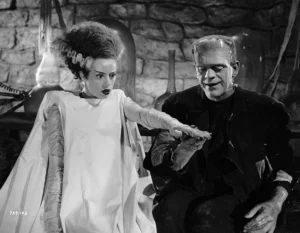
A black-and-white still from the 1935 film Bride of Frankenstein, depicting the Monster and his newly created Bride in the laboratory. The Bride, wrapped in a flowing white gown with streaked hair standing tall, recoils in surprise as the Monster gently reaches out his hand toward hers. The scene is illuminated by eerie lab equipment in the background, capturing both the gothic atmosphere and tragic emotion of the moment.

bride of frankenstein (1935)

James Whale’s sequel surpasses its predecessor in ambition, style, and emotional range. Where Frankenstein (1931) introduced the mythic core — Dr. Frankenstein, the Monster, lightning, and doomed hubris — Bride expands it. The addition of the Bride gives the Monster a tragic desire; the film plays with horror, comedy, pathos, and even irony. Elsa Lanchester’s brief but unforgettable performance as the Bride is iconic. Whale layers the story with visual symbolism, theatrical framing, and emotional density, producing a Gothic dream that still resonates. For many critics and fans, Bride of Frankenstein remains the apex of the Frankenstein cinematic cycle.
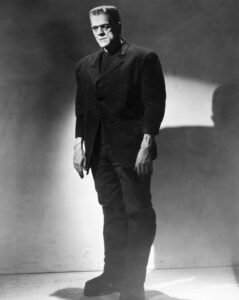
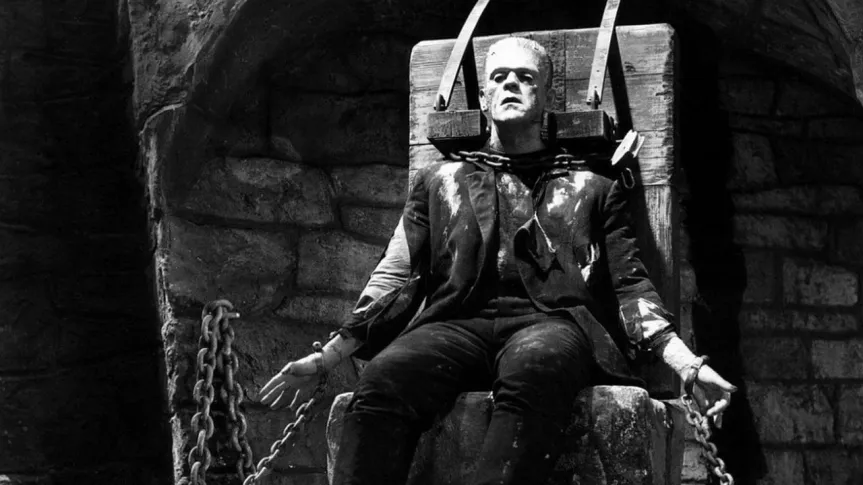
A black-and-white portrait of the Frankenstein Monster from the 1931 film Frankenstein. The creature stands upright in a dark suit, with a square head, heavy brow, and bolts at the neck. His expression is somber, and the dramatic lighting casts a long shadow on the wall behind him, emphasizing the eerie and tragic tone of the classic horror icon.

frankenstein (1931)

The film that (for better or worse) defined the Frankenstein image in popular culture. James Whale’s Frankenstein set the template: the laboratory, the lightning, the bolts in the neck, the mute lumbering monster, the anguished creator. Boris Karloff’s performance — simultaneously childlike, monstrous, and sympathetic — became the monstrously human ideal. It’s not a perfect adaptation — it simplifies, omits, and rearranges plot elements — but as a horror film it remains startling, effective, and deeply influential. It’s one of the foundational movies of the horror genre.
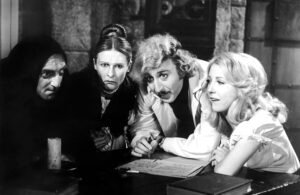
A black-and-white still from the 1974 comedy film Young Frankenstein, showing four characters gathered around a table in a dimly lit laboratory. The group, dressed in period costumes, leans in over handwritten notes, each with a distinct expression—ranging from suspicion to curiosity and amusement. The image captures the film’s blend of classic horror homage and satirical humor.

young frankenstein (1974)

Mel Brooks and Gene Wilder’s affectionate parody may seem like sacrilege in a list of serious Frankenstein adaptations — but it also might be the most uniquely calibrated cinematic Frankenstein. Wilder’s Dr. Frederick Frankenstein (pronounced “Fronkensteen”) inherits his grandfather’s castle, reanimates a Creature, and faces absurdities and horrors in equal measure. Many of its gags play off cinematic nods to the 1930s films: the windmill silhouette, the lab, the Igor/Mutt line, and more. Young Frankenstein is lovingly replete with references, and yet stands on its own as a comic masterpiece that makes us reconsider the original’s loneliness, absurdity, and horror from a fresh angle.
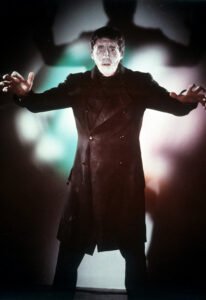
A dramatic color still of the Frankenstein Monster from Hammer Films’ The Curse of Frankenstein (1957). The creature, dressed in a dark, buttoned coat, extends his arms forward in a tense, almost pleading gesture. His pale, scarred face is illuminated by eerie green and red lighting, casting distorted shadows on the wall behind him that enhance the film’s gothic and unsettling atmosphere.

the curse of frankenstein (1957)

The Hammer Horror version of Frankenstein did what the Universal films generally did not: it brought color, visceral gore, and modern brutality to the tale. Peter Cushing’s version of Victor Frankenstein is cold, ruthless, morally ambiguous — a far cry from the anguished Romantic scientist of Shelley or Whale. Christopher Lee’s Creature is grotesque and menacing. The film helped launch Hammer’s horror legacy, and for many it remains the most influential mid-century Frankenstein reimagining. It’s not subtle, but it’s vivid, bold, and memorable.
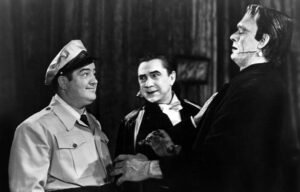
A black-and-white still from the 1948 film Abbott and Costello Meet Frankenstein. The scene features three characters: a smiling man in a uniform cap facing a vampire in a dark cape and the towering Frankenstein Monster. The vampire appears to be speaking to the uniformed man while the Monster looms nearby, creating a humorous yet classic blend of comedy and horror characteristic of the film.

abbott and costello meet frankenstein (1948)

One of the best “monster mashups” in Hollywood history, this horror comedy brings together Dracula, the Wolf Man, and Frankenstein’s Monster in a farcical adventure. It’s not a serious adaptation, but its success is in genre-blending: it treats its monsters as characters in a screwball plot, and leverages audience familiarity with the Universal monsters to comedic effect. On Rotten Tomatoes, it still scores strongly — testament to its enduring charm.
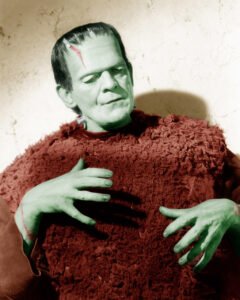
A colorized portrait of the Frankenstein Monster from Son of Frankenstein (1939). The creature, with pale green skin, heavy scars, and metal neck bolts, is shown in a textured reddish-brown garment. His hands are raised near his chest in a contemplative pose, and the soft lighting emphasizes both his iconic features and the tragic humanity beneath the monster’s expression.

son of frankenstein (1939)

This film marks the darker turn in the Universal Frankenstein series. Basil Rathbone appears as the titular son, Bela Lugosi plays Ygor, and Karloff returns as the Monster. The film embraces shadowy visuals, gothic architecture, and moral ambiguity. While not as cohesive or emotionally sharp as Bride, it remains one of the more visually striking sequels and deepens the mythology.
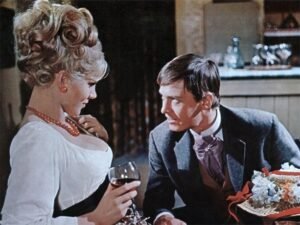
A scene from the 1957 film The Curse of Frankenstein showing a man and a woman in an intimate conversation at a dimly lit table. The man, dressed in a Victorian-style suit, gazes intently at the woman, who wears an elegant dress with pearls and holds a glass of wine. The warm lighting and rich colors highlight the film’s gothic yet sensual atmosphere, typical of Hammer Horror’s visual style.

frankenstein created woman (1967)

One of Hammer’s more experimental entries, this film (directed by Terence Fisher) leans into metaphysical ideas of the soul, afterlife, and identity. Though it may feel uneven, it’s ambitious in linking Frankenstein’s experiments to spiritual horror rather than merely physical monstrosity. It’s not always effective, but in the context of the franchise it’s daring.
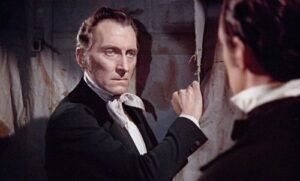
A color still from The Revenge of Frankenstein (1958) featuring a tense confrontation between two men in Victorian attire. The foreground figure, wearing a dark coat and crisp white shirt, stares coldly toward the other man while gripping a curtain or wall for emphasis. The dim lighting and sharp expressions underscore the film’s gothic tension and psychological intensity characteristic of Hammer Horror’s style.

the revenge of frankenstein (1958)

A direct sequel to The Curse of Frankenstein, this film (by Terence Fisher) continues Hammer’s approach: morally compromised scientist, lurid gore, and existential stakes. Cushing returns, and the visuals are striking. It may not reach the heights of Curse, but it’s a worthy continuation and helps solidify the Hammer Frankenstein canon.
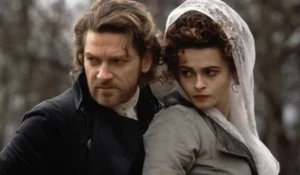
A still from the 1994 film Mary Shelley’s Frankenstein showing two characters in an outdoor setting. The man, dressed in dark 19th-century clothing with a stern expression, looks over his shoulder protectively, while the woman beside him, wearing a light gray dress and lace veil, gazes in the same direction with tension and concern. The muted tones and period costumes evoke the gothic atmosphere of the adaptation.

frankenstein (1994)

Kenneth Branagh’s version is the most literarily ambitious mainstream adaptation in the late 20th century. It strives for a more faithful rendering of Mary Shelley’s novel — including the framing narrative, the Arctic expedition, and Victor’s tormented psyche — while adding its own flourishes. Robert De Niro’s Monster is sympathetic, vulnerable, and disturbing. The film is uneven (some melodrama, occasional lapses in pacing) but deserves credit for ambition and its sincere attempt to grapple with Shelley’s text in a blockbuster medium.
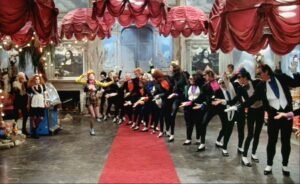
A colorful scene from The Rocky Horror Picture Show (1975) featuring a group of flamboyantly dressed characters performing a choreographed dance in a lavish hall. Red draped curtains hang from the ceiling, and a red carpet leads toward the center where a performer strikes a dramatic pose. The eclectic costumes, playful energy, and surreal décor reflect the film’s campy, theatrical, and rebellious spirit.

the rocky horror picture show (1975)

This film is not a strict Frankenstein adaptation — it’s a campy, riffing musical — yet its DNA is unmistakable. Dr. Frank-N-Furter, the laboratory setting, transgression, and the bodily-creation myth all nod to Frankenstein. As a cultural phenomenon, it demonstrates how Frankenstein can be reinvented far from horror, into queer camp, musical subversion, and cult spectacle.

honorable mentions & other variants
  • Frankenstein Meets the Wolf Man (1943) and House of Frankenstein (1944) are fun monster crossovers that illustrate how the Frankenstein myth was subsumed into the Universal monster stable.

  • Edward Scissorhands or Ex Machina are not Frankenstein movies per se, but they carry its moral core: the outsider, the creator, the ethics of creation. Some critics place Spirit of the Beehive in Frankenstein lists for its metaphorical resonance.

  • Some modern horror or experimental films have flirted with Frankenstein themes — body modification, identity, synthetic life — though they rarely carry the name.

impression

The Frankenstein myth resists a “definitive” film adaptation, and rightly so. Its strength lies in mutability — the ability to be reshaped into comedy, horror, melodrama, or metaphor. The films above are those that, through different modes, embody what’s enduring and unsettling in Shelley’s creation: the longing for life, the terror of isolation, the guilt of unnatural power, and the horror that the maker might become victim.

Related Articles
Modern data center facility with a solar-panel-clad exterior, bright green administrative offices, and secure perimeter fencing, showcasing sustainable digital infrastructure and renewable energy integration

Lombardy’s Data Center Boom: Balancing Digital Ambition with Environmental Responsible

Lombardy has emerged as Italy’s primary hub for new digital infrastructures, particularly data centers—vast complexes […]

In a highly anticipated reunion after 24 years, Adidas Originals and Coca-Cola have joined forces once again to celebrate the FIFA World Cup 2026™. The collaboration revives their iconic 2002 partnership from the Japan-South Korea tournament, now reimagined for the biggest global sporting event of 2026, co-hosted by the United States, Canada, and Mexico. Set to launch on June 6, 2026, this collection masterfully blends Adidas' streetwear heritage with Coca-Cola's timeless branding, creating a vibrant fusion of football culture, nostalgia, and modern style. The drop arrives at a perfect moment. With the World Cup kicking off on June 11, 2026, fans worldwide are gearing up for a summer of football excitement. This collaboration isn't just merch—it's a cultural statement that merges two legendary brands under the banner of "Originals are the Real Thing," a clever twist on Coca-Cola's famous slogan. Historical Context: A Reunion 24 Years in the Making Adidas and Coca-Cola first collaborated during the 2002 FIFA World Cup, producing limited-edition pieces that captured the era's energy. That partnership helped define early 2000s football-streetwear crossover culture. Fast-forward to 2026, and the brands are back with fresh energy, leveraging Adidas' deep FIFA ties (as an official partner) and Coca-Cola's long-standing sponsorship of the tournament. The 2026 edition promises to be historic as the first 48-team World Cup, spanning three countries and generating unprecedented global hype. This collab taps into that momentum, offering fans wearable pieces that celebrate both brands' legacies while looking forward to the future of football fashion. Collection Overview and Design Philosophy The Adidas Originals x Coca-Cola collection fuses 2000s street style with classic sporting aesthetics. Expect bold reds, creams, whites, and silver accents inspired by Coca-Cola's iconic packaging—think classic script logos, droplet detailing, and can-inspired motifs. The lineup spans footwear, apparel, and accessories, divided into two visual directions: one logo-heavy and graphic-forward, the other drawing from vintage advertising aesthetics. Designs pay homage to Coca-Cola's visual language while staying true to Adidas Originals' archival roots. High-quality materials, attention to detail, and versatile silhouettes make these pieces suitable for both match-day wear and everyday street style. The campaign, featuring young football star Lamine Yamal and a diverse cast in everyday scenes building anticipation for the tournament, reinforces themes of originality and shared cultural moments. Footwear Highlights Footwear takes center stage in this collaboration, with reimagined takes on iconic 2000s Adidas silhouettes: Samba and Superstar Models: These classics get Coca-Cola treatment with white/cream/red colorways and prominent script branding. The Samba blends street heritage with football roots, while the Superstar II features weathered bases and bold side panels. Expected pricing around $110–$130. Adistar Control 5: A standout with droplet detailing mimicking condensation on a cold Coke can. This model brings performance-inspired design into lifestyle territory. Predator Sala: Indoor/hybrid style with silver-and-red accents, nodding to predatory precision on the pitch and Coca-Cola's bold energy. Climacool 1: Revived with breathable tech and Coke-inspired graphics, perfect for warm summer days. Megaride F50: A highlight paying tribute to the iconic Coca-Cola glass bottle, with unique contours and refreshing design cues. Each pair incorporates thoughtful details like embroidered logos, custom insoles, and packaging that mimics vintage Coke crates or cans. These shoes are built for durability and comfort, appealing to sneakerheads, football fans, and casual wearers alike. Apparel and Accessories Beyond kicks, the collection offers a full lifestyle range: Track Tops and Jerseys: Standout jerseys fuse retro Coca-Cola advertising from different eras into cohesive football designs. Track jackets feature signature three stripes alongside Coke branding, in vibrant reds and classic whites. Shorts and T-Shirts: Relaxed fits with graphic prints, ideal for casual wear or layering. Expect motivational football motifs blended with refreshing beverage references. Accessories: A bright red airliner bag stands out as a functional statement piece. Additional items may include caps, socks, and tote bags carrying the collaborative spirit. The apparel emphasizes comfort with premium cotton blends, mesh panels for breathability, and oversized silhouettes popular in contemporary streetwear. Unisex sizing and inclusive fits make the collection accessible to a broad audience. Cultural Impact and Fan Appeal This collaboration resonates on multiple levels. For football fans, it represents national pride and global unity ahead of the 2026 tournament. Sneaker enthusiasts will appreciate the nostalgic 2000s revival mixed with modern execution. Streetwear collectors see it as a prime example of how heritage brands can innovate through partnerships. In an era where sports and fashion increasingly intersect, Adidas and Coca-Cola deliver pieces that transcend the pitch. Wear them to watch matches at home, attend watch parties, or hit the streets in any host city—New York, Los Angeles, Toronto, or beyond. The designs are versatile enough for gym sessions, festivals, or daily commutes. The timing aligns perfectly with rising interest in football in North America, boosted by the co-hosting nations. Young talents like Lamine Yamal in the campaign help bridge generational gaps, attracting newer fans while satisfying longtime supporters. Where to Buy and Release Details The collection launches globally on June 6, 2026, via: Adidas CONFIRMED app (for early access and raffles) Adidas.com Select retailers and flagship stores worldwide Some regions may see staggered drops, with Japan and other markets getting early access. Prices are expected to range from $50–$150 depending on the item, making it relatively accessible compared to ultra-limited drops. Pro Tips for Copping: Enable notifications on the CONFIRMED app. Check local stock at Adidas stores in major cities. Monitor resale platforms post-drop for exclusive colorways, but be wary of markups. Size up slightly for oversized apparel fits. Given the World Cup hype, popular items like the Sambas and jerseys are likely to sell out quickly. International shipping is available, but factor in potential customs delays. Styling Suggestions Match Day Look: Pair a collaborative jersey with classic black shorts and Samba sneakers for effortless fan style. Streetwear Rotation: Layer a track top over a graphic tee with wide-leg pants and the Megaride F50 for a bold urban ensemble. Casual Summer: White Superstar with denim shorts and the airliner bag for a refreshing, vacation-ready vibe. These pieces mix seamlessly with existing Adidas or neutral wardrobes, maximizing versatility. Broader Context in 2026 Fashion and Sports The Adidas x Coca-Cola drop is part of a larger wave of high-profile collaborations tied to the World Cup. Adidas continues its dominance in football kit design, while Coca-Cola leverages its sponsorship with collectibles, bottles, and experiential activations like the Trophy Tour. In the sneaker industry, this collab exemplifies the ongoing trend of lifestyle reinterpretations of performance silhouettes. It also highlights how global brands use major events to drive cultural conversations around unity, originality, and joy—core values for both companies. Sustainability notes (based on Adidas' broader initiatives) suggest some pieces may incorporate recycled materials, aligning with modern consumer expectations. Looking Forward: Legacy and Excitement As the countdown to kickoff continues, this collection serves as the perfect prelude to an unforgettable summer of football. Whether you're a die-hard supporter, a fashion-forward collector, or someone seeking motivation through style, the Adidas Originals x Coca-Cola FIFA World Cup 2026 lineup delivers. Expect potential restocks, special event exclusives in host cities, and continued campaign content featuring more athletes. This isn't just clothing—it's a ticket to participate in the global celebration of the beautiful game. Mark your calendars for June 6, 2026. Refresh your wardrobe, lace up those Sambas, and get ready to cheer on your team in style. The "Real Thing" meets the Originals in what promises to be one of the most talked-about releases of the year. This collaboration captures the essence of football's universal appeal: bringing people together through shared passion, iconic brands, and unforgettable moments. As the world prepares for 2026's expanded tournament, Adidas and Coca-Cola remind us that some partnerships are truly timeless.

Adidas Originals x Coca-Cola Collection: FIFA World Cup 2026

In a highly anticipated reunion after 24 years, Adidas Originals and Coca-Cola have joined forces […]

Loewe shoulder bag crafted in brown and black leather with minimalist lion face detailing and a matching fur tail charm

180 Years Unfolded: The Full Story Behind Loewe’s New Campaign

The year was 1846. Queen Victoria was on the British throne and the telephone, the […]