DRIFT AUDIO
Listen to this story
Choose a voice, then press play.
In the relentless march of urban densification, where square footage shrinks while rental prices soar, the art of hospitality faces a quiet crisis. How do you welcome friends, family, or unexpected guests when your living room doubles as your office and your bedroom barely fits a queen bed? French designer Thélonious Goupil and Italian transformable furniture specialist Campeggi have a delightfully clever response: Bienvenue — a plywood box that unfolds into a complete, private micro-guest room. Debuted at Salone del Mobile 2026, this “bed in a box” is more than a clever gadget; it’s a thoughtful meditation on modern living, adaptability, and the enduring human need to offer shelter.
View this post on Instagram
stir
Thélonious Goupil, a Paris-based industrial designer born in 1991, has built a practice around intuitive, sustainable objects that respond to real contemporary needs. A graduate of Ensci-Les Ateliers with experience at studios like Ransmeier Inc. and Jasper Morrison Ltd., Goupil co-directs Collections Typologie, a publishing house dedicated to deep explorations of ordinary objects — from boules to camping tents. His work often sits at the intersection of utility, cultural commentary, and playful functionality.
The idea for Bienvenue emerged from a conversation with Guglielmo Campeggi at Milan’s Small Small Space gallery. Campeggi, a brand with decades of expertise in convertible sofas and multifunctional furniture, was the perfect partner. Together they asked: In an era of ever-smaller apartments, how can design help us maintain the ritual of welcoming others? The result is a product that transforms the humble guest bed into something approaching temporary architecture.
idea
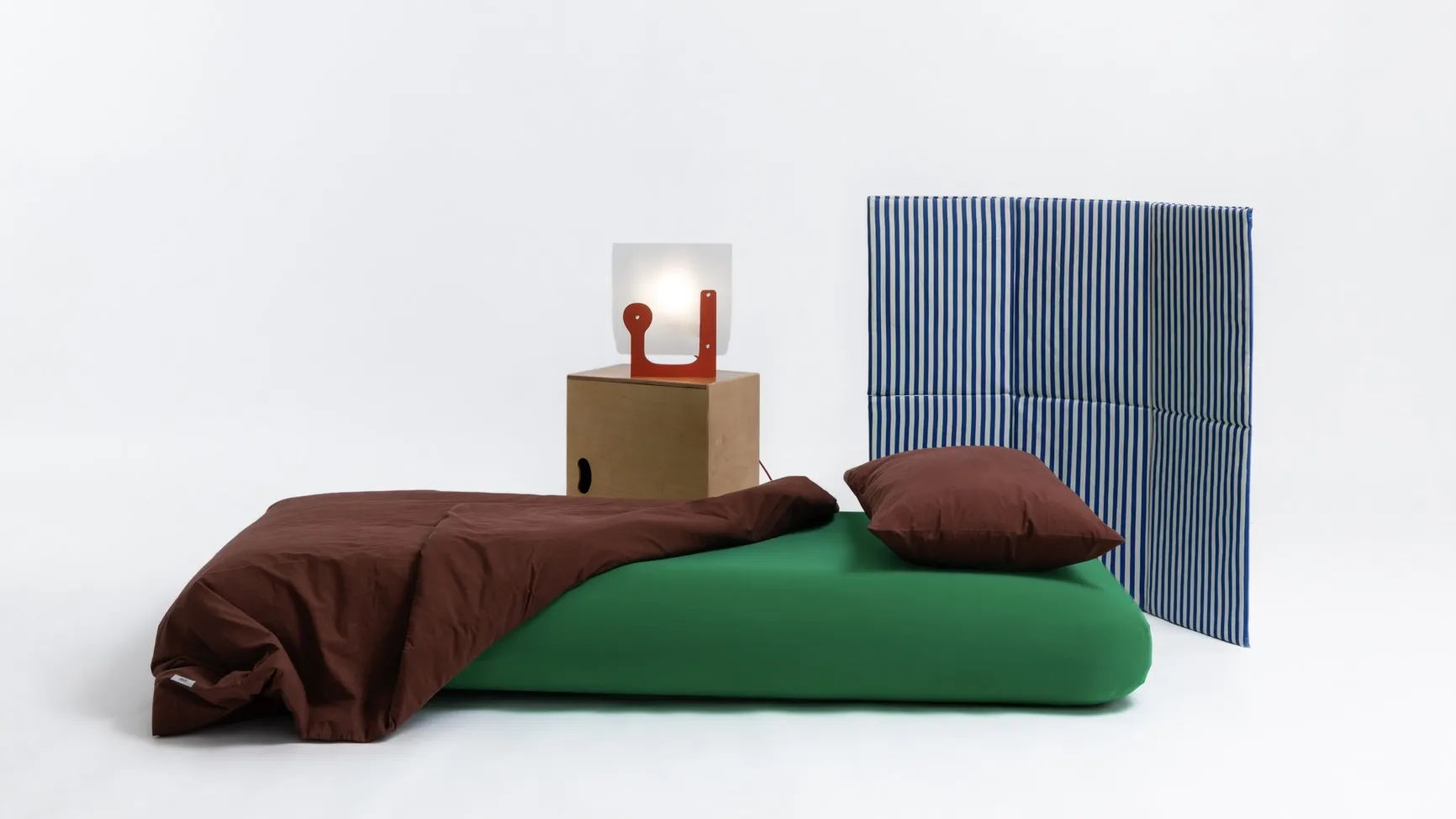
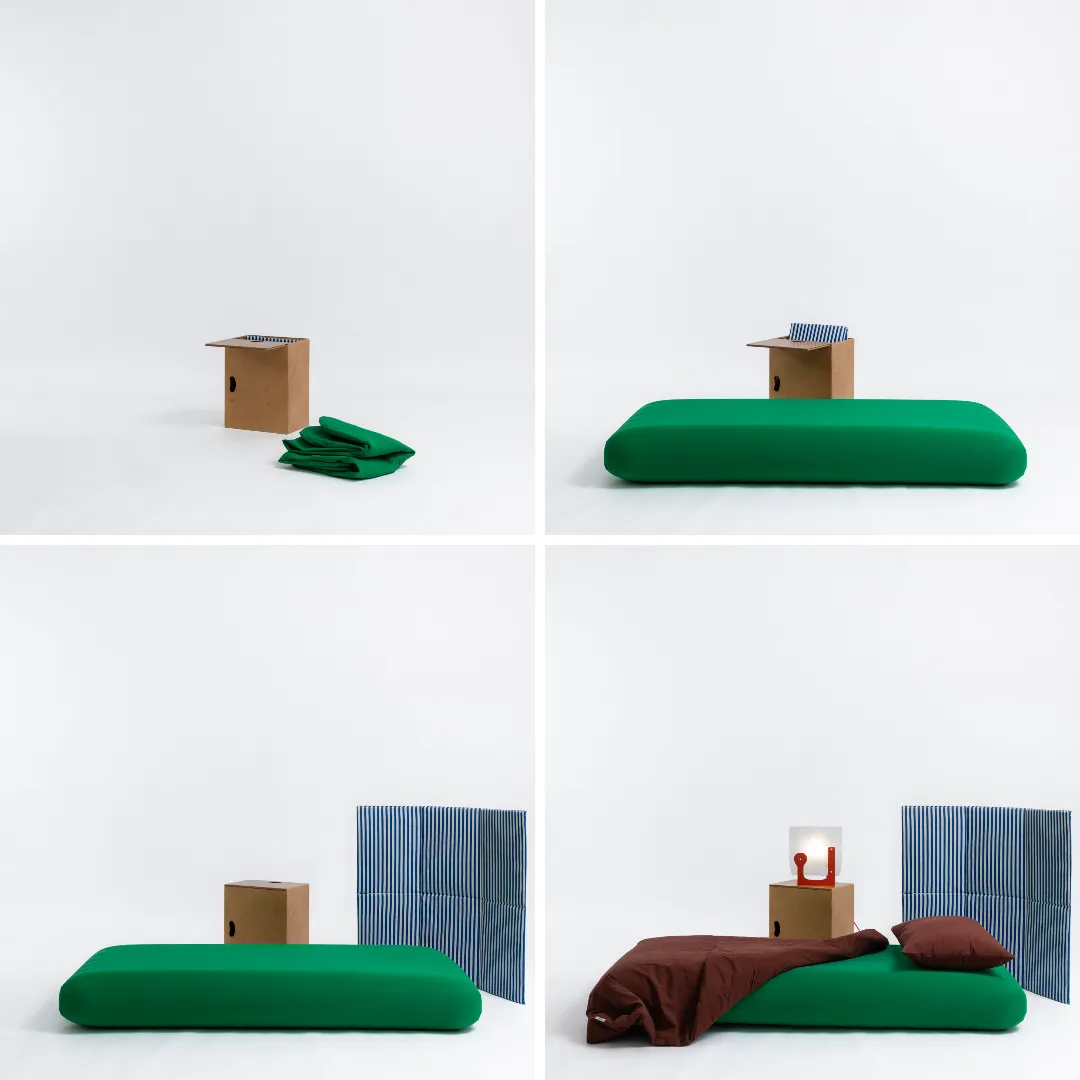
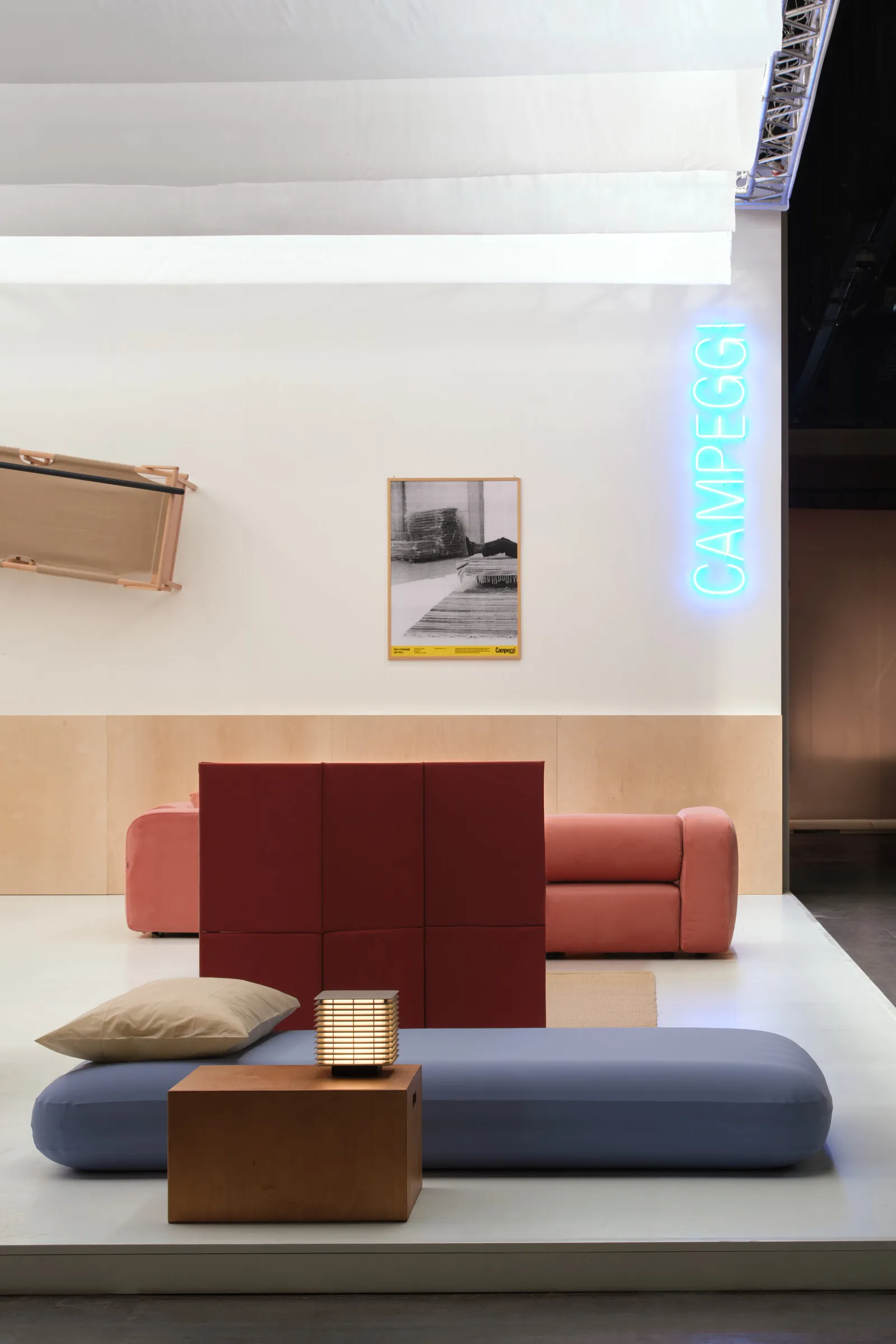
Closed, Bienvenue is an unassuming, beautifully finished rectangular plywood shell made of stained and varnished birch. It functions practically as a stool, side table, or step — compact enough to tuck into a corner or against a wall without dominating the space. A distinctive bean-shaped handle on the side invites interaction. Slide one panel away, and the magic begins.
Inside, a self-supporting foldable headboard deploys, followed by a Lycra-covered inflatable mattress that expands via an integrated electric pump. The setup includes bedding essentials — duvet, pillow — and crucially, a lightweight partition that creates a sense of enclosure and privacy. In minutes, what was storage furniture becomes a fully realized sleeping nook that feels less like an afterthought and more like a deliberate, welcoming space.
The name “Bienvenue” (French for “welcome”) is not accidental. It signals hospitality with a wink. This isn’t just an emergency roll-out bed for crashing on the floor. It’s designed to offer dignity and comfort to the guest while preserving the host’s living environment. When the stay is over, everything packs back into the box with satisfying efficiency — a ritual of compression that feels almost performative.
flow
Goupil’s approach emphasizes sustainability, intuition, and expressive form freed from conventional beauty standards. Birch plywood was chosen for its strength, lightness, and environmental credentials. The piece is portable, easy to move between rooms or even transport to a different location. The inflatable mattress solves the perennial problem of bulk in convertible furniture: when deflated, it takes up almost no space.
The privacy screen is perhaps the most innovative element. In small urban apartments, the psychological comfort of a semi-private zone can make the difference between a guest feeling like an imposition and feeling genuinely welcomed. Bienvenue creates micro-architecture — a temporary room within a room — that addresses both physical and emotional needs.
Campeggi’s long history with transformable systems (think innovative sofa beds and multi-functional pieces) provided the technical backbone. Their collaboration ensures that Bienvenue is not just conceptually strong but durable and user-friendly for daily life.
scope
Bienvenue arrives at a perfect cultural moment. Global urbanization continues unabated. In cities like New York, London, Paris, and Tokyo, average apartment sizes have decreased while remote work, digital nomadism, and frequent travel have increased the need for flexible guest accommodations. Traditional solutions — inflatable air mattresses on the floor, uncomfortable pull-out couches, or expensive dedicated guest rooms — often fall short.
Younger generations, particularly millennials and Gen Z, prioritize experiences over ownership and live in smaller footprints. At the same time, cultural values around community, chosen family, and mutual support remain strong. Bienvenue bridges this gap: it enables generosity without requiring permanent spatial sacrifice.
It also speaks to broader trends in “micro-living” design. Think capsule hotels in Japan, transformable furniture by brands like Resource Furniture, or modular systems from Vitra and others. What sets Bienvenue apart is its warmth and wit. It doesn’t feel clinical or overly engineered; it feels human and optimistic.
compare
While there are many space-saving beds on the market, few achieve Bienvenue’s level of completeness and charm:
- Traditional sofa beds often compromise on comfort and aesthetics when closed.
- Murphy beds require permanent wall installation and significant floor space.
- Basic air mattresses lack structure and privacy.
- High-end modular systems can be prohibitively expensive.
Bienvenue sits in a sweet spot: premium yet accessible in spirit, multifunctional without complexity, and genuinely delightful to use. Its playful personality — the bean handle, the theatrical unfolding — makes the act of hosting feel celebratory rather than burdensome.
sustain
In line with Goupil’s ethos, Bienvenue prioritizes durable materials and minimal waste. The plywood construction is repairable and potentially recyclable. The inflatable components are designed for longevity, reducing the need for frequent replacements. By enabling better use of existing space, the product indirectly supports more sustainable living patterns — fewer people needing larger apartments simply to accommodate occasional guests.
length
At Salone del Mobile 2026, Bienvenue stood out not just for functionality but for its storytelling power. It embodies a particularly French-Italian blend of elegance, pragmatism, and joie de vivre. In a fair often dominated by grand statements, this humble box offered a grounded, relatable solution to a universal problem.
Looking ahead, variations could expand the concept: different sizes, colors, or additional modular accessories (lighting, small shelving, or even integrated charging). Corporate or hospitality versions for offices, short-term rentals, or hotels could prove popular. The core idea — a portable room in a box — has legs far beyond the domestic sphere.
fin
In an age of algorithmic efficiency and environmental anxiety, Bienvenue reminds us that design can still be generous, humorous, and deeply human. It doesn’t lecture about minimalism or scold about consumption. Instead, it offers a tool for connection: a way to say “welcome” even when space is tight.
Thélonious Goupil and Campeggi have created something that feels both radical and obvious — the kind of object that makes you wonder why it didn’t exist sooner. For urban dwellers juggling tight quarters with big hearts, Bienvenue is more than furniture. It’s permission to keep the door open.
As cities continue to densify and lifestyles grow more fluid, products like this will become essential infrastructure for maintaining social bonds. The spare room you don’t have? Now you do — neatly folded away until needed, ready to unfold into comfort and connection at a moment’s notice.
Bienvenue doesn’t just solve a problem. It celebrates the solution with sincerity, ingenuity, and a generous spirit that feels increasingly rare and necessary.
From the DRIFT archive: From Living Room to Headphones: Loewe’s Thoughtful Leap Into Audio
Related Articles

Garage Italia’s Electric Spiaggina Puts the Fiat 500’s Riviera Years on Battery Power
Ten kilowatts, rattan seats and a €85,000 starting price: Garage Italia's 500 Spiaggina rebuilds Ghia's 1958 beach car for the yacht crowd.