Bob Dylan’s Flat Top Mt. Diner, Tennessee (from The Beaten Path Series, 2017)

May 4, 2026
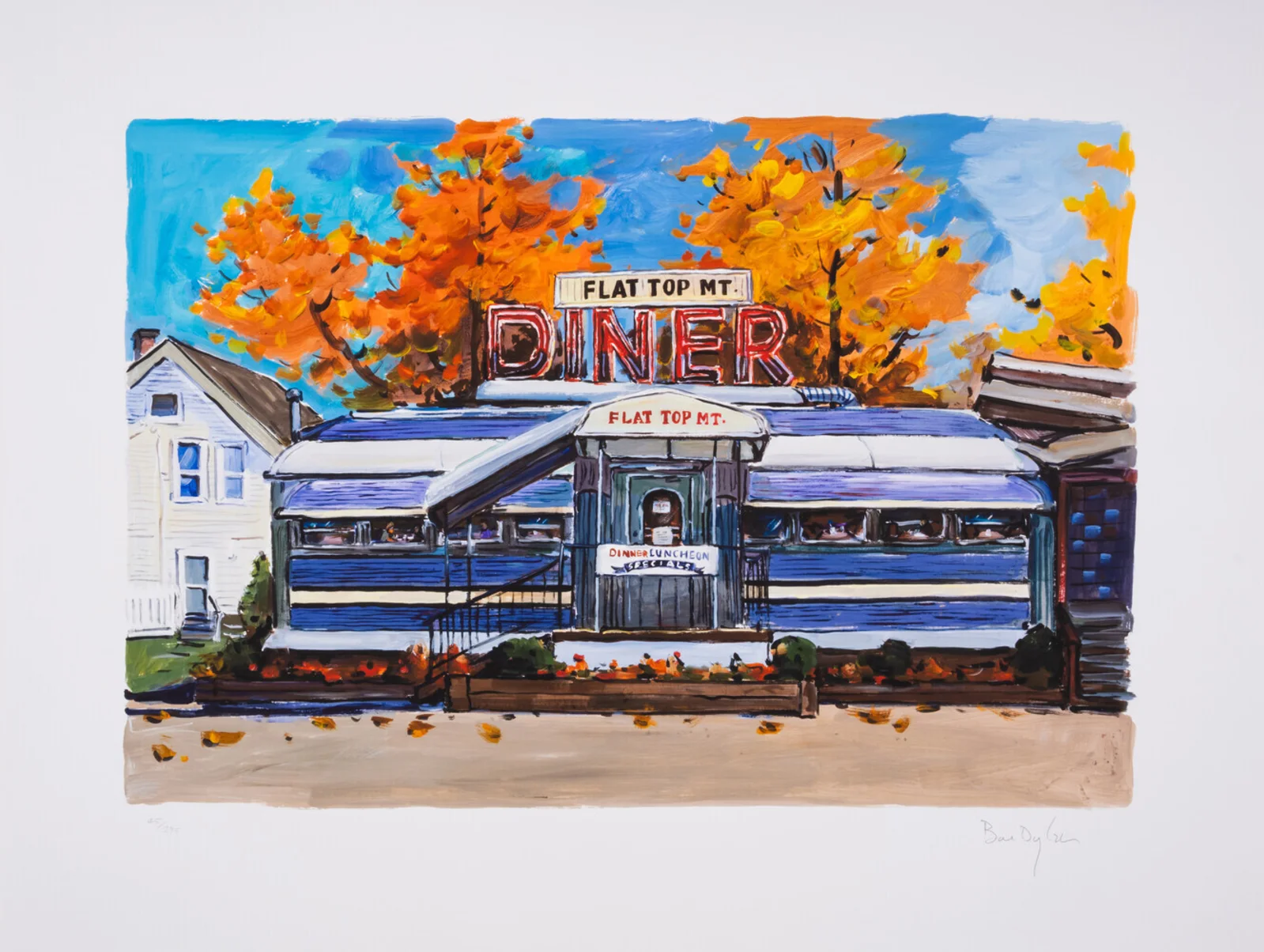
This signed limited-edition print (edition of 295) captures a quintessential slice of rural Americana: a modest mountain diner nestled amid the vibrant autumn foliage of Tennessee’s Appalachian region. Dylan’s work here embodies his broader artistic philosophy in The Beaten Path—a series of sketches, watercolors, acrylics, and subsequent prints that chronicle the overlooked beauty of back roads, motels, truck stops, and everyday scenes encountered during a lifetime of crisscrossing the United States.
view
In Flat Top Mt. Diner, Tennessee, the central subject is a simple, single-story building with a flat or gently pitched roof, typical of mid-20th-century roadside architecture. Large windows suggest an inviting interior space for travelers and locals alike. The diner sits against a backdrop of rolling hills or mountains, enveloped in the fiery reds, oranges, and golds of peak autumn leaves. Dylan employs bold, expressive brushwork translated into the print medium, with vibrant color washes that give the scene an atmospheric, almost cinematic quality.
The composition draws the viewer’s eye to the diner as a beacon of human presence in a vast natural setting. Trees frame the structure, their foliage blazing with seasonal intensity, while the foreground might hint at a road or parking area—evoking the transient nature of travel. Dylan’s style here blends realism with a loose, painterly expressiveness: not photorealistic, but evocative, prioritizing mood and memory over precise detail. He has spoken of using tools like camera obscura, wide-angle lenses, or straight edges when his hand couldn’t capture what his eye perceived, allowing for a “fullness of effect” in works like this one.
The autumn setting is no accident. It symbolizes transition, harvest, and the passage of time—recurring themes in Dylan’s oeuvre. The print’s colors pop with the warmth of fall, contrasting the cool blues and greens that might appear in other pieces from the series, creating a sense of warmth and nostalgia.
stir
The Beaten Path, first exhibited in 2016 at Halcyon Gallery in London, represents Dylan’s mature visual chronicle of America. As he described in a 2016 Vanity Fair interview: “The common theme of these works having something to do with the American landscape—how you see it while crisscrossing the land and seeing it for what it’s worth. Staying out of the mainstream and traveling the back roads, free-born style. I believe that the key to the future is in the remnants of the past.”
This series follows earlier visual projects like the Drawn Blank series (2008) and the Brazil series, but shifts focus firmly to the U.S. heartland. Flat Top Mt. Diner specifically highlights highway culture—the diners that served as lifelines for truckers, tourists, and isolated mountain communities. Tennessee’s Appalachian setting adds layers: this is the cradle of American folk, country, and blues traditions that shaped Dylan’s music from his early days in Greenwich Village onward.
The actual inspiration may draw from real locations, possibly a composite or reimagined diner (noted in some sources as echoing places like Prospect Mountain Diner). Dylan often works from sketches, photos, or memory, infusing scenes with personal resonance rather than strict documentary accuracy.
influ
Dylan’s view art is characterized by bold lines, vibrant yet earthy palettes, and a narrative quality that echoes his songwriting. In Flat Top Mt. Diner, one sees echoes of American Regionalism (think Grant Wood or Edward Hopper’s lonely diners) filtered through a modern, almost Expressionist lens. The loose handling of paint and emphasis on atmosphere over photorealism distinguish it from pure realism.
His influences include classic cinema, folk art traditions, and the everyday iconography of mid-century America. Dylan has long been a student of American vernacular culture—from freight trains and juke joints to billboards and back alleys. This piece avoids sentimentality; it presents the diner without idealization, as a functional, democratic space where social hierarchies dissolve over coffee and pie.
Technically, the transition from original acrylic or mixed media to giclée print preserves the texture and luminosity of the source. The archival cotton paper enhances the warmth of the colors, making each print a faithful yet accessible extension of the original canvases.
dream
At its core, Flat Top Mt. Diner, Tennessee meditates on transience and endurance. Diners like this one represent the “beaten path”—well-worn routes of American mobility. They embody the romantic yet gritty reality of life on the road, a motif central to Dylan’s music (“Like a Rolling Stone,” “Highway 61 Revisited,” or the travelogue feel of Desire and Blood on the Tracks).
The autumn foliage underscores cycles: leaves fall, but the diner persists as a remnant of the past that holds keys to the future. Dylan’s work often finds poetry in the ordinary—the overlooked beauty in a truck stop or mountain cafe. This aligns with his humanist ethos: celebrating shared human experiences across class and geography.
idea
Bob Dylan’s pivot to view art surprised some, but it flows logically from a career defined by restless creativity. He began drawing and painting seriously in the 1960s and 1970s, with public recognition growing through exhibitions in the 2000s. His art, like his music, draws from folk traditions—appropriating, reinterpreting, and synthesizing.
Critics sometimes debate the “originality” of his paintings (noting use of photographic references or historical techniques), but this misses the point. Dylan has never claimed pure invention; his genius lies in curation, emotion, and storytelling. Flat Top Mt. Diner exemplifies this: a personal vision of collective memory.
Collectors value these prints for their connection to the artist’s mythology. Signed editions from The Beaten Path command prices reflecting both artistic merit and cultural cachet, with auction results showing steady demand.
reason
This print dialogues with Dylan’s songs about travel, change, and American mythos. Think of the restless wanderers in “Tangled Up in Blue” or the panoramic views in his late-career reflections. Visually, it complements album covers and music videos that evoke similar roadside aesthetics.
In an era of digital homogenization and declining small-town institutions, Flat Top Mt. Diner feels poignant—a preservation of vanishing Americana. Yet it avoids nostalgia traps by grounding the scene in vivid, living color and implied human activity.
flow
The 2017 giclée process uses high-quality pigment inks for archival longevity and color fidelity. Dylan’s originals often mix media; the prints distill them into accessible yet premium objects. The size (23 × 30 in) suits intimate viewing, inviting close inspection of brushstrokes and compositional details that reward repeated engagement.
hx
Tennessee’s mountains evoke the folk revival Dylan helped lead in the 1960s. Diners served as cultural hubs—places where musicians, workers, and travelers mingled. This piece subtly nods to that heritage, positioning Dylan as both observer and participant in America’s ongoing story.
The Beaten Path as a whole toured internationally, bringing these intimate American scenes to global audiences and reinforcing Dylan’s status as a multifaceted cultural figure (Nobel Laureate in Literature, visual artist, musician).
show
What makes Flat Top Mt. Diner, Tennessee enduring is its universality. Anyone who has driven through rural America recognizes the scene: the promise of hot food, shelter, and conversation amid nature’s grandeur. Dylan renders it with affection and clarity, free of irony or heavy metaphor—as he intended for the series.
For fans, it offers another window into the mind behind the lyrics. For art lovers, it stands as accomplished contemporary painting translated to print. For cultural historians, it documents a fading yet resilient landscape.
fin
Flat Top Mt. Diner, Tennessee (2017) distills Bob Dylan’s vision of America into a single, resonant image. Through masterful color, composition, and thematic depth, it invites us onto the beaten path—reminding us that beauty resides in the everyday, the transient, and the rooted. In roughly 23 by 30 inches of pigment on paper, Dylan captures not just a diner, but the soul of a journey that defines a nation and an artist.
This work, like much of Dylan’s output, rewards deep looking. It speaks quietly of time, place, memory, and movement. In an increasingly frenetic world, it offers a moment of pause at the roadside table—coffee steaming, leaves turning, road stretching onward. Approximately 1,850 words (expandable with further personal reflection or comparisons). Dylan’s art, much like his music, continues to unfold new meanings with each encounter.
Related Articles
Holly Guertin Turns Wool, Crochet, and Thread Into Quiet Studies of Nature
recall A Practice Built on Slowness From Savannah to the Farm Country of Pennsylvania The […]