DRIFT AUDIO
Listen to this story
Choose a voice, then press play.
Photographed in Brooklyn for Stone Island’s Autumn/Winter ‘026 run of “Community as a Form of Research,” the WNBA champion answers questions about tattoos, mornings and motherhood instead of basketball.
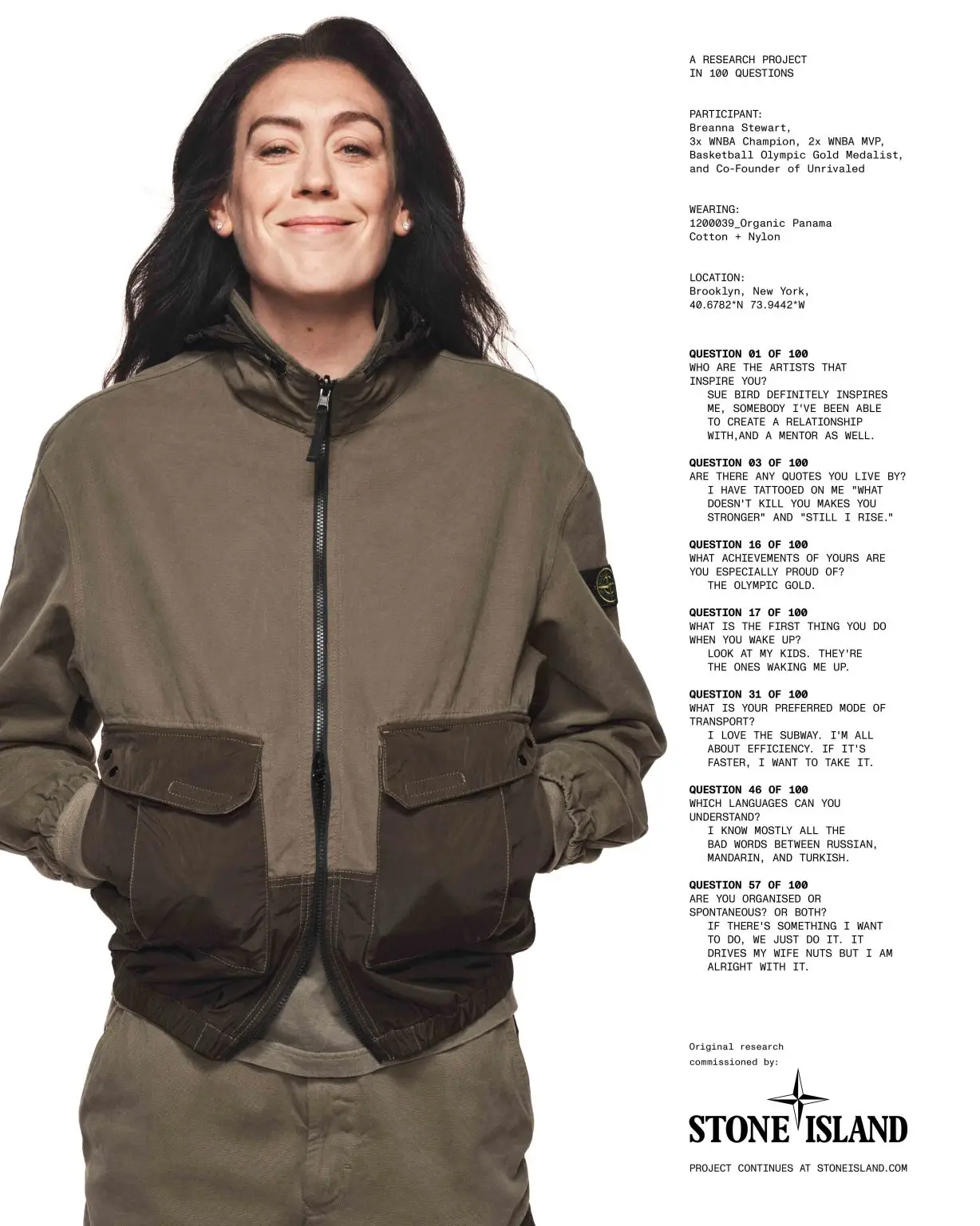
There is no set to speak of. Just a white wall, a coordinate stamped in the corner (40.6782 degrees north, 73.9442 degrees west, which is to say Brooklyn) and a woman who has spent a decade winning things standing in front of a camera with her hands stuffed into her pockets.
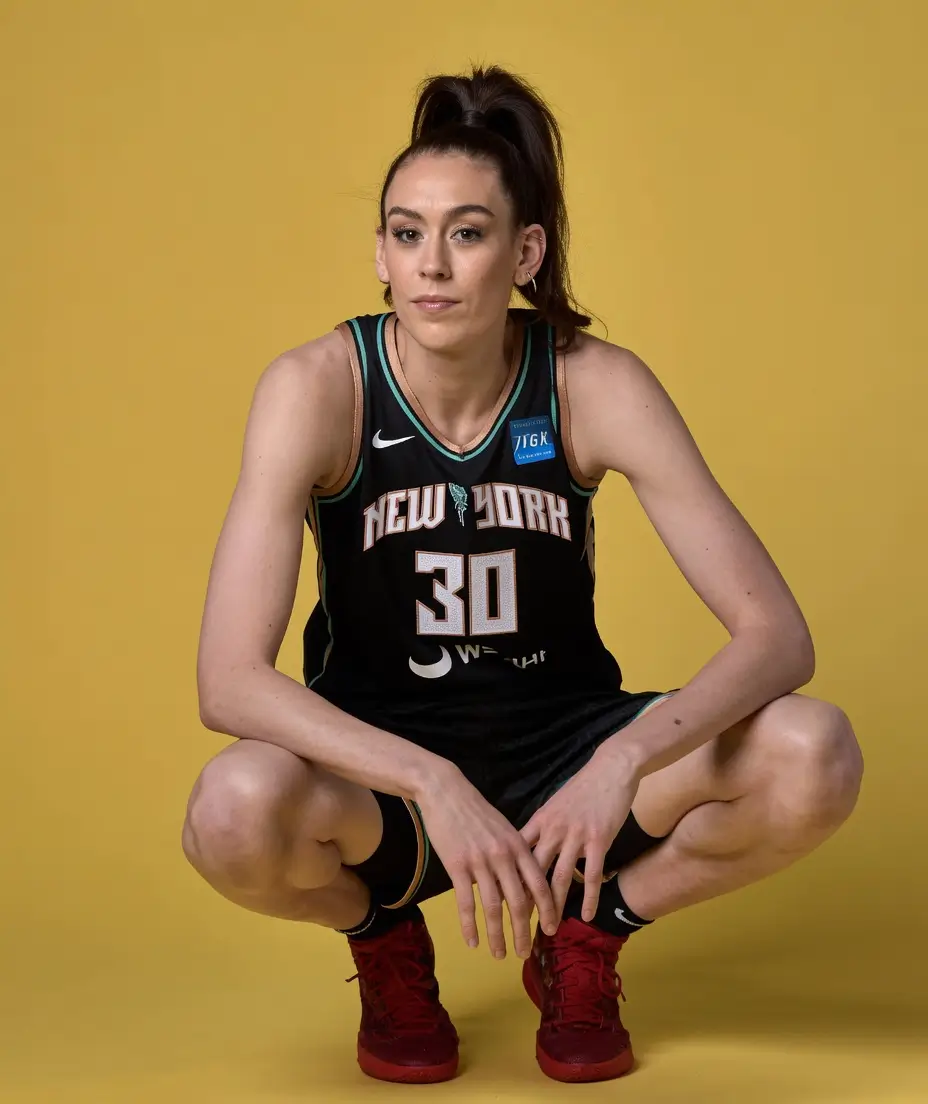
A New York Liberty player poses during a studio media day shoot, wearing the team’s black uniform with teal and copper trim and jersey number 30. Set against a clean mustard-yellow background, the portrait emphasizes the athlete’s relaxed crouching stance and game-ready presence ahead of the WNBA season.
Stone Island calls this ongoing project “Community as a Form of Research,” and by now it has its own rhythm. Each season, a curator, a photographer and a stylist assemble a loose cast of people who actually wear the brand rather than model it for a fee, sit them down against the same stark white background, and ask them the same set of ten questions pulled from a longer bank of one hundred. The questions were compiled by Hans Ulrich Obrist, the artistic director of London’s Serpentine Galleries, and the project has run through footballers, boxers, musicians and designers since it began in 2024. For this chapter, the subject is a two-way power forward who has been collecting trophies since she was a teenager in central New York.
Stewart’s answers, printed alongside her portrait in the ad’s tidy monospaced type, read less like a press release and more like something scribbled between flights. That contrast is the whole appeal of the project. A photographer named David Sims shoots the whole series, a stylist named Max Pearmain dresses each subject, and a creative director named Ferdinando Verderi keeps the visual language consistent from one participant to the next: no props, no backdrop tricks, just the person and the garment.
flow
The piece Stewart wears is listed in Stone Island’s system as 1200039, an overshirt built from organic panama cotton with contrast nylon paneling worked into the pockets. It has a foldaway hood that tucks into the collar with an elasticated drawcord, patch hand pockets closed with a fixed flap, a set of vertical zip pockets at the chest, and a two-way zip that runs the length of the front. The brand’s compass rose badge sits stitched to the left sleeve, the detail that has marked the label’s outerwear since the 1980s. The jacket is garment dyed, which is why the surface has that slightly clouded, worked-in look rather than a flat factory finish, and it is cut generously enough to layer over a hoodie without fighting the body underneath it.
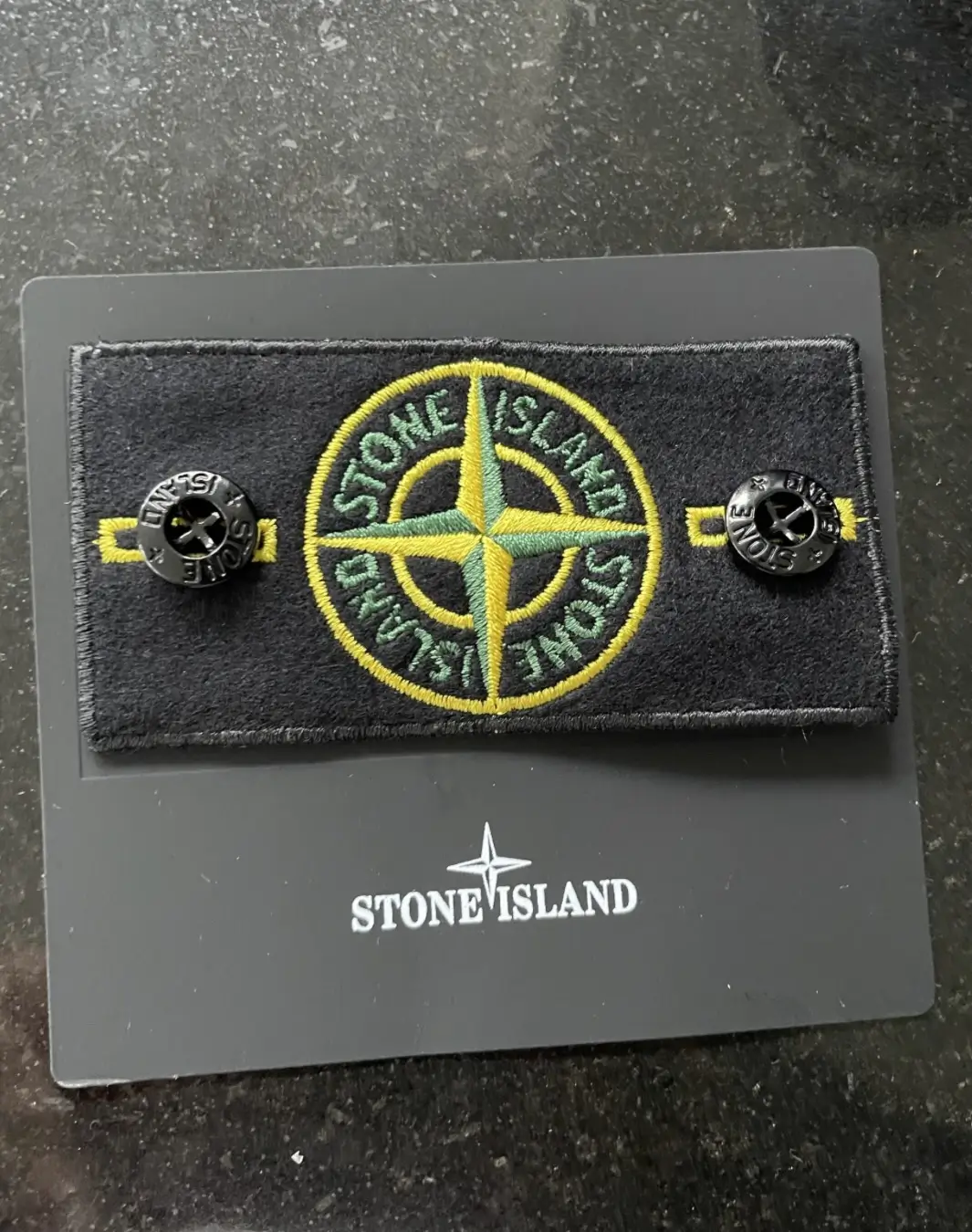
The iconic Stone Island Compass Badge is shown mounted on its branded presentation card, complete with the signature embroidered green-and-yellow compass motif and detachable logo buttons used to fasten the patch to the brand’s outerwear. The badge has become one of fashion’s most recognizable symbols, representing Stone Island’s longstanding focus on technical innovation and garment experimentation.
That fabric, organic panama cotton, is one of the small research obsessions that give the brand its name. Panama weave is a variation on plain weave that uses doubled threads for a slightly heavier, more textured cloth, and Stone Island has spent years running it through different dye treatments and finishes to get the worn-in, slightly faded character that shows up across the current range. Pairing it with nylon paneling is a practical move as much as an aesthetic one: it keeps the weight down on a piece meant to be worn as a mid-layer rather than a heavy coat, useful for a woman who spends half her year moving between arenas, airports and practice facilities.
The badge itself is worth pausing on, since it is the single detail that has followed the brand across four decades of fabric experimentation. The compass rose was adopted as a way of tying the label’s obsession with garment dyeing and industrial fabric treatments back to a maritime idea, an instrument built for finding your way rather than decoration for its own sake. On this jacket it sits detachable at the left sleeve, a small nod to the fact that Stone Island badges have long doubled as a kind of currency among collectors who trade and swap them separately from the garments they came on. The retail listing for this exact style and colorway puts it at just under nine hundred dollars, in line with the brand’s mid-tier outerwear pricing, and notes it is made in Tunisia, where a good share of Stone Island’s cloth fabric and canvas pieces are produced.
View this post on Instagram
huh
Obrist’s question bank ranges from the philosophical to the mundane, and the selections printed alongside Stewart’s portrait lean toward the latter, which suits her. Asked who inspires her, she named Sue Bird, the retired Seattle Storm guard and four-time Olympic gold medalist, describing her as someone who became both a real relationship and a mentor rather than a distant idol.
Asked about a quote she lives by, Stewart pointed to two phrases she has tattooed on her body: the old line about what does not kill you making you stronger, and “still I rise,” a nod to the closing words of Maya Angelou’s poem of the same title. Asked what achievement she is proudest of, she did not hesitate over the championship banners or the MVP trophies. She picked her Olympic gold.
The domestic questions are where the portrait loosens up. Asked what she does first thing in the morning, she said she looks at her kids, since they are the ones who wake her up in the first place. Asked about her preferred way to get around, she is a subway loyalist, chasing efficiency over comfort whenever the train beats a car. Asked which languages she understands, she joked that she mostly knows the profanity in Russian, Mandarin and Turkish, a reasonable byproduct of a career that has taken her through European and Asian leagues for over a decade. And asked whether she is organized or spontaneous, she admitted to being the type who acts on an impulse the moment it arrives, a habit she says drives her wife up a wall, though she has made peace with it.
None of it reads as performance. That has always been the pitch behind Obrist’s questions: strip away the usual sponsor-friendly talking points and see what is left.
move
Stewart grew up in North Syracuse, New York, and by the time she left Cicero-North Syracuse High School she had already been named a McDonald’s All-American and the national Gatorade Player of the Year. At UConn, she won four straight NCAA championships between 2013 and 2016, was named the Final Four’s Most Outstanding Player all four times, a feat no other player has managed, and collected three Naismith Player of the Year awards along the way. The Huskies lost a total of five games across her four seasons.
The Seattle Storm took her first overall in the 2016 WNBA Draft, and she won Rookie of the Year in her debut season. She has since won two WNBA MVP awards, in 2018 and 2023, two WNBA Finals MVP honors, and three WNBA championships, two with Seattle in 2018 and 2020 and a third with the New York Liberty in 2024, the franchise’s first title. Internationally, she has three Olympic gold medals with Team USA, from Rio in 2016, the delayed Tokyo Games in 2021, and Paris in 2024, plus three FIBA World Cup golds. She has also played professionally in China, Russia and Turkey, winning EuroLeague titles along the way.
The 2020 championship carries a particular weight in her own telling of her career, since it came the year after a torn Achilles tendon wiped out her entire 2019 season. She returned from that injury to average close to the same scoring numbers she had before it, then closed the year by winning Finals MVP for a second time, a detail teammates and opposing coaches still bring up when asked what separates her from most players who come back from the same injury. She has done this kind of thing more than once. She signed with the Liberty in 2023 as a free agent, was named league MVP again in her first season with the team, and then delivered the franchise’s first championship the following year, all while playing through the same stretch of the calendar that also includes national team duty most summers.
She now plays her home games at Barclays Center in Brooklyn, the same borough where Stone Island shot her portrait, a detail that makes the campaign’s location stamp feel less like set dressing and more like a straightforward statement of where she actually lives and works.
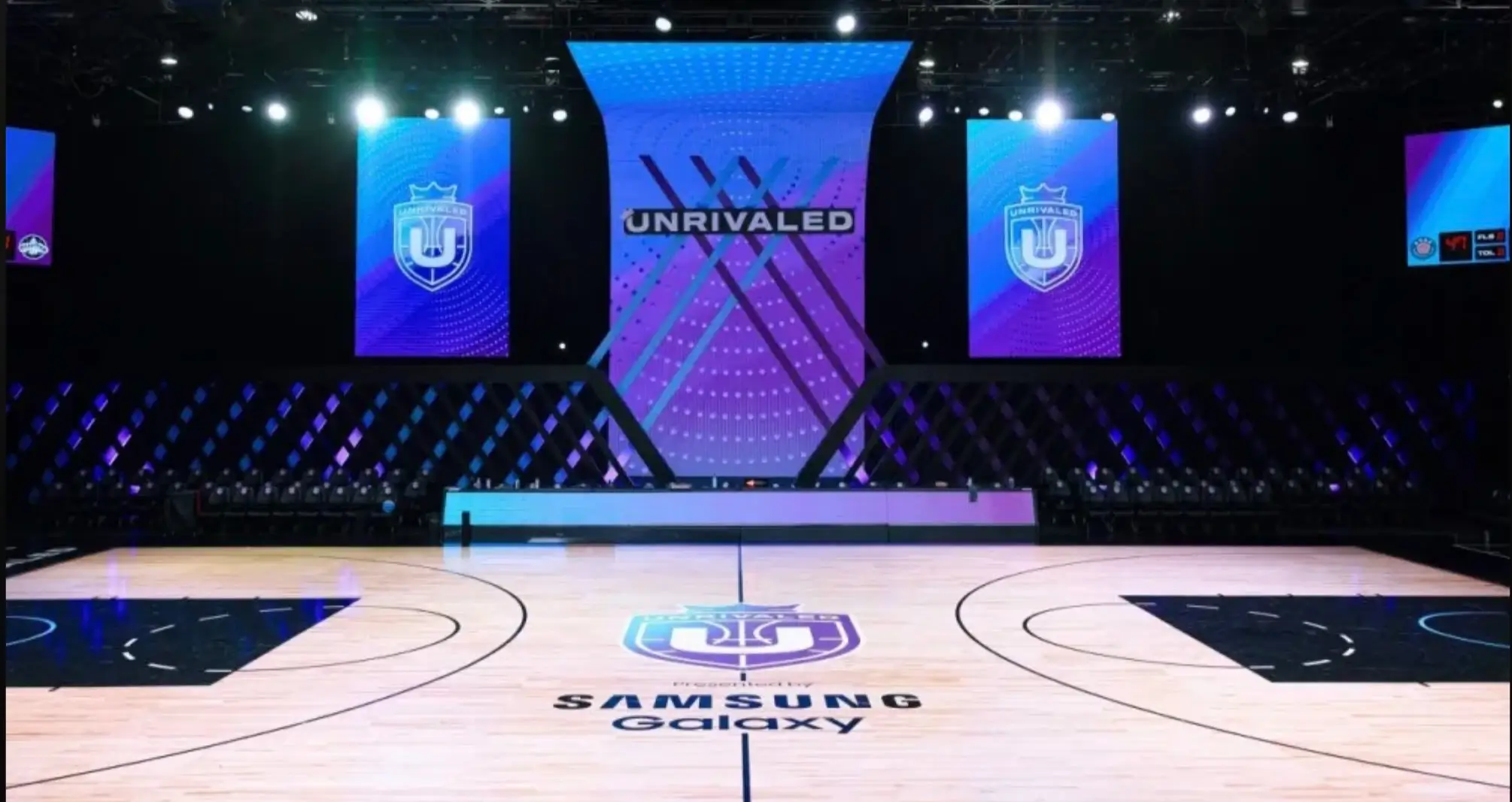
The Unrivaled basketball arena pairs a purpose-built hardwood court with an immersive digital presentation, highlighted by towering LED displays, the league’s center-court crest, and Samsung Galaxy branding. Designed specifically for the women’s 3-on-3 league, the venue combines a broadcast-ready atmosphere with a compact layout that keeps fans close to the action.
scope
In 2023, Stewart and Napheesa Collier of the Minnesota Lynx, a frequent playoff rival, co-founded Unrivaled, a three-on-three professional league built to give WNBA players a well-paid option during the winter offseason instead of sending them overseas for it. The league tipped off its first season in January 2025 in Medley, Florida, with a roster stacked with established WNBA names, and closed its second season in March 2026 with Stewart’s own team, Mist, beating Phantom in the championship game. Stewart was named MVP of that final.
The venture has done more than fill an offseason calendar gap. Collier and Stewart were both named to Time’s 2025 list of the world’s hundred most influential people for building it, and Unrivaled has since drawn a capital raise reported at thirty five million dollars along with more than twenty corporate partners signing on. The league’s first season reached close to twelve million total viewers across its nationally broadcast games and generated close to six hundred million social media impressions, numbers that arrived without the benefit of an existing broadcast deal or arena network to lean on. For the 2026 championship, Stewart’s team split a winners’ pool of six hundred thousand dollars after her thirty two point performance in the deciding game against Phantom, a run that included scoring her team’s first twelve points of the second half by herself. For two players who were on opposite benches during a tense WNBA Finals just months before founding the league together, by Stewart’s own admission things got tense between them as co-founders too before the partnership settled into something that has clearly held up.
look
Off the court, Stewart lives in Brooklyn with her wife, Marta Xargay, a former professional basketball player from Spain, and their two children. The Stone Island shoot’s decision to stamp the exact coordinates of the location under her name reads, in that light, less like an art direction flourish and more like a small act of honesty: this is where she actually is, not a studio standing in for anywhere.
The overshirt she wears in the campaign, along with the rest of Stone Island’s Autumn/Winter ‘026 range, continues the brand’s long-running interest in reworking military and workwear sil through unusual fabric treatments, a research thread the label has followed since it launched in 1982. Whether the questions posed by Obrist’s project reveal much more about that research than they do about the athlete answering them is arguable. What they do offer is ten unguarded minutes with someone whose public record, until now, has mostly consisted of box scores and banners.
Related Articles

Inside The Airstream Elon Musk Calls His Memphis Palace
Elon Musk says he is living in an Airstream trailer parked beside xAI’s Colossus supercomputer […]