DRIFT AUDIO
Listen to this story
Choose a voice, then press play.
Rubber Soul gets the full box set treatment on October 2, the same four weeks of tape that once took The Beatles from touring band to studio band.
Apple Corps and Universal Music Group confirmed on July 29 that Rubber Soul, the Beatles’ 1965 album, is getting the Super Deluxe treatment on October 2. The job falls once again to producer Giles Martin and engineer Sam Okell, the same pairing that has handled every entry in this reissue campaign since it started, and once again the new stereo mix leans on de-mixing technology built at Peter Jackson‘s WingNut Films Productions, the same tool that let engineers isolate individual voices and instruments from decades old four track masters for the Get Back documentary and every reissue since.
The technology matters more here than it might for a later Beatles record, since Rubber Soul was recorded onto four track tape with instruments and vocals frequently bounced together to free up space, a standard 1965 studio practice that left almost no clean separation between parts for a modern engineer to work with using older tools. The de-mixing software, built by a team led by Emile de la Rey, pulls those elements apart digitally rather than relying on the physical isolation earlier remix engineers never had. The result is a new stereo mix sourced directly from the original four track masters, sitting alongside the untouched 1965 mono mix and the original Capitol US album configuration, which shuffled the track list and added reverb effects that UK listeners never heard on original pressings.
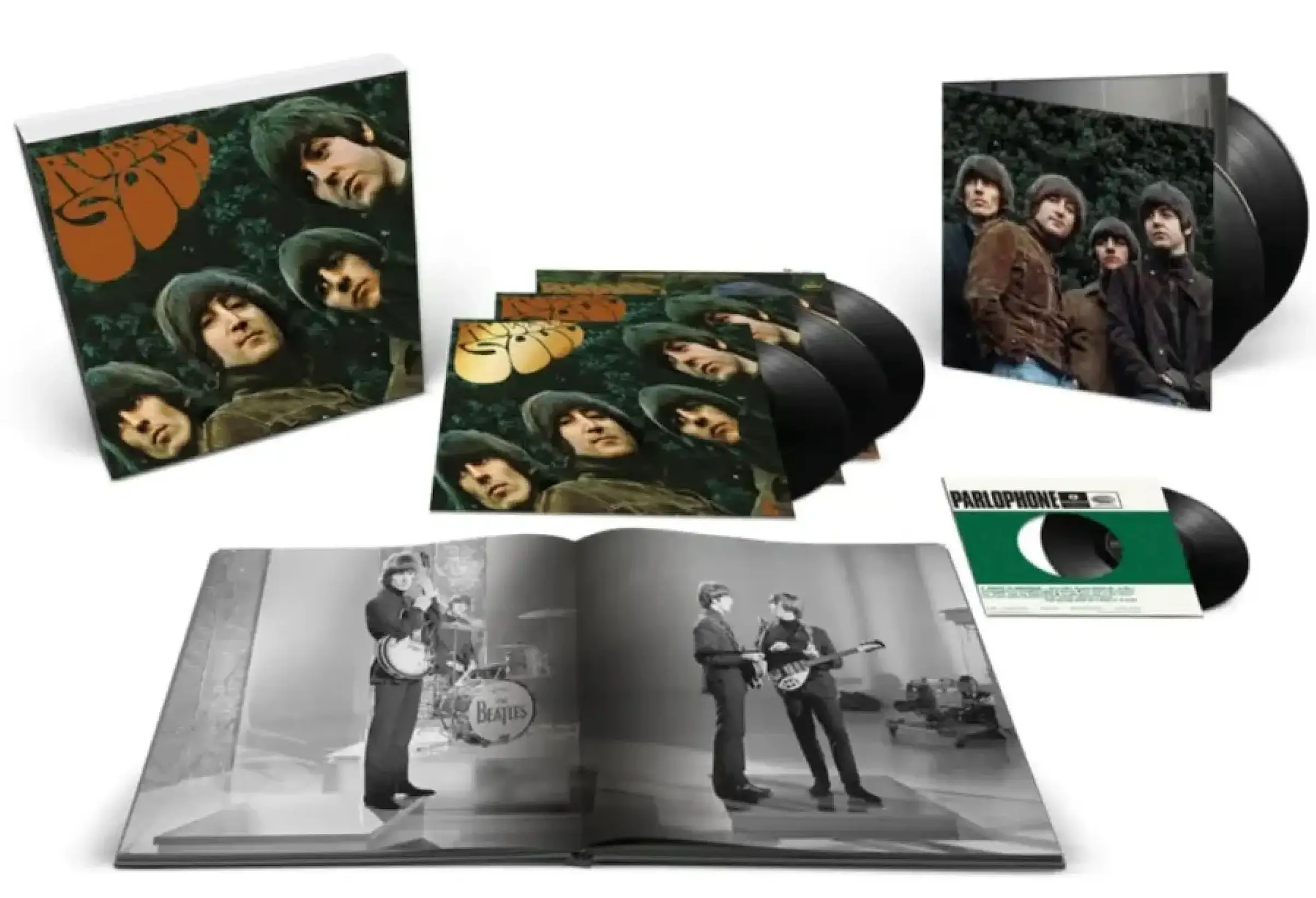
The Super Deluxe vinyl edition of The Beatles’ Rubber Soul brings together multiple LPs, a hardcover book filled with archival photographs, replica artwork, and collectible packaging celebrating one of the band’s most influential albums.
That same de-mixing approach is what made the band’s own Get Back documentary possible in the first place, since restoring decades old film and audio footage required isolating dialogue and performance from background noise using comparable techniques. Applying it to a studio album rather than a documentary is a slightly different technical problem, since the goal shifts from cleaning up incidental noise to genuinely separating instruments that were recorded through the same microphone or bounced onto the same track for storage reasons, but the underlying software lineage running through both projects is the same one Jackson’s team has spent years refining specifically for Beatles material.
stir
The reissue brings together all fourteen new stereo mixes in one place for the first time, plus a Dolby Atmos mix for anyone with the surround setup to hear it properly. Past that, the real draw for longtime collectors sits in the session material. The Super Deluxe collections pull from twenty four early recordings, twenty of them previously unreleased takes and three previously unreleased home demos, including early attempts at Day Tripper and We Can Work It Out, the double A side single the band recorded during the same sessions but kept off the album proper.
One inclusion stands apart from the rest. A song called Little Girl is described as a previously unheard John Lennon song outline, something the band’s own camp says was never before released or even rumoured to exist before this announcement, a genuinely rare claim for a catalog this heavily documented after six decades of bootlegs, fan forums and prior archival digs. An early take of Michelle, one of the album’s best known tracks, is already streaming ahead of the October release, giving an early sense of how raw these session recordings sound next to the finished record.
flow
The 4CD and 5LP Super Deluxe editions ship with an 88 page hardbound book, a feature that has become a defining part of this whole reissue series rather than an afterthought bundled in for collectors. This one carries a newly written introduction from Paul McCartney alongside a foreword built from John Lennon’s own words, assembled from things he said about the album across his life, including years after the band’s breakup, rather than a single new piece written for the occasion. The book also holds rare photographs, track by track background notes, and the kind of studio detail that turns a box set from a nicer sounding record into something closer to a document of how the thing was actually made.
That structure, new commentary from a surviving member paired with archival words from one who is not, has run through the last several entries in this series and gives each box a slightly different emotional register depending on which songs and stories get pulled from Lennon’s archive. For an album made at a moment when the band’s two chief songwriters were still largely working in tandem rather than in separate rooms, pairing their perspectives this way carries a bit more weight than it might for a later, more fractured era of the group’s catalog.
issue
This is not the first time Apple Corps and Universal have run this playbook. Sgt. Pepper’s Lonely Hearts Club Band got the treatment in 2017, the White Album followed in 2018, Abbey Road in 2019, Let It Be in 2021, Revolver in 2022, and a version of the Anthology series returned in 2025. Rubber Soul filling the gap now closes one of the more obvious remaining holes in that run, since it sits directly before Revolver in the band’s own chronology and has been near the top of fan wish lists since Revolver’s own reissue arrived four years ago.
Skipping straight from Revolver back to Rubber Soul, rather than working strictly backward through the earlier records, says something about which albums Apple Corps and Universal consider commercially and critically load bearing enough to justify the full Super Deluxe treatment, expensive engineering time, a dedicated book, and a full manufacturing run across CD, vinyl and Blu-ray all at once. Rubber Soul has long occupied a specific place in that hierarchy: the record most often cited as the turn from a hit making pop band into a studio focused one, which makes it a fairly obvious candidate regardless of strict release order. Earlier records in the catalog, including the band’s first several albums, remain notably absent from this reissue campaign so far, a gap that suggests the series is prioritizing the records most closely tied to the band’s artistic turning points rather than working through the discography in simple chronological order.
length
Rubber Soul first came out on December 3, 1965, recorded in just four weeks across October and November that year, immediately after the band’s record setting concert in front of more than 55,000 people at Shea Stadium in New York. That turnaround, from the biggest live audience of their career directly into a compressed studio sprint, is part of why the record sounds like a band changing its own rules in real time rather than following a settled formula. Drive My Car, Norwegian Wood, Nowhere Man, Michelle, Girl and In My Life all came out of that same month, and the record is widely credited as one of the earliest to treat a pop album as a unified artistic statement rather than a loose collection of songs built around one or two singles.
Coming at the tail end of a year that had already delivered Help! and a nonstop touring schedule, Rubber Soul marked the start of a stretch where the band, freed briefly from film and concert commitments, could actually spend a month living inside a studio rather than treating it as a stopover between tour dates. That shift in working conditions shows up directly in the record itself, in the acoustic textures, the vocal harmonies borrowed from American folk and soul records the band had been listening to, and George Harrison’s first recorded use of sitar on Norwegian Wood, a detail that gets cited constantly because it is genuinely the moment a specific instrument enters the vocabulary of mainstream pop music.
The album’s own title is part of the story too. Rubber Soul reportedly borrowed its name from a phrase McCartney overheard used to describe white musicians attempting soul music, plastic soul, and turned it into something closer to a self aware joke about the band’s own genre tourism at the time, folk one track, R&B influenced groove the next, all filtered through a songwriting partnership that was still, in late 1965, largely working face to face rather than in separate rooms. Bob Dylan’s influence runs through the record almost as view as the sitar does, both in the more introspective lyric writing on tracks like Nowhere Man and in the loosened, less obviously commercial structure of the album as a whole compared to everything the band had released before it.
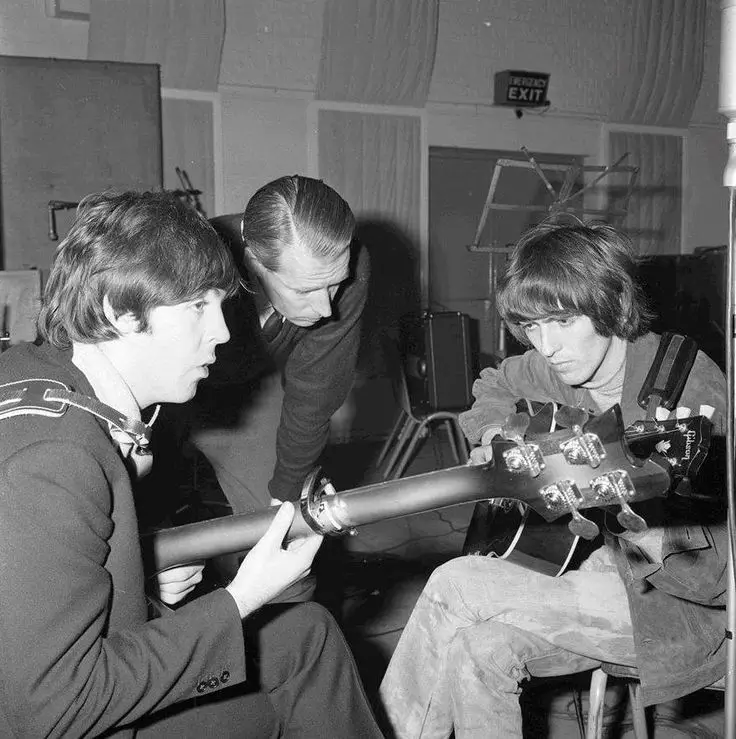
Captured during the Rubber Soul recording sessions at EMI Studios in November 1965, this behind-the-scenes photograph shows members of The Beatles inspecting a Gibson guitar as producer George Martin looks on, offering a rare glimpse into the collaborative atmosphere behind one of the band’s defining albums.
fin
The reissue spreads across a genuinely wide range of formats rather than pushing everyone toward the priciest option. A standard single CD and single LP will carry the core new stereo mix for listeners who just want the finished album. Above that sit 2CD and 2LP Special Editions, which add a curated set of session highlights, demos and the single without going as deep as the full box. At the top, the 4CD and 5LP Super Deluxe editions carry the full 68 track spread, the 88 page book, and, through the band’s own web store, two exclusive fold out posters and two exclusive photo art cards not sold anywhere else.
Reported pricing through the band’s direct to consumer store puts the 5LP Super Deluxe vinyl set at 235.98 dollars, the 4CD Super Deluxe at 159.98 dollars, the 2LP Deluxe at 39.98 dollars, the 2CD Deluxe at 24.98 dollars, a Blu ray edition with the high resolution stereo and Dolby Atmos mixes at 35.98 dollars, and a Zoetrope single LP edition, a novelty pressing designed to create an animation effect when spun under a strobe light, also at 35.98 dollars. A limited edition orange vinyl pressing is also part of the wider release slate, alongside the Blu-ray disc carrying promotional films for both Day Tripper and We Can Work It Out.
The Zoetrope format is worth pausing on since it is not a standard reissue novelty. The technique prints a sequence of images around the record’s run out groove so that, viewed under a strobe or camera shutter effect while the disc spins at the correct speed, the images appear to animate, a analog trick with roots going back well over a century that vinyl labels have revived periodically as a premium collector’s item rather than something aimed at anyone simply wanting to hear the album. Pairing that kind of format with a mid 1960s record built around tape manipulation and instrumental experimentation is a reasonably fitting bit of packaging, even if it has little to do with how most listeners will actually experience the reissue day to day.
None of this arrives in isolation from the band’s wider business either. The same announcement window has already confirmed that 3 Savile Row, the rooftop where the band played their final public concert, is being converted into an official fan experience opening in 2027, and a four film scripted account of the band’s story is set for 2028 through Sony Pictures, directed by Sam Mendes and casting Harris Dickinson, Paul Mescal, Joseph Quinn and Barry Keoghan as the four members. Rubber Soul’s reissue lands as one piece of a considerably larger push to keep the catalog, and the band’s own mythology, in active circulation rather than treating it as a fixed historical record.
Related Articles

Inside The Airstream Elon Musk Calls His Memphis Palace
Elon Musk says he is living in an Airstream trailer parked beside xAI’s Colossus supercomputer […]