DRIFT AUDIO
Listen to this story
Choose a voice, then press play.
The Venice Biennale has appointed an exclusive partner for the first time in Bulgari, and it’s a relationship that will continue until 2030. From Lotus L. Kang’s atmospheric pavilion takeover to Monia Ben Hamouda’s neon interventions, Bulgari’s Biennale debut spans Venice’s past and present.
In May 2026, as the 61st International Art Exhibition of La Biennale di Venezia opened under the curatorial vision of the late Koyo Kouoh (“In Minor Keys”), a quiet but significant shift occurred in the world of cultural patronage. For the first time in its 130-plus-year history, the Biennale named an exclusive partner: the Roman jewellery house Bulgari. This multi-edition commitment—covering 2026, 2028, and 2030—formalizes years of the maison’s cultural engagement into a structured, long-term alliance. It bridges heritage preservation with bold contemporary commissions, all while treading carefully in Venice’s fragile, water-lapped ecosystem.
base
Bulgari’s involvement did not emerge from nowhere. The maison has long supported cultural restoration—famously funding the Spanish Steps in Rome—and partnered with institutions like MAXXI in Rome and the Whitney in New York. The 2024 launch of Fondazione Bvlgari elevated this into a more formalized philanthropic vehicle, focused on heritage, contemporary art, and nurturing talent over time.
As Managing Director Matteo Morbidi explained, the foundation formalized work the maison had already been doing: “It’s not something new, it’s just been formalised to manage the work we started many years ago.” A key principle is long-term artist support rather than one-off projects. Collaborations build on prior relationships, such as residencies or awards, creating continuity and trust.
This know shines through in Bulgari’s 2026 debut, which features two main pillars: a dedicated pavilion in the Giardini and a collateral exhibition in the historic Biblioteca Nazionale Marciana.
cyclic
At Spazio Esedra in the Giardini, Canadian-born, New York-based artist Lotus L. Kang presents her major commission, The Face of Desire Is Loss. Curated by Matthew Hyland (Executive Director of the Contemporary Art Gallery, Vancouver), the installation immerses visitors in themes of transition, impermanence, inheritance, memory, and “becoming.”
Kang’s practice fluidly combines sculpture, photography, and site-responsive installation, often using unstable or reactive materials. A large cast bronze lotus root outside the pavilion sets the tone. Its porous structure—voids that paradoxically grant immense strength—echoes throughout the show. Inside, industrial “superjoists” (lightweight steel supports) mirror the root’s form, suspending large sheets of unfixed photographic film. These “skins” chemically respond to light, humidity, and atmosphere over the Biennale’s duration, slowly developing and changing color.
Overhead sculptures include cast aluminum tatami mats (recording sedimentary traces of life, like mattresses bearing invisible histories) and fiberglass-and-plaster kelp knots. A Super 8 film loop captures Korean mudflats, where land and sea ecosystems blur. Living seaweed becomes inert through casting, while static photographs turn reactive. A choreographed lighting score, inspired by Korean poet Kim Hyesoon, cycles the space through dawn, noon, and dusk rhythms.
Forty-nine bottles of spirits quietly anchor the installation, referencing the 49 days a soul lingers in a liminal state before reincarnation in Buddhist tradition. The title draws from poet Lara Mimosa Montes, suggesting that voids and gaps can become sites of generative strength. Kang channels her Korean heritage to universalize personal and cultural narratives of loss, repair, and cyclical transformation. The work feels alive, contingent on time, light, and visitor presence—perfectly attuned to Venice’s shifting tides and layered history.
This pavilion marks the start of Bulgari’s ongoing presence in the Giardini, signaling a commitment to ambitious, site-specific contemporary commissions across future editions.
straddle
A short walk away in Piazza San Marco, Fondazione Bvlgari curates its first official collateral event in the monumental rooms of the Biblioteca Nazionale Marciana—one of Venice’s most storied repositories of knowledge. Artists Lara Favaretto and Monia Ben Hamouda (winner of the fourth MAXXI Bvlgari Prize) create site-specific dialogues with the library’s heritage of preservation and transmission.
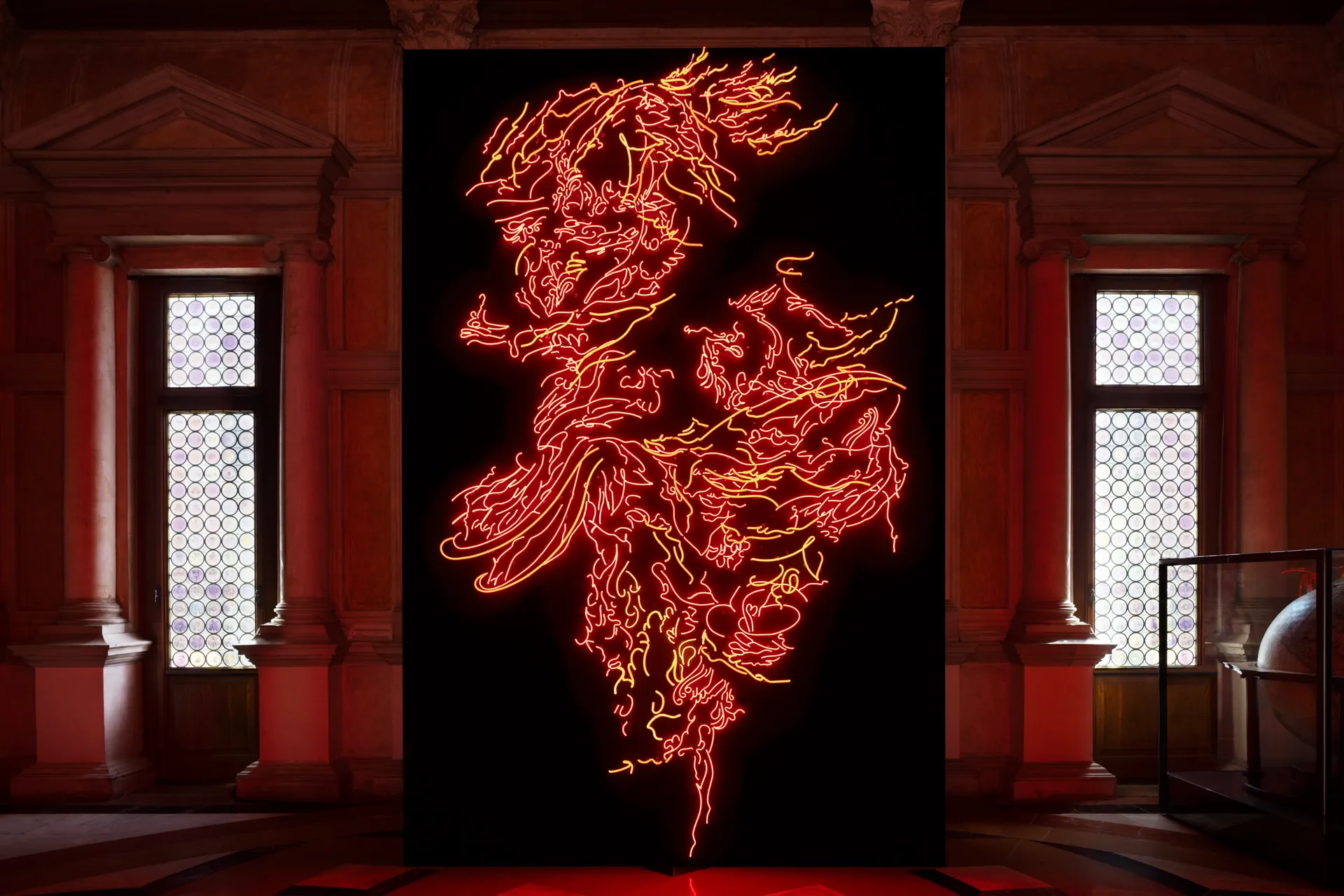
In the vestibule, Tunisian-Italian artist Monia Ben Hamouda installs Fragments of Fire Worship. Two monolithic neon wall sculptures pulse with searing orange light. As the daughter of an Islamic calligrapher, Ben Hamouda treats language as physical gesture. Here, she crafts an expressive but nonexistent alphabet from script-like marks—fragments that evoke writing yet resist legibility. The neon subtly nods to the Marciana’s history of near-destruction by fire, framing language (and light) as ambivalent forces: illuminating yet capable of erasure.
In the grand Salone Sansovino, Lara Favaretto presents the seventh and final chapter of her ongoing series Momentary Monument – The Library. A bespoke shelving unit spans the hall, filled with thousands of donated books from Italian institutions and collections. Before installation, custom software randomly paired each volume with images from Favaretto’s personal archive, which were then printed inside. Visitors encounter books already marked by marginalia and use, now further layered with unexpected images. Crucially, people can take books home, causing the installation to evolve and empty over time.
Favaretto subverts permanence: even “preserved” knowledge proves fragile, shifting, and communal. Morbidi notes the dialogue between the artists and the space as a reflection on “the conservation of memory… something really important for the future generation. It’s a reflection on time, on heritage.”
idea
Bulgari’s strategy emphasizes conversation over imposition. “We had a very delicate approach with Venice. It’s a very fragile environment and we wanted to be in conversation with that,” Morbidi emphasized. By selecting locations first and inviting artists to respond freely, the foundation avoids the pitfalls of corporate branding in sensitive cultural spaces.
This extends to artist selection. Both Kang (via her thematic resonance) and the Marciana artists (tied through prior MAXXI Bvlgari Prize and Italian art awards) represent sustained relationships. The maison positions itself as a guardian of heritage that also invests in emerging and mid-career voices.
scope
Bulgari joins a tradition of luxury houses supporting the arts—think Chanel at the Met or LVMH’s various initiatives—but the exclusive, multi-edition partnership with a major institution like the Biennale feels distinctive. It formalizes patronage into institutional alliance, potentially setting a blueprint for thoughtful engagement.
In an era of scrutiny over corporate involvement in culture, Bulgari’s model—long-term, artist-centered, heritage-sensitive—offers a considered alternative. It aligns with the maison’s Roman roots in craftsmanship, beauty, and innovation, where jewellery-making itself blends ancient techniques with contemporary vision.
Venice, with its own history of patronage, artistic innovation, and vulnerability to time and environment, provides an ideal stage. Bulgari’s interventions echo the city’s layers: Kang’s mutable materials mirror tidal shifts and atmospheric change; the Marciana works probe how knowledge persists (or doesn’t) across centuries.
move
While 2026 focuses on these debuts, the partnership’s longevity promises evolution. Future editions could deepen site-specific responses, expand artist residencies, or explore new dialogues between jewellery, craft, and contemporary art. Fondazione Bvlgari’s commitment to continuity suggests artists may return or new voices build on established relationships.
As the Biennale continues under its curatorial themes, Bulgari’s role as exclusive partner ensures sustained support for the “minor keys”—the subtle, reflective, boundary-pushing voices Kouoh championed.
clue
Bulgari’s Biennale partnership transcends sponsorship. It embodies a philosophy where creativity expresses freedom, heritage fuels innovation, and beauty arises from genuine exchange. In Venice—a city that has inspired artists for centuries—this collaboration weaves the maison’s Roman elegance into the lagoon’s complex tapestry.
From the atmospheric alchemy of Kang’s pavilion to the luminous fragments and emptying shelves at the Marciana, Bulgari’s debut invites reflection on time, loss, memory, and renewal. It positions the luxury house not as an outsider but as a thoughtful participant in culture’s ongoing conversation—one that will echo through 2030 and beyond.
From the DRIFT archive: Eric Stefanski and the Art of Selective Living: A 2025 Confession Painted in Plain Sight
Related Articles
Joël Andrianomearisoa Finds More Than One Black in a Square of Buttons
In La Guerre des Boutons I, a field of ordinary fasteners turns a modest textile […]