DRIFT AUDIO
Listen to this story
Choose a voice, then press play.
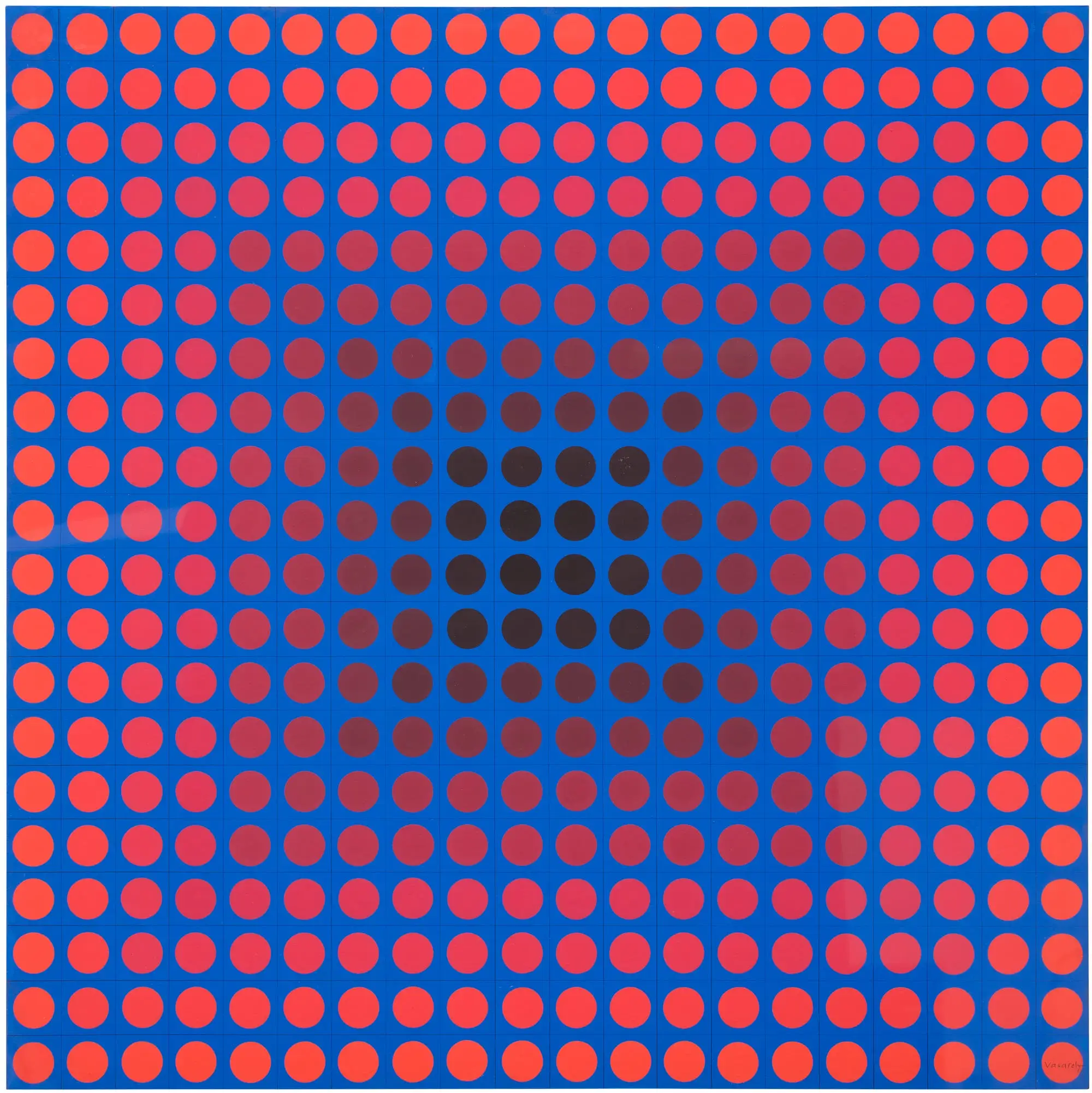
Signed “Vasarely” lower right and inscribed, titled, and dated on the reverse, the painting carries a certificate of authenticity from the Vasarely Foundation and an estimate of $35,000–45,000.
This square-format work belongs to a pivotal moment in Vasarely’s career, when the Hungarian-French master fully crystallized the visual language that would define Optical Art (Op Art). CTA 24 is not merely a painting; it is a perceptual engine, a tightly engineered optical event that invites the viewer into an active dialogue with form, color, and illusion. Its inclusion in Tina Hills’ collection speaks volumes about her taste: a lifelong affinity for bold, expressive tincture married to intellectual rigor.
stir
Victor Vasarely (born Győző Vásárhelyi, 1906–1997) emerged from the culture crossroads of early 20th-century Central Europe. Raised in Pécs, Hungary, he briefly studied medicine before turning to art, first at the Podolini-Volkmann Academy and then at the Muhely Academy in Budapest—the Hungarian counterpart to the German Bauhaus. There, under the influence of Sándor Bortnyik, he absorbed principles of geometric abstraction, color theory (including the Ostwald system), and the integration of art with technology and design.
In 1930, Vasarely moved to Paris. He supported himself as a graphic designer for advertising agencies while conducting private experiments in perception. His breakthrough came early: the 1937 painting Zebra, with its curving black-and-white stripes that seem to undulate and intertwine, is often cited as one of the first true Op Art works. Yet it was in the 1950s and 1960s that Vasarely developed the mature vocabulary for which he is best known—grids, nested squares, circles, rhomboids, and precise tincture gradients that generate illusions of depth, movement, and vibration.
By the mid-1960s, when CTA 24 was executed, Vasarely had achieved international acclaim. The 1965 exhibition The Responsive Eye at the Museum of Modern Art in New York cemented Op Art as a major movement, even if its culture moment proved relatively short-lived. Vasarely, however, continued refining his “plastic alphabet”—a modular system of forms and colors that could be permuted infinitely, much like a visual algorithm. He called these preparatory studies “programmations,” treating painting as a programmable, almost scientific process.
CTA 24 belongs to a series of works whose title likely references “Cercle-Triangle-Arc” or a similar permutation code within Vasarely’s systematic approach. The CTA portfolio and related paintings explore circular and angular motifs within square formats, using graduated color to create kinetic effects. Similar works, such as pieces from the CTA 102 portfolio (screenprints derived from paintings) or CTA-104-E in MoMA’s collection, demonstrate the artist’s fascination with spherical illusions and chromatic expansion.
flow
CTA 24 is executed in tempera on panel—a medium Vasarely favored for its matte finish, precision, and luminosity. Unlike oil, tempera dries quickly and allows for crisp edges and subtle layering, ideal for the razor-sharp geometry demanded by Op Art. The square support (80 x 80 cm) is a recurring format for Vasarely, evoking stability while simultaneously destabilizing the viewer’s sense of space.
Though specific visual documentation of this exact lot is tightly held ahead of the auction, its placement in the CTA series suggests a composition built around nested or interlocking geometric units—likely circles or ovoid forms emerging from or receding into a grid of squares or rhombi, with color gradients shifting across quadrants. Viewers familiar with contemporaneous works like Toll (1965, tempera on board, Cranbrook Art Museum) or Vega series pieces will recognize the hallmark effects: forms that appear to bulge forward or recede, surfaces that seem to ripple or pulse, and colors that vibrate against one another.
The optical phenomena arise from careful calibration. Vasarely studied how the human eye processes contrast, afterimages, and edge detection. By placing complementary or analogous hues in precise adjacency and varying their saturation or value, he could make flat surfaces appear three-dimensional or kinetic. In CTA 24, one imagines cool blues and greens advancing or warm reds and yellows receding, or perhaps a central “sphere” formed by concentric rings that seems to hover above the panel. The result is not passive viewing but active participation: the eye and brain work to resolve contradictions, producing a dynamic, almost hypnotic experience that changes with the viewer’s position and lighting.
This interactivity aligned perfectly with Vasarely’s democratic ideals. He believed art should be accessible—“art for all”—and frequently produced multiples, tapestries, and public installations. Yet original tempera panels like CTA 24 represent the apex of his personal involvement, executed with the meticulous hand that made each illusion perfect.
scope
Argentina “Tina” Schifano Hills (c. 1922–2025) embodied a remarkable 20th- and 21st-century trajectory. Born in Pola, Istria (then Italy, now Croatia), she immigrated to New York as a teenager, studied at NYU, and entered the world of international publishing. She married Ángel Ramos, owner of Puerto Rico’s El Mundo, and after his death continued leading media interests while heading the Ángel Ramos Foundation. In 1977 she became the first woman president of the Inter-American Press Association, championing press freedom across the Americas.
Her second marriage to Lee Hills, the Pulitzer Prize-winning editor of the Miami Herald, brought her to Miami, where the couple became culture powerhouses. Tina served on boards for the Dade County Arts Council, Bayfront Park, Florida Grand Opera, and helped shape the view for what became Pérez Art Museum Miami (PAMM). The Tina Hills Pavilion in Bayfront Park stands as a permanent tribute.
Her collection reflected her personality: elegant, intellectually curious, and vibrantly alive. While the Phillips series highlights major Abstract Expressionist and Color Field works—Joan Mitchell’s Plain (1989), Helen Frankenthaler, Adolph Gottlieb—CTA 24 represents the precise, optically charged side of post-war abstraction. Vasarely’s calculated geometry and pure chromatic joy complemented the more gestural energy of Mitchell or Frankenthaler. Together, they created an environment of “expressive color and dynamic compositions,” as the auction catalogue describes.
Hills acquired CTA 24 during a period when Op Art had moved from avant-garde sensation to established modernist classic. Owning a Vasarely signaled sophistication and an appreciation for art that engages the mind as much as the senses—qualities that defined her own public life.
leg
Vasarely’s tempera technique deserves special note. He built surfaces with thin, even layers, achieving a porcelain-like smoothness that enhances optical purity. No visible brushstrokes distract from the illusion; the panel becomes a flawless optical field. The Vasarely Foundation’s certificate underscores authenticity and condition—critical for works where precision is everything.
In the broader art-historical context, CTA 24 sits at the intersection of several movements. It inherits Bauhaus rationality and Constructivist geometry, dialogues with Kinetic Art (Vasarely collaborated with artists like Jesús Rafael Soto, another work from the Hills estate), and anticipates digital and algorithmic art. Today, Vasarely’s influence appears in everything from graphic design and architecture to virtual reality experiences that manipulate perception.
The market has recognized his importance. While prints and multiples trade more affordably, original panels from the 1960s—especially those with strong provenance—command respect. CTA 24’s estimate reflects both its quality and the current appetite for optically engaging, color-forward post-war works that feel fresh in contemporary interiors.
impression
In an era of digital overload and fleeting attention, Vasarely’s work offers a counterpoint: slow, deliberate looking that rewards patience with wonder. Stand before CTA 24 and the painting performs—shifting, breathing, inviting reinterpretation. It embodies Vasarely’s credo that “the art of tomorrow will be a collective treasure” rooted in universal perceptual principles rather than subjective emotion alone.
For Tina Hills, whose life spanned continents, industries, and causes, such art must have felt like a perfect mirror: ordered yet alive, precise yet joyful, intellectual yet sensuous. Her estate’s dispersal allows new collectors to experience that same life-affirming encounter.
As the gavel falls on May 21, CTA 24 will likely find a new home where its tinctures continue to pulse and its forms continue to dance. In that moment, Vasarely’s view and Hills’ legacy of generous, colorful living converge once more—proof that great art, like great lives, transcends time through pure, vibrant presence.
Related Articles

Where the Face Should Be, Rafael Silveira Paints Open Sky
A pink shirt, shoulder-length hair, then no face at all: in “Surprise,” Rafael Silveira lets flowers and a clear blue sky stand in for the person.