DRIFT AUDIO
Listen to this story
Choose a voice, then press play.
Camper’s anniversary retrospective from Lars Müller Publishers makes room for a money-losing rice ball restaurant alongside its best-known shoes.
Among the stories Miguel Fluxà told at the launch of Camper’s fiftieth anniversary book was one about a rice ball that cost three euros to make and sold for one. Fluxà, the company’s chief executive and the fourth gen of the Mallorcan family behind it, was on stage at La Fábrica in Madrid last week for a convo led by Ana Garriga, sharing the panel with Gloria Rodríguez of the Camper Foundation and the essayist Andrea Lazarov. The occasion was The Walking Society: Now More Than Ever!, a 452-page volume from the Zurich house Lars Müller Publishers that Camper show as the final act of its anniversary. The rice ball is in there. So are the shoes, the shops, the hotels and a fair number of ideas that never left the studio.
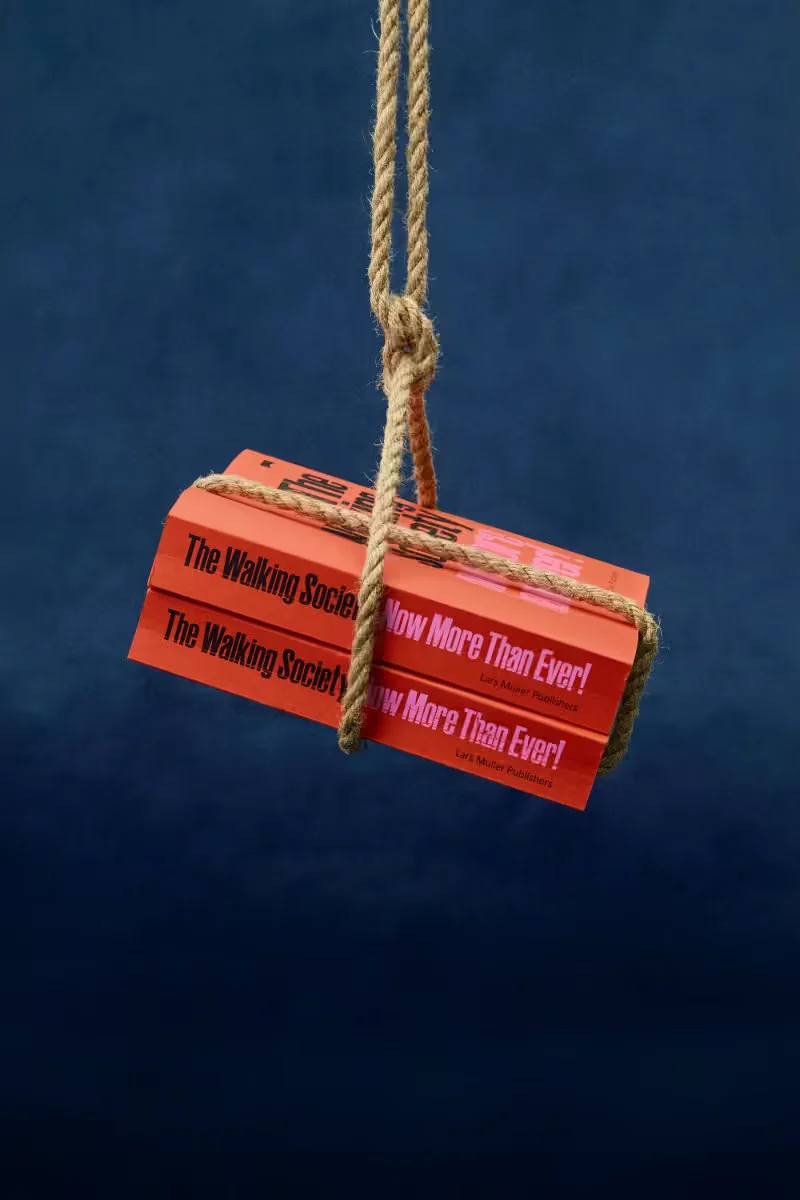
Signal. What happened: Camper presented The Walking Society: Now More Than Ever!, a retrospective built from its own archive in Inca, Mallorca, as the closing chapter of its 50th anniversary program. Exact object: A 452-page book edited by Miguel Fluxà and Gloria Rodríguez, designed by Rodríguez and published by Lars Müller Publishers (ISBN 978-3-03778-819-6), sold by Camper under product code L2132-001. When and where: Presented at La Fábrica in Madrid in late September 2026; on sale through Camper’s own store at €35 in Europe and $45 in the US, with the publisher’s trade listing dated October 6, 2026. Source: Camper’s book page and product listing, plus the publisher’s catalog record. Why it matters: The book puts Camper’s failed projects on the record next to its icons, and it lands in the same year the company changes creative director and makes the first acquisition in its history.
from
Rodríguez, who designed the book as well as co-editing it, told the Madrid audience that the team went through the archive in Inca almost document by document. Sketches, photographs, graphic material and papers that had never been published were used to rebuild the story, including the parts that stayed in the studio and never reached a shop floor. The finished volume is arranged in six sections. The first five move through the company in roughly the order a shoe does: roots, processes, products, voices and spaces. The sixth, titled Beyond, gathers the projects in art, education, gastronomy and hospitality where Camper tried its experimental habits on something other than footwear.
A walking society, in Camper’s telling, sets its own pace and keeps its eyes forward, and the book turns that idea on the company itself, treating fifty years as something still in motion rather than a closed account. Archival documents sit beside essays and photography commissioned for the book.
The product listing credits ten authors: Fluxà himself, Felix Burrichter, Davide Coppo, El Último Grito, Pol Guasch, Lazarov, Miguel Leiro, Andrea Muniáin, Matthew Needham and Joël Vacheron. Camper bills them as writers and thinkers, brought in to follow the company’s curiosity wherever it wandered past the shoe.
The phrase on the cover already does a lot of work for Camper. The Walking Society is the name of the brand’s membership community, the name of its magazine, and the title of the 2015 book that Lars Müller published for Camper’s fortieth. The exclamation mark is the new part.
flow
FoodBALL was one of Fluxà’s first projects at Camper: a restaurant built around rice balls. He was candid in Madrid about the arithmetic and offered it as an example of what the Beyond chapter is for. The project never made money. It stays in the book anyway.
Hospitality and gastronomy are Beyond’s other subjects, and there Camper’s record includes clear wins. Casa Camper, the hotel concept, opened in Barcelona in 2005 and later in Berlin, and the same diversification push produced Dos Palillos, a Michelin-starred restaurant in Barcelona’s Raval district. A rice ball counter that lost two euros a serving sits in the same family tree as a restaurant with a star.
“Our history is what it is, and that is how we tell it,” Rodríguez said at the presentation. The commercial flops are there because, read at a distance of decades, they show how the company has actually worked.
View this post on Instagram
to
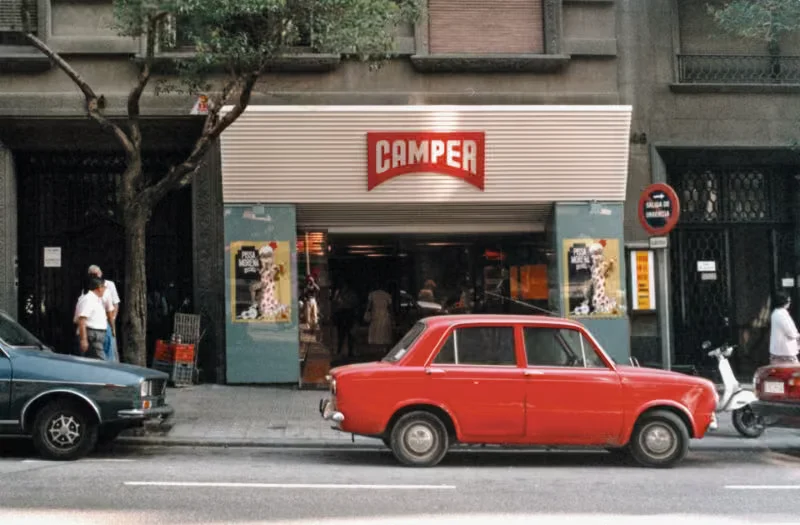
Inca, a market town in the middle of Mallorca, had shoemakers long before it had Camper. In 1877 a local cobbler named Antonio Fluxà returned from England with sewing machines and began the move toward mechanized shoemaking on the island, a history the company still tells as its starting point. His grandson Lorenzo Fluxà founded Camper in 1975, the year Franco died and Spain began reaching for everything new.
The name is the Catalan word for farmer, and the first model, the Camaleón, took its cue from the shoes worn by farmers around Inca. The publisher’s description of the 2015 Walking Society book traces that lineage back to peasant footwear assembled from a piece of old car tire and a scrap of fabric. In 1999, per the company’s Spanish-language history, the Camaleón became the first shoe to receive European ecological footwear accreditation.
The first Camper store opened in Barcelona in 1981, Paris and Milan followed in 1992, and New York in 1999. Pelotas, launched in 1995, takes its name from the Spanish word for balls and its sole from them too: an outsole of 87 small balls, modeled on the hand-stitched balls of early sport and arranged into a cushioning system. Camper calls it its original icon and says the design has not changed in three decades. It sits in the permanent line beside Twins, which put a different design on each foot of the pair, and Peu.
The archive is not only going into print. Camper’s site currently lists a Pelotas Archive Capsule as coming on October 7.
mutable
The spaces section returns to one of the company’s more unusual retail rules: no two Camper stores should look alike. The approach took shape in the early 2000s, and in 2006 Camper gave it a name, Camper Together, a nod to the collaborative way it commissions architects and designers for its shops. Among the early collaborators was Shigeru Ban, years before the Japanese architect received the Pritzker Prize in 2014. The roster since has included the Italian designer Gaetano Pesce.
La Fábrica, the Madrid publisher and bookshop that hosted the launch, knows this chapter well. In 2025 it released Camper Together: The Architecture of a Brand, a 352-page survey of the program, whose list puts Camper’s shop count above 400, no two alike. La Fábrica is also among the retailers now stocking the new book.
extend
Now More Than Ever! is the third book-length Camper history in eleven years, and the second tied to the fiftieth. The first came out with Lars Müller in 2015 for the fortieth anniversary. Edited by Anniina Koivu and running to 408 pages, it moved between the brand’s story and wider subjects, from the anatomy of the foot to the cultural history of the shoe, and its table of contents opened with a chapter titled Walk, Don’t Run.
That phrase became the title of the second book. Walk, Don’t Run, published in 2025 with Walther König and designed by the Dutch book designer Irma Boom, is a compact 336-page softcover that tells Camper’s story through the shoes in its archive, pairing each with images that echo or contradict it, in no fixed chronological order.
The same year brought an anniversary hardcover edition of The Walking Society magazine, its eighteenth issue, shot in Mallorca with photo by Martin Parr, and a limited run of objects with Martí Guixé reworking pieces from his 1999 World Walking Ware exhibit with Camper. Where Boom’s book was built from objects and images, Now More Than Ever! is built from documents and commissioned writing, and it brings the anniversary back to the publisher that handled the fortieth.
fin
For Fluxà, the book also closes one chapter and opens another. In January, Camper announced that Achilles Ion Gabriel would leave after more than six years. The Finnish-born designer joined as creative director of Camperlab in 2019, took on the main line a year later, and pushed Camperlab from a footwear label into a full fashion brand with ready-to-wear. His last collections, for spring and summer 2027, are due to be presented in early December.
In March the company named Abraham Ortuño creative director of both Camper and Camperlab. The Alicante-born designer founded his own label, Abra, in 2019 after working on accessories and footwear for houses including Jacquemus. Fluxà said Ortuño “represents a new generation of creative leadership.” He will oversee product and brand communication for both lines.
In July, Camper made the first acquisition in its history, taking a 60 percent stake in Ancient Greek Sandals, the Athens label founded in 2012 by Christina Martini and Nikolas Minoglou. The founders keep a minority share alongside co-owner Yiannis Vagenas and continue to run it as an independent brand. Camper posted record turnover of €225 million in 2023.
Asked in Madrid how a fifty-year-old brand keeps changing without losing what makes it recognizable, Fluxà named nostalgia as one of the biggest dangers. The subtitle reads as his answer: a book that looks back mainly to argue that the walking is still underway. Ortuño’s first collection, for autumn and winter 2027, is scheduled to be previewed in early 2027 and to reach stores worldwide that June.