DRIFT AUDIO
Listen to this story
Choose a voice, then press play.
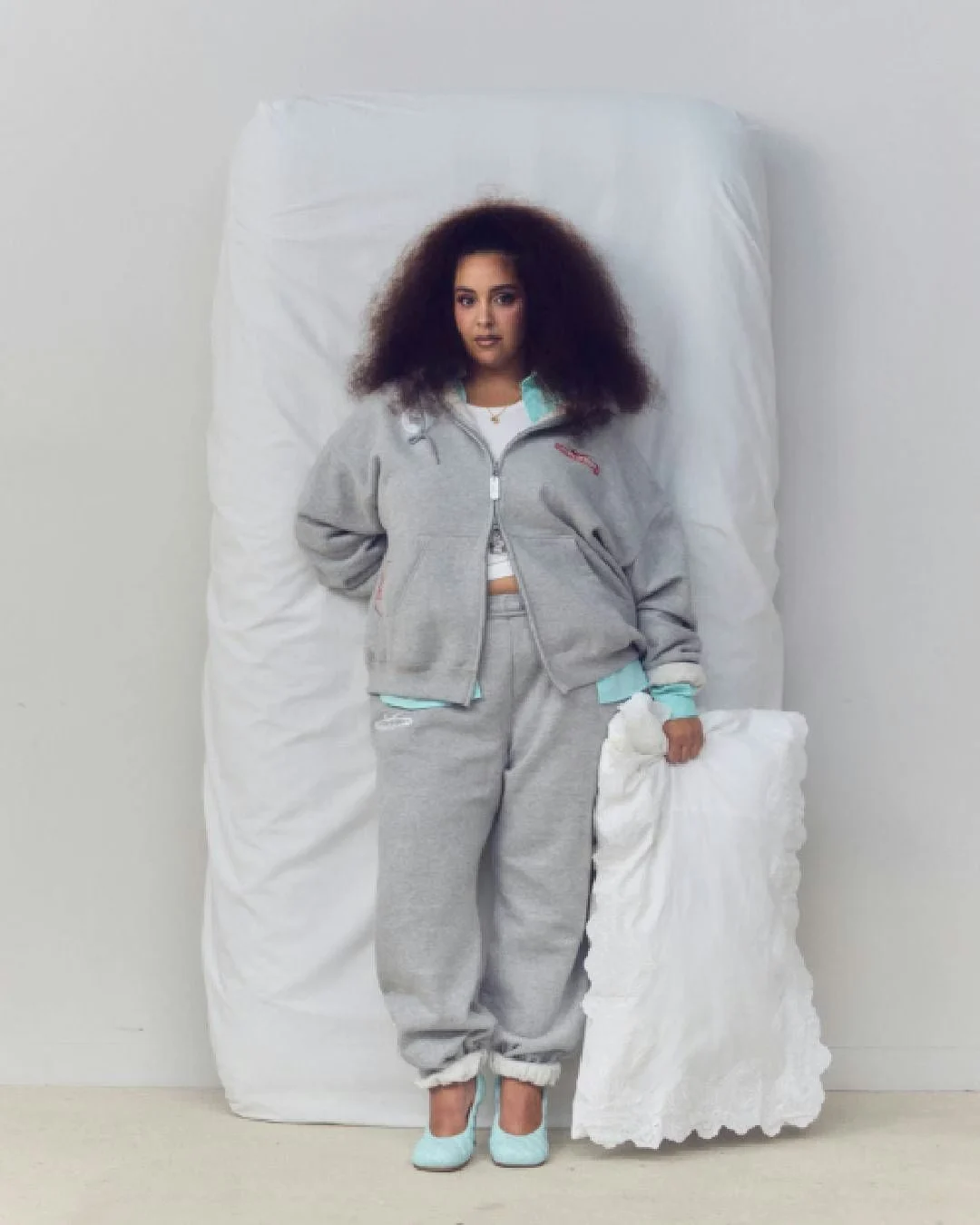
Ten embroidery motifs, a stack of mattresses and a grey cotton rosette: a Paris pattern maker has been handed the keys to Nike’s newest fleece.
Before there was a studio name, there was a paper pattern. Yasmina, the Paris-based artist and designer behind Moshikura, came up through the most technical corner of the clothing trade: pattern making, the discipline that turns a sketch into a garment that can actually be cut, sewn and worn. Her professional profile lists training at the École de la Chambre Syndicale de la Couture Parisienne, the couture federation’s school, and she spent her early years inside major fashion houses before widening the frame. Visual art, graphic design, ceramics and textiles all sit inside the Moshikura practice now, and the thread running through them is the hand. She builds things physically, reroutes materials away from their expected use, and designs objects and garments meant to carry a story rather than a trend cycle.
That background is the key to reading her new project with Nike. A pattern maker thinks about how a garment behaves on a body before thinking about how it photographs, and the brief she accepted was essentially a pattern maker’s problem: take a mass-produced sweatshirt and make it feel like it belongs to one person.
Signal. What happened: Nike gave Moshikura founder Yasmina an open brief through its Nike By You customization program to reinterpret the women’s Nike Studio Fleece collection. Exact object: ten exclusive embroidery motifs designed by Yasmina, applied to Nike Studio Fleece sweatshirts and sweatpants, alongside a campaign built around grey cotton fleece rosettes. When and where: available as in-store embroidery at the Nike House of Innovation Paris, 79 Avenue des Champs-Élysées, until late October 2026, with two workshops held in September. Source: Nike’s own Studio Fleece launch rel. Why it matters: it hands one of Nike’s newest apparel systems to an independent Paris maker only weeks after its worldwide rollout, and routes the result through customization rather than a limited drop.
stir
The garment underneath the embroidery is not an old staple dusted off for the occasion. Nike introduced Studio Fleece on July 30, 2026, pitching it as a complete women’s system rather than a single hoodie. The company says the line was shaped by input from more than 300 women worldwide, and the result is organized like a grid: two fits, a closer standard cut and a roomier oversize cut, across three fabric weights. Lightweight and mediumweight pieces get a surface sueded five times over for softness, while heavyweight styles use a brushed reverse-heather build with more structure. The Total Black colorway runs on a new dye recipe Nike says holds its depth for at least 30 washes, and the collection is led by that black and by Birch Heather, the soft grey that has long been one of the brand’s signature fleece tones.
The finishing details are where Nike’s design team, led on apparel by Claire Durfee, spent most of its energy. Cuffs are trimmed down, sil lines are cleaner, and the hood has been reworked with a self-lined, darted construction and a deeper crossover at the neck so it frames the face instead of collapsing. Each piece carries a Lyon Blue label that separates Studio Fleece from Nike’s older fleece families at a glance. In other words, the base garment already arrives with a considered, almost tailored attitude, which gives an embroidery artist less to fight against and more to build on.
Studio Fleece reached nike.com and select retailers across North America, Europe, the Middle East and Africa at launch, with a worldwide rollout starting September 1. The launch campaign leaned on athletes and musicians, including figure skater Alysa Liu, sprinter Sha’Carri Richardson, and footballers Lauren and Reece James.
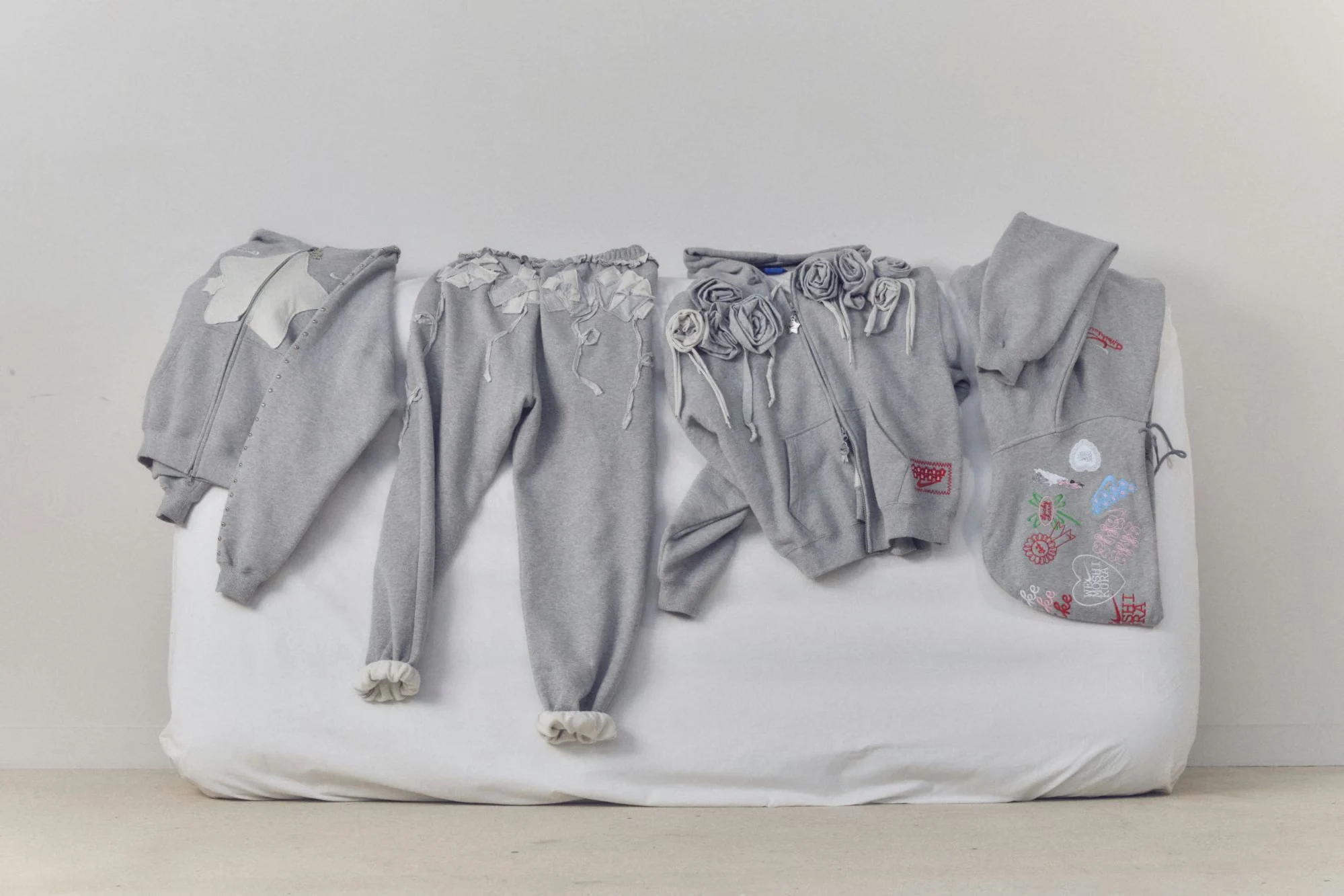
Yasmina’s contribution arrives in a different register. Working within the Nike By You program, she produced ten exclusive embroidery designs that customers can have stitched onto Studio Fleece crews, hoodies and sweatpants in store. The motifs are conceived as small visual accents built into the garment rather than oversized graphics fighting for attention. That restraint says a lot about how she approaches customization: the aim is less about loud self-expression and more about turning an everyday piece into something closer to a keepsake, the sweatshirt you would recognize in a pile of identical ones because of a single stitched detail.
Nike By You has a long track record with outside creatives. The service began life as NIKEiD at the turn of the millennium, originally a web tool for building a custom Air Force 1, and was rebranded as Nike By You in 2019 with an explicit shift toward “co-creation.” Over the years that framing has pulled in fabric specialists, illustrators and streetwear labels, but most of those projects centered on footwear. A fleece program, anchored in embroidery and led by a designer whose training is in garment construction, pushes the service toward apparel in a way that fits the material. Sweatshirt fleece takes thread well. It is forgiving, dense and soft enough to hold raised stitching without puckering, which is part of why embroidered sweatshirts have been a customization staple for decades.
show
The Swoosh is among the most guarded marks in commercial history, which makes any project framed around altering it worth a closer look. The logo was drawn in 1971 by Carolyn Davidson, then a graphic design student at Portland State University, who was paid $35 for the job. It has since been stretched, shrunk, reversed and multiplied across thousands of products, but Nike rarely lets anyone outside the company touch it in a way that reads as editorial.
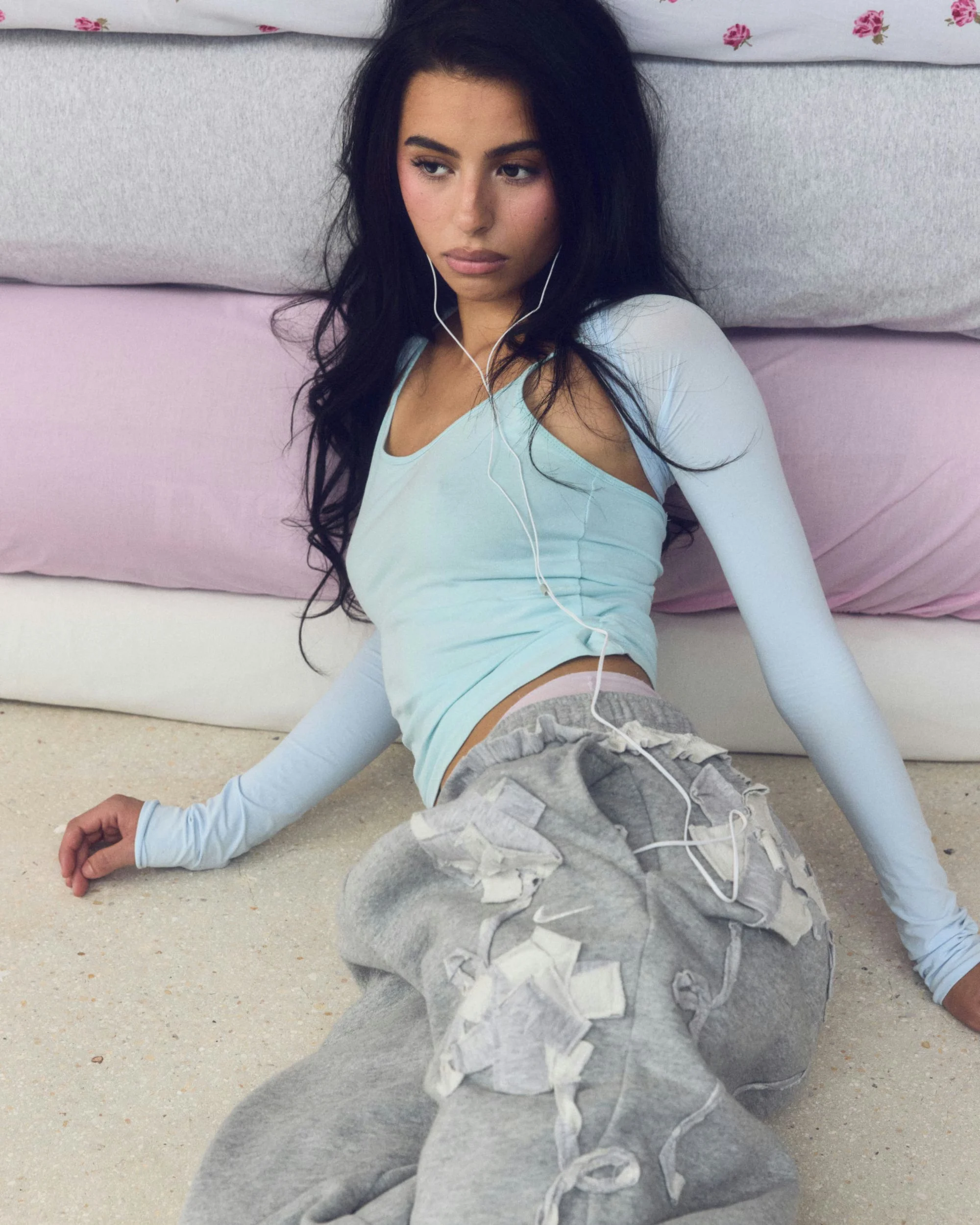
Moshikura’s approach is not a redraw. The project’s central image is a rosette, a gathered, layered ornament that sits on the garment like a brooch or a ribbon decoration pinned to a lapel, and the idea of pinning something soft to something as hard edged as the Swoosh is where the poetry comes from. A rosette is the opposite of a logo in almost every way. A logo is flat, fixed and reproducible at any scale; a rosette is dimensional, handmade in feel and slightly different each time. Put the two together and the brand mark stops being the only point of focus on the chest. The Swoosh is still there, still legible, but it now shares the space with something that looks like it was made by a person at a worktable rather than printed at a factory.
That tension is familiar territory for anyone who trained in a couture environment. Rosettes, bows and fabric flowers are part of the vocabulary taught in those ateliers, the kind of construction that relies on gathering, folding and hand finishing. Transferring that vocabulary onto heavyweight sportswear cotton is the core of what Yasmina is doing here, and it lines up with her stated position that clothing should bend toward the feminine world of the person wearing it rather than asking that person to bend toward the garment.
View this post on Instagram
flow
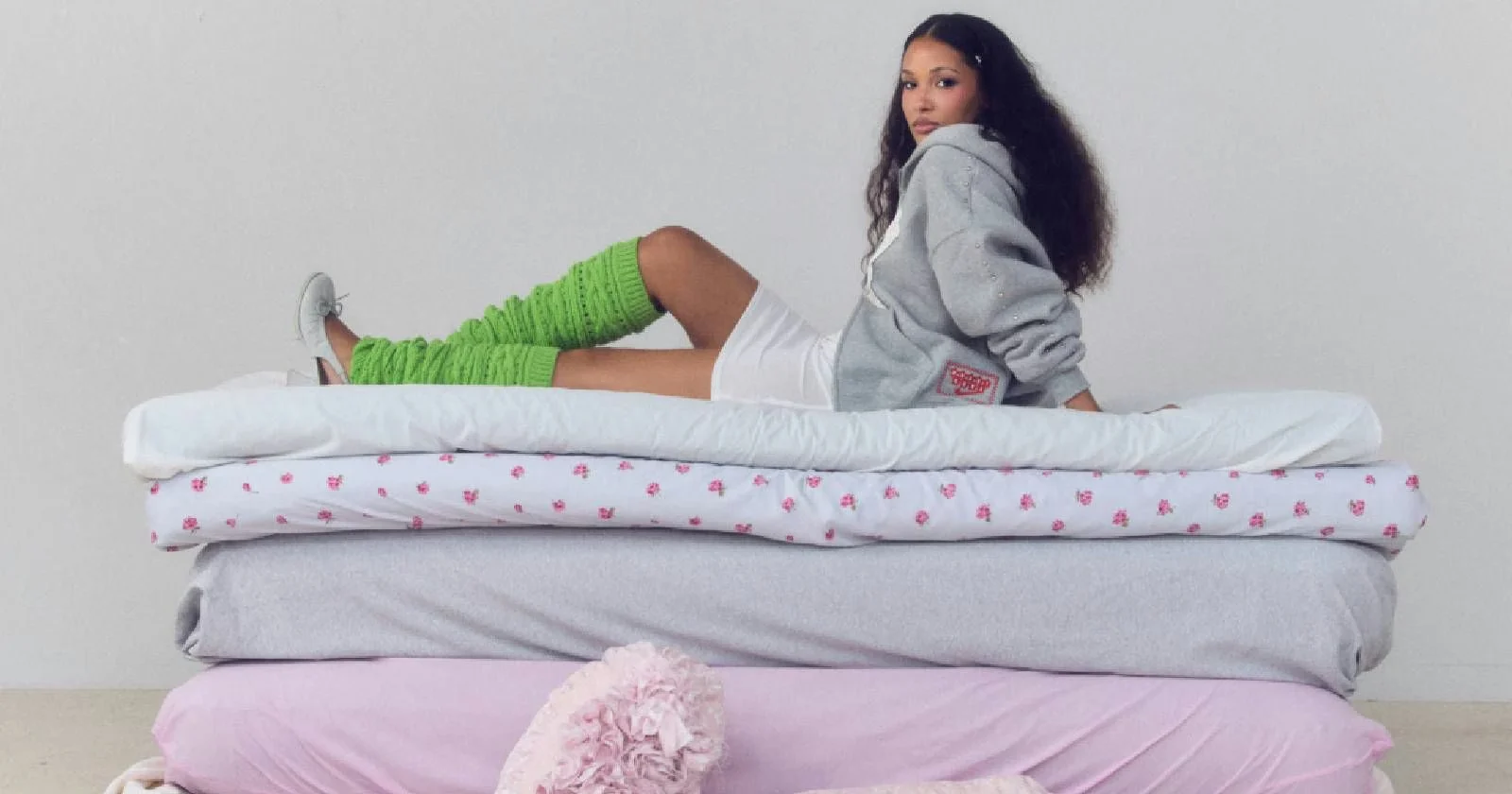
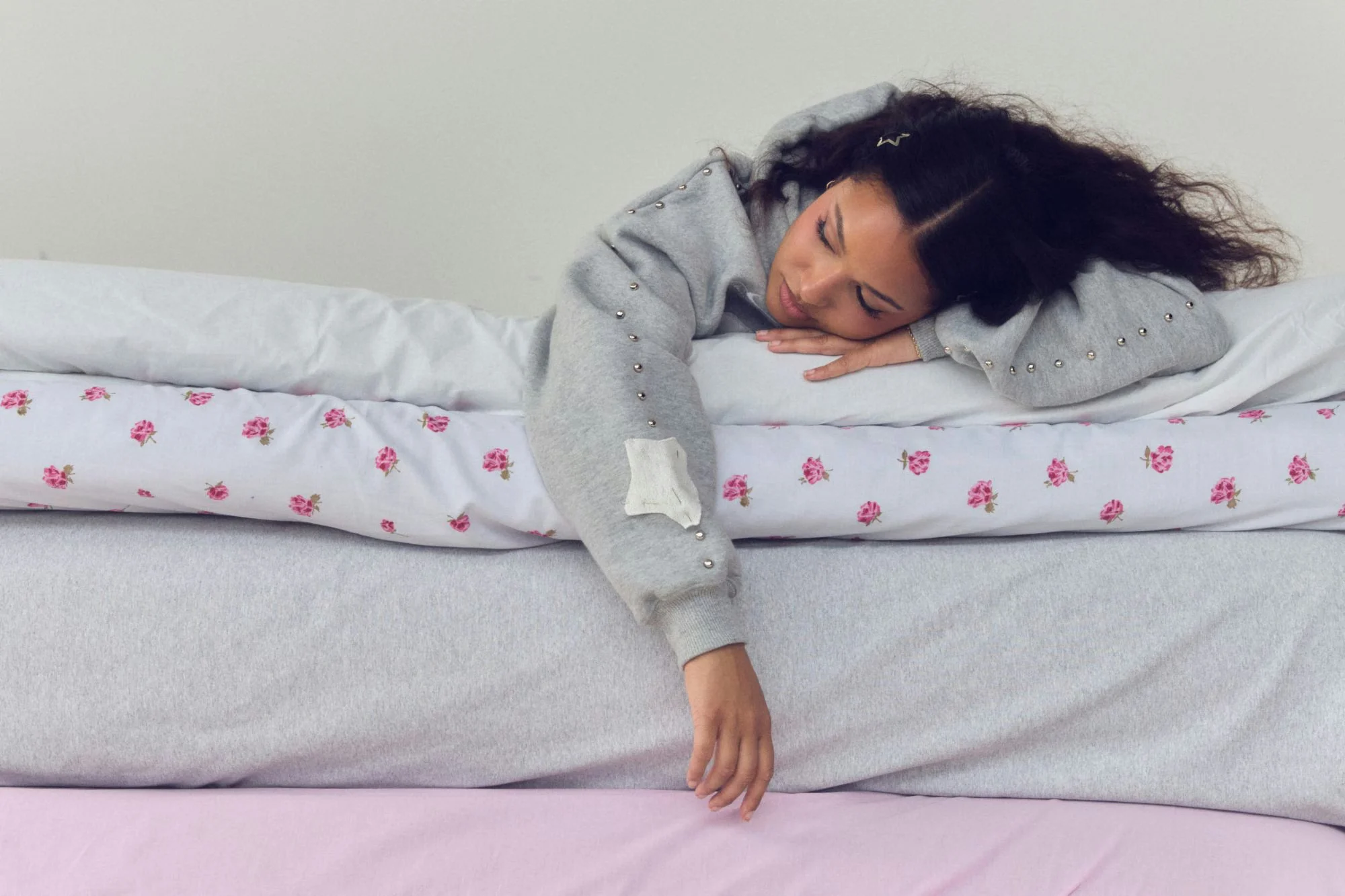
The campaign imagery takes its cue from The Princess and the Pea, the short tale Hans Christian Andersen published in 1835. In Andersen’s version, a queen tests whether a rain-soaked stranger is a true princess by hiding a single pea beneath twenty mattresses and twenty eiderdown quilts. The young woman spends the night sleepless and bruised, and her sensitivity is taken as proof of royalty. The story ends with the pea placed in a museum, where Andersen assures his readers it can still be seen.
The tale appeared in the very first booklet of Andersen’s Fairy Tales Told for Children, a slim collection of four stories that also included The Tinderbox and Little Claus and Big Claus. Danish critics of the day were not especially kind, faulting the stories for their loose, spoken style, which is exactly the quality that made them travel. Nearly two centuries on, the stacked bed has become one of the most instantly readable images in children’s literature, drawn and redrawn by illustrators from Edmund Dulac onward.
It is a smart reference for a fleece campaign, and not only because of the softness. The towering bed is an image of accumulation, layer upon layer of padding, which maps neatly onto a collection sold on its own layering logic of three weights and two fits. The art direction plays up that stacking effect along with nostalgia and texture, treating the grey sweats as bedding as much as clothing. The mood is quieter and more tender than the athletic energy of Nike’s own Studio Fleece launch, which is the point: the same garments can carry a completely different story depending on who is holding the camera and the needle.
View this post on Instagram
Grey cotton fleece does most of the talking. Yasmina treats the material as a blank canvas, cutting and gathering it into rosettes of different sizes that become the collection’s signature ornament. Using the base fabric itself, rather than a contrasting satin or lace, keeps the effect tonal. From a distance the pieces still read as classic Nike sweats; up close, the rosettes introduce a crafted, almost upholstered quality that shifts a streetwear staple toward something more delicate.
There is also a quiet argument about gender embedded in the styling. Sportswear fleece was engineered for locker rooms and team benches, and for most of its history women’s versions were sized-down adaptations of men’s patterns. Nike’s own pitch for Studio Fleece, with its reworked hoods, trimmed cuffs and women-sourced fit research, is a corporate answer to that history. Yasmina’s rosettes are a maker’s answer, made with scissors and thread rather than consumer surveys, and they arrive at a similar conclusion from the opposite direction.
fin
The collision was not limited to product. Two workshops took place in September, bringing together figures from the Paris fashion scene and the city’s content creation community to work through the crossover between Moshikura’s handmade approach and Nike’s customization tools. Names of participants and the exact workshop dates have not been published.
Both the workshops and the embroidery service are anchored at the Nike House of Innovation Paris, the four-floor flagship at 79 Avenue des Champs-Élysées that opened on July 30, 2020 as Nike’s third House of Innovation after New York and Shanghai. The building dates to 1928 and has previously served as a car showroom, a film production studio and a nightclub. From the start, Nike position the store around services rather than pure stock, with a dedicated By You customization space and a floor built specifically around women’s product. A women’s fleece program with an in-store embroidery menu slots directly into both of those original ambitions.
The ten motifs remain available at the Champs-Élysées store until the end of October. Nike has not announced pricing for the embroidery, and there is no indication so far that the designs will be offered online through the Nike By You web configurator or at any other House of Innovation. For now, the only way to wear a Moshikura rosette on Studio Fleece is to walk into one building on one avenue in Paris and have it stitched on.
Related Articles
A Milan Temp Store For Invicta’s 120th Year
1906 England. Turin from 1921. Jolly and Minisac on Heritage. Velba, Wasar, Freeway on Icon. […]