DRIFT AUDIO
Listen to this story
Choose a voice, then press play.
In a Chelsea warehouse during Armory Week, a Lexus RZ looped nose to tail and an RX wrung itself into a spiral, each parked beside the untouched car it used to be.
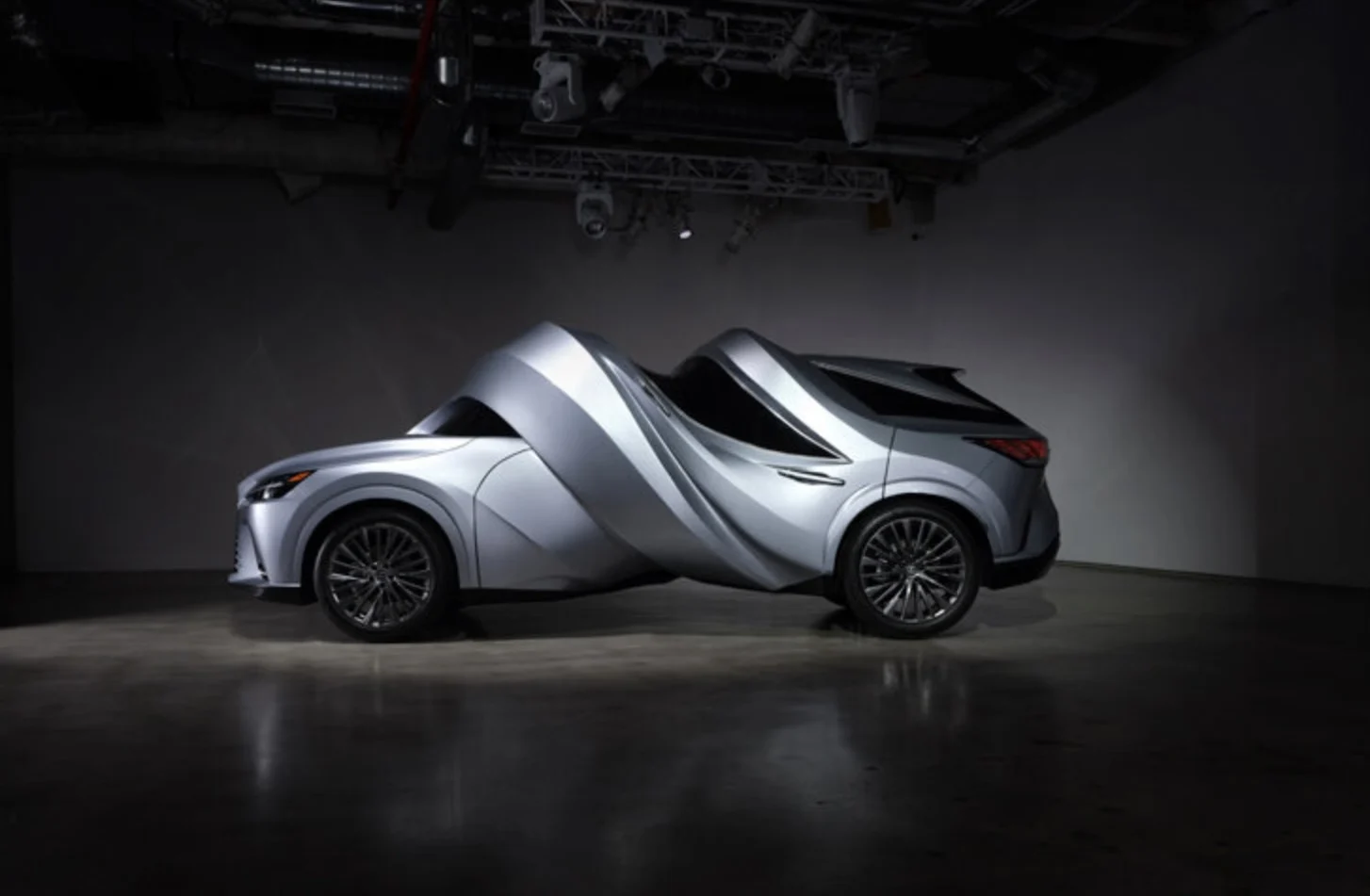
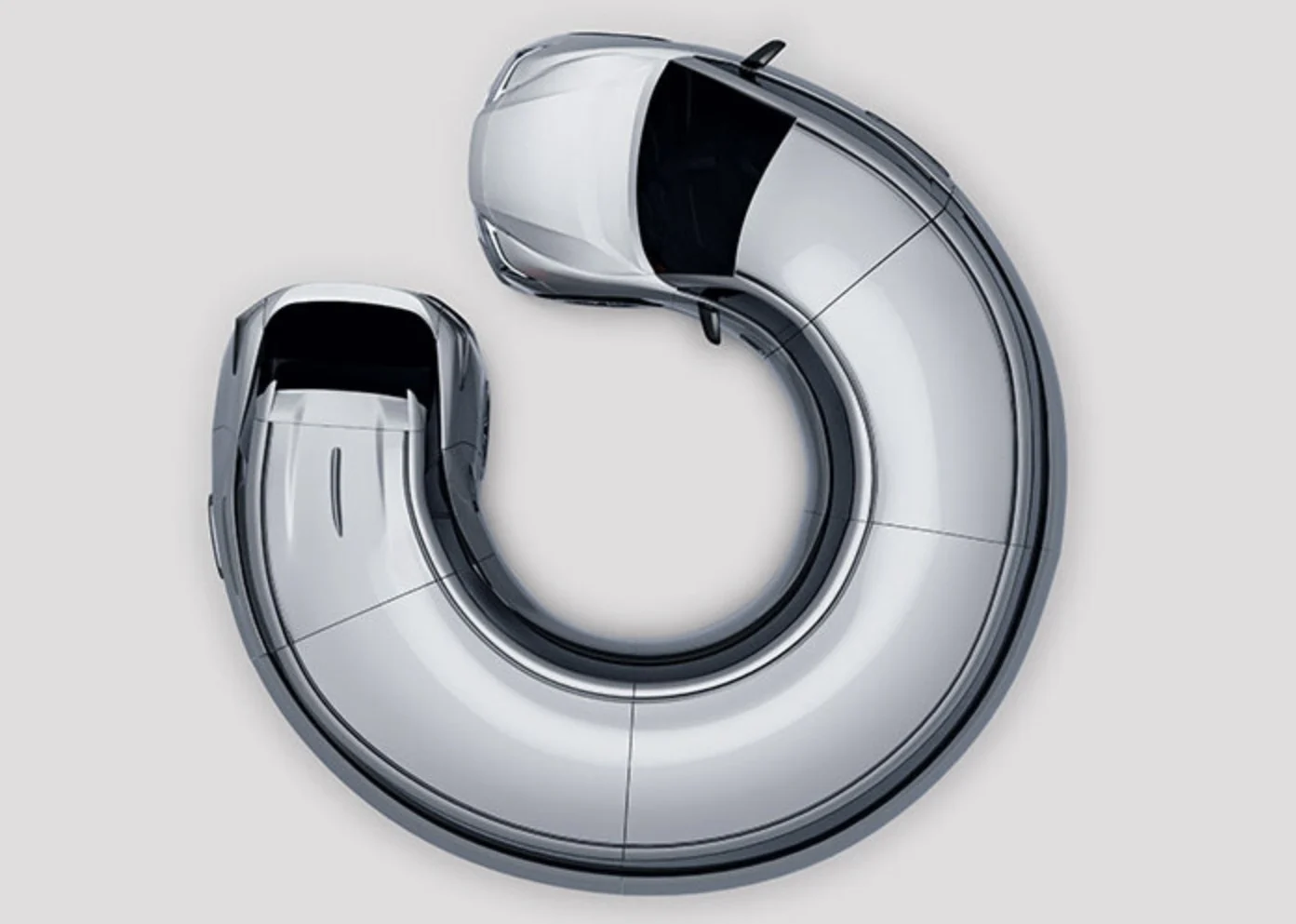
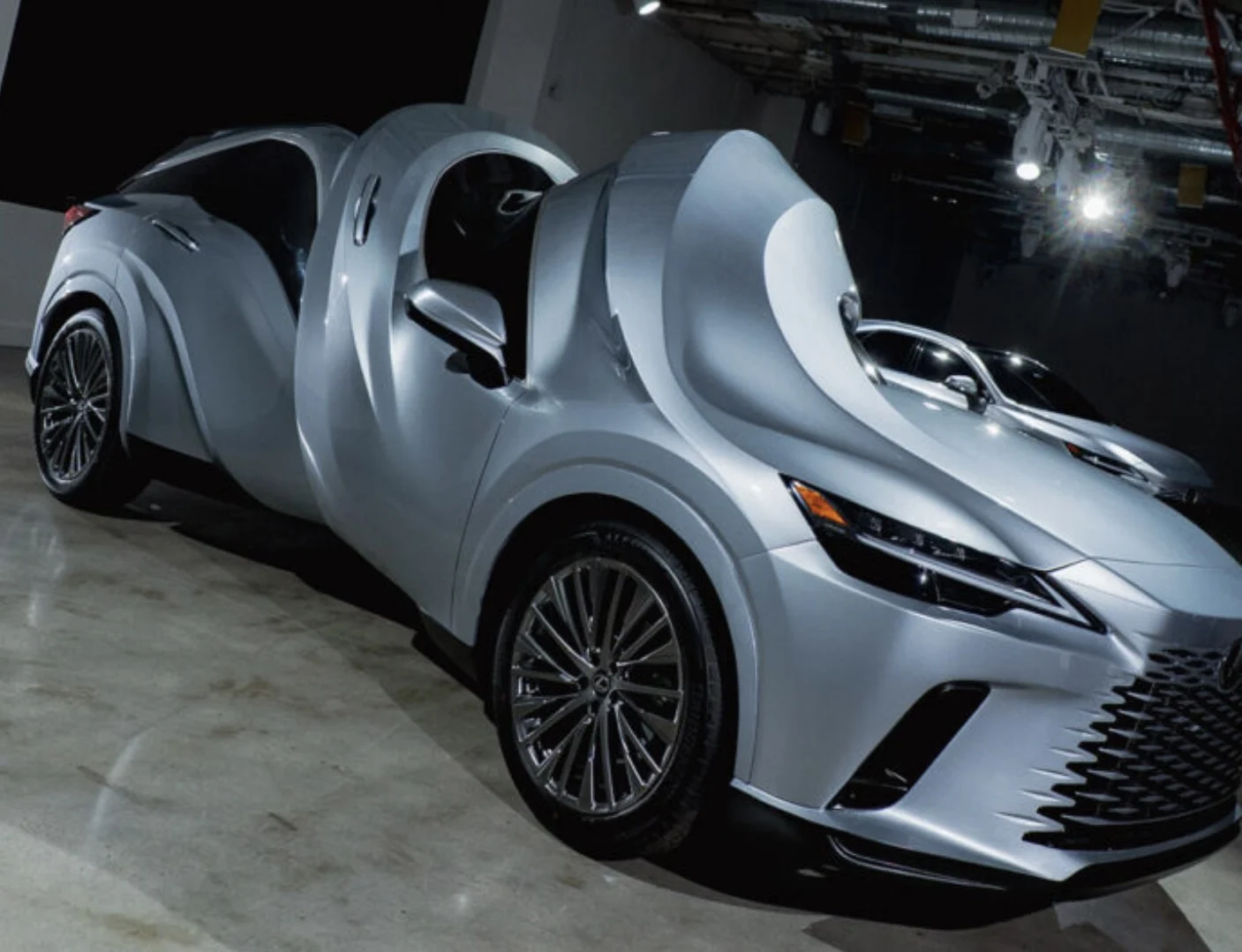
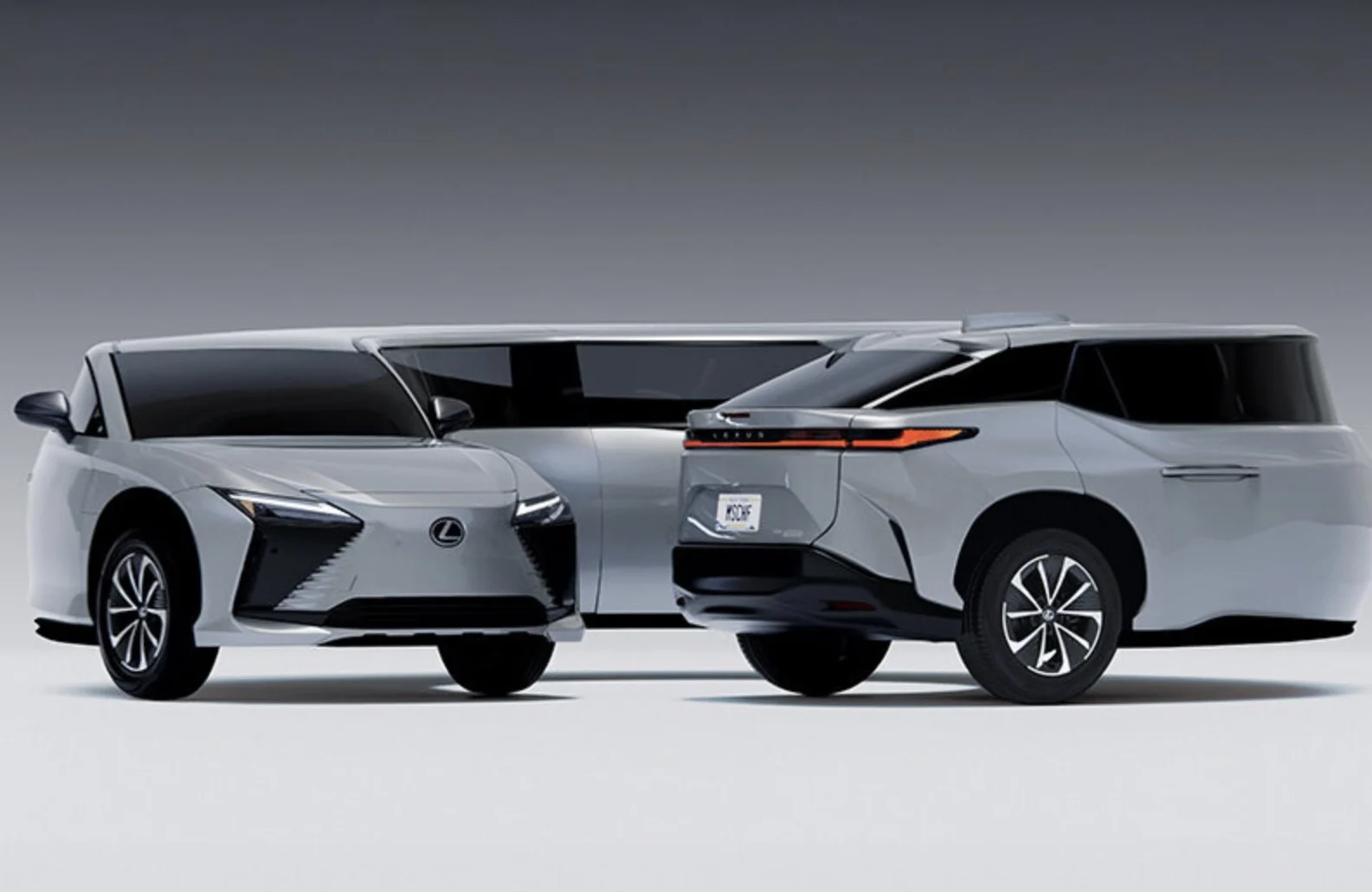
Four silver Lexus vehicles shared one concrete floor on West 28th Street last week, and only two of them could ever be driven. The other two belonged to MSCHF, the Brooklyn collective that has spent a decade turning consumer objects into punchlines with price tags, and they had been bent so far out of true that the word “vehicle” no longer really applies. Lexus commissioned the pair for MOTOMORPHOSIS, a three-day presentation timed to New York’s Armory Week, and the brief was simple enough to fit on a sticky note: take two production electrified cars and make each one a sculpture double of itself.
Signal. What happened: Lexus commissioned MSCHF to transform two production electrified vehicles into sculpture, shown beside their unaltered counterparts in a free, RSVP-only exhibition during New York’s Armory Week. Exact object: Circle Car, built from a Lexus RZ 450e and looped nose to tail, and Twisted Car, built from a Lexus RX 450h+ and rotated along its length into a spiral. When and where: Chelsea Industrial, 545 West 28th Street, New York, with a gallery opening on Thursday, September 24, 2026 from 7 to 9 p.m. and public hours on Friday, September 25 and Saturday, September 26 from 10 a.m. to 6 p.m.; admission was free with RSVP. Source: the official Lexus USA Newsroom announcement dated September 22, 2026, and the exhibition’s own site at motomorphosis.com. Why it matters: it is a rare case of an automaker handing real production bodies to a conceptual art group whose entire practice is built on subverting brands, and letting the result carry the brand’s name.
View this post on Instagram
stir
Circle Car is the easier of the two to read from across a room. The RZ 450e, the all-electric crossover that Lexus built on a dedicated battery-electric platform, has been stretched and curved until its front bumper meets its own rear, forming a continuous loop. Lexus describes it as a car driving infinitely round, which is a neat way of saying a car that can never arrive anywhere. The headlights, the glasshouse, the wheel arches: all of them are still present and still recognizably RZ, just pulled around a bend that no chassis engineer would sign off on.
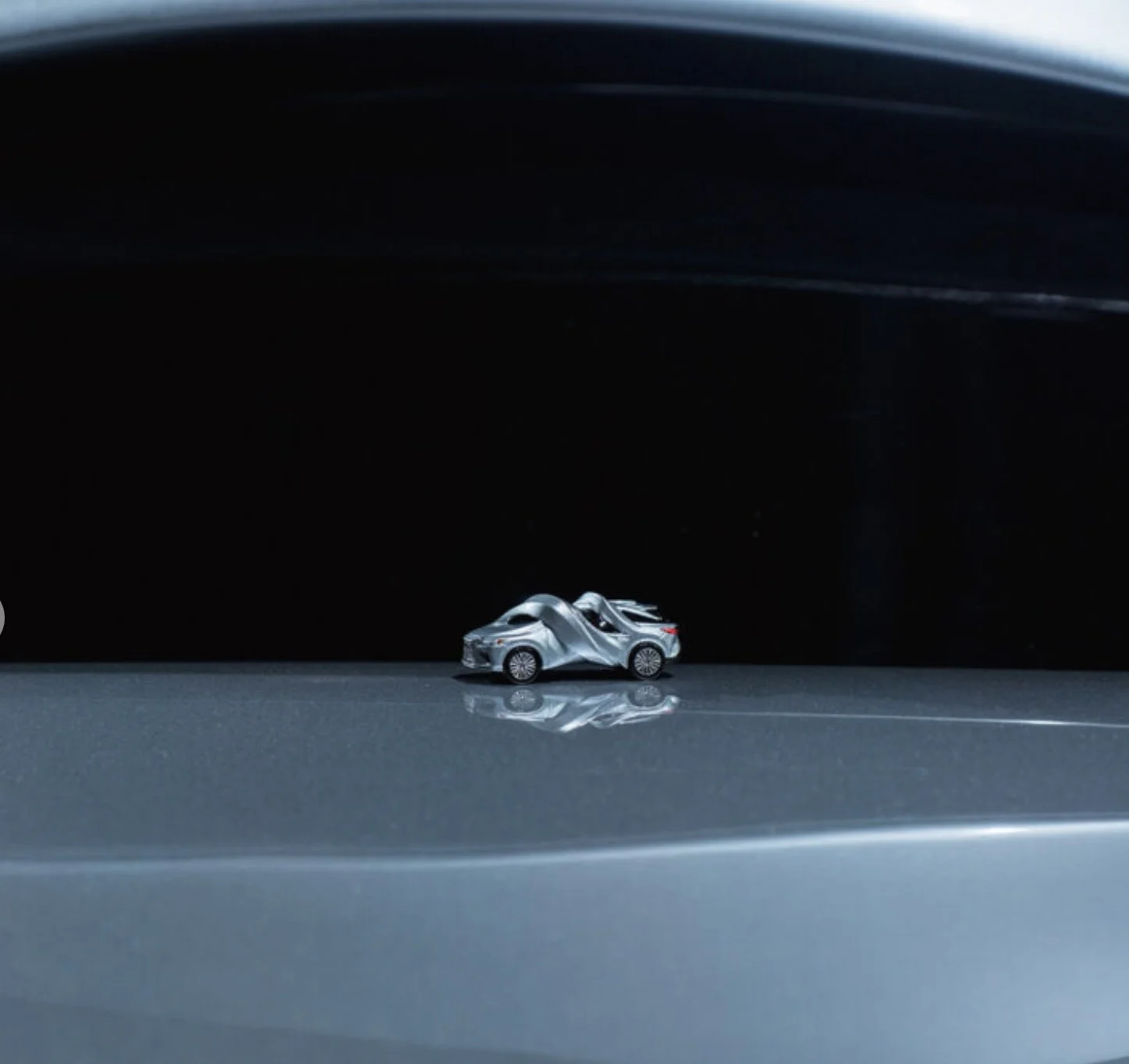
Twisted Car works on a different axis. MSCHF took the RX 450h+, the plug-in hybrid version of Lexus’s long-running midsize luxury SUV, and rotated it along its length, so the body corkscrews from nose to tail. Windows, doors and character lines get dragged along with the torsion, following the spiral like stripes on a candy cane. According to the Lexus announcement, the surface features are pulled tangent to the twist, which is exactly what happens when you grab a 3D model by both ends in software and turn one hand.
The choice of source cars is not random. The RX is the model that effectively invented the luxury crossover when the original RX 300 arrived in 1998, and it has been one of the brand’s best sellers in the United States ever since, which makes it about as familiar a Lexus silhouette as exists on American roads. The RZ is the opposite kind of landmark: the first Lexus designed from the ground up as a battery-electric vehicle rather than adapted from a combustion car. One sculpture distorts the brand’s most established shape, the other distorts its newest direction, and together they cover the arc from where Lexus has been to where it says it is going.
The pair was the point. Each sculpture was installed next to an ordinary, showroom-spec version of the same model in the same silver finish. A visitor account in FAD Magazine described walking in and briefly mistaking the room for an auto show, with the transformations only registering once the writer started circling the cars. That delayed double take is the whole effect. The eye reads “Lexus” first and “impossible” second.
frame
Anyone who has scrubbed frame by frame through a cartoon fight scene has seen what MSCHF is quoting here. Animators have long used squash and stretch to make objects feel elastic, and they use smear frames, single drawings where a character or object is grotesquely elongated, to sell speed in the fraction of a second between two poses. At normal playback the smear vanishes. Pause on it and you get something monstrous: a fist ten feet long, a car the length of a city block.
MOTOMORPHOSIS takes those in-between frames and holds them still. The Lexus release frames the work around the plasticity of geometry in 3D animation, where shapes squash and stretch according to action rather than staying fixed. The result is an odd reversal. A parked car communicates nothing about motion, but a car frozen in the middle of a smear frame reads as fast even though it cannot roll an inch.
That is also where the digital vocabulary comes in. Bend, twist, taper and loop are default operations in any 3D package. They take seconds to apply and produce shapes that would be absurd in the physical world. MSCHF’s recurring move, which the exhibition site describes as applying the vernacular of digital-native operations to physical objects, is to take those throwaway software gestures and pay the real cost of doing them in metal, glass and paint.
There is a physical cost hiding in that sentence. A twist that takes one drag of a mouse in software means panels, glass and trim that no factory tooling was ever built to produce, and a loop means a body with no clean beginning or end. Neither Lexus nor MSCHF has published how the pieces were fabricated, but the finish is the tell: the sculptures carry the same paint and brightwork as the production cars beside them, so the distortion reads as something that happened to a real Lexus rather than a replica built to look like one.
from
MSCHF gave the works a label of its own: Form Cars. The contrast with the concept car is deliberate. A concept car is a real vehicle’s future dressed up for an auto show, engineered, or at least styled, to suggest what might one day move on a road. A Form Car inverts that. As Lexus puts it, a production car is concretely engineered to move, while these objects are sculpted only to produce the idea of movement.
It is a tidy bit of wordplay, and it explains why the unaltered cars had to be in the room. Without the originals, Circle Car and Twisted Car could pass as elaborate props. With them, the viewer carries the memory of a working vehicle over to its distorted double, and that mental image of a car that can drive is what makes the static sculpture feel kinetic. The Lexus release describes this as the fluid way the mind represents objects, never fully separated from what those objects are for.
View this post on Instagram
The official materials also include a note that the vehicles shown are special project vehicles modified with non-Lexus parts, not street legal, and potentially warranty-voiding. It is standard automotive boilerplate, but in this context it reads almost like a wall label.
why
For Lexus, MOTOMORPHOSIS is a way of talking about electrification without talking about range, charging speeds or battery chemistry. Lisa McQueen, senior manager of Lexus marketing, framed the project as swapping the usual question of how a car is powered for a looser one: “what can electricity power in our imagination?” Both source vehicles are electrified models, one fully battery-electric and one a plug-in hybrid, so the exhibition doubled as a quiet product showcase for the two ends of the brand’s current powertrain lineup.
It also fits a busy September for the brand’s culture program. A week earlier, Lexus announced “The Future Classic Club”with AMBUSH, the Tokyo label led by Yoon Ahn. And across town at the Javits Center, Lexus ran a separate installation inside The Armory Show itself, titled “Where Art Meets Energy,” built around the new Lexus TZ and all-electric Lexus ES with live illustration from artist-in-residence Alex Alpert. That fair ran September 24 to 27, which put MOTOMORPHOSIS in Chelsea on the same opening night as the main event on the far west side.
The commission is still a gamble in one sense. MSCHF’s reputation rests partly on work that brands did not ask for and sometimes sued over. Handing that group two real production bodies and letting it deform them in public is a very different posture from a typical car launch, where every panel gap is controlled down to the millimeter.
raw
MSCHF was founded in 2016 by Gabriel Whaley, a former BuzzFeed staffer who still runs it as CEO, and it operates legally as MSCHF Product Studio, Inc. Its projects arrive as “drops,” a vocabulary borrowed from streetwear, and they range from browser extensions to sneakers to auctions. The Lexus release describes the collective as using cultural properties, from objects and brands to behaviors, as its working media, which is about as accurate a summary as exists.
The best-known examples mostly involve other companies’ products. In 2019 MSCHF sold customized Nike Air Max 97s filled with holy water, and in 2021 it followed with the Satan Shoes, a run of 666 pairs made with Lil Nas X that prompted a trademark lawsuit from Nike within hours of release, a saga Complex has chronicled in its MSCHF timeline. The collective cut up Hermès Birkin bags to make Birkenstock-style sandals, bought a Damien Hirst print and sold off its spots individually, and in 2023 released the Big Red Boots, the cartoonish rubber footwear that briefly took over every social feed that February.
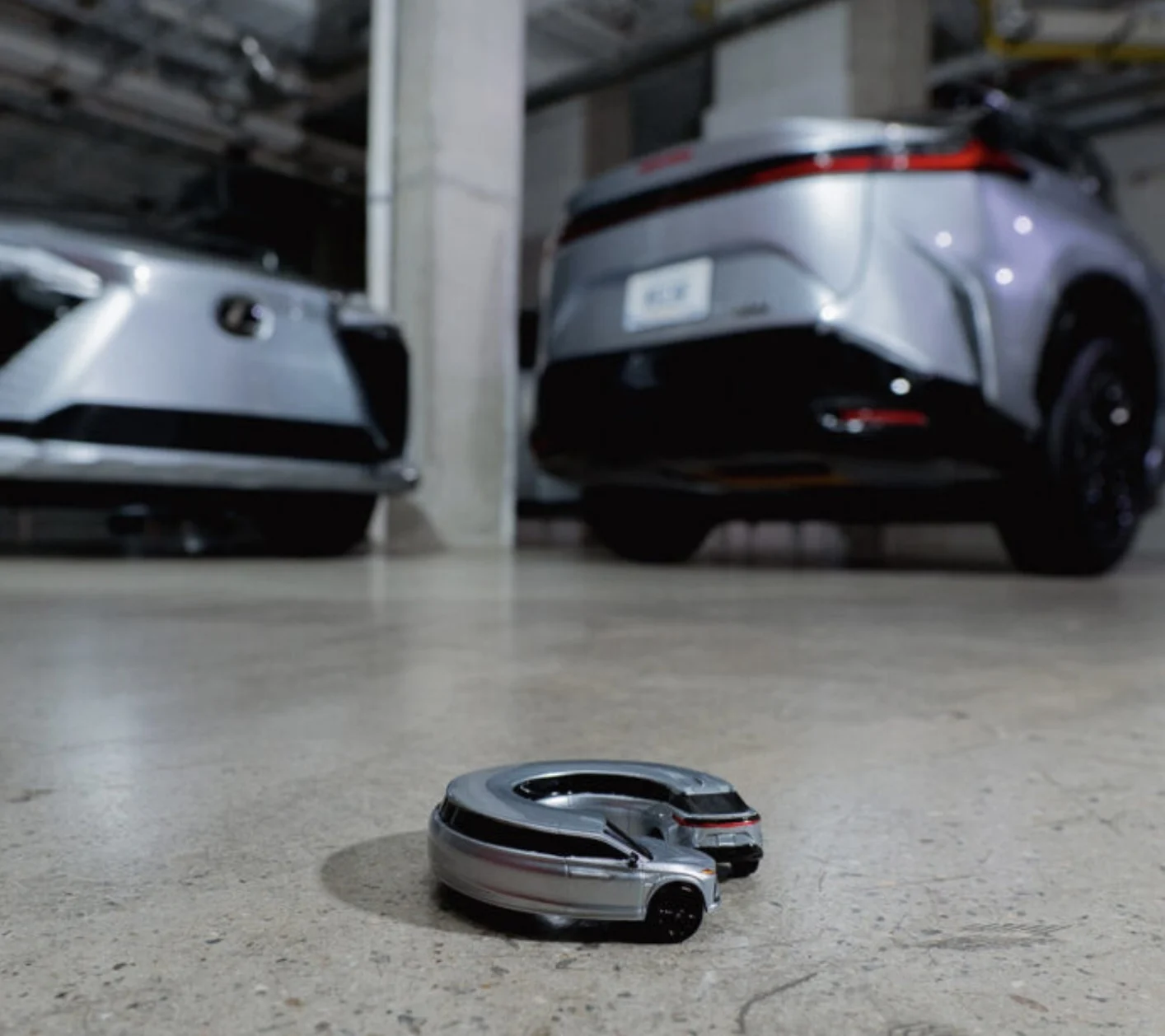
Cars have come up before, at a much smaller scale. In August 2024 MSCHF partnered with Mattel Creations on Not Wheels, a Hot Wheels die-cast of a beat-up early 1990s Japanese import with mismatched wheels, a missing tire, a cracked windshield and “WASH ME” scrawled on the rear glass. Its selling point was that it did not roll. Two years later the same joke returns at full scale and with the opposite finish: pristine luxury paint instead of rust, but still a car deliberately stripped of the one thing a car is supposed to do.
The difference this time is who signed the check. Not Wheels was a licensed toy. Satan Shoes were an unlicensed provocation. MOTOMORPHOSIS is a corporate commission, which invites the obvious question of whether mischief still counts when the brand being bent is paying for it. MSCHF has never pretended the line between artwork, product and marketing is firm; collapsing that line has more or less been the house style from the beginning.
day
The venue was Chelsea Industrial, a roughly 22,000 square foot event space near the corner of 28th Street and 11th Avenue, with polished concrete floors, 18 foot ceilings and floor to ceiling windows. It sits a few blocks from the Chelsea gallery strip, close enough to feel like part of the Armory Week circuit without being inside any single fair.
The run was short. A gallery opening on Thursday evening, September 24, was followed by two public days on Friday and Saturday, with the doors closing at 6 p.m. on September 26. Entry was free, gated only by an RSVP through the exhibition’s website. Lexus has not said where Circle Car and Twisted Car go next, whether they will tour, enter a collection or be offered for sale, and no pricing has been attached to either work.
What remains is the image: two cars that look like they were caught mid-swerve by a paused video player, parked beside the sensible versions that roll off the line in Japan. Yanko Design compared the effect to a video glitch, which is close. A glitch is the moment a system shows its seams. For three days in Chelsea, a carmaker let an art collective show its product’s seams on purpose, and then parked the evidence next to the showroom model.