DRIFT AUDIO
Listen to this story
Choose a voice, then press play.
Leica M11 over $10,000. M6 about $7,000. Revenue near $650 million. Andreas Kaufmann. Analog is back. The factory is not a slogan.
Leica still put most of its expensive, reticent cameras together in Europe. Wetzlar is the German town on the nameplate. The top-selling M line leaves that plant at about 45 bodies a day. A digital M11 lists above $10,000. A film M6 sits near $7,000. Company revenue is described around $650 million, a fraction of Canon, with record years in four of the last five. Majority owner Andreas Kaufmann used an inheritance to buy the house when digital looked like an extinction event. Two decades later the same house is one of the few European camera makers still standing.
The name is Leitz plus camera. The microscope shop dates to 1849. The first consumer 35mm Leica went on sale in 1925. Cartier-Bresson’s tool, war correspondents’ coat-pocket, auction objects that now clear millions: all of that sits on a rangefinder the size of a paperback. The current argument is not nostalgia as mood board. It is a factory count. Forty-five a day is slow on purpose.
Signal. What happened: reporting out of Wetzlar put Leica’s M cadence, M11 and M6 prices, and ~$650 million revenue on the record. Exact products: M11 digital, M6 analog, hand-finished glass. When and where: Leica stores and leica-camera.com, built in Europe. Source: company figures circulating with the Wetzlar plant visit. Why it matters: a camera company survived phones by staying small and expensive, not by matching volume.
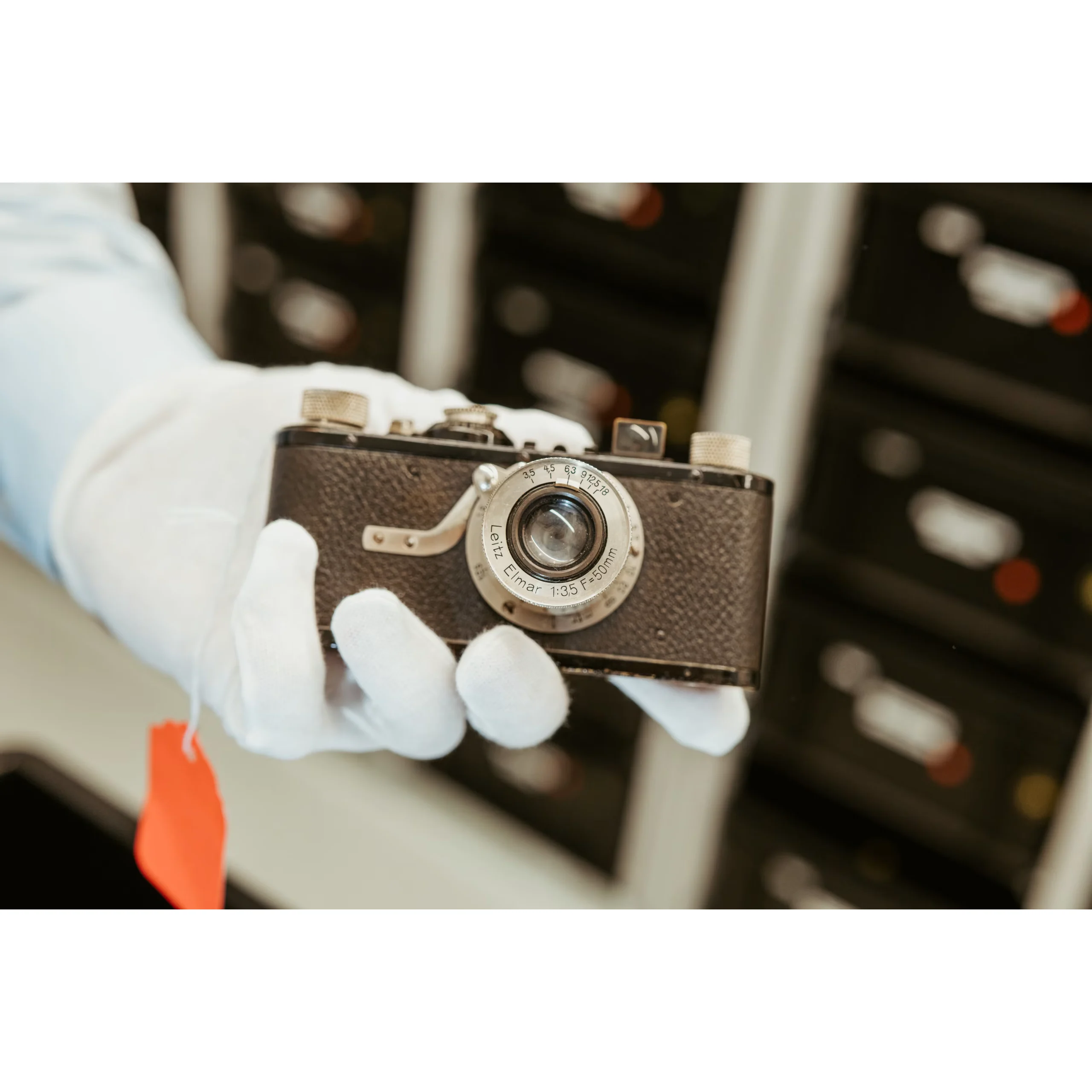
vintage Leica camera
stir
When Kaufmann took control, Leica was close to gone. Digital SLRs from Japan had already eaten the middle. Phones were about to eat the rest. A German precision house with a rangefinder cult and a thin balance sheet is not an obvious survivor. He kept the M. He kept Wetzlar. He did not turn the red dot into a licensing sticker on a plastic compact.
That decision only works if the object stays scarce and the finish stays visible. Technicians in robes and hairnets still sit at benches polishing, cementing, and hand-painting glass. A machine around the corner presses lens elements. Both sentences can be true in the same building. The romantic version of Leica forgets the press. The industrial version forgets the paint. The price tag needs both.
Sales records in four of five recent years track a second fact: young buyers came back to analog. Film M6 money at $7,000 is not a student camera. It is a luxury analog that happens to load 35mm. The same cohort that made vinyl a lifestyle object made a mechanical rangefinder look current again. Leica did not invent that wave. It already owned the shape the wave wanted.
$650 million against Canon is the scale reminder. Leica is not winning units. It is winning margin on a body that can cost more than a used car before a single Summilux is screwed on. Portugal and Germany share the “made in Europe” sentence in company talk. The M’s myth is still Wetzlar.
make
The M is a rangefinder. You focus through a window, not through the taking lens. No mirror slap. Quiet shutter. Lenses from 16mm to 135mm on the M mount, with the 50mm as the house religion. Digital M11 keeps the same silhouette and puts a full-frame sensor behind the same cloth-like quiet. Film M6 is the analog twin that never needed a menu. Both wear leatherette, a top plate, a red dot or a discreet script, and a load that sits in one hand.
Forty-five M bodies a day is not a marketing cadence. It is a constraint. You cannot flood a boutique channel at that rate. You also cannot miss a polish mark and hide it in volume. Every body that leaves is a large fraction of the day’s work. That is why $10,000 does not read as a software number. It reads as time.
Limited M11 editions of a hundred units (New York, Germany, and the rest of the anniversary set) sit on top of that trickle. They are not the business. The business is the standard black and silver chrome that looks like the last sixty years of street work. Leica Camera USA still sells glossy black M11 and M11 Monochrom as current catalog, not as museum copies.
Auctions are a parallel market Leica does not have to run. 0-Series prototypes and papal presentation bodies have cleared into the millions. That heat helps the living catalog. A new M11 buyer is not purchasing an auction lot. They are purchasing the right to stand next to one.
Sofort and other lower lines exist so the brand can speak below ten thousand dollars. They are not the sentence that keeps Wetzlar open. The M is.

why
The warning that travels with the success story is simple. Retro design plus European handwork plus a cult price is not a template you can drop onto a dishwasher or a mid-market EV. Leica already had a century of pictures attached to the object. Cartier-Bresson, Capa, a thousand contact sheets: that archive does advertising that a new brand cannot buy. Kaufmann’s buy only works because the object was already a sentence in photo history.
Rising European costs, thin export weather, and Chinese volume in optics are the same forces that closed other camera lines. Leica’s answer was not to become cheaper. It was to become more itself: fewer bodies, higher tickets, analog as a feature instead of a leftover. Younger film buyers helped. So did the fact that a phone already won the “good enough” war. Once “good enough” is free, the remaining money concentrates on the thing that is obviously not a phone. An M11 in the hand does that work without a slogan.
The playbook fails if you need millions of units. It fails if your design language is only three years old. It fails if your factory cannot show a person in a hairnet next to a press. It works if you can live on 45 rangefinders a day and a lens bench that still paints by hand.
Wetzlar is still doing that. The M11 is still over ten thousand. The M6 is still film. Kaufmann still owns the majority. That is the European manufacturing sentence, complete. It is also a sentence almost nobody else in cameras can copy, because almost nobody else still has the name.
Related Articles
A Milan Temp Store For Invicta’s 120th Year
1906 England. Turin from 1921. Jolly and Minisac on Heritage. Velba, Wasar, Freeway on Icon. […]