DRIFT AUDIO
Listen to this story
Choose a voice, then press play.
For “Twizzler,” the world’s biggest dream-pop band traded its usual view restraint for Kirsten Thys van den Audenaerde’s 2021 photograph “Styrofoam” — reviving a decade-long habit of borrowing its cover art from the art world itself.
In This Story
- The Link
- Inside “Styrofoam”
- Who Is Kirsten Thys van den Audenaerde
- Instantdreams and the Analog Photography Circuit
- “Twizzler” Inside Cigarettes After Sex’s 2026
- A Band With a History of Borrowing From Art
- What Comes Next
Cigarettes After Sex has built its identity on restraint — hushed vocals, spare arrangements, and cover art that has tended toward the plain and the painterly rather than the provocative. That restraint bent, if only slightly, with the release of “Twizzler,” the band’s first new single of 2026, which arrived on May 19 via Partisan Records. For the cover, the band went looking not to a in-house creative team or a commissioned shoot but to the archive of a working photographer: Brussels-based artist Kirsten Thys van den Audenaerde, whose 2021 photograph “Styrofoam” now serves as the single’s defining image.
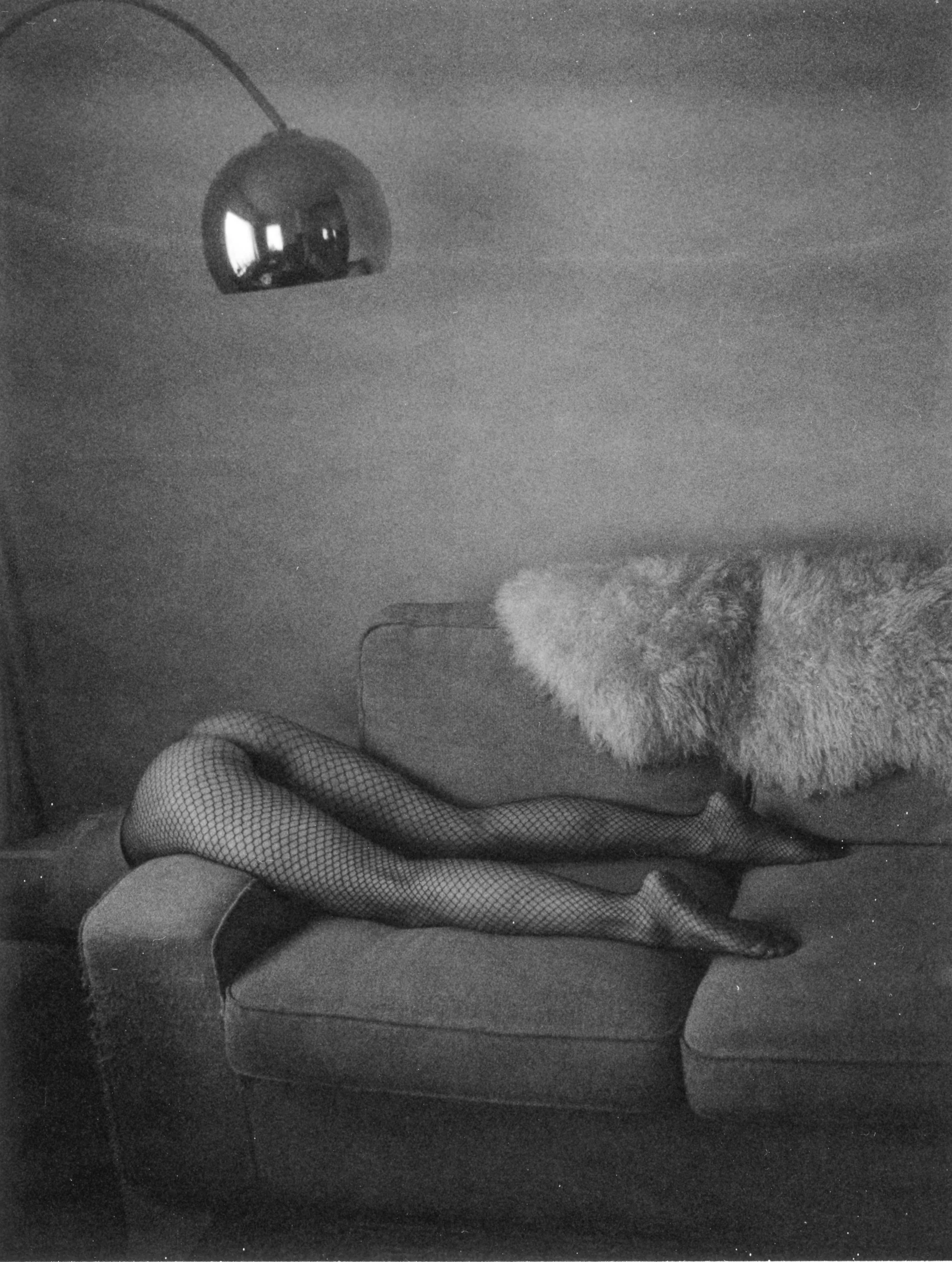
The photograph depicts a figure in fishnet tights draped across a sofa, shot in van den Audenaerde’s signature analog style — a composition that, since becoming the cover of “Twizzler,” has circulated widely, drawing attention both for its surreal staging and its frank sensuality. It is a striking departure for a band whose most recent visual language, across the 2024 album X’s and last year’s standalone single “Anna Karenina,” had settled into something closer to muted, cinematic restraint. “Twizzler” arrived without an accompanying video or press rollout, the image itself doing the introducing.
For van den Audenaerde, whose photography has largely circulated through gallery representation and art fairs rather than mainstream media, the placement marks a significant expansion of audience. The image will now reach millions of listeners who have likely never set foot in a gallery — a crossover moment that photographers represented by small, artist-run spaces rarely get handed to them by a band with the commercial footprint of Cigarettes After Sex.
in
According to an interview van den Audenaerde gave to her representing gallery, Instantdreams, “Styrofoam” was not the product of a planned concept shoot. The image emerged spontaneously while she was photographing her longtime muse and frequent collaborator, a model referred to as Rosemary, inside the model’s own home. Van den Audenaerde has described being drawn, in the moment, to an unplanned convergence of props already present in the room: a sofa, a sheepskin throw, a hanging lamp, and the fishnet tights her subject happened to be wearing.
The resulting composition isolates the legs while withholding the rest of the body from view, an approach the photographer has said was intentional from the outset — an image built around absence as much as presence, closer to a mannequin or a doll than a conventional portrait. The title itself came after the fact, drawn from van den Audenaerde’s own reading of the finished photograph as something like a mold: two halves that could be opened to reveal the shape of a body encased inside. Reflecting on the shoot afterward, she said the final image came out “exactly how I had imagined.”
That instinct toward ambiguity is, by the photographer’s own account, central to her broader practice. She has spoken about wanting viewers to sit with a degree of visual confusion — to look, look away, and look again, arriving eventually at their own reading of what the image shows rather than a single fixed interpretation. It’s a sensibility that maps unusually well onto Cigarettes After Sex’s own songwriting, which trades in half-remembered scenes and impressionistic detail rather than linear narrative.
The band’s request for the image reportedly came as a surprise to van den Audenaerde, who has said she’d always hoped one of her photographs might end up on an album cover, but assumed it would be for a band operating on a much smaller scale. Discovering that a group she was already a fan of wanted to use “Styrofoam” left her, in her own words, momentarily speechless.
who
Van den Audenaerde is a self-taught photographer based in Brussels whose practice centers almost entirely on analog processes. Her early work focused on art nude photography, and the human body — captured in its most unembellished, unretouched form — has remained the throughline of her output since. A 2016 impulse purchase of an Impossible Project I-1 camera redirected her practice decisively away from digital image-making; she has described that first Polaroid exposure as something close to an infatuation, one that led within weeks to a full transition into analog and expired-film photography, embracing the light leaks, color shifts, and unpredictable “defects” that come with shooting on aging stock.
That commitment to analog imperfection produced Polaroad: A Polaroid Road Trip, a project born from repeated road trips through Utah and California beginning in 2017, pairing the human form with the desert landscapes of the American Southwest. Van den Audenaerde has continued to return to those trips in subsequent years, eventually building out a body of work shown across Brussels, Barcelona, Ogden, Bombay Beach, Arles, and Paris — a circuit that runs closer to the world of fine-art photography fairs than to commercial or editorial work.
The “Twizzler” placement represents her most visible crossover into mainstream pop culture to date, arriving at a moment when her photographic language — intimate, unretouched, deliberately imperfect — is reaching an audience many times the size of her existing gallery following.
scope
Van den Audenaerde’s work is represented through Instantdreams, a gallery built around Polaroid and analog photography and closely associated with artist Stefanie Schneider, who founded and continues to run it. Instantdreams has operated as both a physical exhibition space — with shows staged in Berlin, Morongo Valley, and elsewhere — and an online gallery presence through platforms including Artsy and 1stDibs, where limited-edition prints from van den Audenaerde and a small roster of fellow analog photographers are made available for sale.
The gallery’s roster reflects a specific corner of the contemporary photography world: artists working almost exclusively in instant and expired film, often exhibiting together at events like the Bombay Beach Biennale’s Polaroid Museum, which Schneider co-founded. It’s a niche but well-established scene, one where van den Audenaerde has built her reputation over roughly a decade of consistent gallery exposure — long before “Styrofoam” found its way onto a dream-pop single with a global audience.
That scene traces back, in part, to Schneider’s own history within analog photography and to the 2016 documentary Instant Dreams, which followed the effort to revive Polaroid film production after the company’s original factory shut down. Instantdreams the gallery grew out of that same world, positioning itself as a home for photographers committed to shooting exclusively on instant and expired stock rather than emulating the format digitally. Group shows under the Instantdreams banner have historically paired van den Audenaerde with a small, recurring roster of like-minded artists — among them Carmen de Vos, Julia Beyer, and Sven van Driessche — often in spaces built around a shared visual language of faded color, soft focus, and the physical unpredictability that comes with shooting on film long past its expiration date.
It is a scene built, in other words, on the same appetite for imperfection and ambiguity that runs through “Styrofoam” itself — which makes its sudden exposure to a global streaming audience feel less like a fluke and more like a specific, if unusually large, extension of the circuit van den Audenaerde has worked within for nearly a decade.
flow
The single itself has been described, including by the band’s own label materials, as arguably the most upbeat track Cigarettes After Sex has ever released — a standalone song that sits slightly outside the band’s usual sonic orbit while retaining frontman Greg Gonzalez’s signature hushed vocal delivery. Lyrically, the track leans into small, specific, sun-bleached details: a moon necklace, an outdoor cinema, candy shared between lovers, and the images typical of Gonzalez’s songwriting, filtered this time through a noticeably brighter arrangement.
“Twizzler” is the band’s first new material since the conclusion of the touring cycle behind 2024’s X’s, a run that included sold-out dates at Madison Square Garden, London’s O2 Arena, and the Kia Forum in Los Angeles, and which reportedly sold upward of 750,000 tickets globally. It follows last year’s standalone double single, “Anna Karenina” and a cover of The Doors’ “The Crystal Ship,” and lands in the middle of an unusually visible stretch for the El Paso-formed trio of Gonzalez, Jacob Tomsky, and Randall Miller.
That visibility has been driven in large part by streaming milestones and an unexpected pop crossover. The band’s 2017 single “Apocalypse,” revived through TikTok in 2022, has now surpassed 2.3 billion streams on Spotify, placing it among fewer than 200 songs ever to cross that threshold. Combined with three additional tracks that have each passed one billion streams within the past year, Cigarettes After Sex now sits among a group of just eleven artists — a list that includes Fleetwood Mac, AC/DC, and Queen — with four or more songs surpassing a billion Spotify streams.
Just weeks before “Twizzler” arrived, Gonzalez made his most visible appearance yet outside the band’s core fanbase, joining Colombian superstar Karol G onstage during her Coachella 2026 headlining set to perform “Después de Ti,” a new collaborative single that received its official streaming release shortly afterward. Between the Karol G moment and the “Styrofoam” cover, Cigarettes After Sex — a band that built its reputation on a kind of deliberate anti-visibility — has spent the first half of 2026 stepping, however quietly, into the spotlight.
hx
The “Twizzler” cover extends a pattern that dates back to the band’s earliest releases. Cigarettes After Sex’s 2017 self-titled debut album used a detail from Man Ray‘s 1929 surrealist photograph Anatomies, itself a striking, cropped image of the human form shot decades before the band existed. That instinct to lean on existing fine-art photography rather than commissioned band imagery has quietly defined much of the group’s visual identity since.
It’s a lineage with well-known precedents across popular music more broadly. Andy Warhol‘s banana illustration became inseparable from The Velvet Underground & Nico’s 1967 debut, while Gerhard Richter‘s 1983 painting Kerze became the enduring cover image of Sonic Youth’s 1988 album Daydream Nation. In each case, a band borrowed the authority and mood of an existing artwork rather than generating something new, letting the art carry meaning the music didn’t have to spell out.
Cigarettes After Sex’s version of that instinct is smaller in scale but consistent in spirit — reaching not for blue-chip names but for photographers working in specific, art-world-adjacent scenes, whether Man Ray’s surrealist archive in 2017 or van den Audenaerde’s contemporary analog practice in 2026. The result is a cover art history that functions almost like a secondary discography, tracking which corner of the photography and art world the band has been paying attention to at any given moment.
fin
Neither Cigarettes After Sex nor Partisan Records has announced further releases, a tour, or an accompanying video for “Twizzler,” and the band has given no indication of new album plans following X’s. For van den Audenaerde, the immediate effect has been a surge of attention toward “Styrofoam” and, by extension, toward her wider catalog of analog work, much of which remains available through Instantdreams’ online listings on Artsy and 1stDibs.
Either the placement translates into gallery representation beyond her current scene or additional crossover work with musicians remains to be seen. What’s clear is that a nearly decade-old photograph, made spontaneously in a model’s living room with borrowed props, has become — almost by accident — one of the most-seen images in contemporary pop music, at least for as long as “Twizzler” holds the internet’s attention.
Related Articles
Robin Rhode, Edition of Five: Inside the 2017 C-Print Called David
A 2017 C-print by Robin Rhode, titled David, measures 185.8 x 227.8 cm in an […]