DRIFT AUDIO
Listen to this story
Choose a voice, then press play.
The Dutch artist builds Renaissance-style costumes from bubble wrap, foam, and fruit netting, then photographs them with the solemnity of a 15th-century painting.
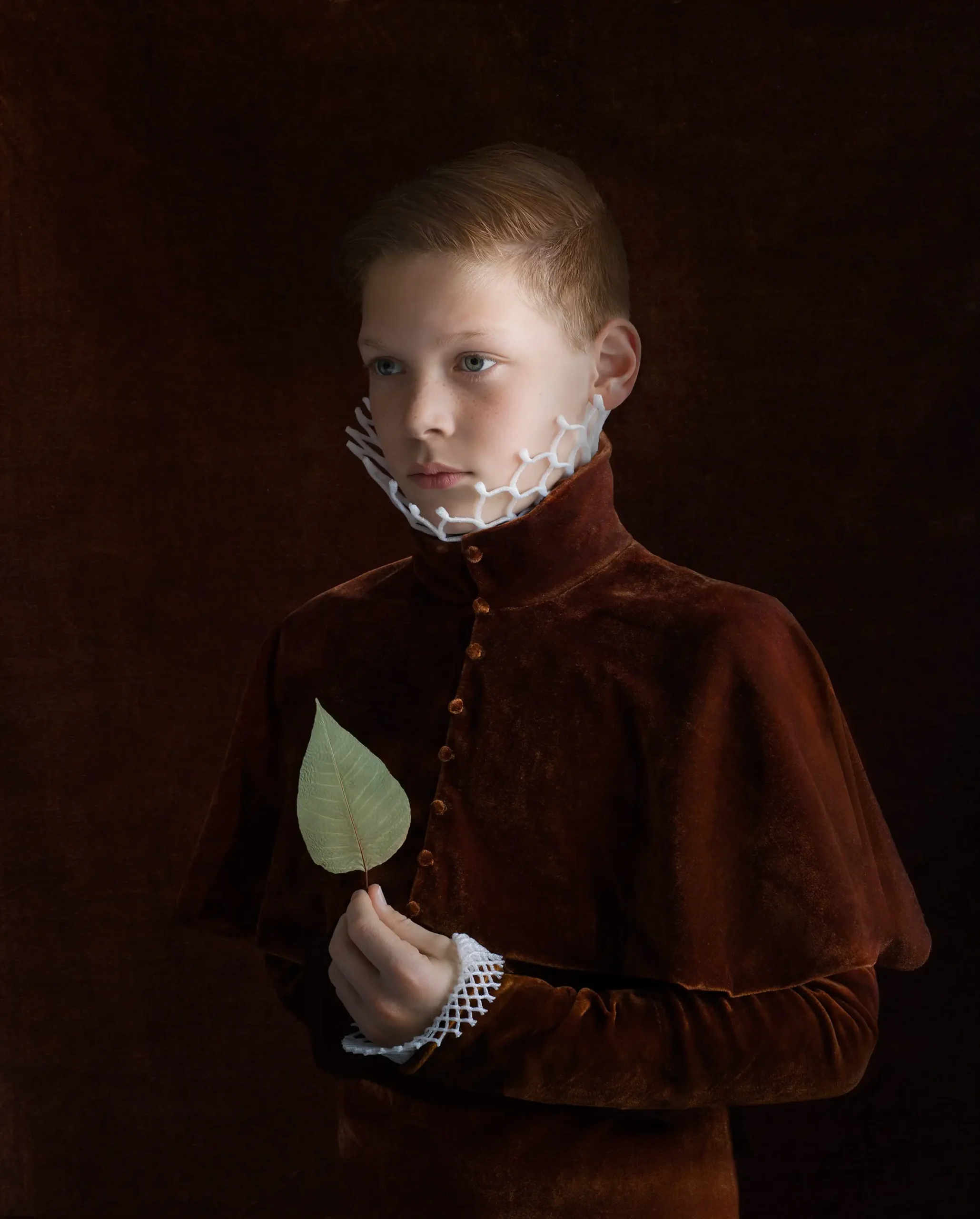
A boy stares out from beneath a velvet collar, a sprig of green leaf pinched between his fingers. His ruff looks like lace until you notice the grid pattern running through it, the kind printed on the plastic mesh sleeves fruit gets shipped in to keep it from bruising. The image is called “Kindred Spirits – Childhood,” and it belongs to Dutch artist Suzanne Jongmans, who has spent nearly two decades turning the things households throw away into costumes worthy of a Rembrandt sitting.
from
Jongmans was born in Breda, Netherlands, in 1978, and by her own account the instinct that drives her work now was already active when she was a kid collecting toilet paper rolls and trying to turn them into something else. She studied textile design and photography at the Academie voor Beeldende Vorming in Tilburg, originally drawn to the school for its theatrical design program before it closed and she shifted into photography and textiles. Her lecturers there introduced her to the private collections of painters like Hans Holbein the Younger, Johannes Vermeer, and Jean Clouet, and those paintings, along with the sewing she’d absorbed watching her mother and grandmother make clothes, became the twin foundations of everything that followed.
The breakthrough material arrived by accident in 2007. Jongmans was building a test costume, ran short of fabric, and grabbed sheets of the packing foam lying around her studio instead. When she sewed it, the fabric held its shape and stood upright on its own, essentially sculpting itself into a garment. That piece, an untitled medieval-style cloak, became the seed of what she now calls “Mind over Matter,” the first of two long-running series built on the same premise: packaging trash, worked with enough patience, can pass for silk, lace, or fur.
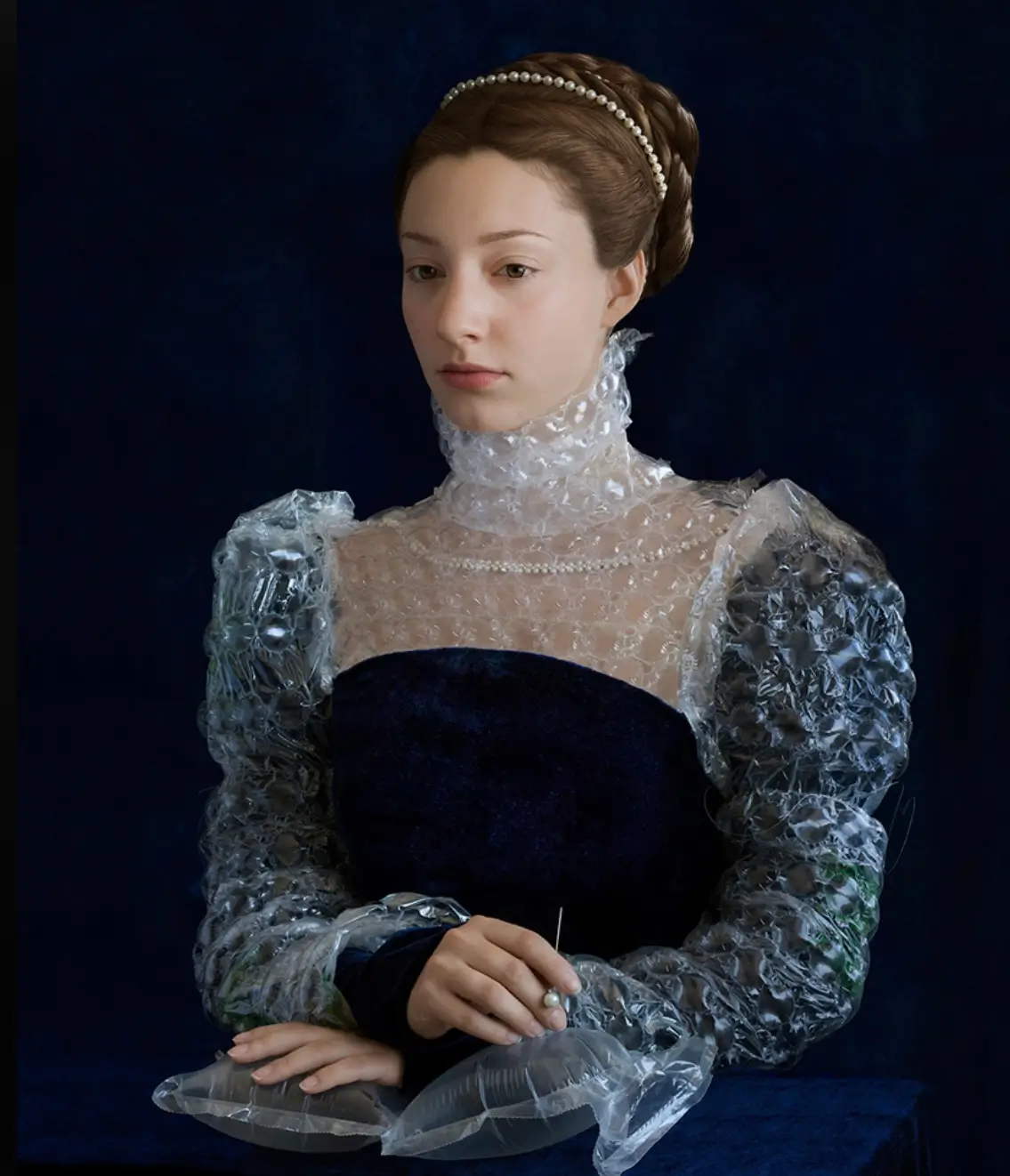
Young Woman Wearing A Renaissance-Inspired Gown With Transparent Sculptural Sleeves, High Ruffled Collar, Pearl Headband And Dark Velvet Bodice Against A Deep Blue Background
The instinct behind that discovery traces back further than the studio accident itself. A decade earlier, during her second year at the academy, Jongmans won a student design prize for an installation titled “Mijn huid, mijn littekens,” meaning “my skin, my scars,” built from sheets of thick foam cut and stitched so the seams read as scars across the material’s surface. The same qualities that made foam useful for that early piece, its flatness, its capacity to hold a cut shape, its resemblance to skin once it’s stitched, became the technical foundation everything since has built on. It’s a rare case of an artist’s student thesis material quietly resurfacing, two decades later, as the working method of an entire career.
build
The process is slow by design. Jongmans sews every costume herself, sculpting foam, bubble wrap, and plastic sheeting into ruffs, bonnets, and gowns that mimic the volume and drape of 15th and 16th century dress. Once a model is styled, she shoots hundreds of close-range photographic fragments and reassembles them into a single composite image, building the final portrait in layers the way a painter would apply glaze over glaze. The result is a kind of photographic trompe l’oeil: from a normal viewing distance, the costumes read as brocade and lace, and it’s only up close that the printed packaging text, recycling symbols, and torn plastic edges give the materials away.
That layering technique also lets her stage her subjects against the kind of deep, shadowed backgrounds associated with early Netherlandish and Italian portraiture, the same view register found in Leonardo da Vinci’s “Lady with an Ermine“ or Antonello da Messina’s “Portrait of a Young Man.” Her sitters hold the same composed, downcast gazes and pious stillness as their painted counterparts, a stillness that makes the discarded material draped over them read as dignity rather than debris.
Jongmans isn’t just working from photographs of those paintings, either. She has described returning to specific compositions the way a musician returns to a standard, restaging them closely enough that the source is legible while still leaving room to substitute her own materials and, often, her own life circumstances into the frame. Her 2012 piece “Julie, Portrait of a Woman” pairs directly with Rogier van der Weyden’s “Portrait of a Lady” from around 1460, right down to the entwined fingers and downcast eyes, and a Holbein-inspired image called “Mind over Matter – Gratitude” borrows its composition from “The Darmstadt Madonna” while replace a devotional rosary with one strung from rose hips. The pairing is never a straight copy. Each work keeps enough distance from its source to function as commentary rather than reproduction, closer to a cover version than a forgery.
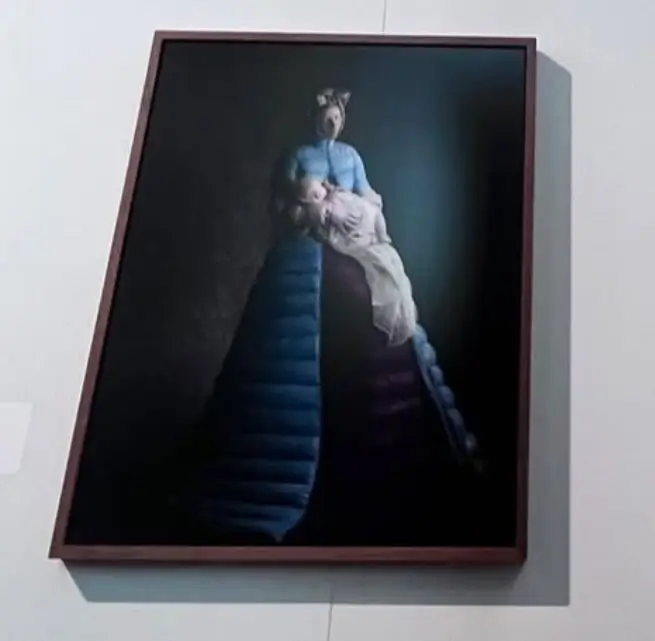
Frame Portrait Of A Woman In A Dramatic Blue Period Gown Holding A Figure Draped In Pale Fabric Against A Dark Background
to
Jongmans’ materials list has grown more specific over time. Early “Mind over Matter” pieces leaned on styrofoam bonnets, foam rubber head-dresses, and dresses studded with polystyrene beads. A 2012 portrait called “Julie, Portrait of a Woman,” staged after Rogier van der Weyden’s “Portrait of a Lady,” dresses its subject in a ring sculpted from a discarded tomato sauce lid, worn exactly where a Renaissance sitter might wear a jeweled band. More recent work in “Kindred Spirits” has widened the material palette to include copper coils salvaged from the electric motors of dead household appliances and blown fuses, twisted into headpieces and collar work that catch light the way metal thread once did in real 16th century dress.
The recycling references aren’t always hidden. Several works carry the printed lemniscate, the infinity-loop recycling symbol, stamped directly onto the foam or plastic used in the costume, a detail that reads as a deliberate wink rather than a flaw to be edited out. In one piece from the “Mind over Matter” series, a young woman poses with an inverted hourglass; in another, a girl in a Vermeer-style cap holds an infinity sign bent from a red rubber band. The symbols do double duty, standing in for the vanitas imagery common in Golden Age Dutch painting while pointing straight at the modern waste stream the materials came from.
flow
Jongmans has said her work sits in the space between the material and immaterial world, where questions of era, emotion, and belief overlap. In a recent statement, she pointed to the broader cultural shift she’s responding to: a Western drive toward modernization and mechanization that has, in her view, pushed myth and imagination to the margins of daily life. Concealment runs through the work as both a visual device and a subject in its own right, showing up as veils, hoods, ruffs, and wrapped fabric that hide as much as they reveal.
That interest in concealment extends into more pointed territory around gender and the body. One recent image, “Valentino blue,” shows a woman in a floor-length blue puffer coat breastfeeding a baby, a domestic act staged with the same formal solemnity as a Madonna and Child. It’s a deliberate provocation aimed at what still counts as acceptable to show in public, filtered through the same view lang Jongmans uses for everything else. Motherhood recurs elsewhere too. “Kindred Spirits – Present” is a self-portrait of the artist with her own son, wrapped in thin plastic sheeting that stands in for a veil, continuing a lineage of mother-and-child imagery that runs from the Renaissance straight through to a studio in the Netherlands stocked with packaging waste.
endure
Nearly everything Jongmans makes falls under one of two ongoing bodies of work. “Mind over Matter,” the earlier of the two, tends toward more overtly sculptural costuming and closer engagement with specific Old Master compositions, restaging paintings by van der Weyden, Holbein, and others with a named source in mind. Pieces like “Solitude,” which shows a young woman in a foam-rubber habit holding a sprig of jasmine as a symbol of purity, and “Cutting Loose,” a Queen Elizabeth I-inspired image built around an expired packing clip, both sit in this earlier series. “Kindred Spirits,” the series that includes “Kindred Spirits – Childhood,” moves more freely, using the same visual grammar to explore contemporary subjects like family, gender, and self-portraiture without tying each image back to a specific historical painting. A 2021 piece from that series, “In Resonance,” moves further still from any single painted source, framed instead as a meditation on vibrational connection across the universe, while a later work, “The Whole of Who We Are,” uses a handful of battered marbles standing in for planets as a meditation on creative potential.
Across both series, the underlying question stays consistent: what determines whether something counts as valuable or as trash. Jongmans has talked about every material having two ends, an unwanted end and a wanted one, and her practice is largely an argument that the line between those two ends is a matter of attention rather than any quality inherent to the object itself. A piece of foam rubber destined for a landfill becomes a bonnet. A tomato sauce lid becomes a ring. The transformation is manual, unglamorous, and time-intensive, closer to the patience of an old master’s studio than to anything resembling a quick photographic trick.
fin
The work has moved well beyond gallery walls in the Netherlands. Jongmans was commissioned to shoot a project for the Italian fashion house Moncler in collaboration with creative director Pierpaolo Piccioli for Valentino, and her practice has been the subject of a documentary on Deutsche Welle along with coverage in CNN and the Washington Post. She’s held a solo exhibition at the European Economic and Social Committee in Brussels and shown work at the Welt Museum in Vienna, alongside gallery fairs across the Netherlands including PAN Amsterdam and KunstRAI, where her longtime representing gallery, Galerie Wilms, has shown her work for over a decade. A recent retrospective, “Rewriting History,” filled the historic rooms of the Dordts Patriciërshuis museum in Dordrecht through the fall of 2025, pairing her hyperreal portraits with the antique interiors of an 18th-century townhouse in a way she’s said lets the setting and the artwork reinforce each other. That show included family portraits like “Prins Jona,” depicting the artist’s nine-year-old son dressed as a young nobleman in a foam-heart collar, alongside earlier pieces from both series spanning close to two decades of work.
From the DRIFT archive: American Visionaries: Property from an Important Private Collection — Joan Mitchell, Untitled
Related Articles
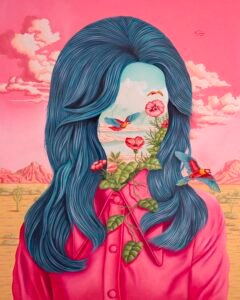
Where the Face Should Be, Rafael Silveira Paints Open Sky
A pink shirt, shoulder-length hair, then no face at all: in “Surprise,” Rafael Silveira lets flowers and a clear blue sky stand in for the person.