DRIFT AUDIO
Listen to this story
Choose a voice, then press play.
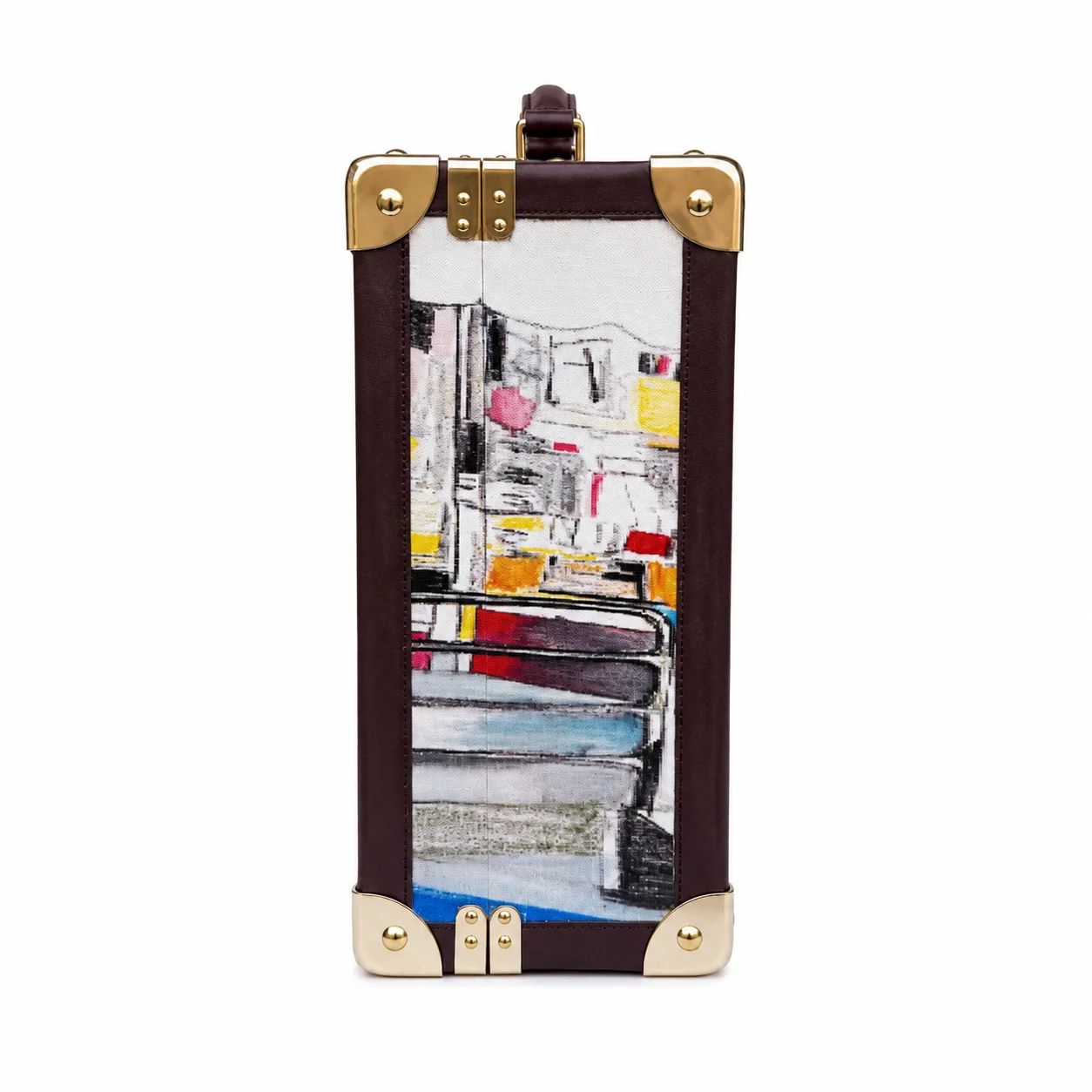
Fifty leather cases, each hiding a different drawing inside, mark KidSuper founder Colm Dillane‘s first release through Phillips’ Dropshop platform.
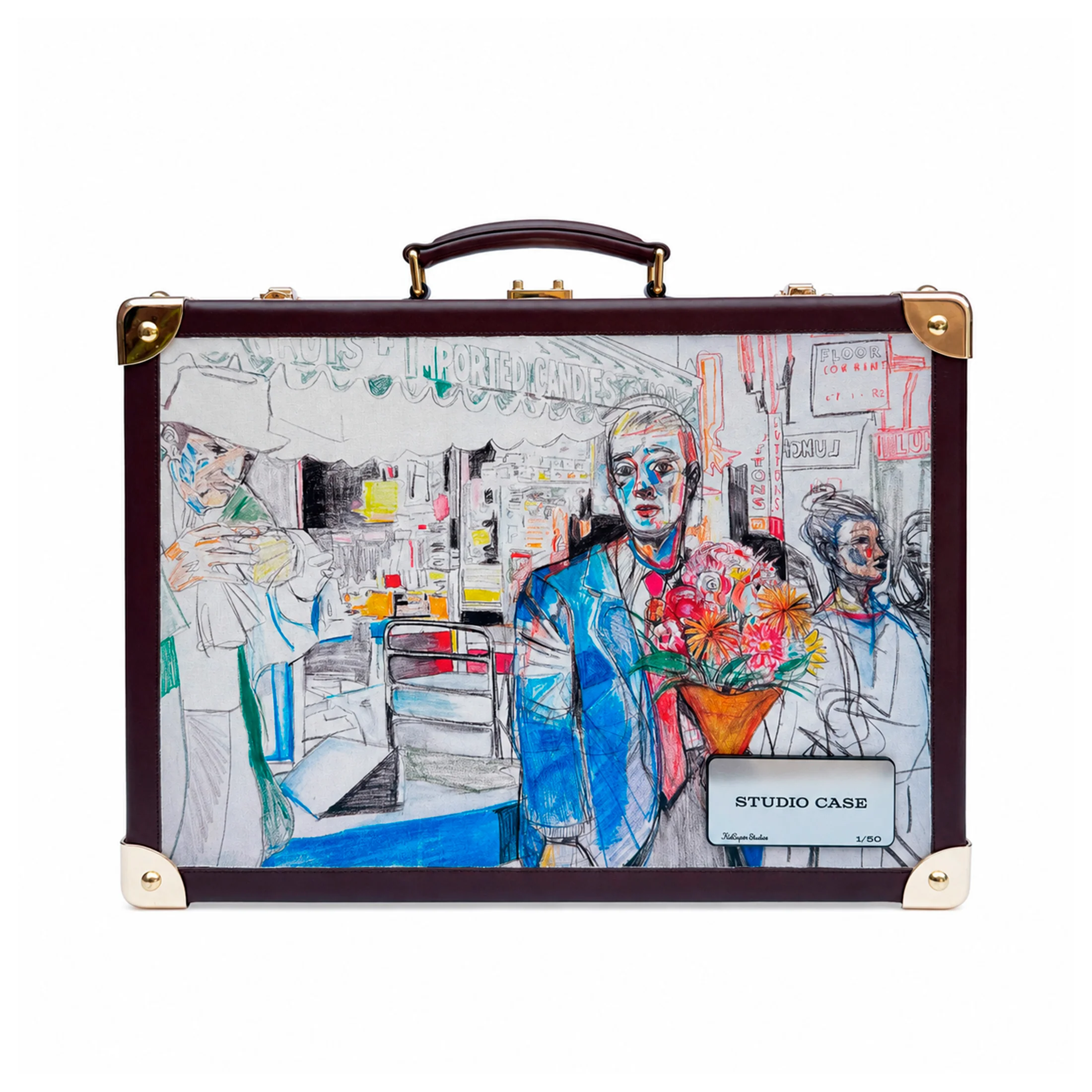
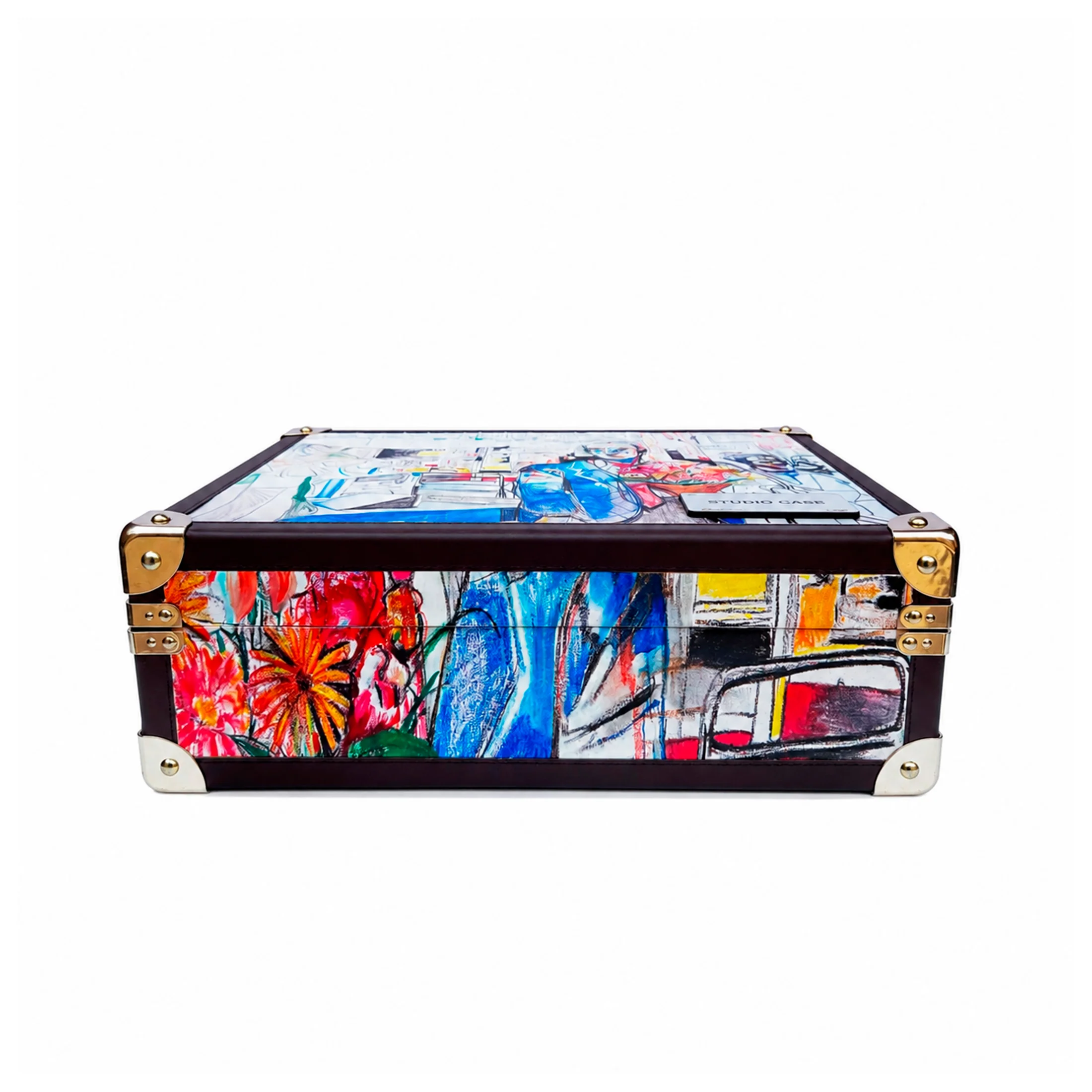
A hard-sided travel trunk is not, on its face, an unusual object for a fashion designer to reissue. Colm Dillane has never been especially interested in doing the expected version of anything, so the KidSuper Studio Case, the piece anchoring his new rel through Phillips’ Dropshop platform, is not simply a nice leather bag with a logo stamped on it. It is a contemporary reworking of the classic steamer trunk, built as an object that can be carried, opened, displayed or simply looked at, and priced at $1,500. The exterior of every case carries an original artwork painted directly onto the leather by Dillane, and a custom metal plaque on the front marks its place in the edition, the kind of detail auction houses usually reserve for prints and sculpture rather than luggage.
That pedigree is intentional. KidSuper Studios, the Brooklyn-based label and creative operation Dillane founded, has spent more than a decade blurring the line between clothing and fine art, and the Studio Case sits squarely on that line. It functions as an object you could theoretically pack a suitcase into, but its value, and its price, come from the fact that it was painted by hand, by an artist whose canvases now sell through the same platform as his trunks. Frame that way, the case reads less like an accessory and more like a piece of studio furniture that happened to be built with hinges and a handle, something meant to sit in a room rather than get checked at an airport counter.
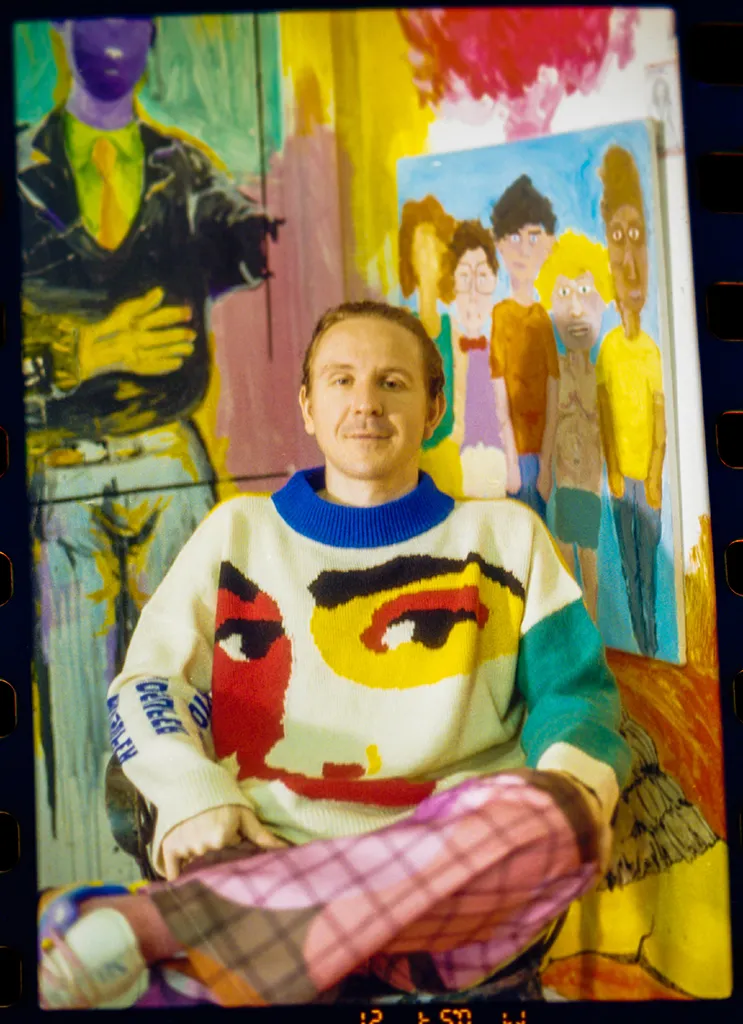
Dillane Seated In Front Of Colorful Figurative Paintings Wearing A Graphic Knit Sweater And Pink Plaid Trousers
The choice of a trunk in particular carries its own logic. Luggage is an object built around the idea of a journey, of things being carried from one place to another, and Dillane’s own career has been defined by exactly that kind of movement, out of a Brooklyn basement, through a series of increasingly high-profile collide, and now into an auction house’s retail arm. Turning that idea into a physical object, one that literally has a place to put things inside it, gives the rel a conceptual backbone that a simple capsule collection would not have had.
stir
Open the case and the surprise continues. Tucked inside is a separate original drawing on paper, meaning that across the edition of fifty, no two examples are the same twice over: fifty different exterior paintings, and fifty different interior drawings, each one specific to its own trunk. The effect collapses the usual distinction between a functional object and a collectible one. A buyer is not purchasing a copy of a Dillane work packaged inside a nice case; they are purchasing a case that is itself two separate, unrepeated works, joined by a shared metal shell and an edition number.
It is a structure that rewards close looking rather than a glance, which tracks with how Dillane has described his own paintings elsewhere: dense, detail-heavy compositions built from recurring characters and small incidents pulled from ordinary life rather than grand statements. Applying that instinct to an edition of fifty identical-looking trunks, each one privately different from the forty-nine others, turns the release into something closer to a scavenger hunt for collectors than a standard product drop.
It also means the case resists being reduced to a single image. A photograph of the exterior painting tells a buyer almost nothing about what they will find once the latches come open, and Phillips has leaned into that ambiguity rather than smoothing it over, framing the interior drawing as a genuine unknown rather than a bonus extra. For a platform built on selling directly to collectors rather than through the usual gallery intermediaries, that kind of built-in surprise is also a fairly effective way of making fifty outwardly similar objects feel individually worth chasing.
flow
The project did not originate inside Phillips itself. It was introduced to the auction house by curator and creative advisor Ché Morales, who worked alongside KidSuper Studios and the Dropshop team to develop the release from concept through to the finished objects. That path, an outside curator connecting an artist with a specific market opportunity rather than the artist approaching the platform cold, is fairly typical of how Dropshop has built its roster since launching in 2023, and it gave the KidSuper drop a level of curatorial shaping that a straightforward merchandise licensing deal would not have had.
Phillips’ own frame of the rel leaned into that curatorial angle. Chris Miele, the house’s Head of E-Commerce, pointed to how rarely an artist moves between disciplines the way Dillane does, calling his output shaped by the city and by a habit of turning ordinary encounters into something unexpected. It is a reasonable description of a designer whose past decade has run through streetwear collide, a Louis Vuitton runway show and now an auction-house retail platform without any of it reading as a detour from the others.
Morales’ role sits somewhere between curator and matchmaker, the kind of behind-the-scenes credit that rarely gets much attention outside a press rel but that tends to shape how a project actually comes together. Bringing a streetwear-rooted, self-taught painter into a program run by one of the major auction houses is not an obvious pairing on paper, and having someone positioned to speak both languages, the art-market side and the fashion-and-culture side Dillane operates in, appears to have been part of what made the collision workable rather than just aspirational.
seven
The Studio Case is not traveling alone. The same drop includes seven new paintings by Dillane, priced individually from $8,750 up to $32,000, all of them built around New York City as a subject. Where the trunks work in miniature, hiding their second artwork from view, the paintings are the drop’s larger, more public statement: layer scenes stitched together from recurring characters and small incidents lifted from daily life in the city, the same instinct for accumulated detail that shows up inside the cases, scaled up onto canvas.
Together, the paintings and the cases read less like a themed capsule collection and more like two different formats for the same working method. Dillane’s practice has always treated painting, fashion, show and design as pieces of one ongoing project rather than separate lanes he steps in and out of, and pairing seven gallery-scale New York paintings with fifty pocket-sized trunks carrying their own hidden drawings is a fairly direct illustration of that approach.
The price spread across the seven works, running from $8,750 up to $32,000, also signals that this half of the release is aimed squarely at collectors rather than at the wider streetwear audience that has followed KidSuper through its shoe and apparel drops. Where the Studio Case sits at a price point closer to a luxury accessory, the paintings are priced and positioned like the rest of a contemporary art program, which is presumably the point of routing this particular release through an auction house’s platform rather than through KidSuper’s own storefront.
transition
The route from that beginning to an auction house retail platform has been a specific and fairly well-documented one. Dillane grew up in New York City and started selling shirt to classmates in the cafeteria at Brooklyn Technical High School as a teenager, a hobby that eventually became KidSuper, developed out of his parents’ basement rather than a design studio. He went on to study mathematics at New York University, where he also played midfielder on the men’s soccer team, before returning full time to the brand he had already started building.
What followed was a run of collide that moved KidSuper further into fashion’s upper tier without abandoning its street-level origins: a multi-season partnership with PUMA built around Dillane’s paintings applied directly to sportswear, a Paris runway moment with BAPE that folded in his own history hawking bootleg tees outside the brand’s New York store, and outerwear built alongside Canada Goose and the NBA. Elsewhere in that same stretch, Dillane put his paintings onto a UGG Tasman Sport slip-on for Coachella, and has described his own KidSuper output as running through collide as varied as Suicoke, The Rolling Stones and English football club Barnsley F.C., a list that resists any single category. In 2021, LVMH awarded Dillane its Karl Lagerfeld Prize, and in January 2023 he was tapped to guest design Louis Vuitton’s menswear show, a booking that put a designer with no formal fashion training in charge of one of the industry’s most closely watched runways.
Through all of it, the operational center of gravity has stayed put in Brooklyn. KidSuper Studios is built around a Williamsburg hub that houses a retail store, an art gallery, a podcast studio and a screenprinting shop under one roof, less a corporate headquarters than a working clubhouse for whatever Dillane is making at a given moment. That home base earned him recognition from his own borough in 2025, when he was named the inaugural Brooklyn Arts Ambassador and given the job of redesigning a limited-edition run of the official Brooklyn pin. The Phillips drop is the version of that same trajectory landing inside the art market rather than a runway calendar or a borough honor, but it draws on the identical raw material: a New York upbringing, a self-taught painting practice, and a habit of treating union as the default mode rather than the exception.
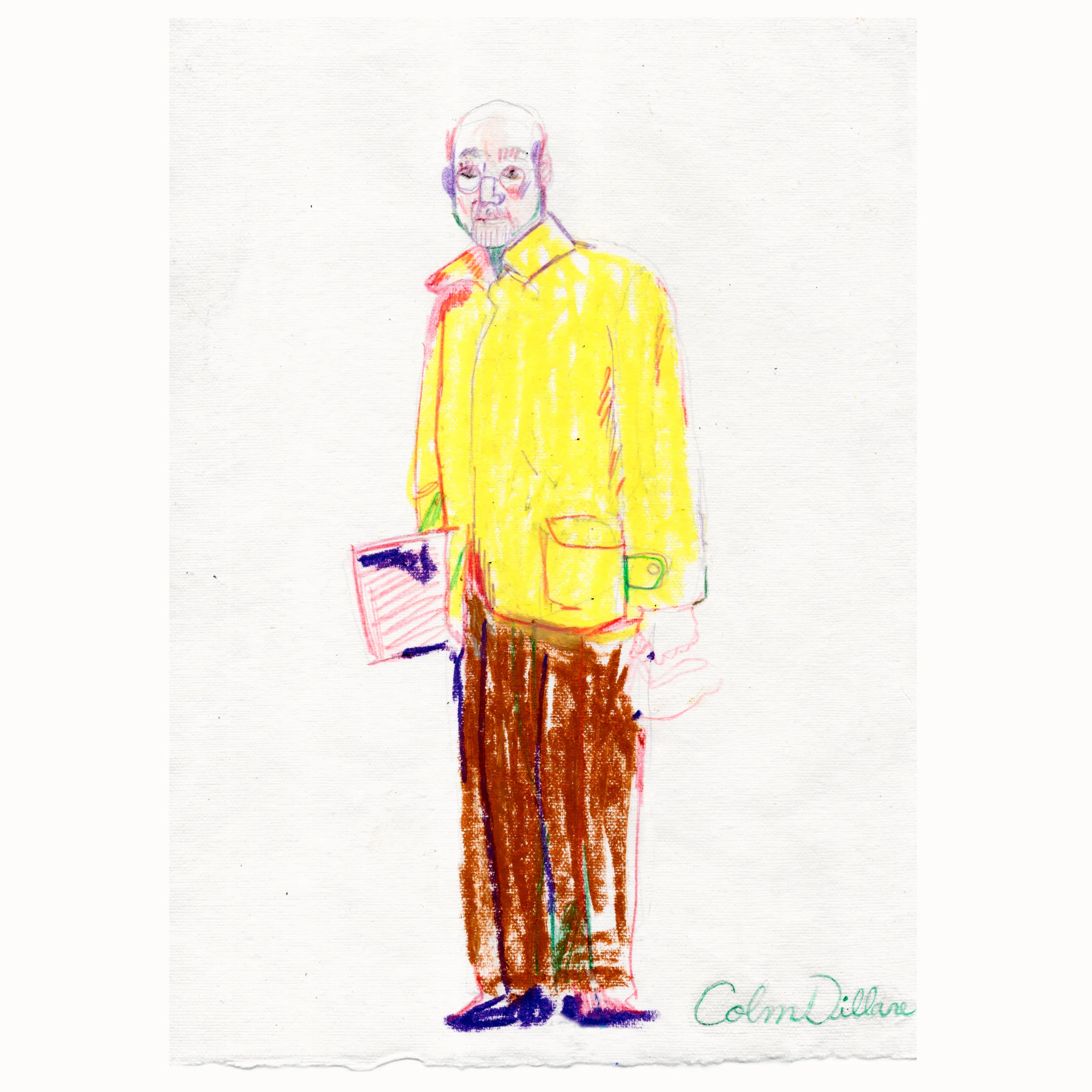
Scope Hand-Drawn Portrait Of A Man Wearing A Bright Yellow Jacket And Brown Trousers
fin
Dropshop itself is a fairly young platform, launched by Phillips in 2023 as a way to sell newly commissioned editions and objects directly from artists and collaborators to collectors, sidestepping the traditional gap between primary market galleries and secondary market auction houses. Its first release paired the artist Cj Hendry with a run of one hundred bronze inflatable crowns, and monthly drops since then have mixed prints, objects and, now, a leather trunk designed by a streetwear founder. Each drop is described as first come, first served, with works either signed, numbered or accompanied by a certificate of authenticity, and Phillips has said it uses market data alongside conversation with the artists themselves to settle on edition sizes and pricing before anything goes live.
Phillips has also floated a resale royalty of three percent for participating artists on any future sale of their work through the house, an arrangement that is not standard practice among auction houses and one the platform has pitched as a point of difference, though the royalty is only honored if a work is eventually resold back through Phillips rather than elsewhere. All orders through the platform ship out of New York once a given drop closes, and international buyers are responsible for their own customs duties and import taxes on arrival, standard terms for a young e-commerce operation still working out how to run a global art business through a shopping cart rather than an auction room.
The KidSuper release launched through Dropshop on August 11, with both the Studio Case and the seven paintings available while supplies last. From August 12 through August 30, Phillips is extending the project into its Park Avenue galleries in New York with a physical exhibition featuring all seven paintings, the Studio Case, and an archival runway look pulled from KidSuper’s own history, giving the online drop a walk-in counterpart for anyone who wants to see the fifty trunks’ shared shell in person before deciding whether to go looking for one of the fifty different drawings hidden inside.
Pairing a Shopify-style checkout with a gallery hang on Park Avenue is its own kind of statement about where Phillips sees this category of buyer sitting. A collector can click through the Dropshop listing from home, but the physical show gives the same audience a reason to walk into a Phillips gallery in person, stand next to the archival runway look, and see how a single painted trunk holds up against the human-scale paintings hanging around it. For a designer who started out painting shirts in a basement for classmates, having that work eventually hung on Park Avenue is its own quiet marker of distance traveled, even if nobody involved in the release seems especially interested in stating it that plainly.
Explore more of the artist’s practice in Drift’s profile of Colm Dillane, KidSuper, and “Touch of Color”.
From the DRIFT archive: The Art of the Can: Chaz Bojórquez’s Hand-Signed MTN Spray Paint Edition
Related Articles
Where the Face Should Be, Rafael Silveira Paints Open Sky
A pink shirt, shoulder-length hair, then no face at all: in “Surprise,” Rafael Silveira lets flowers and a clear blue sky stand in for the person.