DRIFT AUDIO
Listen to this story
Choose a voice, then press play.
Seventy years after he coined a genre by accident, the painter who wanted you to weep in front of a canvas has become the unlikely patron saint of a gen raised on infinite scroll
In This Story
- A Genre Named After the Fact
- From Marcus Rothkowitz to Color Field Pioneer
- Scale as Argument: Why the Canvases Got So Big
- Fourteen Walls in Houston
- The Square Counterpoint: Josef Albers
- Slow Looking in a Fast-Scroll World
- A Weather Report, Painted by Rothko
- What the Fields Still Hold
No painter sets out to invent a genre with a name as flat as “color field.” The term was applied retroactively, a piece of critical shorthand that stuck because nothing else fit. Mark Rothko didn’t ask for it, and neither did his two closest peers in the designation, Barnett Newman and Clyfford Still. According to Tate, the label was first attached to the trio’s work from around 1950 onward, then formalized two decades later when critic Irving Sandler used it as a chapter title in his history of Abstract Expressionism.
What united the three painters wasn’t technique so much as temperament. Where their contemporaries Jackson Pollock and Willem de Kooning hurled paint at canvas in spontaneous, gestural attacks, Rothko, Newman, and Still wanted something closer to stillness. Within abstract expressionism, this second grouping was deeply interested in religion and myth, and built simple compositions out of large areas of color meant to produce a contemplative or meditational response in the viewer. The brushwork disappeared. The subject matter disappeared. What remained was tincture, scaled up until it became less an object to look at than an environment to stand inside.
It’s worth distinguishing this first wave from what came after. A second gen, including Helen Frankenthaler, Morris Louis, and Kenneth Noland, pushed color field painting toward a more depersonalized abstraction in the 1960s, stripping out the spiritual undertones in favor of formal experimentation with stained, raw canvas. Both waves share a genre tag today, but the emotional register couldn’t be more different.
stir
Rothko’s route to those luminous rectangles was neither quick nor direct. Born Marcus Rothkowitz in Dvinsk, Russia, in 1903, he immigrated to the United States at age ten with his mother and sister, joining a father and brothers who had already settled in Portland, Oregon. He studied at Yale on scholarship, dropped out without a degree, and landed in New York, where he spent more than two decades teaching children’s art classes at a Brooklyn Jewish community center — a day job he kept even as his own painting evolved through several complete reinventions.
Those early reinventions are easy to forget given how total his later style feels. His paintings through the late 1930s and into the mid-1940s were expressionist and figurative, full of subway scenes and isolated city dwellers produced under the WPA, before he moved into Surrealist-inflected work exploring Greek mythology and automatic drawing techniques borrowed from Joan Miró and André Masson. It wasn’t until 1947, by the National Gallery of Art’s account, that Rothko stripped away the last vestiges of myth and symbol, arriving within three years at the format the world now recognizes instantly: two or three soft-edged, luminescent rectangles, stacked weightlessly on top of one another, floating against a colored ground.
The commissions that followed read like a survey of mid-century American institutional ambition — a mural series for the Four Seasons restaurant in 1958, murals for Harvard’s Holyoke Center in 1961, and finally a chapel commission in Houston that occupied him from 1964 to 1967. He never lived to see that last project completed. Rothko died by suicide in his New York studio in February 1970, roughly a year before the chapel that bears his name opened to the public.
flow
Rothko’s insistence on enormous canvases — many running upward of ten feet — was never about spectacle for its own sake. He wanted intimacy at a scale most artists associate with grandeur, and he said as much directly: a painting, in his own words quoted widely across institutional accounts of his life, “is not a picture of an experience; it is an experience.” Bigness, in his hands, was a delivery mechanism for closeness. Stand far enough back from a Rothko and the rectangles read as composition. Stand close, as he intended, and the edges blur, the field expands past your peripheral vision, and the painting stops being something you observe and becomes something you’re inside.
This is part of why Rothko was famously controlling about installation conditions, lobbying for low lighting, close hanging, and rooms scaled to his own specifications, treating the gallery less as a neutral display case and more as an instrument he was tuning. The approach reached its purest expression in his final, largest undertaking — a building designed around his own paintings.
theory
The Rothko Chapel is the clearest evidence that tincture field painting was never really about tincture in isolation. Commissioned in 1964 by collectors and philanthropists John and Dominique de Menil, the octagonal, non-denominational chapel in Houston’s Montrose neighborhood houses fourteen Rothko paintings rendered in varying, almost imperceptible hues of black, maroon, and plum. Rothko produced the works as three triptychs and five individual canvases, finishing half as hard-edged black rectangles on maroon ground and the other half as soft, monochrome tonal fields — a formal departure from the diffuse, cloud-like edges that had defined his work for nearly two decades.
The architecture itself became a point of conflict. Original architect Philip Johnson clashed with Rothko over the building’s design and was eventually replaced by Houston-based architects Howard Barnstone and Eugene Aubry, who worked the project through to completion according to Rothko’s specifications. Natural light, controlled with obsessive precision, remained non-negotiable throughout; it’s the single design element most credited with making the paintings legible at all, since the canvases shift in apparent hue depending on the hour and the cloud cover outside.
Rothko never saw the finished space. A sculpture by his colleague Barnett Newman, Broken Obelisk, was installed in the reflecting pool in front of the chapel in 1970, dedicated to Martin Luther King Jr. after the de Menils’ attempt to gift it to the city for that purpose was declined. The pairing turned the site into something more than a museum annex: more than 100,000 visitors a year now travel to the chapel, which has hosted Tibetan monks, interfaith colloquia, and a human rights award ceremony alongside its role as a standalone work of art.
alt
It’s tempting to pair Rothko with a contemporary who approached the same basic question — what can tincture alone communicate — from a nearly opposite temperament. Josef Albers, a former Bauhaus instructor who later chaired Yale’s design department, spent the final twenty-six years of his life on a single, obsessively repeated form. Homage to the Square, the series he began in 1950 and continued until his death in 1976, comprises more than a thousand paintings, all built from nested squares of unmixed color applied directly from the tube with a palette knife.
Where Rothko wanted transcendence, Albers wanted data. He described his own working method as a closed system — “a cooking pot that cooks for four people, and no more” — using the same rigid compositional scaffolding across the entire series so that color, and color alone, could be observed reacting against itself. Every panel records its own materials on the back, a practice that has let conservators trace exactly how each combination of pigment was built, coat by coat. The two artists arrived at the same conclusion from different directions: that color, given enough room and enough repetition, behaves like a language with its own grammar. Rothko used that grammar to write something close to scripture. Albers used it to write a manual.
slow
Tincture field painting’s current moment owes less to a retrospective or an auction result than to an algorithm. Across TikTok and Instagram, videos centered on Rothko’s work are now accumulating hundreds of thousands of views, part of a broader reappraisal among Gen Z audiences who are encountering him primarily through digital feeds rather than gallery visits, as reported by the Guardian. Natalia Sidlina, curator of international art at Tate Modern — which currently displays Rothko’s Seagram Murals, the nine ruminative maroon-and-brown canvases originally commissioned in 1958 — frames the trend as a net positive for cultural engagement, since digital exposure often pulls viewers toward seeing the actual paintings in person rather than substituting for it.
The appeal isn’t hard to locate. An entire generation defined by relentless visual stimuli has found in Rothko’s meditative fields a kind of aesthetic refuge — a discovery of depth through simplicity that functions as an antidote to feed overload even when experienced through the very feeds that overload them. The timing lines up with renewed institutional attention, too: Rothko’s work is currently showing across three sites in Florence, including a Museo di San Marco exhibition curated by his son Christopher Rothko that puts the painter in direct dialogue with early Renaissance master Fra Angelico.
There’s an obvious irony sitting underneath all of it. Rothko spent his career trying to engineer total physical immersion — controlled light, close hanging, scale calibrated to overwhelm peripheral vision — and the format now introducing him to the widest audience he’s ever had is a six-inch rectangle held at arm’s length. Whether that counts as betrayal or just evolution depends on who you ask. The Tate’s own position, filtered through Sidlina, leans toward the latter.
huh
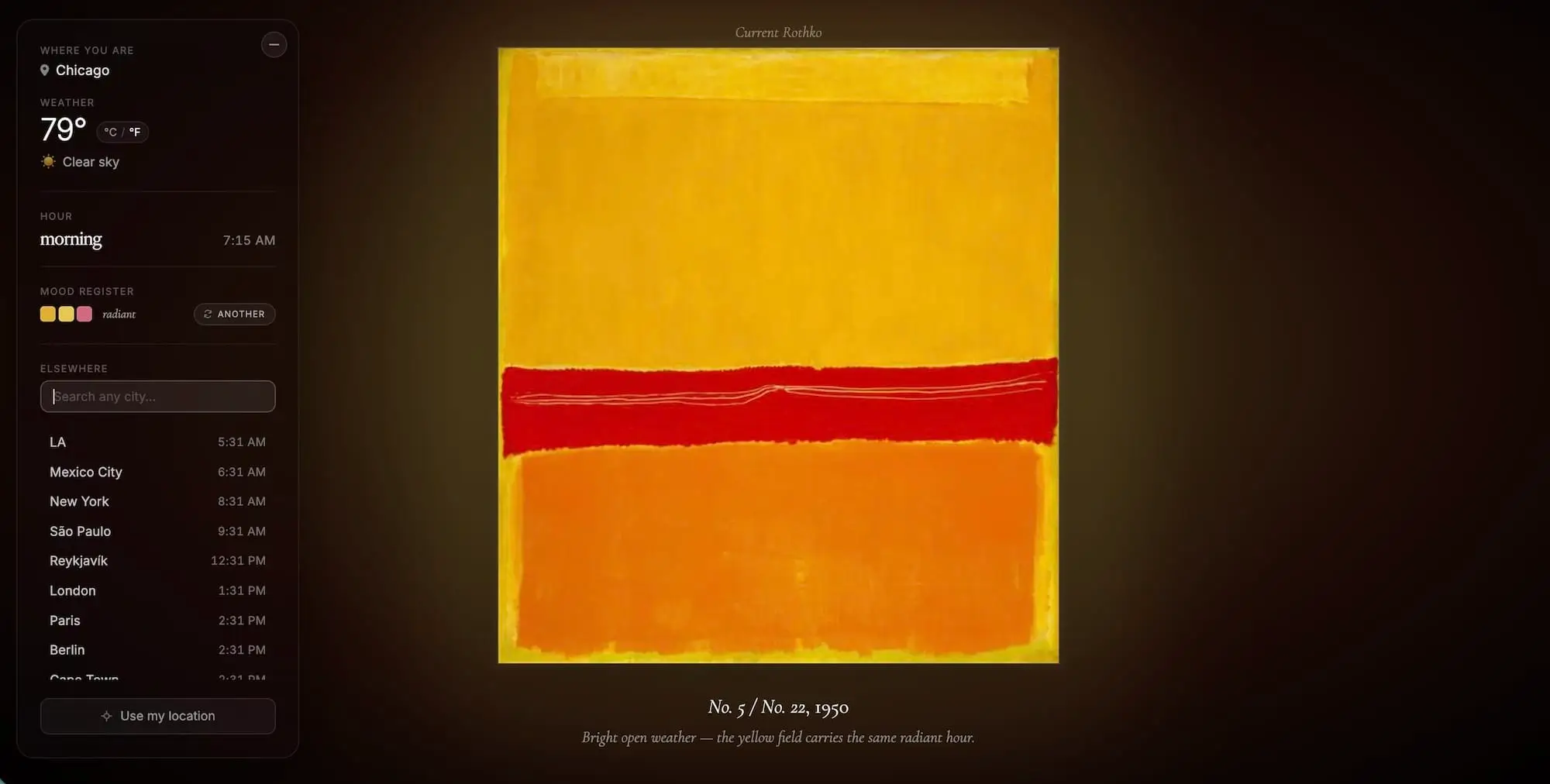
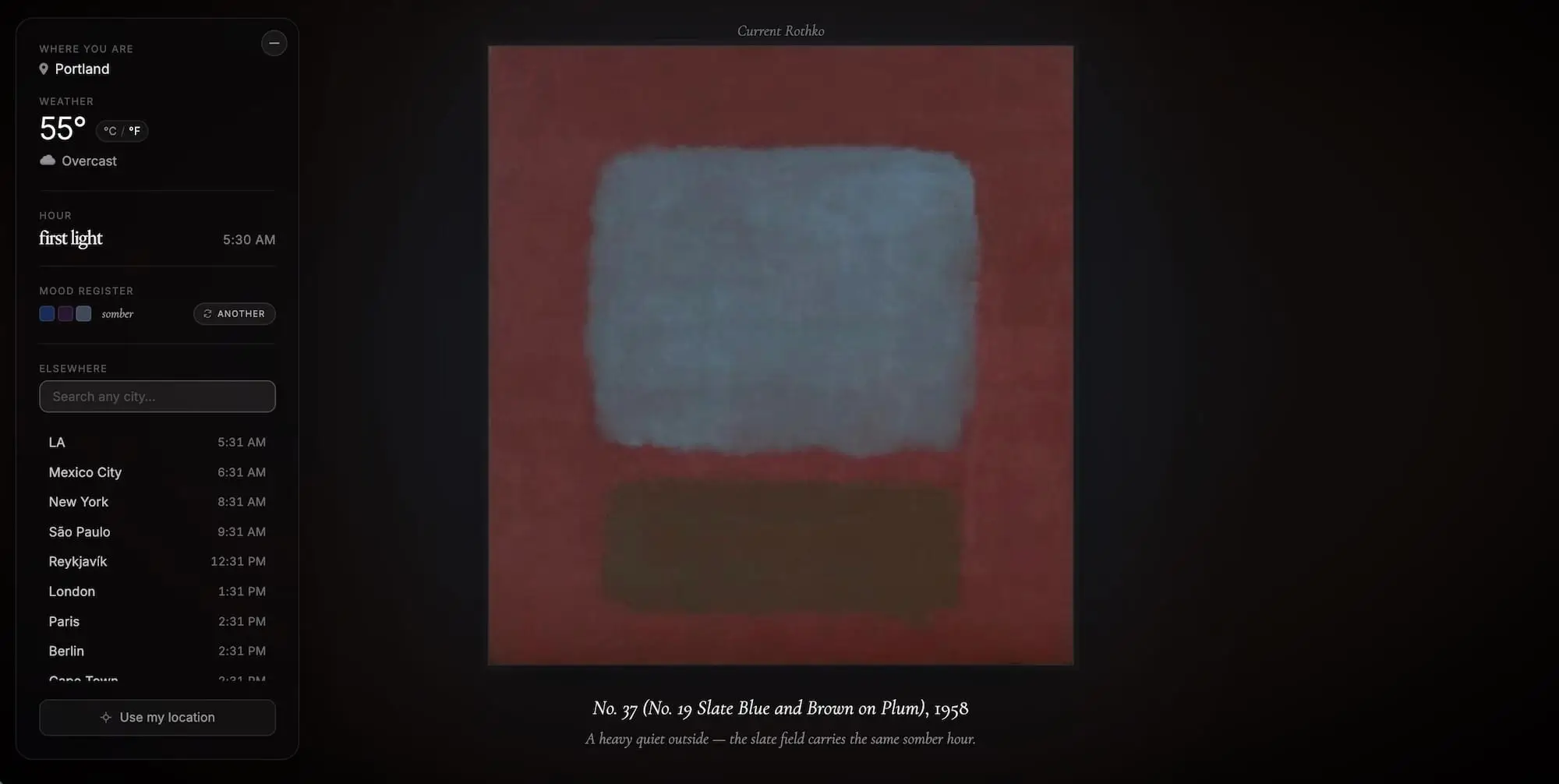
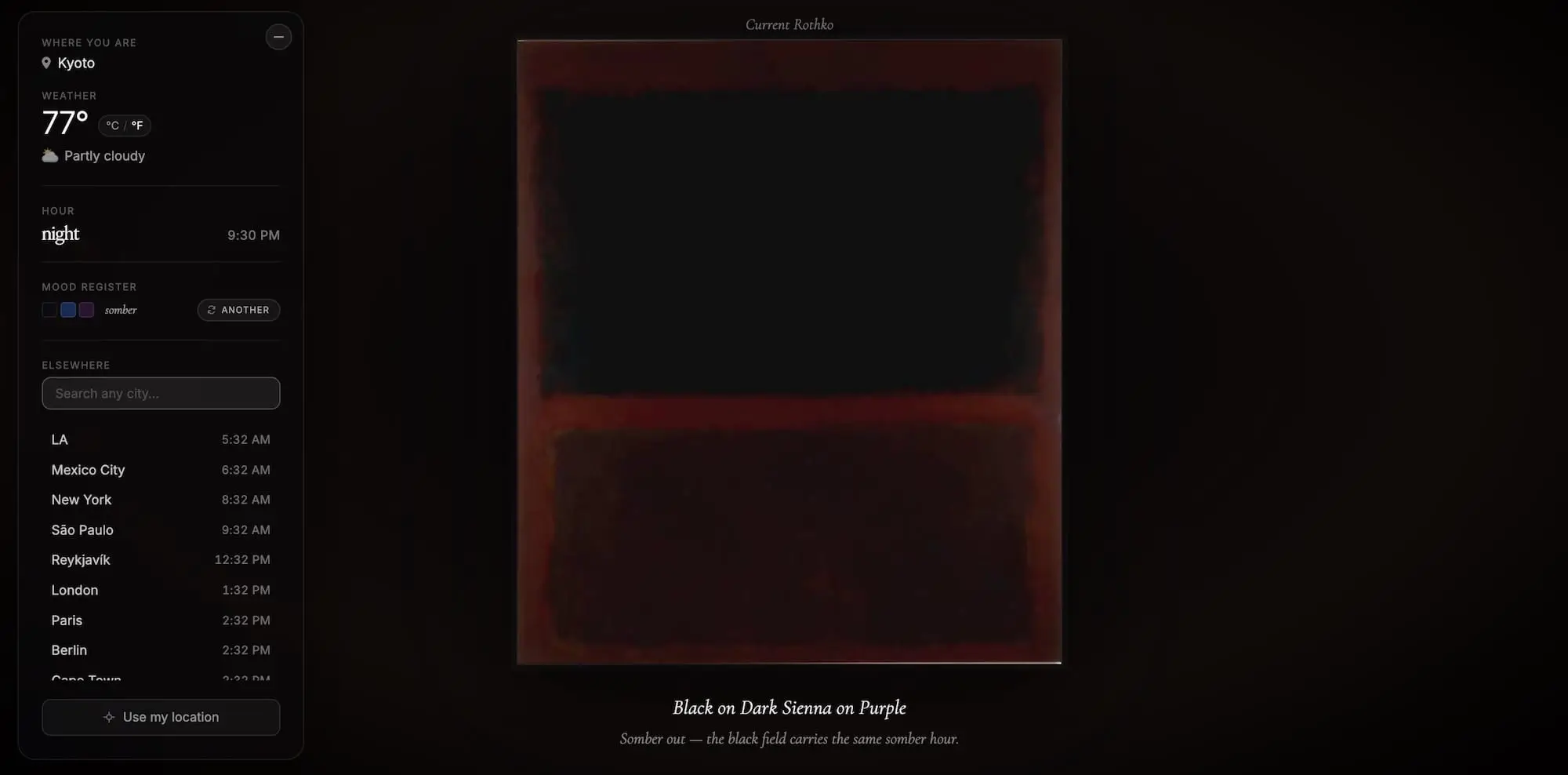
If the TikTok wave represents one kind of digital afterlife for color field painting, Current Rothko represents a more deliberately engineered one. Finnish product designer and creative director Joonas Virtanen built the project as a weather forecast that swaps numbers for paintings, using a user’s location to pull live conditions and then matching that data against a curated set of Rothko canvases. As Virtanen told Fast Company, the goal wasn’t to replace a conventional forecast but to translate it: “The weather forecast tells you the temperature and whether to bring an umbrella, but I’m interested in translating all of that into what the day or the moment feels like, what emotional register it belongs to.”
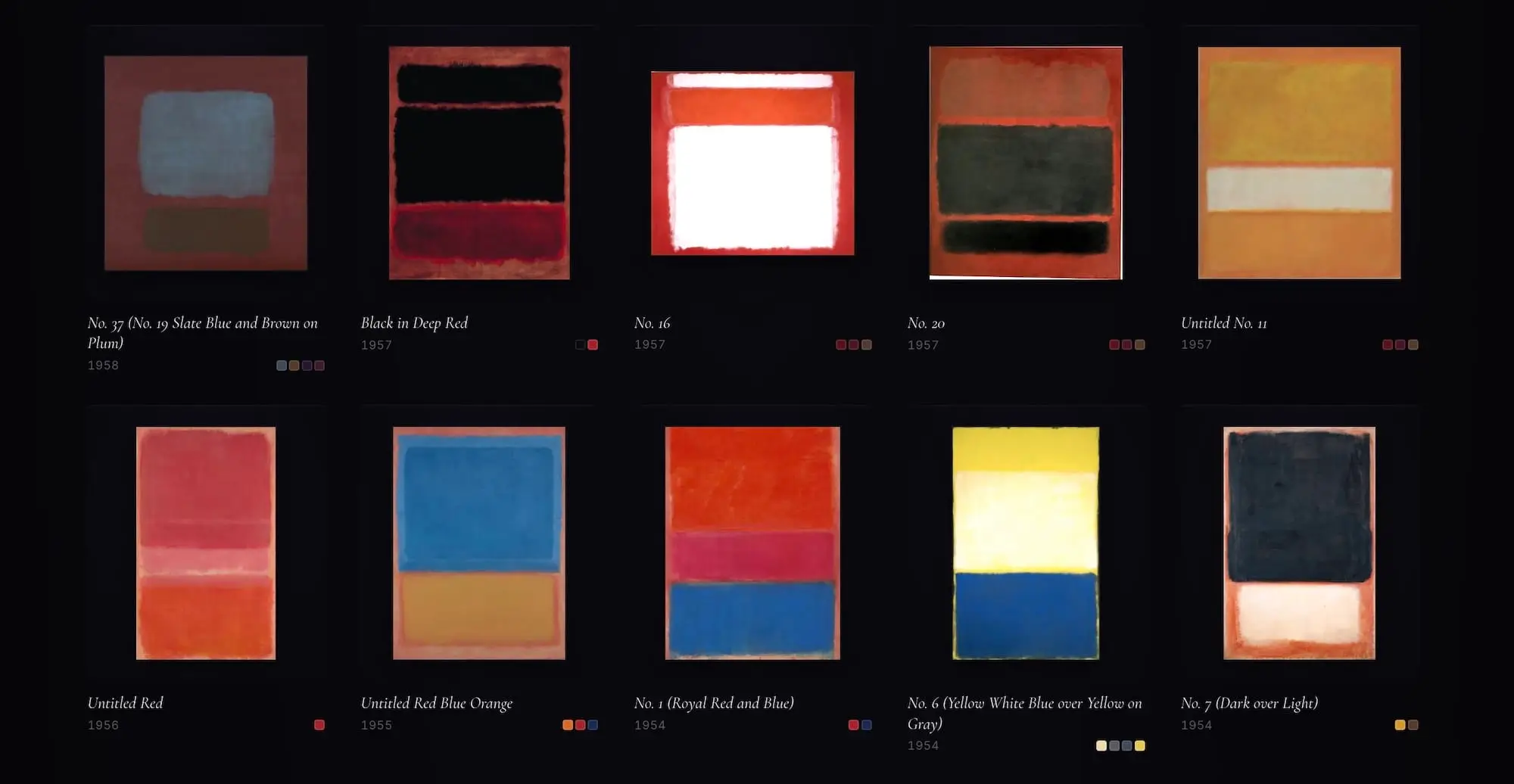
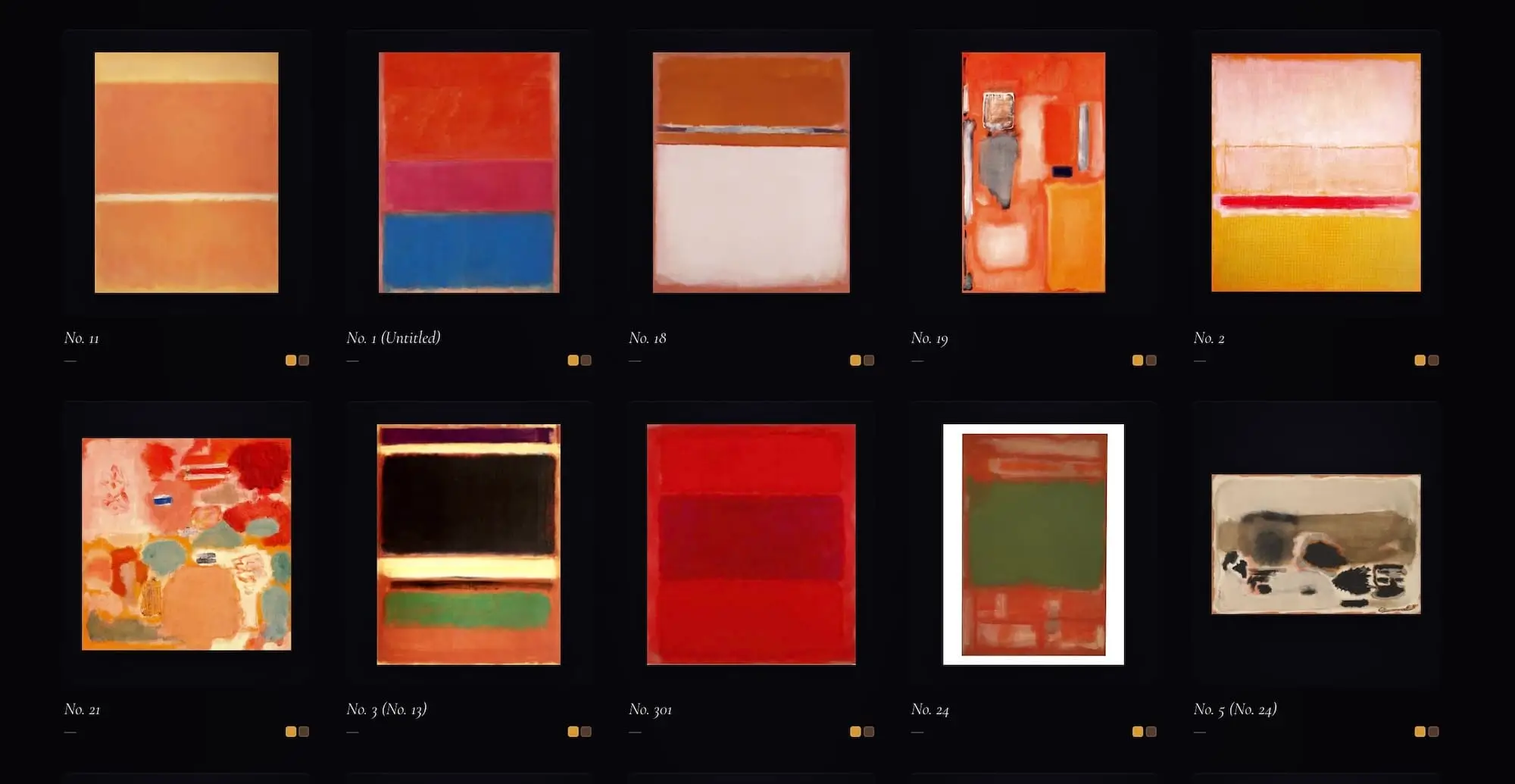
The mechanics are more rigorous than the premise might suggest. The site pulls temperature, time of day, cloud cover, rain, fog, and storm conditions for any location worldwide, converts that data into what Virtanen calls a “mood register,” and runs it through a scoring engine against eighty-nine Rothko paintings tagged by emotional tone. A gloomy day tends to surface the grays and deep purples associated with the Rothko Chapel works, while a sunny afternoon pulls toward the warmer yellows and reds of pieces like his 1950 canvas No. 5/No. 22. Calibrating that engine, Virtanen said, was the hardest part of the build — keeping it from simply defaulting to the most visually striking painting regardless of what the weather actually called for took considerable iteration.
Current Rothko sits inside a wider body of work from Virtanen built around the same instinct — that data, given the right interface, can feel like something rather than just report something. His other projects include Timeforms, which generates art from time and temperature, and Tangled Lines, which visualizes New York’s subway service status, all built on his own no-code AI platform, Wabi. He’s framed the broader project as a corrective to an increasingly grim internet, telling Fast Company that he makes these tools “because I believe projects like this are what the internet was actually made for.” It’s a small, slightly absurd proposition — that an artist who spent his life trying to slow people down might end up powering a UI element you glance at before leaving the house — and also, somehow, a faithful one. Rothko wanted his color to register as weather. Virtanen just built the app that says so.
fin
What’s notable about Rothko’s current culture position is how little the work itself has changed to earn it. The canvases haven’t been reinterpreted, tinctured, or remixed; they’re the same soft-edged rectangles that confused and occasionally enraged critics in the 1950s. What’s shifted is the context around them — a digital environment so saturated with stimulation that total abstraction now reads less as a void to be filled and more as a place to rest. Albers built a closed system to study how tincture behaves in isolation. Rothko built an open one, designed to be entered. Seventy years on, both are still being walked into, just through different doors than either painter could have anticipated.
Related Articles
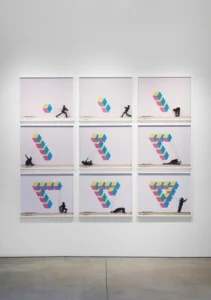
Robin Rhode, Edition of Five: Inside the 2017 C-Print Called David
A 2017 C-print by Robin Rhode, titled David, measures 185.8 x 227.8 cm in an […]