DRIFT AUDIO
Listen to this story
Choose a voice, then press play.
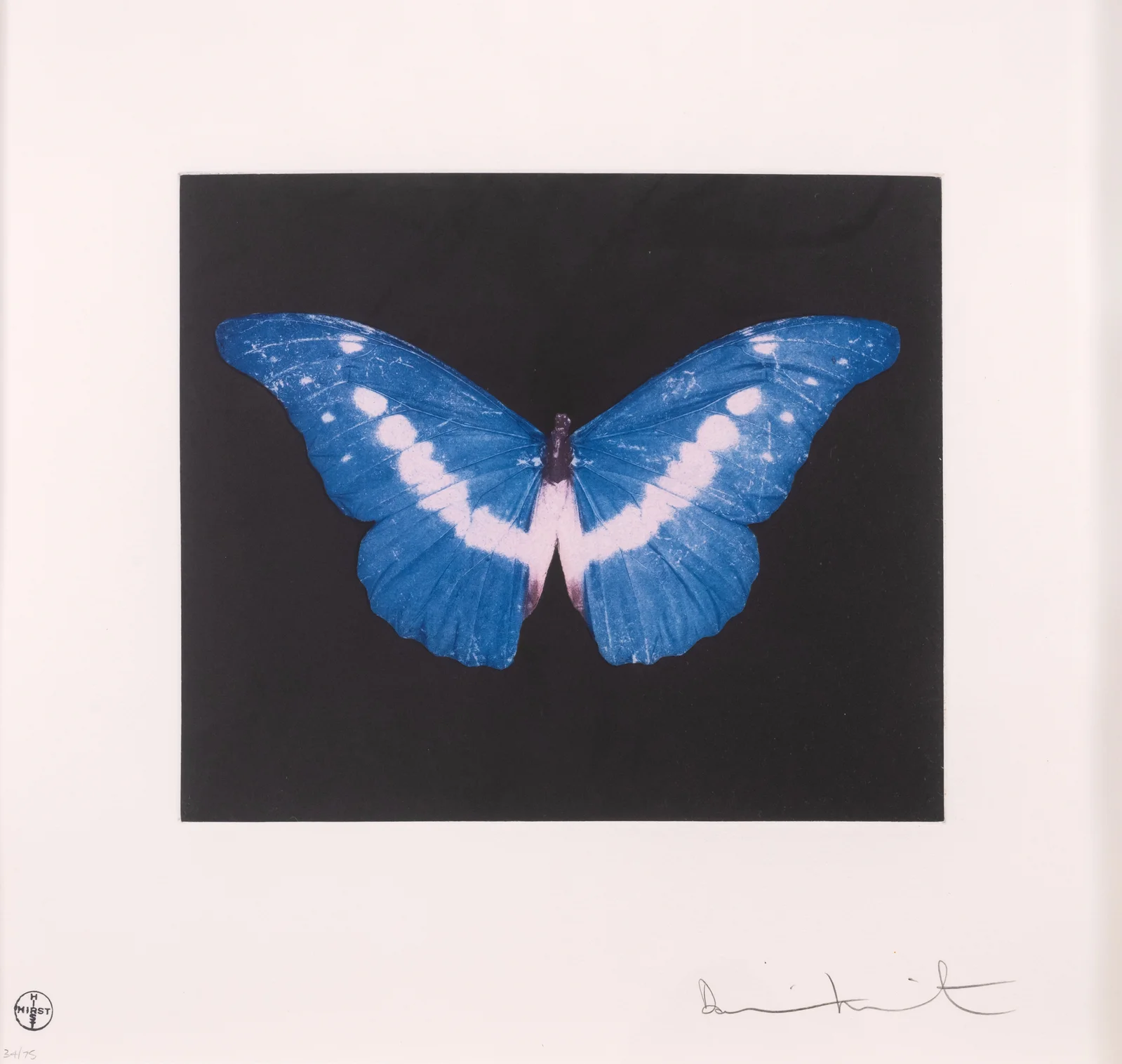
In the bombastic world of contemporary art, where Damien Hirst built an empire on diamond-encrusted skulls, formaldehyde sharks, and spot paintings that fetch millions, To Belong from the Butterfly Etchings series (2008) stands out for its intimate scale and poetic restraint. This limited-edition etching with aquatint, signed and numbered from an edition of just 75, measures a modest 41 × 44.5 cm (sheet size) yet carries the full weight of Hirst’s lifelong obsession with life, death, transformation, and the human need for connection.
Published by Other Criteria in London, the work features full margins on wove paper, the artist’s ink stamp, and is often presented framed (typical framed dimensions around 48 × 51 cm). It is a quintessential example of Hirst’s printmaking prowess — vibrant, technically masterful, and loaded with symbolism. In an era where Hirst’s headline-grabbing auctions dominate headlines, pieces like To Belong offer collectors a more accessible yet profound entry point into his practice. Current market estimates place signed examples in the £3,400–£5,000 range, with recent auction results hovering around £3,000 hammer.
This review dives deep into the artwork’s creation, symbolism, technical execution, market position, and cultural significance — everything a serious collector or enthusiast needs.
stir
Born in Bristol in 1965, Damien Hirst emerged as the poster boy for the Young British Artists (YBAs) in the late 1980s. His 1988 exhibition Freeze, which he curated while still a student at Goldsmiths College, launched a generation. Hirst has consistently explored mortality, religion, desire, and the commodification of art itself.
His breakthrough works — The Physical Impossibility of Death in the Mind of Someone Living (1991 shark) and For the Love of God (2007 diamond skull) — cemented his reputation for shock and spectacle. Yet throughout his career, Hirst has returned to quieter motifs like butterflies, using them as universal triggers for beauty and fragility. As Hirst himself has noted, butterflies represent both life and death: “I love butterflies because when they are dead they look alive.”
By 2008, Hirst was at the peak of his commercial power. That year he staged the landmark Beautiful Inside My Head Forever auction at Sotheby’s, which grossed nearly $200 million. Amid this frenzy, the Butterfly Etchings series — including To Belong — offered a more contemplative counterpoint.
flow
To Belong belongs to a small but significant group of etchings produced in 2008, often discussed alongside titles like To Begin, To Believe, To Lose, To Love, and To Lure. These works form a poetic sequence exploring human emotions and existential states.
Each print in the series is an etching with aquatint printed in colors, created with meticulous attention to detail. The process allows for rich tonal variations and luminous color that captures the iridescence of butterfly wings without using actual specimens (unlike his kaleidoscope paintings). Edition size of 75 makes them rarer than many of Hirst’s mass-produced spot prints but more available than unique works.
The series bridges Hirst’s early 1990s live butterfly installations (In and Out of Love, 1991) and his later monumental kaleidoscopes made from real wings. In prints like To Belong, the butterflies appear arranged in symmetrical, almost mandala-like or stained-glass patterns against rich backgrounds, evoking religious iconography and Victorian entomological displays.
scope
To Belong presents a central cluster of vividly colored butterflies — often in blues, pinks, oranges, and blacks — arranged in a circular or radial composition. The aquatint technique creates soft gradients and velvety depths, while the etched lines define delicate wing veins with scientific precision. The color printing brings a jewel-like quality that shifts under light, much like real butterfly scales.
The title To Belong adds emotional layering. Butterflies, traditionally symbols of the soul (Psyche in Greek mythology, resurrection in Christian imagery), here cluster together in a harmonious whole — a visual metaphor for the human desire for connection, community, and transcendence. Yet the fragility of the medium reminds us how easily that belonging can be lost.
Framed, the piece feels intimate and devotional, suitable for both minimalist modern interiors and more traditional spaces. The full margins (sheet approx. 410 x 445 mm) allow breathing room that enhances the ethereal quality.
style
Hirst collab with master printers for this series. The combination of etching (for sharp lines) and aquatint (for tonal areas) is a classic intaglio technique revived in contemporary printmaking. Colors are applied in multiple passes, requiring precise registration. The result is a print that feels both contemporary and rooted in centuries-old traditions — a hallmark of Hirst’s approach to bridging high art and accessible media.
Condition is critical for value. Look for strong, unfaded colors, no foxing on the wove paper, and clear pencil signature and numbering. The artist’s ink stamp adds authenticity.
symb
Butterflies have deep cultural resonance:
- Transformation: From caterpillar to winged beauty.
- Ephemerality: Short adult lifespan mirrors human existence.
- Resurrection: Ancient and religious symbolism.
Hirst weaponizes this duality. In To Belong, the clustered wings suggest unity and love, yet the pinned, arranged quality hints at death and control. The work asks: Do we truly belong, or are we merely arranged in pleasing patterns by forces beyond our control?
This ties into broader Hirst themes — the vanity of collecting, the commercialization of beauty, and the intersection of science and spirituality. In 2008, amid global financial crisis and personal success, To Belong resonates as both celebratory and melancholic.
weight
Recent auction results show steady demand. Estimates of £3,000–£5,000 are realistic for good examples, with strong provenance boosting prices. Compared to Hirst’s unique works (which can reach millions), this remains an accessible blue-chip entry point.
Factors driving value:
- Rarity (edition of 75)
- Signature and documentation
- Condition and framing
- Growing interest in prints as the broader market cools on spectacle pieces
Secondary
through platforms like MyArtBroker, Artsy, and auction houses like Forum Auctions confirm liquidity. For collectors, it pairs well with other Hirst prints or butterfly-themed works.
show
This piece shines in:
- Contemporary living rooms with neutral palettes (the colors pop against white or dark walls)
- Home offices or libraries (intellectual yet decorative)
- Bedrooms (intimate scale)
- Corporate or hospitality spaces (conversation starter without overwhelming)
Pair it with minimalist furniture or alongside other YBA works, skulls, or natural history-inspired pieces. Lighting is key — side lighting enhances the aquatint depth.
compare
- Vs. Kaleidoscope paintings: More intimate, no real wings, but similar mandala energy.
- Vs. Spot paintings: Organic and emotional rather than mechanical.
- Vs. In and Out of Love: Static beauty instead of living (and dying) spectacle.
It represents Hirst at his most refined — provocation through poetry rather than shock.
fin
In today’s art market — saturated with NFTs, AI-generated works, and digital hype — Hirst’s traditional printmaking feels refreshingly analog and permanent. To Belong embodies the quiet luxury of owning something tangible that rewards repeated viewing. It reminds us that great art doesn’t need to scream; it can whisper profound truths about our shared humanity.
For new collectors, it’s an ideal starter Hirst. For veterans, it completes thematic groupings. Either way, it delivers enduring emotional and aesthetic value.
From the DRIFT archive: London Streets Print by Arina Iastrebova Captures the Soul of a Rainy City · Chris P. Bacon: Francis DiFronzo’s Quiet Rebellion Against the Everyday
Related Articles
Damien Hirst Hands His Most Famous Motifs to a 123-Year-Old Scottish Knitting Mill
Barrie, Chanel’s cashmere house in Hawick, has knitted a numbered capsule with Damien Hirst, a […]