DRIFT AUDIO
Listen to this story
Choose a voice, then press play.
OSGEMEOS, the artistic moniker of identical twin brothers Gustavo and Otávio Pandolfo (born 1974 in São Paulo, Brazil), have forged one of the most distinctive voices in contemporary art by bridging street graffiti, Brazilian folklore, hip-hop culture, and a shared dream world they call Tritrez. Their 2015 work Momentos mágicos (Magic Moments) exemplifies this idea. Created as part of the “Silence of the Music” exhibition at Lehmann Maupin in New York, it stands as a shimmering portal into their imaginative universe.
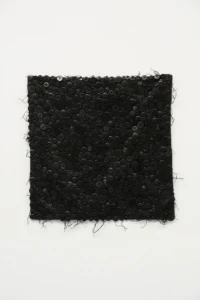
This large-scale mixed-media piece on MDF board measures roughly 2.35 meters tall by 2 meters wide, with a notable depth of 8 cm that gives it a sculptural presence. The use of sequins elevates the surface from flat painting to a glittering, light-responsive object that shifts and sparkles depending on the viewer’s position and the ambient illumination—evoking the magic promised in its title.
flow
The Pandolfo twins grew up in the Cambuci neighborhood of São Paulo during the turbulent 1980s, a time of economic hardship, political transition after Brazil’s military dictatorship, and the explosive arrival of hip-hop culture via imported records, breakdance, and graffiti. Starting around 1987, they began tagging walls under the name OSGEMEOS (“the twins”). Their early work absorbed New York-style graffiti but quickly infused it with local flavors: the cryptic, angular pixação (São Paulo’s unique form of tagging), vibrant Brazilian folk art, carnival excess, and the resourcefulness of working-class life.
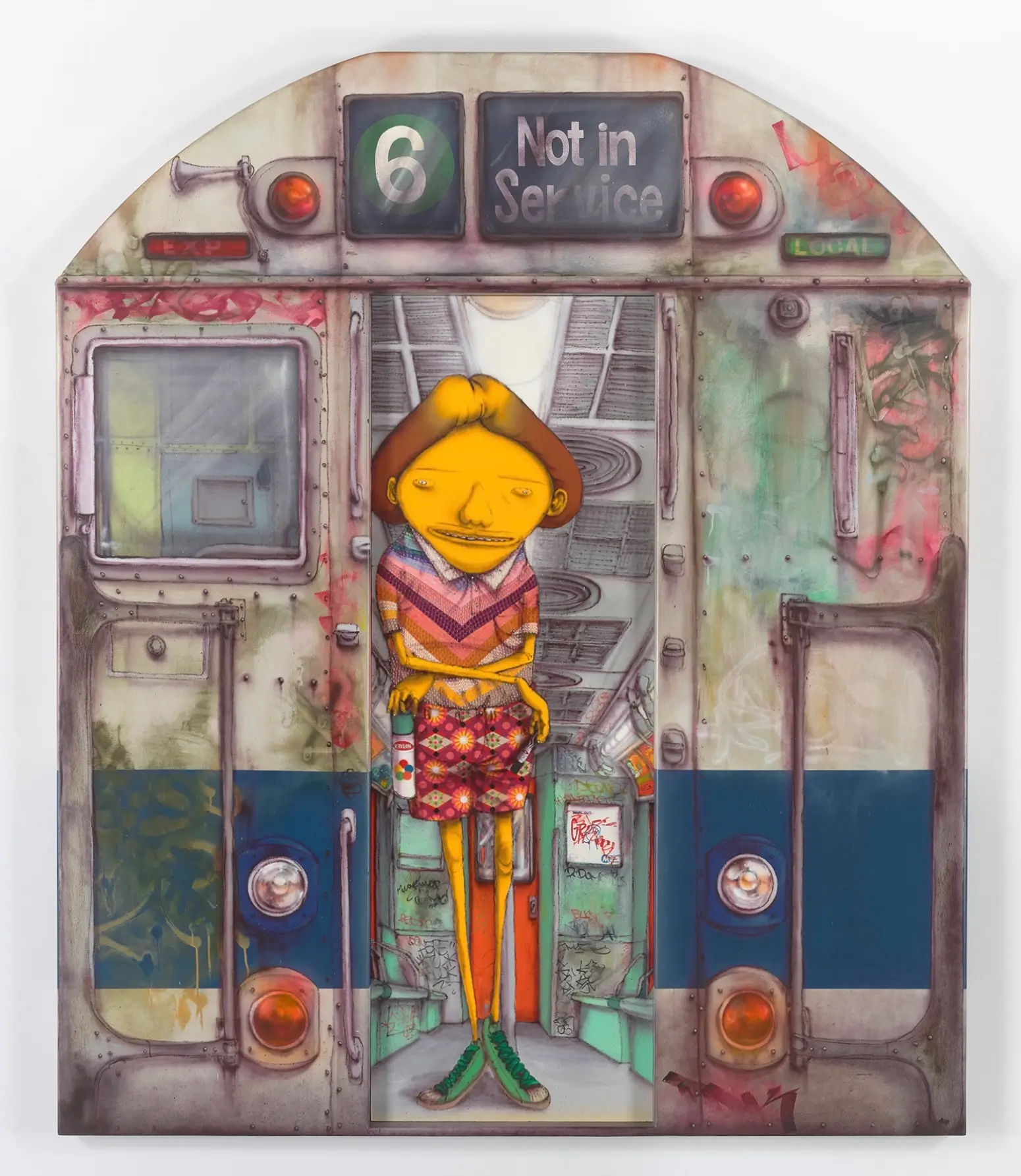
By the 1990s, after meeting Barry McGee (Twist), they expanded into studio practice while maintaining a commitment to public art. Their signature style emerged: elongated, yellow-skinned figures with thin black outlines, oversized heads, simplified facial features, and bodies clad in intricate, patterned clothing. Yellow became a deliberate choice—highly within view from afar on city walls, racially neutral (defying skin-tone hierarchies), and tied to the golden, sunlit quality of their shared dreams.
Tritrez—their invented mystical realm—serves as a recurring setting. In the artists’ words, it is a place of unique harmony where “there’s nothing to worry about,” rivers glow with colorful fish, and flowers bloom along every path. It functions as both escapist fantasy and subtle social commentary: a counterpoint to the inequalities and violence of urban Brazil.
show
Though specific public high-resolution images of the full piece are limited in open sources, exhibition documentation and details from Lehmann Maupin reveal a characteristic OSGEMEOS composition. The work likely centers on one or more of their iconic long-limbed yellow figures engaged in a moment of coltish ritual or reverie, surrounded by symbolic elements: floating orbs, geometric patterns reminiscent of Op Art or temple architecture, stylized animals or hybrid creatures, and architectural fragments (houses, hills, or portals).
The sequins—applied densely over painted areas—transform ordinary forms into jewels. A pink house on a hill might shimmer with iridescent scales; clothing patterns pulse with metallic dots; celestial bodies or tears drip with reflective light. This materiality recalls carnival costumes, candomblé or umbanda ritual objects, and the bling of hip-hop culture, all refracted through a dream lens. The MDF support, rigid and industrial, contrasts with the organic, hand-applied exuberance, nodding to their street-art roots where found materials were common.
The color palette is quintessential OSGEMEOS: dominant sunny yellows and greens for landscapes, punctuated by hot pinks, turquoises, deep reds, and electric blues. These hues create a psychedelic yet harmonious vibration, pulling the viewer into a state of childlike wonder while the scale (nearly life-size or larger for the figures) invites immersion. The 8 cm depth suggests possible layered elements—perhaps raised sequined appliqués or subtle relief—that enhance the tactile, jewel-box quality.
In detail shots from the exhibition, one sees the meticulous labor: thousands of individual sequins hand-placed, catching light like stars. This technique slows down the viewing process. Where a flat painting can be scanned quickly, Momentos mágicos demands movement—circling the piece to watch it ignite and fade—mirroring the ephemeral nature of “magic moments” themselves.
day
The title Momentos mágicos evokes fleeting instances of transcendence amid ordinary or difficult lives. For the twins, these moments often arise in music, dance, family, dreams, or street culture. Breakdancing—a recurring motif in their 2015–2016 works—appears as a form of liberation and ritual. In the broader “Silence of the Music” series, pieces like É hora de dançar break and sound-equipped sculptures explore rhythm even when view “silent.”
Here, the magic moment might depict figures in mid-dance, levitating, or communing with nature/spirits. The sequins amplify this: they suggest stardust, festive lights, or the inner glow of joy. Symbolically, such works often include portals (doors, mirrors, windows) that OSGEMEOS use literally and metaphorically—entry points to the subconscious or alternate realities. A floating feather, a crowned chicken (as seen in related works), or a hybrid bird-person could populate the scene, blending Brazilian folklore (saci-pererê tricksters, curupira guardians) with universal archetypes.
This piece also dialogues with Brazilian popular culture. Carnival, with its sequined costumes and transformative energy, is an obvious parallel. So too is the cordel literature and woodcut traditions of the Northeast—narrative, moral, fantastical. Yet OSGEMEOS update these for a global, post-hip-hop audience. The work celebrates resilience: magic is not escapism but a tool for survival and resistance, allowing the marginalized to imagine better worlds.
innov
Using sequins on MDF represents a maturation of their practice. Early graffiti relied on spray paint for speed and scale. Gallery works allowed experimentation with texture and permanence. Sequins add optical dynamism and haute, elevating street aesthetics into high-art objects while retaining accessibility—sparkle appeals across cultures and ages. Mixed media likely includes spray paint, acrylic, markers, and possibly collage or found objects, layered to create depth within the relatively flat board.
The choice of MDF (medium-density fiberboard) is practical yet symbolic: an engineered, democratic material common in Brazilian homes and construction, repurposed for art. It echoes their use of discarded doors in other works—everyday objects transformed.
oeuvre
Momentos mágicos fits into a prolific phase where the twins produced numerous sequin-enhanced panel works for gallery exhibitions. “Silence of the Music” (2016) featured related pieces like Um segredo do mar, O anjo abduzido, and kinetic sculptures. These explored sound, rhythm, and silence, with breakdance as a central metaphor for freedom.
Later retrospectives, such as “Segredos” at Pinacoteca de São Paulo (2020–2021) and “Endless Story” at the Hirshhorn (2024–2025), have contextualized such works within their larger narrative arc—from street to museum, local to global. In the Hirshhorn show, similar sequined panels sit alongside immersive installations, reinforcing how individual “magic moments” contribute to an endless, shared story.
sig
OSGEMEOS helped legitimize Brazilian street art on the international stage. Their works appear in major collections and biennales while remaining rooted in São Paulo. Momentos mágicos embodies their humanist message: art as a democratic force that fosters empathy, joy, and imagination. In an era of political polarization and digital overload, the piece’s tactile sparkle and dream logic offer respite and reconnection.
Critically, their style has been compared to Hieronymus Bosch (detailed surreal worlds) and M.C. Escher (geometric play), yet remains uniquely theirs—warm, optimistic, and culturally hybrid. The yellow figures promote unity beyond race or nationality. Children respond instinctively; adults find layers of nostalgia and critique.
xp
As identical twins who claim to share dreams, Gustavo and Otávio operate with rare synchronicity. Their collaboration transcends typical artistic partnership; it is almost telepathic. Momentos mágicos likely emerged from such a shared vision—perhaps a dream of dancing under sequined skies or a memory of childhood street parties. This intimacy infuses the work with authenticity and emotional warmth rare in conceptual art.
clue
Today, as AI-generated imagery floods visual culture and attention spans shrink, Momentos mágicos reminds us of the value of handmade wonder. Its sequins demand physical presence; its narratives reward slow looking. In a world hungry for magic amid climate anxiety and division, OSGEMEOS offer a counter-spell: playful, inclusive, and profoundly human.
The piece does not preach. It invites. Step closer, move around it, let the light dance across the sequins, and for a moment, you too might enter Tritrez—where harmony reigns and every day holds the potential for magic.
From the DRIFT archive: Between Walls and Silence: Nuno Viegas’s Street Artist (2018)
Related Articles
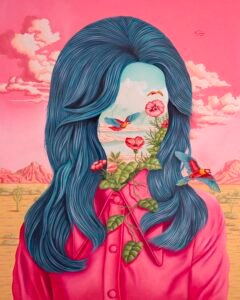
Where the Face Should Be, Rafael Silveira Paints Open Sky
A pink shirt, shoulder-length hair, then no face at all: in “Surprise,” Rafael Silveira lets flowers and a clear blue sky stand in for the person.