DRIFT AUDIO
Listen to this story
Choose a voice, then press play.
As Zidane: A 21st Century Portrait returns to Los Angeles for the World Cup, the artist floods the gallery with neon confessions and vinyl scripture translated into the city’s own languages
In This Story
- A Homecoming, Twenty-Five Years On
- Ninety Minutes, Seventeen Cameras, One Man
- The Text Works: Scripture, Pop Lyrics, and a City’s Many Tongues
- A World Cup Summer for American Museums
- Douglas Gordon, From Glasgow to the Global Stage
- What to Expect at Gagosian Beverly Hills
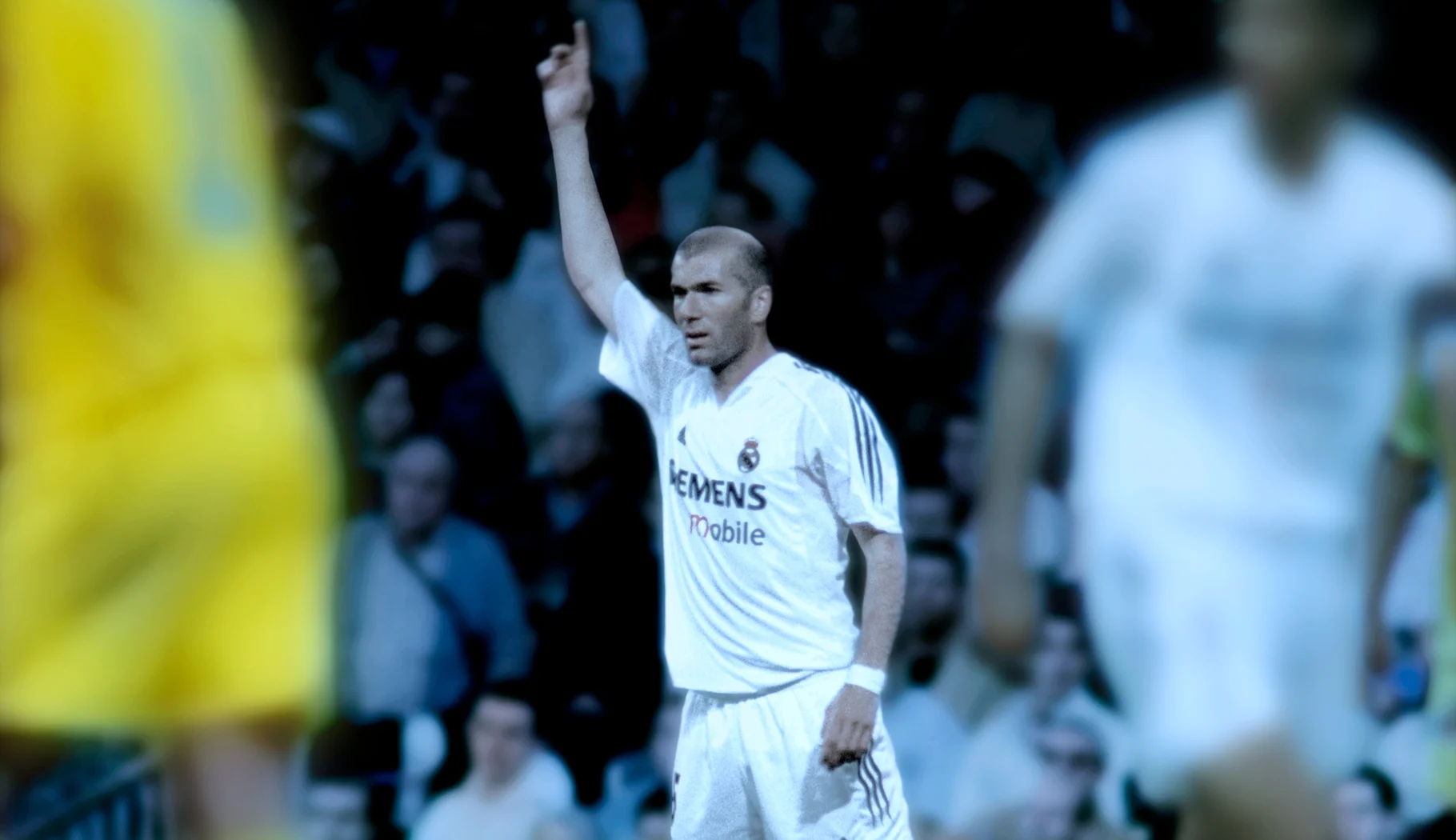
Douglas Gordon has spent three decades making work about watching — about what happens to an image, a body, or a belief when it is held under sustained, obsessive attention. This July, that lifelong preoccupation returns to Los Angeles in Magic is sometimes very close to nothing at all, an exhibition opening July 16 and running through August 22 at Gagosian Beverly Hills. The show’s title is lifted from the final line spoken by its central subject, Zinédine Zidane, in the film that anchors the presentation: Zidane: A 21st Century Portrait (2006), Gordon’s landmark collaboration with French artist Philippe Parreno.
It is, in a sense, a homecoming. The Beverly Hills presentation arrives twenty-five years after Gordon’s first major American survey, staged at the Museum of Contemporary Art, Los Angeles, in 2001 — a fact the gallery is keen to underline as it reintroduces the artist to a city he last addressed at institutional scale a quarter-century ago. This time the occasion is different: rather than a museum retrospective, Gordon has built something closer to an environment, one designed to spill past the gallery’s own walls. Neon and vinyl text works climb the ceiling, cover the floor, and extend onto the building’s exterior and the sidewalk beyond, turning the entire footprint of Gagosian’s Beverly Hills space into an extension of the film’s meditation on fame, faith, and the strange intimacy of being watched.
stir
At the exhibition’s core is Zidane itself, a two-channel, ninety-minute film shot on seventeen synchronized 35mm cameras trained exclusively on Zinédine Zidane during a single La Liga fixture: Real Madrid against Villarreal at the Santiago Bernabéu Stadium in Madrid, played on April 23, 2005. Rather than following the ball, the cameras follow the man — his footwork, his breathing, his stretches of stillness while play unfolds elsewhere on the pitch. The result, edited together with live television commentary and the ambient roar of 72,000 spectators, produces something closer to a psychological portrait than a highlight reel. A brooding score by the Scottish post-rock band Mogwai deepens the film’s sense of interiority, pulling Zidane out of the register of sport and into something nearer to cinema.
The film exists in seventeen distinct versions, several of which now sit in major public collections, including the National Galleries of Scotland in Edinburgh and the National Gallery of Canada in Ottawa. Gagosian’s own account of the presentation, detailed in its press materials, frames the work as a study in devotion as much as athleticism — a document of what it means to fix a single figure at the center of collective attention for the length of a match. FAD Magazine’s preview of the Beverly Hills show notes that the exhibition’s title itself is drawn from Zidane’s own closing words in the film, a small gesture that folds the subject’s voice back into how the show announces itself.
Nearly twenty years on from its premiere, Zidane has lost none of its currency. Real Madrid remains one of the sport’s dominant institutions, and Zidane’s own path from the pitch into management — including a run in charge of the club itself — has only thickened the mythology the film was already probing: the way a single athlete can become a screen onto which an entire stadium, and eventually an entire art world, projects its need for a hero.
Much of the film’s staying power lies in what it withholds. Conventional football broadcasting is built around the ball — around goals, near-misses, the shape of a match as a narrative with a beginning, middle, and end. Gordon and Parreno instead offer something closer to surveillance reimagined as devotion: long stretches in which nothing appears to happen, in which Zidane merely walks, adjusts his shirt, or spits onto the turf, filmed with the same reverence typically reserved for a goal. That patience is what separates Zidane from either sports documentary or fan-made highlight reel, and it is the quality Gordon has spent his career refining across very different subjects, from Hitchcock’s Psycho to his own family history. Watching Zidane in a gallery context, rather than on a stadium screen or a television broadcast, sharpens that distinction: freed from commentary graphics and score tickers, the footage becomes legible as portraiture, closer in spirit to an old-master study of a single sitter than to sports media.
That distinction matters for how the Beverly Hills exhibition positions itself relative to the wider wave of sport-themed programming accompanying the World Cup’s arrival in North America this year. Where much of that programming — kit retrospectives, photography surveys, fan-culture group shows — treats football as subject matter, Gordon and Parreno’s film treats it as a philosophical problem: what does it mean to be watched so completely that the watching itself becomes the content. Gagosian’s decision to let that question anchor a commercial gallery show, rather than confine it to a museum context, is itself a small statement about how thoroughly the line between blue-chip gallery programming and museum-grade video art has eroded over the past two decades.
flow
Where the film supplies the show’s emotional center, Gordon’s text-based works supply its argument. Wrapped across the gallery’s walls, ceiling, and floor is a survey of vinyl and neon pieces spanning more than three decades of the artist’s practice, beginning with Meaning and Location (1990), an early vinyl work that renders a biblical line — “Truly, I say to you, today you will be with me in paradise” — twice, in circular form, with the sentence’s meaning quietly reversed by the placement of a single comma. It is a characteristically Gordon move: a devotional quotation destabilized by punctuation, faith rendered as a kind of optical illusion.
Later works trade scripture for pop culture without losing that same interest in belief and its fragility. The neon piece Tears are not Enough (2023) borrows its text from a lyric by the British synth-pop group ABC, while SELF-PORTRAIT AS AN ACTOR (2017) draws on sources the artist keeps deliberately untraceable. Taken together, the text works chart a shift in Gordon’s language pieces — from the explicitly religious quotations of his early career toward broader questions about the emotional loyalties that popular culture, fandom, and celebrity now generate in place of formal belief.
For the Beverly Hills presentation specifically, Gordon and the gallery have translated a number of these text works into languages spoken widely across Los Angeles — including Armenian, Farsi, and Korean — alongside the considerably less common Chumash language, indigenous to the region’s original inhabitants. Art Plugged’s coverage of the show frames the gesture as a deliberate widening of the exhibition’s address, drawing the work outward toward the city’s many communities and voices rather than confining it to a single audience or language. It is a choice that ties the show explicitly to its Los Angeles moment: 2026 is a World Cup year, with matches taking place across the city, and Gordon — by his own account a lifelong football fan — has used the tournament as an occasion to think about the sport as one of the few remaining sites of genuinely collective feeling, where belief, tribal loyalty, and heartbreak still play out in full public view.
scope
Gordon and Parreno’s Zidane is not confined to Beverly Hills this summer. As American institutions mark the country’s co-hosting of the FIFA World Cup 2026 — staged jointly across the United States, Canada, and Mexico — the film is on simultaneous view at the Solomon R. Guggenheim Museum in New York, at both the Bass Museum and the Pérez Art Museum Miami, and at the Walker Art Center in Minneapolis, alongside additional screenings on the festival circuit. It is an unusually broad institutional footprint for a single film, and one that speaks to how thoroughly Zidane has been absorbed into the canon of art made about sport, in a summer when several major galleries and museums have leaned into sport-themed programming timed to the tournament.
Part of what makes that footprint possible is the film’s own multiplicity: because Zidane exists in seventeen separate versions rather than a single master print, institutions across four cities can mount concurrent presentations without competing for the same physical object, a distribution model closer to that of a limited-edition print series than a conventional feature film. That structure has also helped the work travel steadily since its 2006 premiere at the Cannes Film Festival, moving through museum survey shows, dedicated film festivals, and now a coordinated, multi-city American moment timed precisely to the sport it depicts.
That the Gagosian presentation folds a museum-grade film work into a commercial gallery setting — alongside sellable neon and vinyl pieces — is itself a familiar late-career pattern for blue-chip artists represented by mega-galleries, where landmark early works are re-staged as anchors for new, market-facing bodies of work. Whether visitors come for the Zidane nostalgia or the World Cup timing, the show’s design ensures they leave having also spent time with three decades of Gordon’s language pieces.
transition
Born in Glasgow in 1966, Gordon studied sculpture and environmental art at the Glasgow School of Art before attending London’s Slade School of Fine Art, where his interest shifted decisively toward film. Returning to Glasgow in 1990, he became closely involved with Transmission Gallery, the artist-run space that helped incubate a generation of Scottish artists. Two years later, he presented 24 Hour Psycho (1993) at Tramway — slowing Hitchcock’s film to a running time of a full day — a work that remains one of the defining gestures of 1990s conceptual video art and that established the durational, obsessive approach to found and appropriated footage he has returned to throughout his career, Zidaneincluded.
Gordon won the Turner Prize in 1996 and represented Britain at the Venice Biennale the following year, cementing his position as one of the most significant artists to emerge from the Glasgow scene of that era, alongside contemporaries who came up through the same Transmission Gallery circles. His work since has ranged across film, sculpture, photography, neon, and performance, consistently returning to questions of memory, mortality, and the instability of the self under observation — themes that make Zidane, with its unblinking ninety-minute study of a single man under a stadium’s collective gaze, feel less like an outlier in his practice than its clearest statement.
That throughline is easy to trace across the decades separating 24 Hour Psycho from Zidane and, now, from the neon and vinyl works filling Gagosian Beverly Hills. Each project asks a version of the same question: what survives of a person, a narrative, or a belief once it is stretched, slowed, translated, or otherwise pulled out of its original context and held up for prolonged inspection. Applied to Hitchcock, that method produced a landmark of appropriation art; applied to a footballer at the peak of his career, it produced Zidane; applied now to scripture and pop lyrics rendered in Armenian, Farsi, Korean, and Chumash, it produces an exhibition explicitly built around translation itself — around what a sentence keeps and loses as it moves between languages and audiences, much as Zidane’s own image kept and lost meaning as it moved from stadium broadcast to gallery projection.
extent
Magic is sometimes very close to nothing at all runs July 16 through August 22, 2026, at Gagosian’s Beverly Hills location on North Camden Drive. Visitors can expect the ninety-minute Zidane film screening on a two-channel projection at the heart of the space, surrounded by — and in places overtaken by — Gordon’s neon and vinyl text works, several rendered newly in Armenian, Farsi, Korean, and Chumash for this presentation. Given the film’s full runtime, those planning to watch Zidane start to finish should build in time accordingly; the work rewards the same kind of sustained attention it pays to its subject.
With World Cup matches taking place across Los Angeles this summer and Zidane simultaneously on view at four major American institutions, Gordon’s Beverly Hills show arrives at a rare moment of alignment between the art world’s summer calendar and the broader cultural spectacle of the tournament itself — a convergence the artist, by all accounts, has been waiting a long time to make explicit.
From the DRIFT archive: Larry Cohen: Brentwood, 1982 A Study in Suburban Tension and the Cinematic Stillness of California
Related Articles
Where the Face Should Be, Rafael Silveira Paints Open Sky
A pink shirt, shoulder-length hair, then no face at all: in “Surprise,” Rafael Silveira lets flowers and a clear blue sky stand in for the person.