DRIFT AUDIO
Listen to this story
Choose a voice, then press play.
The Guangzhou-born, London-based painter’s watercolor offers a compact case study in how he builds a scene without ever settling on a single story
In This Story
- A Puzzle That Builds Itself
- Inside D47-Gaze
- From Guangzhou to the Royal College of Art
- Storytelling Without a Single Meaning
- The London Studio and a Punishing Routine
- From Zabludowicz to ICA Miami
- Auction Momentum
- A Landmark Return to China: Song Art Museum
- Where D47-Gaze Fits In
- What’s Next
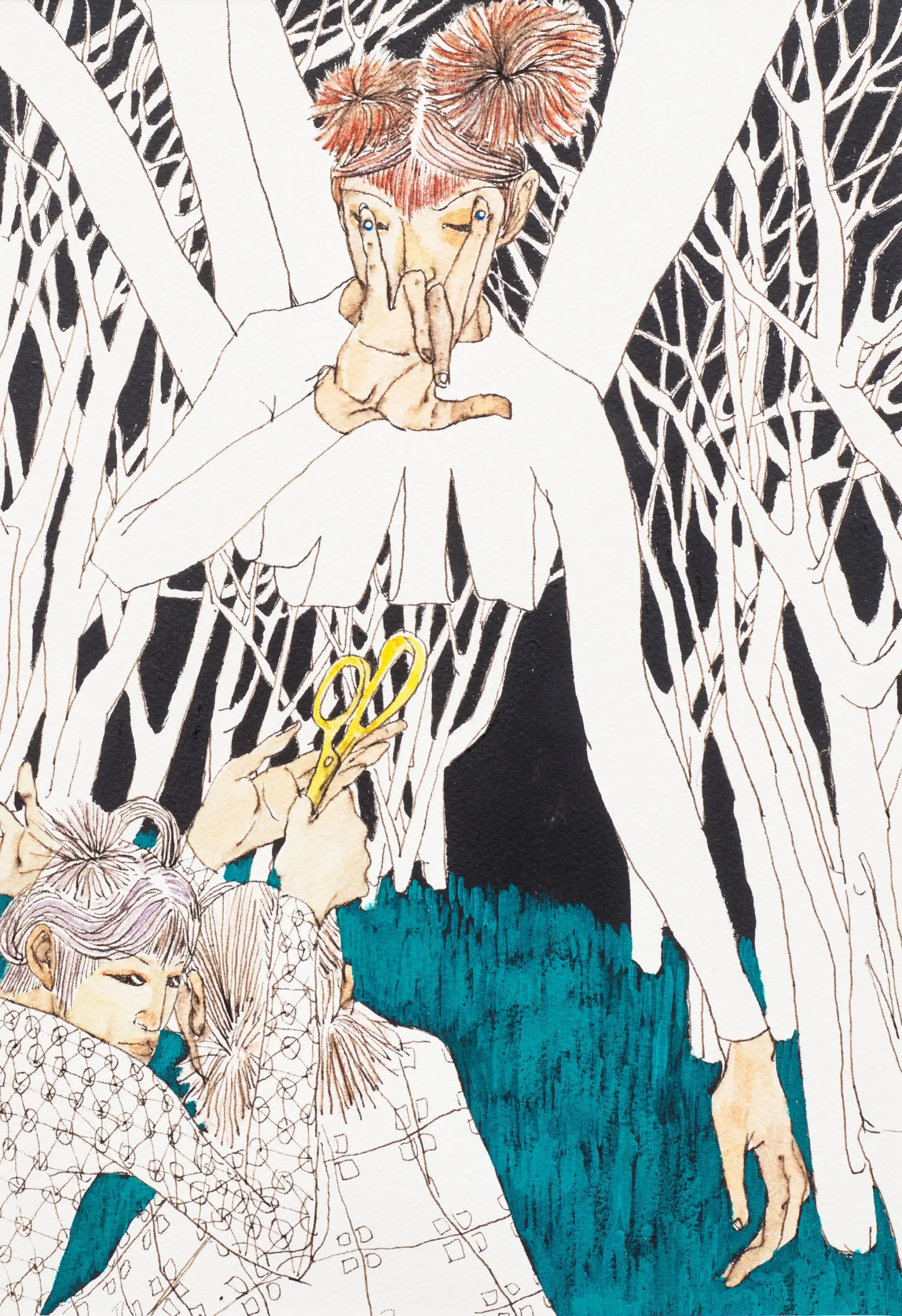
Ding Shilun doesn’t start a painting with a finished story in mind. By his own account, he often begins with a single detail — an eye — and lets the rest of the composition accumulate around it. “It’s like a puzzle game, it comes piece by piece,” he has said of his process, adding that he sometimes finishes a work without being able to trace exactly where it began. That improvisational logic is on full display in D47-Gaze.
At just one lot among a sale that also includes work by George Condo, Sterling Ruby, and James Turrell, D47-Gaze is a modest object by scale and price relative to Shilun’s recent auction results. But it offers a useful, compact entry point into a practice that has, over the past two years, carried the 27-year-old artist from a London postgraduate studio to institutional solo shows on three continents.
in
The work centers on a scene built from careful, controlled mark-making: rows of trees rendered in slight, precise strokes, a central figure with elongated, splayed fingers and pom-pom hair, and a supporting cast that appears to be responsible for some kind of minor act of chaos. Shilun varies his line and touch according to material — short, staccato strokes render the grasses underfoot, while denser, flatter patterning describes the figures’ costumes, creating a scene in which every element seems to be occurring simultaneously rather than in sequence.
The narrative hook, such as it is, involves a piece of fabric cut from the central figure’s shirt, which drifts upward to join the forest canopy as it unravels. A flash of yellow scissor handles near the center of the composition points toward the cause, while the culprits themselves linger in plain view, caught somewhere between hiding and showing off. It’s a structure typical of Shilun’s smaller works: a scene with a clear imply of cause and effect, but no single, stable narrative that resolves it. The mischief is legible; the full story is not, and that gap is where the painting does its work.
transition
Shilun was born in 1998 in Guangzhou, into a family already steeped in art — his father is a traditional landscape painter, and his mother ran a local art school, though neither taught him to paint directly. He studied oil painting at the Guangzhou Academy of Fine Arts, graduating with a BA in 2020, before relocating to London to complete an MA in painting at the Royal College of Art, from which he graduated in 2022.
The move proved formative beyond the change of studio. A six-month exchange at the Slade School of Fine Art, which preceded his RCA studies, pushed Shilun to reconsider a figurative lang he had developed within a specific Chinese culture context. Removed from that context, he has said, he was forced to ask how to explain and translate his work for a different audience — a question that reshaped his approach to painting as a medium rather than simply a technique.
His early academic focus in Guangzhou had leaned toward major historical painting, a genre with institutional support and a long tradition in Guangdong province. But Shilun found himself uninterested in the heroic register that mode of painting tends to demand, gravitating instead toward the parts of a story that rarely get told that way. That pivot away from grand historic narrative and toward the overlooked margins of a scene has stayed central to his work ever since, including in a piece as small in scale as D47-Gaze.
scope
Shilun’s view vocabulary draws from an unusually wide set of references: the precision of the Lingnan gongbi painting tradition, the expressive line work of Japanese manga, the rhythm of stand-up comedy and sitcoms he has described himself as being obsessed with, and — increasingly — the Chinese tradition of zhiguai storytelling, a genre of tales involving ghosts and strange phenomena that indirectly reflect on power and society. Shilun has said he’s less interested in history itself than in how it gets misread, retold, and distorted in the process — with the recurring “ghost” figures in his work standing in for that process of mistranslation.
That deliberate refusal to resolve into a single reading is, by design, one of the more consistent threads across his output. Viewers of his 2024–2025 solo exhibition at the Institute of Contemporary Art, Miami described the work in starkly different terms depending on where they were standing — some finding a hell-like quality in Miami, others in Guangzhou reading similar imagery as something that could ward off evil. For Shilun, that range of interpretation isn’t a communication failure; it’s close to the point. D47-Gaze, with its unresolved cast of onlookers and unexplained act of small-scale destruction, works from the same premise on a much smaller canvas.
idea
Shilun’s working process is famously exacting. He builds up his compositions using heavily diluted oil paint applied in thin, watercolor-like layers, a technique intended to mimic the translucent quality of traditional Chinese gongbi pigment work. The method leaves little room for correction — as he’s put it, the paint “can’t be washed off,” which demands a level of sustained focus he has compared to a kind of dance with the material itself.
That intensity extends to his schedule. Shilun has described working in his studio, located in an industrial pocket of west London, from around 11 a.m. to 11 p.m., seven days a week — a pace he’s characterized less as a discipline he imposes on himself than as something that has simply absorbed the rest of his life. Large canvases can take a month or two to complete under that regimen; smaller, faster works like D47-Gaze offer something closer to a sketchbook release valve between bigger projects.
turnover
Shilun’s institutional profile has built quickly since his 2022 graduation. A 2023 presentation at the Zabludowicz Collection in London extended his intricate watercolor-and-ink illustration practice into a site-specific wall mural, anchoring a salon-style display of thirty related works and tracing a recurring, spiky-haired artist-surrogate character through a series of urban, semi-supernatural encounters.
That was followed by “Janus,” his first solo US museum exhibition, staged at the Institute of Contemporary Art, Miami from December 2024 through March 2025. The show debuted a group of newly commissioned paintings alongside a site-specific install, drawing on Nuo opera — a form of ritual show from Chinese folk religion — as well as Francisco Goya’s Los caprichos prints, with the exhibition’s title taken from the two-faced Roman god of beginnings and endings. Shilun has described his approach to storytelling across these works as a “personal fable,” with the recurring figures in his paintings functioning as projections of himself navigating life across different cultures and belief systems.
Alongside his solo program, Shilun’s work has entered a number of significant institutional collections, including the ICA Miami, the High Museum of Art in Atlanta, the Dallas Museum of Art, the Albertina Museum in Vienna, and the Art Gallery of Western Australia in Perth. A 2025 inclusion in Hauser & Wirth’s group exhibition “Interior Motives,” alongside painters Koak and Cece Philips, marked an early step into a more established blue-chip gallery context beyond his primary representation with Bernheim Gallery in Zurich and London.
arena
Shilun’s secondary market has developed rapidly and somewhat unevenly, in keeping with an artist still early in his auction history. His 2021 painting The Adoption of the Maiden sold for £114,300 (roughly $151,500) at Phillips London, more than quadrupling its £20,000–30,000 presale estimate and setting what was then a new benchmark for the artist. That record didn’t hold for long: in May 2026, his 2022 work Three Princes sold for more than seven times its low estimate at Sotheby’s, reaching $358,400 — a result acquired by the consignor at Shilun’s very first solo exhibition with Bernheim in Zurich back in 2022, when the artist’s prices were a fraction of where they stand today. Both results have come from a genuinely small pool — only a handful of Shilun’s works have appeared at auction to date, with a smaller painting titled RING selling within estimate for just over $5,000 at a Phillips Hong Kong sale as recently as this past March — which makes each new sale disproportionately influential in setting expectations for where his market sits. Against that backdrop, D47-Gaze’s comparatively modest £4,000–6,000 estimate reflects its status as a smaller-scale watercolor and ink work rather than one of the large-format oil paintings that have driven Shilun’s headline auction results, and offers a lower-cost entry point for collectors watching his market from the sidelines.
return
The most significant milestone on Shilun’s current calendar is closer to home. From May 20 through June 28, 2026, the Song Art Museum in Beijing’s Shunyi District hosted Shilun’s first comprehensive solo presentation in China — a homecoming of sorts for an artist who has built almost his entire institutional exhibition history in London, Zurich, and Miami since leaving Guangzhou. The museum itself, opened in 2017 and set among 199 planted pine trees that give the institution its name, has built a reputation for pairing historic Chinese painting with contemporary practice, making it a fitting, if coincidentally tree-lined, venue for an artist whose smaller works — D47-Gaze among them — often return to forested, semi-domestic settings as a backdrop for their stranger events.
The Beijing exhibition followed closely on the heels of “Spectres in Rehearsal,” Shilun’s third solo show with Bernheim Gallery, staged in Zurich from February through April 2026. That exhibition’s four large-scale paintings leaned into grand history painting conventions — Jacques-Louis David-style composition crossed with Bruegel-esque humor — positioning Shilun, as one gallery text put it, as a kind of contemporary Balzac charting a Human Comedy for the present day.
niche
Set against those large, theatrical institutional presentations, D47-Gaze reads as something closer to a working sketch of the same instincts at smaller scale — a single vignette rather than a stage-managed tableau, built from the same layered, diluted-paint technique and the same refusal to hand the viewer a tidy resolution. The scissors, the drifting fabric, the onlookers who aren’t quite hiding: all of it works from the same “personal fable” logic Shilun has applied to his largest institutional commissions, just compressed into a single sheet of watercolor and ink.
For collectors and viewers encountering Shilun’s work for the first time through an online sale rather than a museum wall, that compression may actually be an advantage. D47-Gaze doesn’t require familiarity with zhiguai folklore or Nuo opera to land; the mischief is legible on its own terms, even as the fuller network of reference — manga, Chinese tradition, pop culture, personal memory — sits just beneath the surface for those inclined to dig further.
fin
Shilun has signaled plans to expand beyond painting and watercolor into comics and stop-motion or handmade animation, extending the paper models and props he already builds as preparatory material for his canvases into standalone works. He has spoken about wanting to preserve a hand-made element in that expansion even as digital and AI-assisted tools become more available to artists working in adjacent media, describing the physical contact between material and body as something he isn’t willing to give up. Additional institutional exhibitions are reportedly in development, including a forthcoming show at the Albertina Museum in Vienna, continuing a run of international placements that shows little sign of slowing down.
Related Articles
Where the Face Should Be, Rafael Silveira Paints Open Sky
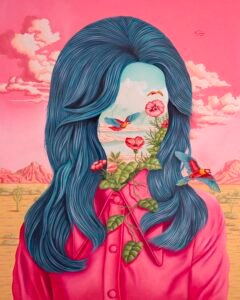
A pink shirt, shoulder-length hair, then no face at all: in “Surprise,” Rafael Silveira lets flowers and a clear blue sky stand in for the person.