DRIFT AUDIO
Listen to this story
Choose a voice, then press play.
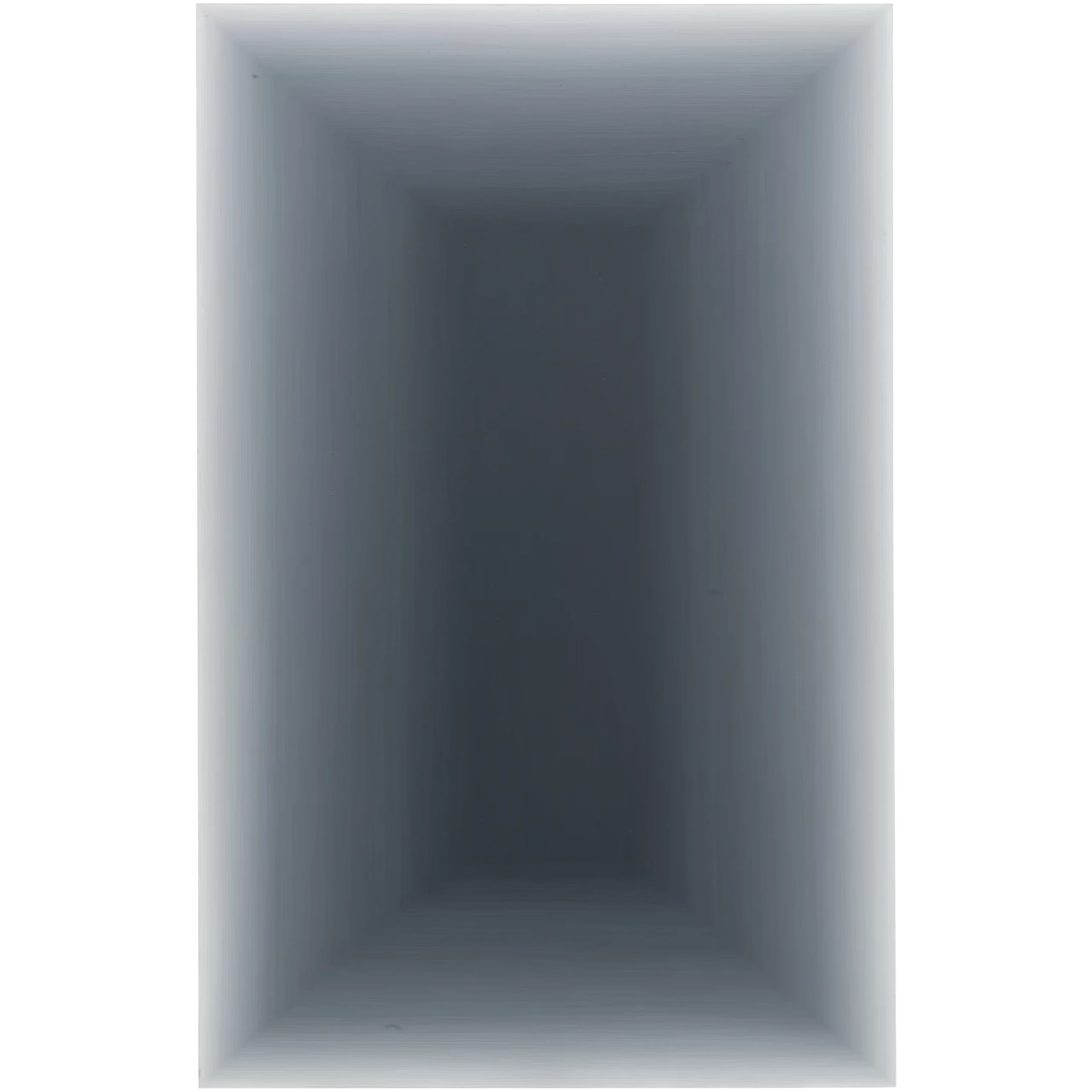
Wang Guangle paints a single color for months at a time, twice a day. 120330 is what that discipline looks like at nearly nine feet tall.
Wang Guangle was born in 1976 in Songxi, a small town in China’s Fujian Province. At 16 he left for Beijing to attend the high school affiliated with the Central Academy of Fine Arts (CAFA), then continued into the academy’s oil painting department, where he studied under painter Liu Xiaodong, a figure closely associated with the observational, socially grounded realism that dominated Chinese academic painting through the 1990s. Wang graduated in 2000 and won the Director’s Prize, CAFA’s top honor, for his thesis piece, a five part painting called “3 to 5 p.m.” that tracked a sliver of sunlight crossing the floor of an empty classroom. It was a strange, shh subject for a graduating show, and it set the direction for everything that followed: light, duration and the accumulation of very small changes over very long stretches of time.
Three years later, Wang and eleven fellow CAFA graduates gathered in Beijing and decided to start showing together. They called the group N12, a name Wang himself has described as an arbitrary designation with no real meaning behind it, chosen only because painting was the one working method all twelve members happened to share, not because their individual work had anything else in common. The group, which also counted painters Hu Xiaoyuan and Qiu Xiaofei among its members, held its first exhibition at the CAFA gallery in 2003 and staged three more annual group shows through 2006, becoming one of the most closely watched Neo Academic collectives to come out of Beijing that decade, and one whose members (Wang included) would go on to build the bulk of their individual careers off the credible the group built early on.
Around the same time, Wang began painting terrazzo floors, the speckled stone composite common to Chinese hospitals, schools and apartment blocks of the 1980s and 90s. His uncle had worked with the material, and Wang has spoken about the process of rendering its tiny embedded stones as something close to needlework, a task he compared to his mother knitting sweaters. In a later interview with the writer Helu, he described a single terrazzo canvas taking three months or longer to complete, and said it was the time invested, more than the finished picture, that mattered most to him.
Perot Museum of Nature and Science, Dallas
flow
By 2004, Wang had turned toward the subject that would define his career. In his home province of Fujian, it is customary for elderly residents to buy their own coffin in advance and apply a coat of red lacquer to it once a year, a ritual act of preparation and acceptance that continues until the owner dies. Wang adapted that ritual into a painting method he called Coffin Paint: acrylic layered onto canvas in a fixed, repeated sequence until the surface built up into something closer to sediment than picture. The resulting works fell into two recurring formats, either a dense stack of horizontal hue bands that drip off the canvas’s lower edge, or a large rectangular field where the tincture shifts almost imperceptibly from a dark, saturated center to pale gray at the margins.
Wang debuted the series at Aye Gallery in Beijing over the winter of 2007 and 2008, then followed it with solo shows at Beijing Commune in 2009 and 2011, while also showing in group exhibitions further afield, including the Prague Biennale in 2009 and the Busan Biennale in South Korea in 2010. Individual Coffin Paint works from this period range from densely saturated, multi-tincture canvases (an early one is titled simply “9 Tins of Acrylic Paints,” a nod to the literal number of paint cans emptied into it) to near monochrome fields in muted grays. It was also in those years that Pace’s Beijing outpost began including Wang in its annual “Beijing Voice” survey shows, in 2010 and again in 2011, the kind of low key institutional courtship that tends to precede something bigger. Work from this stretch of Wang’s career now sits in the collections of M+ in Hong Kong, the Rubell Museum in Miami, Sammlung Goetz in Munich, the Long Museum in Shanghai, the Fondation Guy and Myriam Ullens in Switzerland, and the Vanhaerents Art Collection in Brussels, among others.
show
That something bigger came in the form of a new body of work Wang started calling, simply, Untitled. The paintings extended directly out of Coffin Paint’s logic (layered acrylic, a fixed sequence, no narrative content) but pushed the accumulation further: Wang added paint to each canvas twice a day, with every new layer pulled slightly farther back from the edge than the one before it. Over weeks or months, the center of the painting thickens into something almost sculptural, ringed by a paler band of earlier, thinner layers that functions like a built in frame. True to the method, each finished painting takes its title from the date Wang decided it was done, rendered as a six digit string: year, month, day.
120330, painted in 2012, carries that logic to a genuinely monumental scale. At 280 by 180 centimeters, roughly nine feet two inches by five feet eleven, it sits at the very top of the size range Wang was working in during this period, matched only by a handful of other Untitled canvases from the years around it. According to the gallery material accompanying its exhibition, it was among the paintings selected to represent Wang in what became a pivotal American showcase, and by most accounts the largest and most physically commanding work in that room.
There is an obvious philosophical undercurrent running through all of this, whether or not Wang intended it as such. Martin Heidegger spent the better part of “Being and Time” arguing that existence cannot be separated from its own duration, that to be is always to be situated inside a stretch of time rather than a single instant. Wang’s paintings do not illustrate that idea so much as they enact it: a viewer standing in front of 120330 is looking at hundreds of individual, dated decisions, compressed into one static object. It is the same question Wang was already circling as a 24 year old CAFA graduate, when he spent his thesis show tracking sunlight across an empty floor. The philosophy is optional. The arithmetic of the labor is not.
retro
In June 2012, Pace Gallery opened what it billed as the first solo exhibition of Wang’s work in the United States, at its 534 West 25th Street space in Chelsea. The show ran from June 22 through August 10 and gathered seven new paintings from the Untitled series, 120330 among them. Pace’s own catalogue text at the time laid out the mechanics of the work in plain terms: canvases built from layers of acrylic paint applied in a predetermined order, the tone shifting as the layers accumulate, the lighter gray perimeter reading almost like a frame around a darker, denser core.
What made the show notable in hindsight is timing. Wang would not become a formally represented Pace artist until 2014, two years later. The 2012 exhibition functioned instead as an introduction, the kind of show a major gallery mounts to test an audience’s appetite before making a longer commitment. It followed a run of institutional attention that had been building steadily in China: N12’s continuing group shows, the Beijing Voice inclusions, and, according to Pace’s own bibliography, a January 2012 Wall Street Journal feature on China’s emerging art market that ran just months before the Chelsea opening. Within a year of the New York show, Wang’s work would appear in the Ullens Center for Contemporary Art‘s survey “ON | OFF: China’s Young Artists’ Concept and Practice” in Beijing and in the California Pacific Triennial at the Orange County Museum of Art, part of a broader wave of curatorial interest in the generation of Chinese painters who had come up through CAFA in the early 2000s.
Once the formal representation did arrive, it held. Pace gave Wang a second New York show in the fall of 2014, at its 510 West 25th Street space, accompanied by a catalogue titled “Time Paintings” with an essay by critic Dan Cameron. A third followed in January 2019 (“Duo Color,” fourteen new paintings), and Wang’s relationship with the gallery expanded outward from there: a London debut in 2016 called “Yellow,” a second London show in 2022 titled “Faded Colours,” a first Korean solo in Seoul in 2024, and, most recently, “Delayed Gravity” at Pace’s Chelsea headquarters in early 2026, his first New York show in seven years.

Pace Gallery
two
What the 2012 show did not have, and what none of Wang’s exhibitions really have, is much in the way of spectacle. There is no gesture to photograph, no single dramatic brushstroke. The labor is the point, and the labor is deliberately unglamorous: two coats of paint, applied at more or less the same time every day, for as long as it takes. It is not a coincidence that the method traces back to a mourning ritual. Painting a coffin once a year is a way of metabolizing the fact that time is passing and will keep passing regardless of what anyone does about it. Wang’s studio practice asks the same question of the canvas, just on a compressed and secular timeline.
The instinct toward repetition has followed Wang outside the canvas, too. In an ongoing body of work called Phosphorus, begun in 2007, he coats surfaces in red match striking phosphor and lets studio visitors try, and mostly fail, to strike a flame across it, accumulating a record of gestures rather than a record of paint. In 2023, Gallery Weekend Beijing commissioned him to build “White Box,” a maze like outdoor sculpture with walls just tall enough to keep visitors visible from outside even as they lose their bearings inside it. Wang has called it “a flawed stage, a cube with cracks that are then filled with the performers’ bodies,” and in 2024 theater director Chen Zihao adopted the structure as the literal stage set for his production “500 Miles.” The throughline from a repainted coffin to a maze built for other people’s movement is not subtle: Wang keeps building structures that only complete themselves once time, and other people, pass through them.
But the 2012 show, and 120330 with it, mark the point where a painter working almost entirely within Beijing’s own institutions first had to answer for his method in front of an audience that had never seen a coffin repainted for luck.
Related Articles
fnnch Revives the Honey Bear Hunt for Halloween, No Tape Required
San Francisco’s honey bear artist is turning porch season into a scavenger hunt again, five […]