DRIFT AUDIO
Listen to this story
Choose a voice, then press play.
Rouje marks ten years in business by opening a bistro inside its own flagship, built from the founder’s memories of growing up in her parents’ restaurant.
On May 30, 2026, a door opened at 11 bis rue Bachaumont in Paris’s second arrondissement, and it was not a new clothing rack or a beauty counter behind it. It was a bistro counter in worn wood, a scattering of small mosaic tiles underfoot, and banquettes upholstered in the same red that has defined Rouje since Jeanne Damas started the label a decade ago. The Café en Rouje sits inside the brand’s flagship, the same address where Rouje first put down physical roots in Paris back in 2019, and its arrival coincides deliberately with the label’s tenth anniversary.
View this post on Instagram
Damas has never been shy about the fact that Rouje was built as an idea of Parisian life before it was a business plan, and she has said as much directly. Speaking to AD Magazine ahead of the opening, she framed the project in blunt terms: her sense of Rouje has always run through cafés, so a café was, in a way, overdue. What is notable is how personal the framing gets from there. This is not a brand extension dreamed up by a strategy deck. It is a room assembled, tile by tile, out of a childhood spent in a family restaurant.
stir
Damas grew up around a restaurant her parents ran, and she has described the physical details of that place with the kind of specificity that only comes from actually having lived inside it: aged mirrors, a floor made of broken tile fragments, banquettes that had already absorbed a thousand conversations by the time she was old enough to notice them. That description is not incidental. It is close to a blueprint for what the Café en Rouje now looks like.
The comparison she draws is to Proust’s madeleine, and she uses the phrase without irony. As a child, she could always find her parents at the restaurant, at almost any hour, and there was a kind of security in that. The café, she has said, revolves entirely around that memory. It is less a themed environment than an attempt to rebuild a specific feeling of being reachable, of a place that runs on its own rhythm and lets people linger in it.
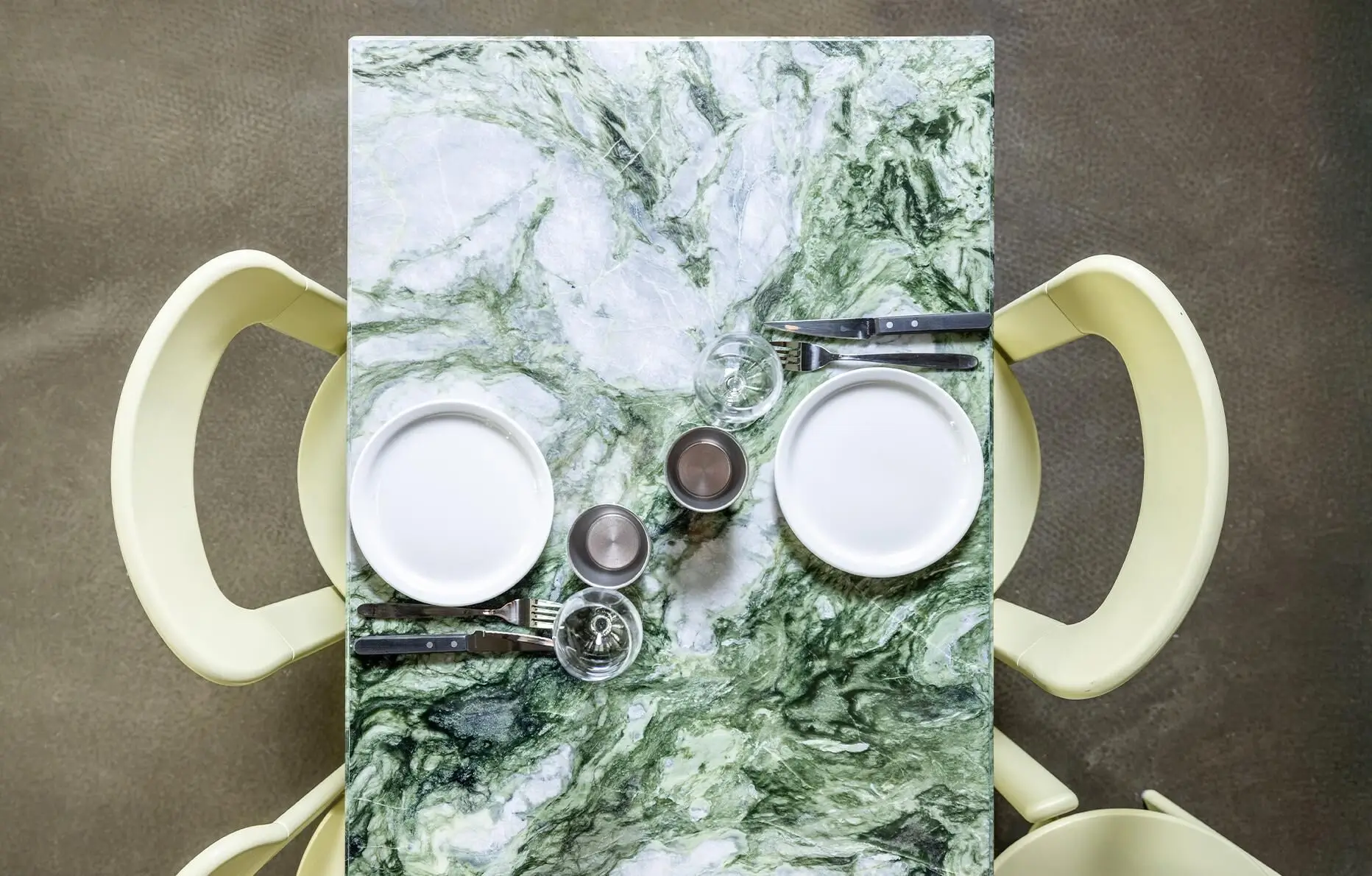
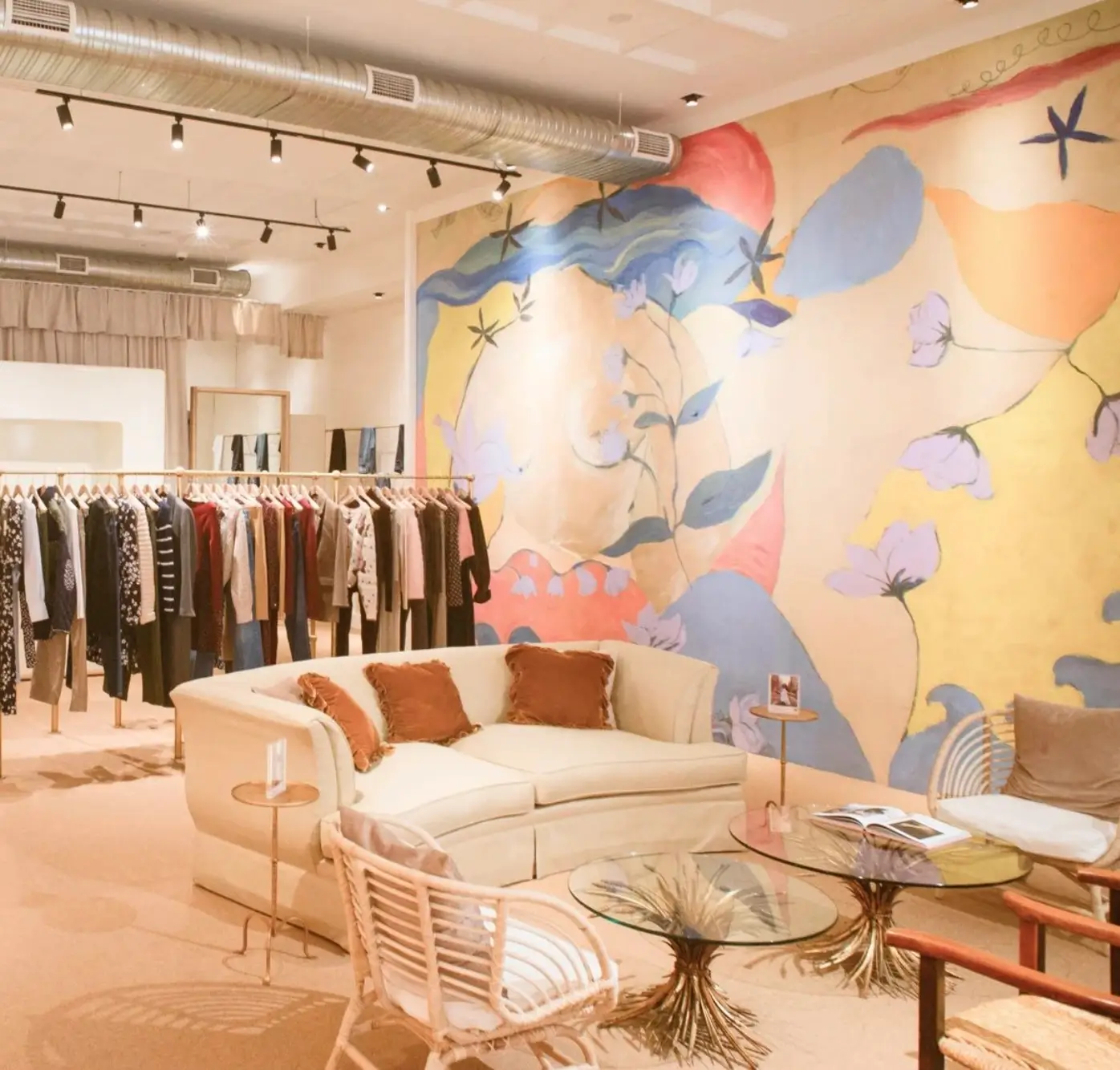
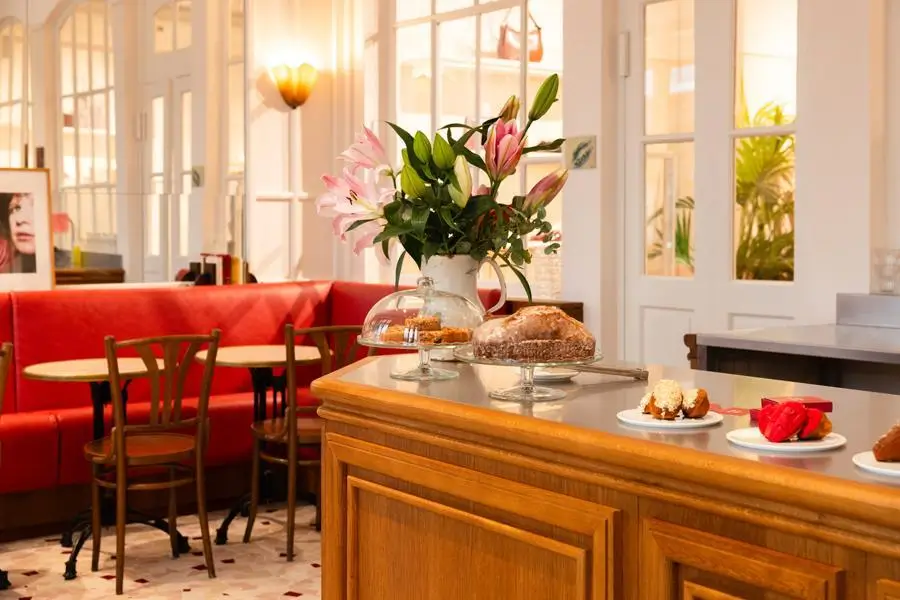
Physically, the space favors warmth over polish. The wooden counter is the visual anchor, flanked by mosaic tile work and red banquettes that read as inherited rather than newly installed, even though everything in the room is new. Coverage in the French press since the opening has repeatedly used the word bistro rather than café, and that distinction matters. A bistro implies a slower churn, a room built for sitting rather than passing through, and that is the register the Café en Rouje is working in. It sits inside a working retail flagship, but the intent is clearly to pull people out of shopping mode and into something closer to a neighborhood ritual.
show
The menu is short and specific rather than expansive. The signature item is a housemade madeleine, baked fresh each morning and served alongside the coffee, which functions as the room’s most literal nod to the Proust reference Damas keeps returning to. It is meant to be eaten on site or taken away, and its presence on nearly every table has already become something of a visual signature for the space.
Coffee itself is sourced through Fève, a Paris-based specialty roaster known within the city’s coffee scene for working directly with growers and favoring precise, small-batch roasting over volume. Beans are available to buy and grind on site, a detail that pushes the café slightly toward the specialty coffee shop model even as its interior leans fully into old-school bistro signaling. Alongside coffee, the café pours tea and a matcha latte, plus a signature drink built around chocolate, beetroot and vanilla with a note of Espelette pepper, an unusual combination that reads as the one place on the menu where the concept gets genuinely of play rather than nostalgic.
None of this is presented with much fuss. Reporting from Sortiraparis and Time Out Paris both describe a room built for repeat visits rather than a single splashy debut, the kind of place a nearby office worker might duck into on a Tuesday rather than a destination requiring a special trip. That is very much in keeping with how Damas has talked about the project. The ambition was never to build a landmark restaurant. It was to build a room that behaves like the one she grew up in.
There is a practical rhythm to the menu that is easy to miss on a first read. The madeleine is baked in house every morning rather than shipped in from an outside pastry supplier, which means the café is committing to an actual kitchen operation instead of a display case restocked on a delivery schedule. That is a meaningful shift for a brand whose retail business has, until now, run entirely on manufactured goods with long production lead times. Coffee, tea and pastry are perishable, made-to-order categories, and running them well day to day requires a different kind of discipline than shipping a clothing collection twice a season. Choosing to build that discipline internally, rather than licensing the café to an outside hospitality operator the way many fashion brands do with their restaurant tie-ins, is itself a signal of how much creative control Damas wanted over the finished room.
scope
Rouje’s expansion into food and drink is its first real move outside apparel and beauty since the label launched Les Filles en Rouje, its cosmetics line, in 2022, and it is worth pausing on how deliberate the sequencing has been. Rouje built a clothing business first, working almost entirely through online sales for its earliest years before opening any physical retail space at all. It then added a beauty arm once the fashion side was established, and only now, a full decade in, has it stepped into hospitality. Each step has stayed tightly authored by Damas herself rather than handed off to outside category experts brought in to run a new division, which is part of why the café reads as continuous with the rest of the brand rather than bolted onto it as a marketing exercise.
That continuity is worth dwelling on, because plenty of fashion labels have tried the café-as-brand-extension move and ended up with something that feels closer to a themed pop-up than an actual neighborhood spot. The difference here seems to be that Damas is not borrowing hospitality as an aesthetic. She grew up inside one, spent her adolescence around the specific mechanics of running a restaurant, and is now applying that lived experience to a room that happens to also sell branded keychains. Whether that distinction survives contact with day-to-day operations, the churn of service, the wear on those banquettes after a few thousand covers, is the kind of thing that only becomes clear months in. But the intent, at least, is legible from the opening week coverage: this was built by someone who understood the category from the inside before she ever touched a clothing pattern.
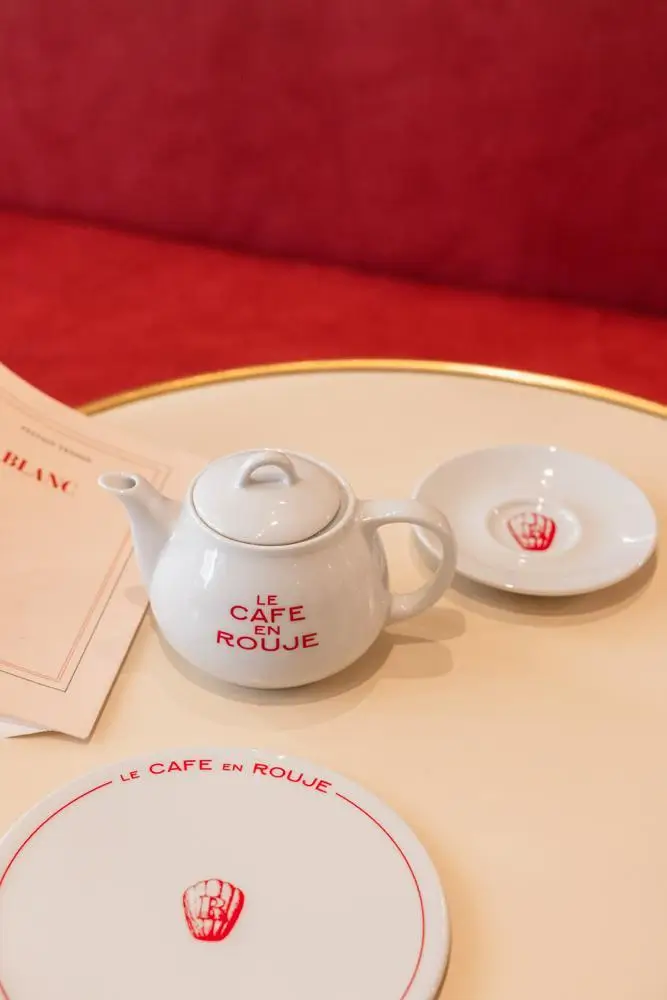
The retail logic sitting underneath the café is straightforward. A capsule of Café en Rouje branded goods launched alongside the space itself, including cups and saucers, keychains, matchboxes and a t-shirt, all carrying the café’s own mark rather than the main Rouje logo. Bagged coffee beans, roasted by Fève specifically for the café, are also sold to go. None of this is unusual for a lifestyle brand looking to extend its footprint, but it does mean the café functions on two levels at once: as a working neighborhood spot serving actual coffee, and as a fully merchandised extension of Rouje’s retail business, generating its own product line rather than simply lending its name to somebody else’s café concept.
View this post on Instagram
That dual function is very much in line with how Rouje has operated from the start. Damas built the label around a specific, curated vision of French femininity and everyday Parisian style, drawing on inspirations she has cited from Pedro Almodóvar’s films to the particular ease of a woman walking through Belleville. The café simply gives that same aesthetic a physical room people can sit in rather than a wardrobe they put on. It is worth noting, too, that Damas’s own path into fashion started with a similarly personal thread: as a teenager working a stint at Jean-Paul Gaultier’s atelier, arranged after he became a regular at her parents’ restaurant, before she eventually built her own label out of a Tumblr blog documenting her style.
fin
The choice of address is not incidental either. Rue Bachaumont sits in the Montorgueil neighborhood, a pocket of the second arrondissement that has become closely associated with a particular strand of contemporary Parisian retail and dining, dense with small independent shops and restaurants rather than large flagship chains. Rouje has occupied this same address since 2019, when it opened its first physical store there alongside Chez Jeanne, Damas’s earlier restaurant venture next door. Folding the Café en Rouje into that same building rather than opening a standalone location elsewhere keeps the entire footprint concentrated in one spot, reinforcing the idea of the address as a kind of Rouje campus rather than a single retail outpost.
For a label whose identity has always leaned on a specific, walkable version of Paris rather than a generic luxury address, that concentration matters. The Café en Rouje does not need to prove itself as a destination restaurant competing on the wider Paris dining scene. Its job is narrower: to give people already in the neighborhood, or already shopping the Rouje store, a reason to sit down for a few minutes longer.
It also means the café inherits a built-in customer base rather than having to build one from zero. Anyone already familiar with Rouje’s clothing, or with Damas’s own following, arrives at the café with a reasonably clear sense of what to expect stylistically before they have even ordered. That is a genuine advantage over a standalone café opening cold in a competitive neighborhood, and it is one Rouje earned the slow way, through nearly seven years of operating a physical store on that exact block before adding the coffee counter. Ten years into the brand’s life, that modesty of ambition, a coffee counter rather than a full-scale restaurant relaunch, reads as a fairly accurate summary of how deliberate Rouje has built itself out, one recognizable room at a time, rather than chasing a splashier hospitality debut elsewhere in the city.
Related Articles
Jerry Hsu Put Fifteen Years Of Los Angeles In A Book Called Never
How About Never, MACK, 2026. Skateboarder, photographer, first years living alone. A marriage hidden until […]