DRIFT AUDIO
Listen to this story
Choose a voice, then press play.
A 240 million year old predator is being freed from rock in public view, by volunteers with day jobs and no paleontology training at all.
On the ground floor of the Copernicus Science Centre in Warsaw, there is a laboratory with walls made entirely of glass, and on the other side of that glass there is usually a small crowd. Children press against the barrier and point. Parents stand back and try to work out what kind of animal could have owned bones this size. Inside the room, people in protective goggles hunch over slabs of rock, working a pneumatic chisel back and forth in movements so small they barely look like movement at all.
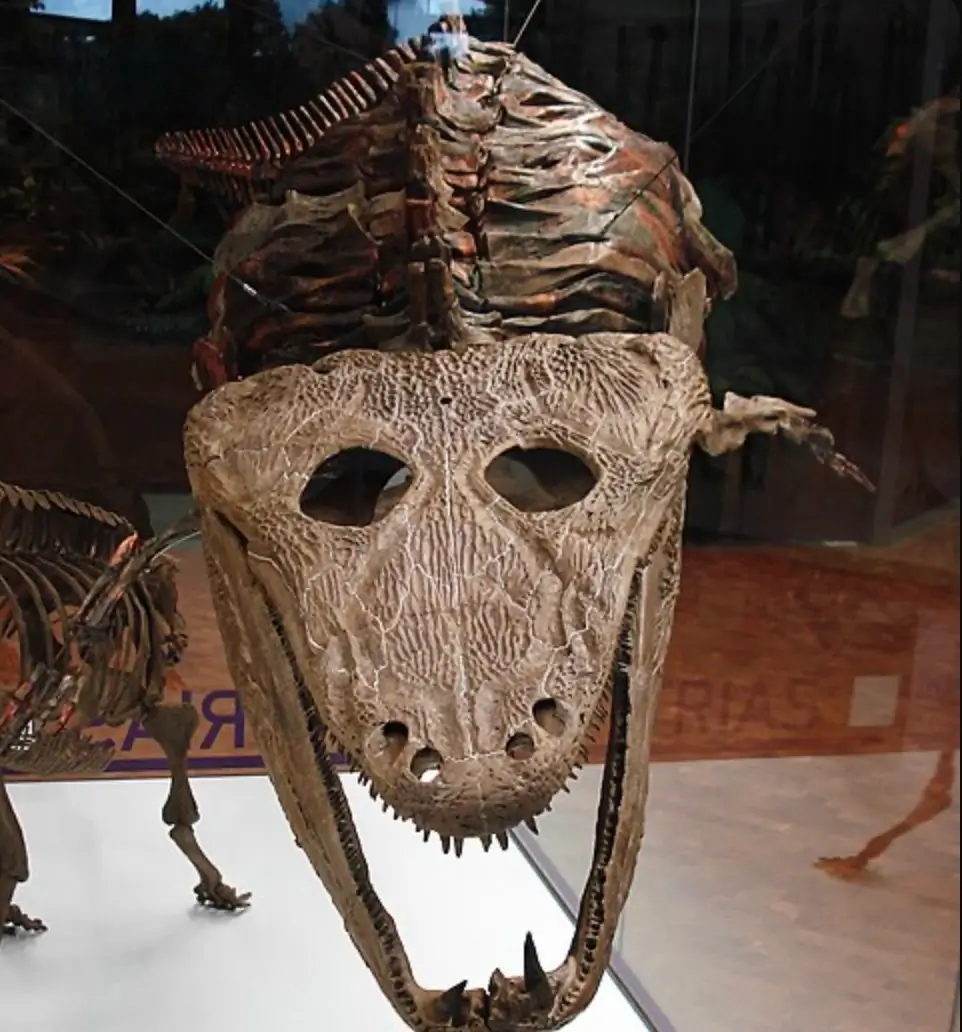
What they are freeing, millimeter by millimeter, is the skeleton of a Mastodonsaurus, an aquatic ambush predator that patrolled the rivers and lake beds of what is now Poland about 240 million years ago, during the Middle Triassic. It is one of the largest amphibians that has ever existed, and the specimen taking shape in that Warsaw laboratory is unlike any other found anywhere in the world.
More than 2,000 volunteers have rotated through the project so far, working under supervision in two hour sessions, and the whole operation is designed to happen where the public can see it rather than behind closed doors in some university back room. That visibility is the point. This is not a dig site cordoned off from the world. It is restoration as performance, and also as public science education, running in real time in the middle of a capital city.
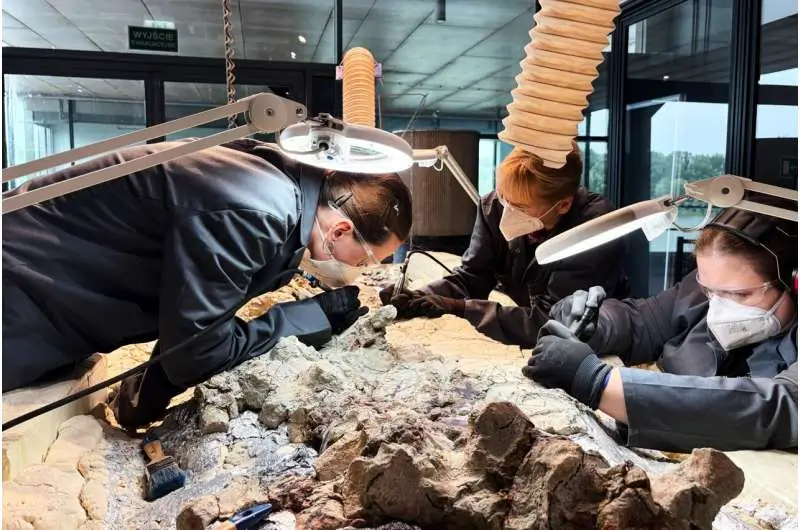
Paleontology specialists meticulously uncover fossilized dinosaur remains using fine tools during a conservation and excavation process inside a museum laboratory.
Most museum conservation work happens far from any visitor’s eyeline, in back rooms with climate control and swipe access, precisely because the process is slow and unglamorous and easy to damage if handled wrong. The Copernicus Science Centre inverted that logic entirely. Rather than hide the slowest, least photogenic part of paleontology, the museum put it on display and staffed it with the public. The bet is that watching real scientific labor, however tedious it looks from the outside, is more compelling than any finished exhibit could be on its own. Judging by the crowds pressed against that glass wall, the bet has paid off.
idea
The process is slower and more delicate than most people picture when they hear the word excavation. Bone has to be separated from the surrounding rock in tiny increments, using a pneumatic chisel whose needle tip gently breaks the stone away without touching what lies beneath it. Ultraviolet light plays a critical role here too: under UV, the boundary between fossilized bone and the rock encasing it becomes visible in a way it simply is not under ordinary light, letting volunteers see exactly where to stop.
Nobody picks up that chisel without preparation first. New volunteers go through training and are issued protective gear before they are allowed anywhere near the specimen, and even then they work in supervised two hour blocks rather than free sessions. It is closer to surgery than digging, and the scientists running the project treat it that way.
The rock encasing the bones is not uniform either, which is part of why the work cannot simply be automated or handed to a machine. Sediment hardness shifts from one section of the block to the next, and a chisel setting that safely clears rock in one spot can crack bone in another a few centimeters away. That is why supervision stays constant rather than tapering off once a volunteer has logged a few sessions: a trained eye needs to be watching the UV boundary line as closely as the hands holding the tool. It also explains why a project this size takes months rather than weeks, even with thousands of people contributing labor. Scale helps, but it does not replace patience.
through
Part of what makes this project unusual is who is doing the work. These are not graduate students or career geologists putting in hours between coursework. Tatyana Kozyk, who coordinates the volunteer teams, has described the group as managers, cleaners, and tattoo artists rather than trained paleontologists, which is precisely the point of opening the process to the public in the first place.
Kozyk herself has talked about the strange gravity of the work. Handling bone that has sat underground for nearly a quarter of a billion years and realizing she may be the first human being to ever touch a given piece of it is not something she has fully processed, by her own account.
Dorota Serafin, a 51 year old manager from Warsaw who has become one of the project’s regular volunteers, described the experience in almost meditative terms: relaxing and philosophical, even mystical, working alongside the remains of something this old. She has said she plans to keep returning for more sessions, and that she wants to bring her own family to see the finished skeleton once it goes on public exhibition later this year.
There is something worth sitting with in the fact that a project of this scientific weight runs largely on people who signed up between shifts at other jobs. A tattoo artist and a corporate manager kneeling side by side over the same slab of ancient rock is not the image most people carry of how paleontology gets done, and that gap between expectation and reality seems to be exactly what draws people back for repeat sessions. The work does not ask volunteers to already understand Triassic biology. It asks for steady hands, patience, and a willingness to follow instructions precisely, which turns out to be a far more available skill set than an advanced degree in geology.
discover
The skeleton itself was found in southern Poland in 2023 by Tomasz Sulej, a paleontologist and professor at the Institute of Paleobiology at the Polish Academy of Sciences, working alongside Wojciech Pawlak of the Faculty of Geology at the University of Warsaw. It was Sulej and Pawlak who came up with the idea of inviting members of the public in to help with the restoration rather than keeping the work confined to specialists.
According to Sulej, the specimen is already revealing anatomy that does not match earlier assumptions about how a Mastodonsaurus was built. The structure of the body is different from what scientists previously understood, he has said, calling the information genuinely new to the field rather than a confirmation of existing models. That alone would justify the years of careful work ahead. Other Mastodonsaurus remains have turned up before in Germany and in Russia, but those specimens run only about two to three meters long, a fraction of the size of what is emerging in Warsaw.
huh
Scientists estimate the animal could reach nearly six meters, roughly 20 feet, in length, making this the largest Mastodonsaurus skeleton known to exist anywhere. The full skeleton weighs approximately 1,300 kilograms, close to 2,865 pounds, once assembled. When the restoration is finished, Sulej has said it will be the largest specimen of its kind exhibited in any museum in the world.
Picture the animal itself and the scale starts to make sense. It had a broad, flattened head, elongated jaws, and rows of sharp conical teeth, giving it a silhouette that resembles a crocodile at a glance, even though it belongs to an entirely separate branch of the vertebrate family tree. It hunted underwater, ambushing fish and smaller amphibians that shared its lakes and rivers, in an era just before the earliest dinosaurs began appearing on land and long before they came to dominate the planet.
That crocodile resemblance is a case of convergent evolution rather than kinship. The Mastodonsaurus belongs to an extinct group of amphibians called temnospondyls, a lineage that has no living descendants and only a distant relationship to modern frogs and salamanders. Its body plan, a flattened skull built for lurking near the surface and jaws capable of a quick sideways snap, evolved independently of the crocodilians that would eventually fill a similar ecological role tens of millions of years later. Finding a specimen this complete gives researchers a rare chance to check those assumptions against an actual skeleton rather than reconstructions built from partial remains.
upon
The team expects the restored skeleton to go on public exhibition at the Copernicus Science Centre in October or November of this year, transforming a project that has spent months as a live demonstration into a permanent centerpiece for the museum. For a facility built around hands on public science, a 20 foot Triassic predator assembled in full view of thousands of visiting volunteers is about as fitting a flagship exhibit as it could ask for.
Serafin, for her part, is already planning that return trip. Having spent sessions working directly on the bones, she has said she intends to come back once the skeleton is mounted and bring her family along to see the finished version of something she helped uncover piece by piece.
survive
There is a wider context to when this animal lived that the scientists involved keep returning to. The Mastodonsaurus swam the Earth’s waters in the stretch of time after the largest mass extinction event known to science and just before dinosaurs rose to prominence, a period when life on the planet was still finding its footing again.
Sulej has drawn a direct line from that history to present day anxieties about climate change, framing the Mastodonsaurus as something closer to a hopeful case study than a cautionary tale. Nature always finds a way to manage, in his telling, and the idea that humanity could permanently destroy life on the planet runs counter to what the fossil record actually shows. Life and nature, he argues, tend to find ways to survive.
None of which is to say the animal itself was gentle. It was a six meter ambush predator with a mouth full of conical teeth, built to make a living hunting other creatures in murky Triassic water. Which, respectfully, ought to settle the theme park question before anyone brings it up: cleaning the bones of a 240 million year old predator with a pneumatic chisel under museum supervision is one thing. Splicing its genetic material with a frog and opening the gates to the public is an entirely different plan, and one with a well documented track record of going poorly.
For now the only reconstruction underway is the literal one, bone by bone, behind that glass wall in Warsaw, with a few thousand more chiseling sessions standing between the current state of the block and whatever finally goes on display in the fall. Sulej and Pawlak still have work ahead of them mapping exactly how the animal’s body differed from earlier assumptions, work that will likely gen its own findings long after the skeleton itself is mounted and the volunteers have moved on to whatever the museum takes on next.
Related Articles
Jerry Hsu Put Fifteen Years Of Los Angeles In A Book Called Never
How About Never, MACK, 2026. Skateboarder, photographer, first years living alone. A marriage hidden until […]