DRIFT AUDIO
Listen to this story
Choose a voice, then press play.
Jannik Sinner is out with a knee injury. Carlos Alcaraz is back from four months away, and he’s bringing Serena Williams with him.
Qualifying rounds are already underway at the USTA Billie Jean King National Tennis Center, with the main draw of the US Open set to open on August 30 and run through September 13. Every US Open carries its own weather, but this one arrives with an emptied top line and a mixed doubles pairing nobody predicted six months ago.
The tournament’s other signature is smaller and pinker: the Honey Deuce, Grey Goose‘s vodka, lemonade, and Chambord cocktail topped with three honeydew melon balls cut to look like tennis balls. It debuted in 2007 at $12 and holds at $23 this year, the same price as last year, when fans bought more than 550,000 cups for close to $13 million in sales. It has become as reliable a fixture of the grounds as any player in the draw, which this year is saying something.
stir
World No. 1 Jannik Sinner announced his withdrawal on August 21, citing a right knee injury that had already forced him out of the Cincinnati Open earlier in the month. Sinner had not competed since defeating Alexander Zverev in the Wimbledon final in July, a result that gave him his fifth Grand Slam title and a successful defense of his All England Club crown. In an Instagram post, Sinner said he and his team had made the difficult call after more on-court testing in Monte Carlo left him short of full fitness.
It is the first Grand Slam Sinner has missed since his major debut at this same tournament in 2019, and it snaps a run of seven straight US Open appearances that included his first title in 2024 and a runner-up finish to Alcaraz last year. Sinner enters the fall having gone 44-3 with six titles across a season that also included a stumble in the heat against Juan Manuel Cerundolo at Roland Garros. His absence removes the only player who had taken a set off Alcaraz in a major final in the last twelve months, and it leaves the top of the men’s draw thinner than it has been at a hard-court Slam in years.
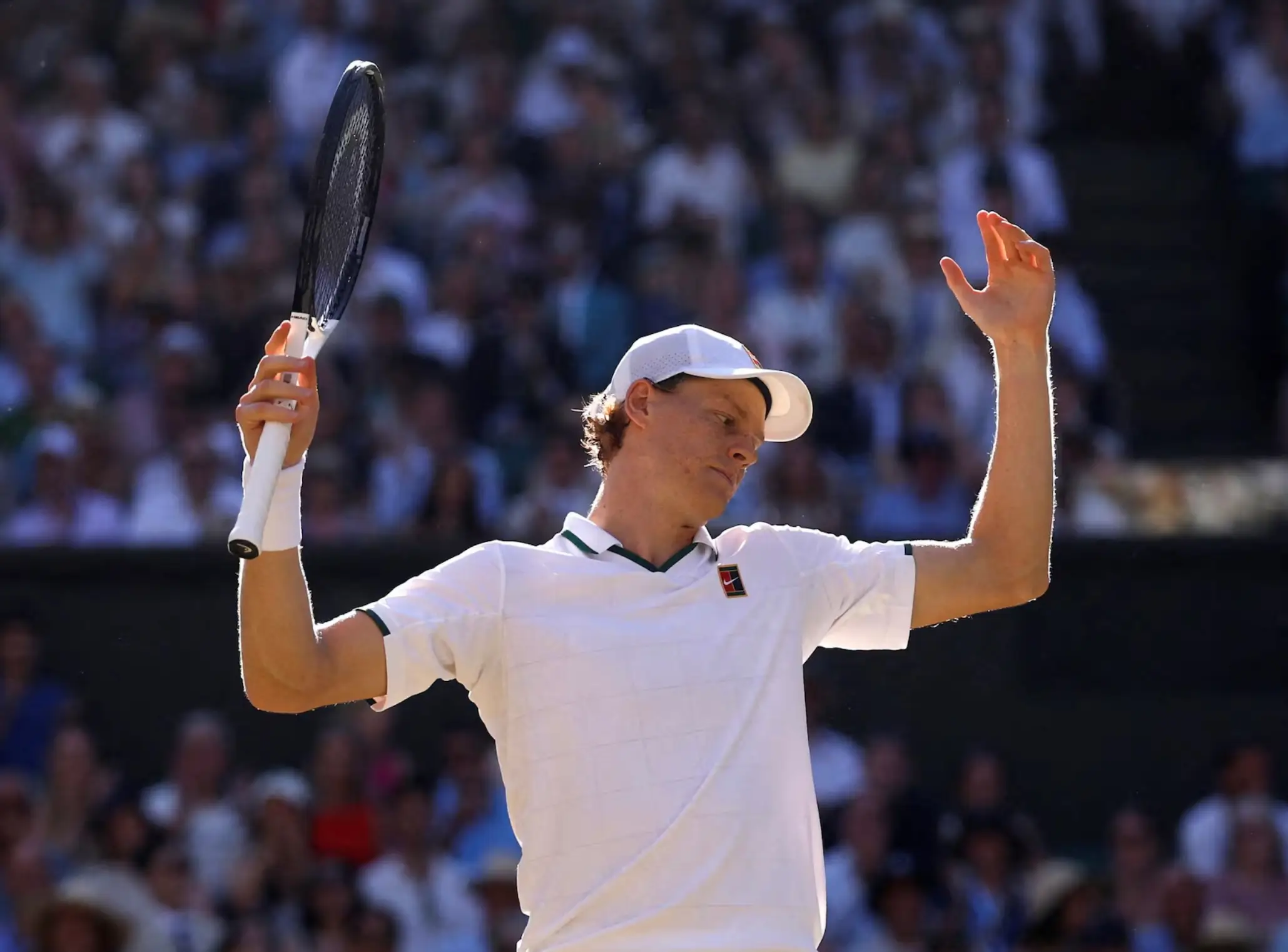
Tennis Player In White Raises His Racket During A Match On A Grass Court
Jack Draper will also sit out New York entirely, both in singles and in the mixed doubles draw, after an ongoing arm injury kept him out of all four majors this year. It marks a rare season in which two of the sport’s most talked-about names, Sinner and Draper, missed multiple Slams in the same calendar year while a third, Alcaraz, missed two of his own before this comeback. Qualifying matches at the Billie Jean King National Tennis Center continue this week regardless, with players outside the direct-entry cutoff fighting through three rounds for one of the sixteen remaining men’s and sixteen women’s singles spots in the 128-player main draws.
straddle
The tournament’s headline act is still walking onto the grounds, just later than planned. Carlos Alcaraz confirmed on August 20 that he would return to competition at the US Open after more than four months away with tenosynovitis in his right wrist, an injury that surfaced during his opening match at the Barcelona Open in April and forced him out of the French Open, Wimbledon, and the North American hard-court swing through Toronto and Cincinnati. “Here we go,” Alcaraz wrote in a video posted with sportswriter Fabrizio Romano, a short line that traveled fast among fans who had watched his season stall after a hot start.
That start was real: Alcaraz opened 2026 by winning the Australian Open and a title in Doha, building a 22-3 record before the wrist injury interrupted his year in April. He trained with fellow Spaniard Holger Rune in Murcia in the weeks before New York, gradually raising the intensity as he tested the joint. He arrives as the two-time defending US Open champion, having beaten Sinner in four sets last September for his second title at the tournament and his seventh major overall, and as the man who now holds the World No. 2 ranking he reclaimed from Zverev after Wimbledon.
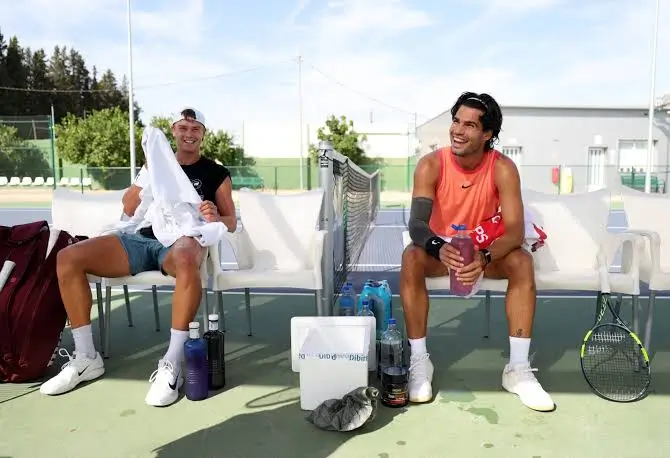
Two Tennis Players Relax And Smile Courtside During A Practice Session
<div style=”max-width:100%;margin:40px 0;”> <img src=”” alt=”Carlos Alcaraz training on court ahead of his US Open return” style=”width:100%;border-radius:16px;box-shadow:0 20px 40px rgba(0,0,0,0.25);”> <p style=”font-style:italic;color:#555;text-align:center;”>Alcaraz worked out with Holger Rune in Murcia in the final stretch before New York. Named public figure: licensed press photo required, not sourced via image search.</p> </div>
A four-month layoff is a long stretch to carry into a best-of-five tournament, and Alcaraz has done it before: he missed the 2023 Australian Open with a hamstring injury and rebuilt from there. What is different this time is the size of the gap he’s returning into. Until this season, Alcaraz had missed only that one major since his 2021 debut; 2026 alone has cost him two, French Open and Wimbledon, to the same wrist. With Sinner out, Alcaraz is the highest-ranked player left standing in a men’s draw that suddenly looks far more open than it did a month ago, and also the one whose own fitness is the least tested going in.
return
The story that has traveled furthest outside tennis circles, though, has nothing to do with the singles bracket. On August 22, the USTA confirmed that Alcaraz would partner Serena Williams in the mixed doubles event, one of the tournament’s three final wild card entries. Williams retired from full-time competition in 2022 but returned to singles this season, playing at Wimbledon before falling in the first round, and more recently partnering her sister Venus in a three-set doubles loss at the Cincinnati Open.
Flushing Meadows is not neutral ground for Williams. She has won the US Open singles title six times, across 1999, 2002, 2008, 2012, 2013, and 2014, and it’s also where her Grand Slam trophy case first opened: in 1998, a 16-year-old Williams partnered Max Mirnyi to win the US Open mixed doubles title, months after the pair had already won Wimbledon mixed doubles together that same year. Combined across singles and doubles, Alcaraz and Williams bring 46 Grand Slam titles into a single pairing, a figure repeated across nearly every outlet that covered the announcement because there’s genuinely no easy comparison for it.
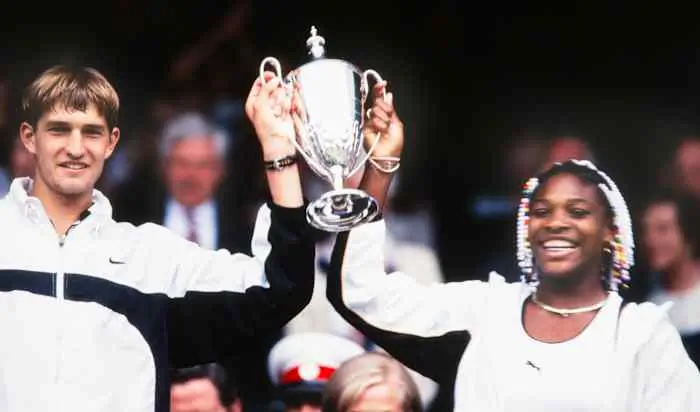
Williams’ 1998 US Open mixed doubles title with Max Mirnyi
Either Williams also enters the singles draw on home soil remains an open question; the USTA has reportedly held back one final singles wild card that could go to her, though nothing had been confirmed as of this writing.
Williams’ broader résumé needs little introduction to anyone who has watched tennis in the last quarter-century: 23 Grand Slam singles titles, a career Golden Slam completed in both singles and doubles, and a run at world No. 1 that spanned parts of three different decades. What makes the Alcaraz pairing land differently than a typical exhibition-adjacent wild card is that Williams has genuine recent doubles form to point to, not just nostalgia. The Cincinnati appearance with her sister showed her still moving well enough at net to be useful in a format that rewards instinct and reflexes over full-match stamina, which is exactly the shape of tennis mixed doubles asks for.
flow
The Alcaraz-Williams pairing is the loudest name on a mixed doubles bracket that the US Open has clearly built for attention. World No. 1 Aryna Sabalenka and 24-time major winner Novak Djokovic are set to be top seeds by combined singles ranking. Americans Emma Navarro and Tommy Paul, along with Karolina Muchova and Jakub Mensik, round out the round of final wild card entries alongside Alcaraz and Williams.
This is the second year running the tournament has staged mixed doubles as its own headline event ahead of the singles main draw, a format the USTA expanded after last year’s version, which paired stars like Iga Swiatek with Casper Ruud and Emma Raducanu with Alcaraz himself, drew heavy attention during Fan Week. That edition ultimately went to doubles specialists Sara Errani and Andrea Vavassori, a reminder that star power and match-winning chemistry don’t always line up. The main-draw mixed doubles matches are scheduled for August 25 and 26, days before the singles tournament even begins, with a reported $1,000,000 purse for the winning team.
The rest of the sixteen-team field filled out through a mix of direct entry and an August 24 qualifying event. Katerina Siniakova and Henry Patten, Gabriela Dabrowski and Harri Heliovaara, Luisa Stefani and Neal Skupski, and three other pairs earned direct qualifying spots based on combined doubles rankings, while Mirra Andreeva and Andrey Rublev, plus Peyton Stearns and Christian Harrison, played their way in on wild cards of their own. It is a format built to reward exactly the kind of pairing Alcaraz and Williams represent: recognizable names playing shortened, high-speed matches (no-ad scoring, tiebreaks in place of third sets) that trade the grind of best-of-five tennis for something closer to a sprint.
chase
With Sinner out, the men’s field reshuffles around Alcaraz. Zverev, who lost the Wimbledon final to Sinner in July, is the man Alcaraz passed in the rankings to reclaim world No. 2 after that same tournament, and he enters New York as one of the more experienced hard-court campaigners left in a thinned-out top of the draw. Djokovic, fresh off confirming his own mixed doubles pairing with Sabalenka, remains a factor in singles at almost every major he enters regardless of the calendar, a 24-time Grand Slam champion whose presence alone changes how the rest of the draw plans its route to the final. Behind them sits a group of players who have spent the season chasing two men, Sinner and Alcaraz, who spent large stretches of it either injured or simply untouchable.
None of that changes the practical math for Alcaraz: four months off, a wrist that only recently cleared him for full training, and a draw that opens with players who have been playing best-of-five hard-court tennis all summer while he has not. Grand Slam draws have punished less rusty returns than this one.
fin
By the time the trophy is handed out on Arthur Ashe Stadium on the tournament’s final Sunday, New York will have decided more than a champion. It will have shown whether Alcaraz’s wrist holds up across two weeks of best-of-five tennis, whether the Alcaraz-Williams mixed doubles pairing produces results to match its headlines, and whether a men’s draw missing its top seed opens a real window for someone other than the two names that have dominated the sport’s back half of 2026.
There is also a smaller, more human question sitting underneath all of it: what a 44-year-old, four-years-retired Serena Williams still has to offer on the court that made her career, playing a format she hasn’t competed in seriously since she was a teenager. Mixed doubles wraps on August 26, days before the singles draw even opens, so that answer will arrive first, before Sinner’s absence or Alcaraz’s wrist have a chance to fully play out. Qualifying continues through the week regardless, filling out the last of the men’s and women’s singles fields ahead of the August 30 start.