DRIFT AUDIO
Listen to this story
Choose a voice, then press play.
A cotton handkerchief stitched with one of Louise Bourgeois’ own lines has become one of her most collected small multiples.
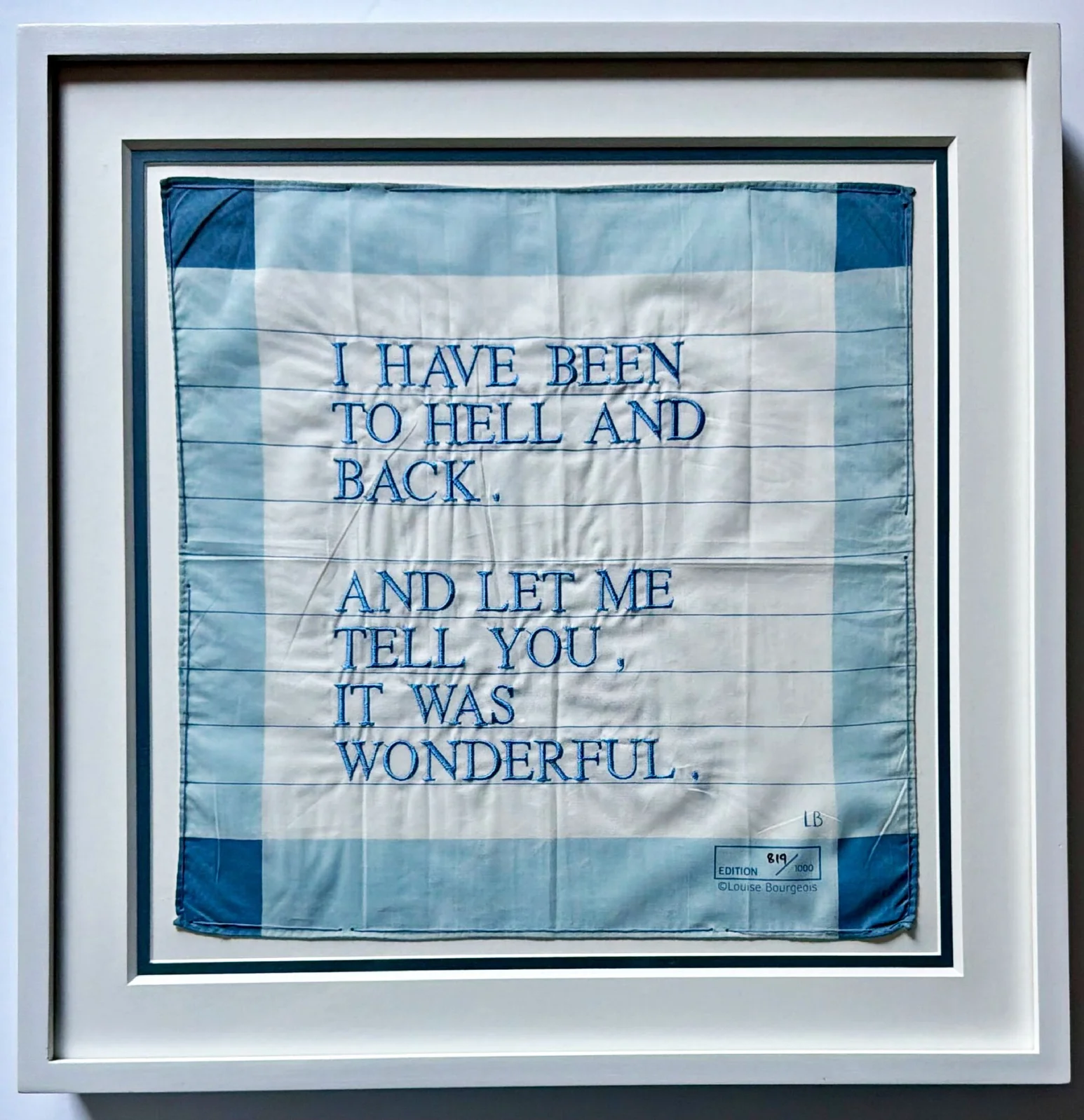
A single line runs across a square of white cotton in formal, serif capitals, broken by faint ruled horizontal bands that make the whole object read like a page torn from a schoolbook: “I Have Been to Hell and Back. And Let Me Tell You, It Was Wonderful.” The phrase belongs to Louise Bourgeois, and the handkerchief carrying it, screenprinted and machine-embroidered onto 100 percent cotton in an edition of 1000, is one of the most widely circulated small multiples the artist ever authorized. The specific copy described in the brief for this piece is numbered 819 of that edition, in the blue colorway, framed at roughly 17 by 16 3/4 inches including its mount.
Bourgeois made the handkerchief in three colorways, blue, red and pink, with blue released first. Each carries the same embroidered text and the same faint ruled lines, differing mainly in tincture and in however each individual seller has since chosen to frame and price their copy. The design itself isn’t an invention of 2007. It’s a smaller, licensed descendant of a larger untitled embroidered handkerchief Bourgeois made in 1996, roughly 19 1/2 by 18 inches unframed, predating the edition by more than a decade.
Individual numbered copies from the 1000-run edition now surface across a scattered secondary market rather than through any single dealer. Galleries including Alpha 137 Gallery in New York and Singulart, and auction houses including Chiswick Auctions, Roseberys and Millon, have all sold individually numbered blue, red or pink copies in recent years, each with its own frame, condition and price. The specific 819/1000 blue copy described in the brief wasn’t independently traceable to a single dealer’s own current listing at the time of writing, though every other detail supplied, the tint, the medium, the general framed dimensions, matches copies independently verified elsewhere in the market.
stir
The handkerchief exists because of a specific moment in Bourgeois’ career. Tate Modern opened a major survey of her work on October 10, 2007, running through January 20, 2008: the first major UK survey of Bourgeois since 1995, organized in association with the Centre Pompidou in Paris and curated by Frances Morris, Marie-Laure Bernadac and Jonas Storsve. The show spanned more than 200 works across seven decades, from Bourgeois’ earliest drawings and paintings through to installations made in materials as varied as latex, bronze, marble and mirrors, with Tate’s own billing specifically singling out “her most recent works using fabric” as a highlight. It marked the UK debut of her 1974 installation The Destruction of the Father, and gave visitors another look at Maman, her enormous bronze spider sculpture, which had filled the Turbine Hall when Tate Modern opened in 2000 (the same year Bourgeois’ installation I Do, I Undo, I Redo became the first commission in the gallery’s Unilever Series).
The exhibition went on to tour to the Centre Pompidou in spring 2008, the Solomon R. Guggenheim Museum in New York that summer, the Museum of Contemporary Art in Los Angeles that autumn, and the Hirshhorn Museum in Washington, D.C. in early 2009. Its accompanying catalogue, published by Tate Publishing in 2007 and by Rizzoli in the US the following year, was structured as an A-to-Z glossary of Bourgeois’ life and work, running from Maman to Mapplethorpe and pulling in quotations from her diaries, interviews, poems and psychoanalytic notes alongside the illustrations, a format that treated Bourgeois’ own writing as inseparable from the art itself. The handkerchief was sold through Tate’s own gift shop, tied specifically to the London leg of that tour, and sold out shortly after release.
flow
Sourcing on this piece turns up a small but genuine wrinkle: some listings date the handkerchief to 2007, while others, particularly for the blue colorway, date it to 2009. Both figures trace back to real facts about the object rather than to an error on one side. The design itself was created for and first sold alongside the 2007-08 Tate exhibition. But the retail edition itself was produced through a licensing collaboration with Third Drawer Down, an Australian design studio (now trading as Studio TDD) that dates its own Bourgeois collaboration with Tate to 2009 and describes it as the first project the studio ever took on. That gap between design date and manufacturing or cataloguing date likely explains why individual sellers, cataloguing individual numbered copies years apart, have landed on different years without necessarily being wrong.
scope
Louise Bourgeois was born in Paris in 1911, moved to New York in 1938, and died in 2010 at 98, having made art for more than 70 years without ever formally aligning herself with a single movement, despite work that engaged with both Surrealism and Abstract Expressionism along the way. She’s best known publicly for large-scale sculpture, particularly the spider forms like Maman, a bronze, stainless steel and marble sculpture standing more than 30 feet tall, that made her an instantly recognizable figure late in life, but her practice ran just as deep into painting, printmaking, installation and, especially in her final decades, fabric.
Fabric wasn’t a late-career novelty for Bourgeois so much as a return. Her parents ran a tapestry restoration workshop outside Paris, and Bourgeois described her mother, who oversaw that workshop, as a weaver: the same association she later gave as the reason for building Maman as a spider in the first place, calling the sculpture “an ode to my mother.” Decades after childhood afternoons spent around looms and repaired tapestries, cloth and thread became one of the central materials of Bourgeois’ late work. By her own account and that of the Museum of Modern Art, which holds several of her fabric pieces, Bourgeois had turned specifically to printing on old handkerchiefs by around 2000, working with a seamstress, Mercedes Katz, whom she’d hired the year before. The Tate handkerchief, made seven years into that practice, sits alongside other blunt, text-based fabric works from the same stretch of her career, including I Am Afraid, a 2009 woven fabric piece published by Carolina Nitsch Editions that lists out a series of fears in Bourgeois’ own words, and Do Not Abandon Me, made around 1999 and 2000. Bourgeois herself described sewing as a form of repair, telling interviewers she associated the needle with fixing damage she felt she’d caused in her own relationships.
Tate’s own framing of the 2007 retrospective flagged Bourgeois’ fabric works specifically as among her most recent output at the time, made when the artist was well into her 90s. Read against that history, the handkerchief isn’t simply merchandise stamped with an artist’s name. It’s a small, licensed extension of a material practice with roots in her own childhood, using a medium, embroidered cloth, that had become central to how she was working late in her life.
confession
The bluntness of the phrase isn’t an outlier in Bourgeois’ output. It’s closer to a method. Beginning in 1952, at 41, Bourgeois entered psychoanalysis with Dr. Henry Lowenfeld, a former student of Freud, and stayed in treatment, at varying intensity, until Lowenfeld’s death in 1985, a run of roughly three decades. Alongside that analysis she kept diaries for most of her adult life and produced a separate, private archive of writing directly tied to her sessions, later described by scholars as dream recordings and process notes rather than conventional journaling. Her longtime assistant Jerry Gorovoy discovered two boxes of that psychoanalytic writing in 2004 and two more in early 2010, shortly before Bourgeois’ death, revealing an archive of more than a thousand loose sheets that scholars have since connected directly to specific sculptures and installations, including The Destruction of the Father, the 1974 rubber, latex and wood installation depicting a family dinner table where a tyrannical father figure is set upon and devoured by his own terrified household.
Bourgeois herself described making art as a form of psychoanalysis, a way of gaining direct access to the unconscious rather than simply representing it after the fact. Read against that history, a handkerchief bearing one unguarded sentence in her own words fits a pattern running through her sculpture, her fabric books and her drawings alike: private material, much of it worked out over decades of therapy and journaling, pushed out into a public, exhibitable object. The difference here is scale and format. Where a piece like The Destruction of the Father works through similar territory at room size, the handkerchief compresses the same impulse into something a visitor could fold into a pocket and carry out of the Tate gift shop.
fin
Bourgeois’ overall market has grown enormously since her death. Her auction record stands at $32.8 million, set at Sotheby’s in 2023, and she’s represented on the primary market by Hauser & Wirth and Xavier Hufkens, with work held in the permanent collections of the Museum of Modern Art, the Centre Pompidou, the Guggenheim Bilbao and the Los Angeles County Museum of Art, among others.
Against that backdrop, the handkerchief sits at the accessible end of her market by design, and specifically by edition size. I Am Afraid, the comparable 2009 fabric text work discussed above, was published in an edition of just 15 plus 3 artist’s proofs and now sits in the permanent collections of MoMA, the Centre Pompidou, Stockholm’s Moderna Museet and Tate itself. The handkerchief, by contrast, was made in a run of 1000 across its three colorways, a scale closer to a museum shop print than a gallery-published fabric edition, and priced accordingly at the time of sale. Individual numbered copies now trade in the low thousands unframed on the secondary market, with framed examples running higher depending on color, condition and provenance; a framed blue copy listed through Artsy by Alpha 137 Gallery, edition 319 of 1000, was priced at $10,000, a figure that reflects the object’s rarity and its Tate-shop origin rather than the cost of the cotton and thread that make it up. What would, without Bourgeois’ name and authorization, be a novelty item became a genuinely collected multiple specifically because she signed off on the design herself, during her own lifetime, in collaboration with the museum staging what would prove to be one of the last major surveys of her career before her death in 2010.
The edition has been sold out at retail for well over a decade. What circulates now moves only between the roughly 3,000 numbered copies split across the three colorways, changing hands wherever their individual owners choose to sell.
Related Articles
fnnch Revives the Honey Bear Hunt for Halloween, No Tape Required
San Francisco’s honey bear artist is turning porch season into a scavenger hunt again, five […]