DRIFT AUDIO
Listen to this story
Choose a voice, then press play.
A 1981 screenprint sealed in diamond dust, and the negotiation that let Andy Warhol borrow the one character Disney almost never lends out.
In October 1980, Andy Warhol noted in his diary that he had signed on for a new print project with the dealer Ronald Feldman. The concept was Feldman’s: ten screenprints, each built around a figure so familiar to American audiences that the image needed no caption. Warhol titled the resulting portfolio Myths, and it became his first print series built entirely around fictional and folkloric characters rather than living celebrities or supermarket packaging.
By 1981, Warhol had spent three decades building a career out of images everyone already recognized. He had started that way, too: after graduating from Pittsburgh’s Carnegie Institute of Technology in 1949, Warhol worked through the 1950s as a commercial illustrator in New York, drawing shoes, cats, and fashion spreads for Vogue, Harper’s Bazaar, and department store ad campaigns before Campbell’s Soup labels, Coca-Cola bottles, Marilyn Monroe’s publicity headshot, and Chairman Mao’s official portrait made him famous. Myths pushed that same instinct a step further, away from real people and actual products and toward characters that existed only as characters, figures with no original photograph to appropriate because they had never been photographed as anything but themselves.
The ten subjects, catalogued today as Feldman and Schellmann II.258 through II.267, span the full range of twentieth century American storytelling: Superman, Dracula, Santa Claus, Uncle Sam, Howdy Doody, the pulp radio hero The Shadow (for which Warhol used his own face), the Wicked Witch of the West (played by the actress who originated the role on screen decades earlier, Margaret Hamilton), an invented figure called Mammy, the silent film icon Greta Garbo rendered as The Star, and Mickey Mouse.
Nine of the ten prints, Mickey Mouse included, carry a dusting of ground industrial diamond across the screenprinted surface, a material Warhol had only recently begun using and one that turns each sheet from a flat graphic into something that visibly catches light depending on where a viewer stands. Dracula is the lone print in the portfolio without it. Mickey Mouse, printed at roughly 38 inches square on Lenox Museum board, is signed in pencil at the lower left corner, a detail that sets it apart from most of its portfolio mates: The Star, The Witch, and Howdy Doody are signed on the verso, while Uncle Sam, Superman, Mammy, Dracula, Santa Claus, and The Shadow are all signed lower right.
stir
Putting a cartoon mouse into a fine art portfolio sounds simple until you remember who owns him. Securing rights to Mickey meant Warhol and Feldman had to sit across from The Walt Disney Company‘s own legal department, not simply photograph a toy off a shelf.
The negotiation ran through Disney’s company attorney, identified in later accounts as Pete Smith, and it produced an agreement unusual by Disney’s own standards. The studio granted Warhol permission to use its archival Mickey imagery in exchange for a licensing fee, a set of the finished prints for its own collection, and a condition that has followed the character into nearly every license Disney has written since: the image could not depict Mickey in a sexualized or derogatory way. In return, Warhol and Feldman kept shared rights to the resulting artwork, while Disney retained approval over any commercial use of the image beyond Warhol’s own promotion of it.
Feldman summed up the arrangement years later in blunt terms: Disney had effectively surrendered half its interest in whatever image Warhol produced of its own mascot. Two years after the print debuted, in 1983, Disney returned the favor, putting Warhol’s Mickey Mouse on the cover of a special anniversary supplement inside Life magazine, an unusually warm embrace from a studio that has spent decades guarding its intellectual property with considerably more caution than generosity.
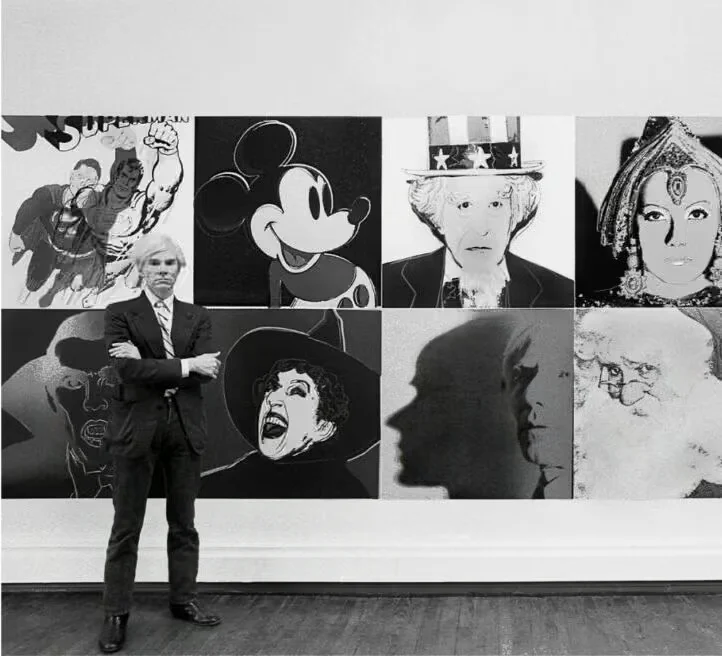
A monochrome photograph of Andy Warhol standing in front of his 1981 “Myths” portfolio, a series of ten screenprints featuring American cultural icons.
accept
Not every character Warhol wanted made it into the final ten. He and Feldman had also hoped to use Aunt Jemima, the Quaker Oats trademark, but the company threatened legal action and refused outright. Rather than drop the slot, Warhol and Feldman built an invented substitute they called Mammy, drawn from the stereotype popularized decades earlier by Gone with the Wind rather than from any single licensed character. A planned Coca-Cola Santa Claus, based on the version illustrator Haddon Sundblom had defined for the brand starting in the 1930s, was scrapped too, after Sundblom’s estate declined permission; Warhol’s Santa Claus in the finished portfolio is his own invention instead. Margaret Hamilton took a different route entirely: she agreed to pose in costume for Warhol’s camera as the Witch in exchange for a set of prints rather than a fee.
Against that backdrop, the Mickey Mouse deal looks less like a formality and more like the exception. Two trademark holders said no outright. One estate said no as well. Disney, holding what was by any measure the more valuable and more heavily protected character, said yes, with conditions it was willing to put in writing.
endure
The finished Mickey Mouse screenprint runs in tincture with diamond dust on Lenox Museum board, printed by Rupert Jasen Smith, the New York printer who served as Warhol’s primary printmaker and art director through most of the 1980s, from Myths through the later Ads and Reigning Queens portfolios. Ronald Feldman Fine Arts published the edition and stamped its own mark, alongside Warhol’s copyright inkstamp, on the verso of every sheet.
The print exists in a standard edition of 200, signed and numbered in pencil, backed by an additional 30 artist’s proofs, 5 printer’s proofs, 5 exhibition proofs, and a run of 30 trial proofs used to test colorways before the edition was finalized.
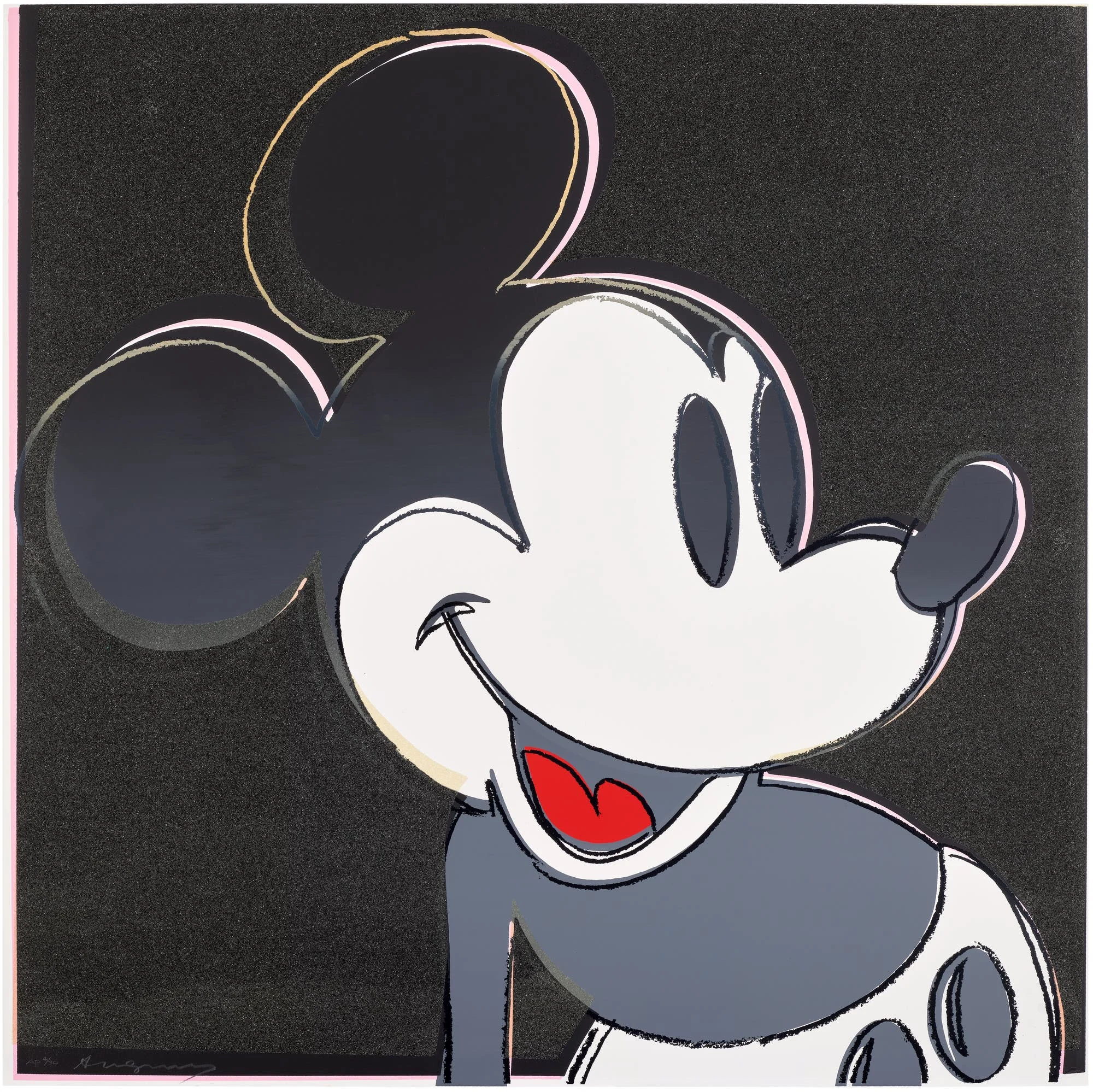
Compositionally, Mickey fills nearly the entire square: an off center crop that crowds his oversized ears and trademark grin against the frame, rendered in flat blocks of color outlined in gold and pink over a dark, near black ground. The diamond dust catches whatever light hits that background, an effect Warhol had first explored on his Shadows paintings a few years earlier and leaned on across most of the Myths series to give what were, structurally, mass media cartoon and movie images the surface glamour normally reserved for gemstones or couture.
define
The number embedded in the print’s formal title is shorthand for Andy Warhol Prints: A Catalogue Raisonné, the reference work compiled by Frayda Feldman, Ronald Feldman’s wife and longtime gallery partner, together with the print dealer Jörg Schellmann. First published in 1985 and now in its fourth edition, issued in 2003, the catalogue assigns a sequential reference number to every print Warhol released through a publisher during his lifetime, organized roughly by portfolio and date. Myths runs from II.258 through II.267, with Mickey Mouse as II.265.
For dealers, auction houses, and collectors, the F. & S. number works the way a VIN works for a car: it is the fastest way to confirm that a given sheet matches a documented, authenticated edition rather than an unauthorized reprint, and it is the number that shows up first in nearly every auction catalogue entry and gallery listing for the print, ahead of the title itself.
to
Myths made its public debut in September 1981 at Ronald Feldman Fine Arts Downtown in New York. The following month, it traveled to the NorthPark National Bank art gallery in Dallas, where it hung alongside a small study of the boxer Muhammad Ali and examples from Warhol’s own early Campbell’s Soup Cans, an unlikely but fitting pairing of Warhol’s earlier commercial icon period with his mythic one.
The most unusual stop on the tour was retail rather than institutional. Weinstock’s, a department store in Sacramento, built its entire 1981 holiday campaign around the portfolio, displaying the serigraphs in store and selling a complete set for $15,000, with individual prints going for $1,500 apiece. The store commissioned Warhol to design the cover of its Christmas gift magazine, The Art of Giving, using the Santa Claus print from the same series, and that print eventually entered Weinstock’s own permanent collection. In connection with the promotion, Weinstock’s also established an art scholarship in Warhol’s name at the University of California, Davis, and Warhol himself flew to San Francisco that November to sign reproductions in store.
Myths traveled to the Reconnaissance Gallery in Fitzroy, Victoria, in 1982, where Australian critic Robert Rooney gave the portfolio a mixed but attentive review, calling it a slickly produced, commercially minded body of work that nonetheless held together, with particular praise for the color coordination on Dracula and Mammy. Anyone hoping for the rawer, more accidental screenprinting of Warhol’s 1960s work, he suggested, would likely find Myths too polished for their taste.
The portfolio’s most lasting public home came later still. In May 1988, the Children’s Museum of Pittsburgh, in Warhol’s own hometown, opened a permanent Andy Warhol Myths gallery built around the series, pairing the ten prints with a hands on silkscreening studio where visiting kids could try the technique themselves, turning a portfolio built from licensed cartoon and movie characters into, fittingly, a museum exhibit aimed at children.
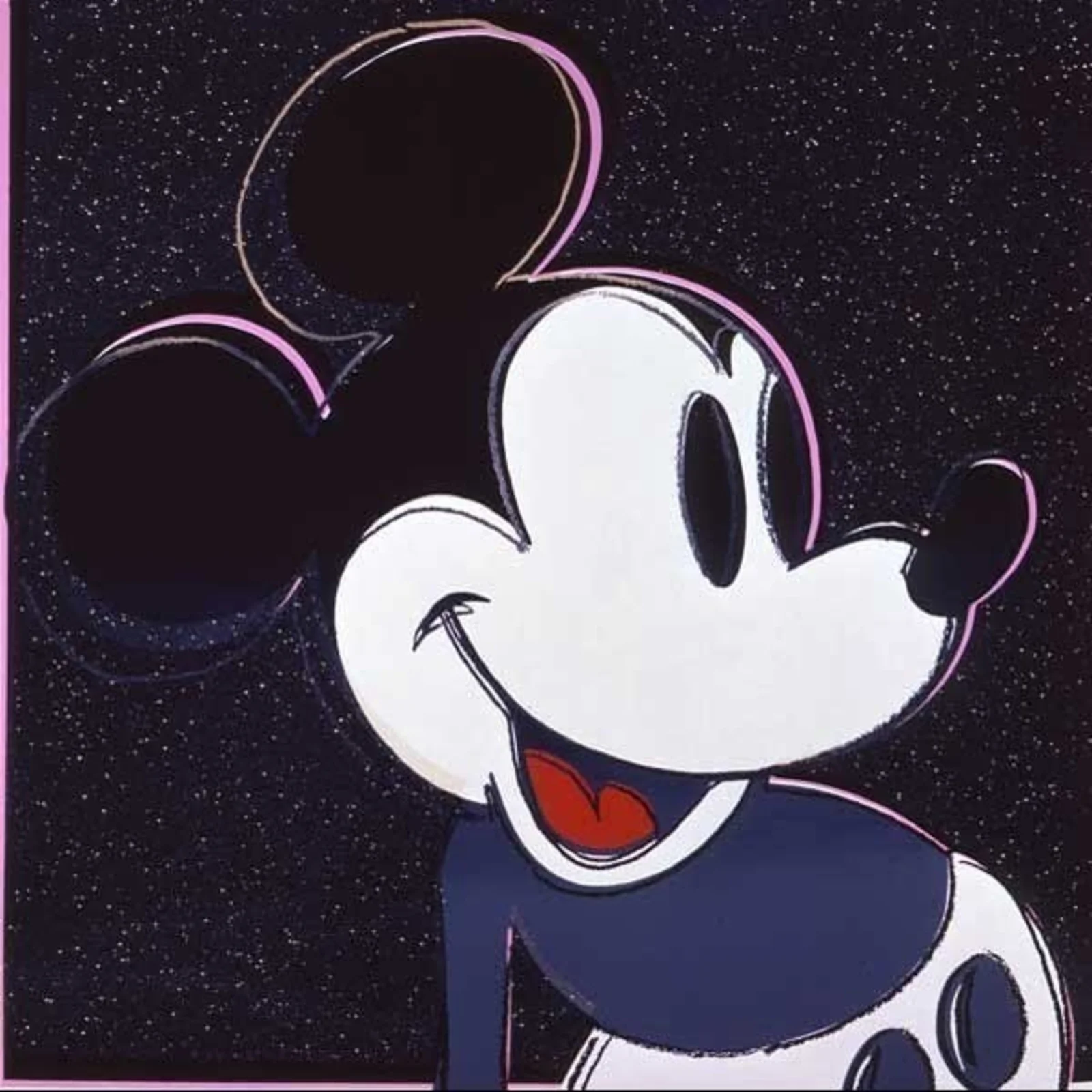
A black and white screenprint of Mickey Mouse from Andy Warhol’s 1981 “Myths” series, set against a dark, starry background with a pink diamond dust outline.
length
Four decades on, Mickey Mouse remains one of the strongest performers within Myths on the secondary market, trailing only Superman, whose trial proofs have brought as much as $831,500 at Sotheby’s in recent years. Individual numbered impressions of Mickey Mouse, tracked by dealers including Guy Hepner and the auction database MyArtBroker, have sold at prices ranging from roughly £118,000 to more than $300,000 depending on the venue, the specific edition number, and condition. Phillips carried impression number 7 of 200 against an estimate of $140,000 to $180,000, and it sold for $201,600, comfortably above the high end. MyArtBroker alone has recorded 33 separate auction appearances for the print since its first tracked sale in 1999.
The complete ten print portfolio has performed strongly too. A full suite sold for $780,500 at Christie’s in New York in October 2018. In February 2025, Christie’s ran an online single artist sale devoted entirely to Myths, in which a set of unique painted versions brought a combined $832,900, led by Superman.
That trajectory looks almost quaint next to the print’s original asking price. In 1981, Weinstock’s sold individual Myths serigraphs, Mickey Mouse included, for $1,500 apiece. What a Sacramento shopper could once pick up as a Christmas gift now regularly clears six figures at auction, and has done so often enough that Mickey Mouse (F. & S. II.265) counts as one of the more frequently traded prints in Warhol’s entire catalogue rather than a rarity that surfaces once a decade.
None of that market activity changes what actually sits at the center of the print. It is a mouse Walt Disney drew in 1928, borrowed by an artist who spent his career asking what counted as valuable, run through a contract that gave Disney final say over Mickey’s dignity and gave Warhol, for one portfolio at least, permission to treat a copyrighted trademark the same way he had once treated a can of soup.
Related Articles
fnnch Revives the Honey Bear Hunt for Halloween, No Tape Required
San Francisco’s honey bear artist is turning porch season into a scavenger hunt again, five […]