DRIFT AUDIO
Listen to this story
Choose a voice, then press play.
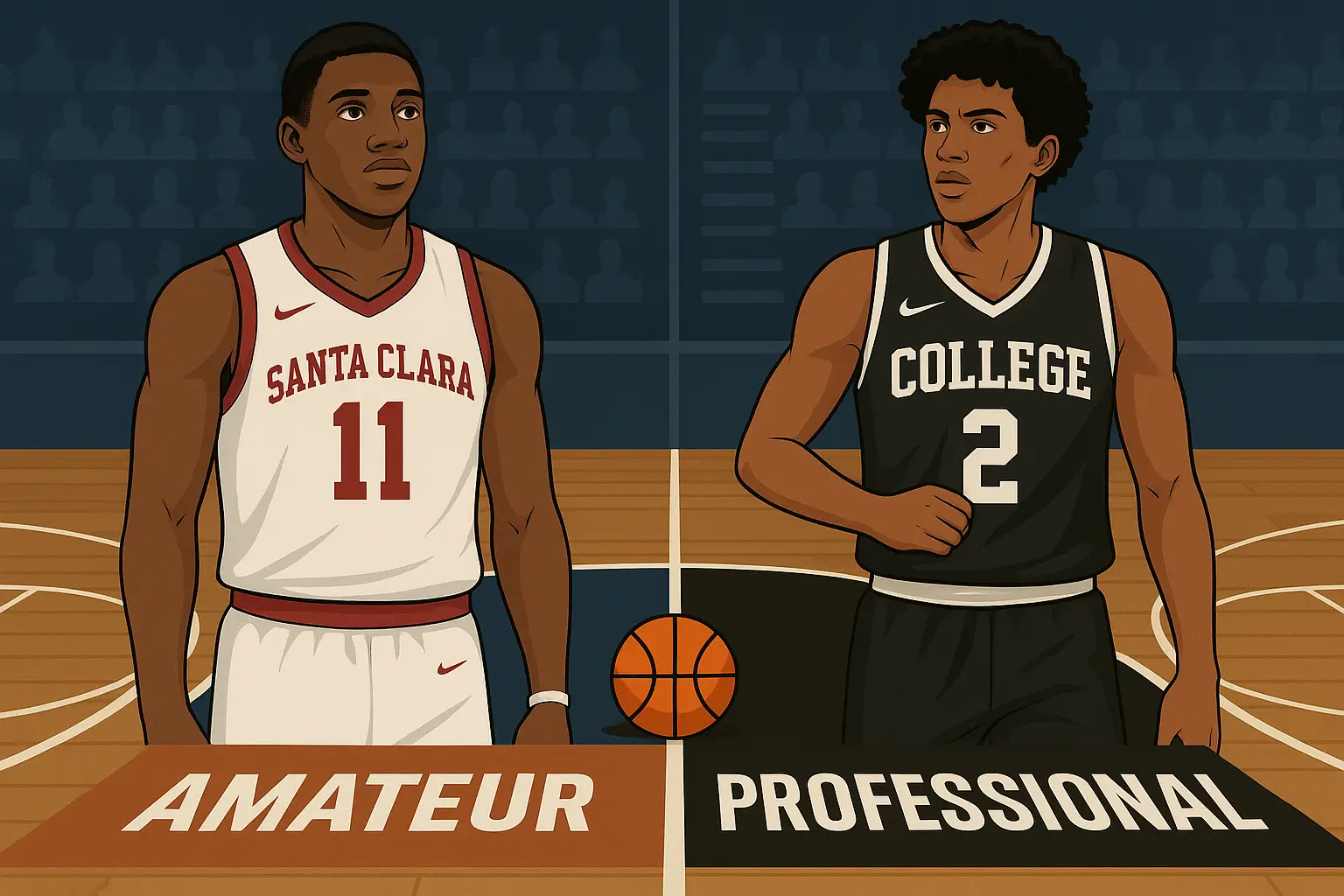
In the changing world of college basketball, few developments have drawn as much attention as the arrival of former professional players into NCAA programs. The cases of Thierry Darlan and London Johnson, two athletes who once played in the NBA G League before gaining eligibility to compete in Division I college basketball, have reignited long-simmering debates over amateurism and fairness. Their inclusion has forced coaches, administrators, and fans to reconsider what defines a “college athlete” in an era when professional and amateur boundaries have nearly dissolved.
The shift represents a crucial moment for the NCAA, whose authority and rules have already been challenged by the Name, Image, and Likeness (NIL) revolution, court rulings, and player empowerment. As these former pros lace up for college programs, the question becomes not only whether they can play, but whether their presence permanently alters the structure of college basketball.
the change
For decades, the path from high school to the NBA ran through college basketball. The rhythm was predictable: a top recruit committed to a major program, spent a year or two in college, and then declared for the draft. But the creation of alternative routes has fractured that simplicity. Professional options now exist for teenagers before they ever step foot on a campus. These include the NBA G League Ignite, Overtime Elite, international academies, and even semi-professional circuits abroad.
The G League Ignite was created to give elite high-school graduates a professional alternative that would combine player development with exposure to NBA-level competition. Thierry Darlan, a talented international prospect from the Central African Republic, joined the Ignite after coming through the NBA Academy Africa in Senegal. London Johnson, a Georgia-born guard and five-star high-school recruit, also bypassed college to sign with the Ignite straight out of Norcross High School. For both, the appeal was immediate: salary, NBA-caliber training, and professional experience.
But now, the reversal of direction—leaving professional ranks to return to college—is rewriting the rules. This backflow of players into college basketball would once have been inconceivable. Today, the combination of NIL money, evolving NCAA definitions, and the collapse or restructuring of leagues like the Ignite has opened new doors.
why
Colleges are embracing these players because they offer a unique combination of experience and marketability. Coaches have discovered that former professionals bring an advanced understanding of systems, physical readiness, and composure under pressure that few teenagers possess. They are not developmental projects; they are immediate contributors.
Another factor is the short-term benefit of roster impact. Players like Darlan enter as juniors with two years of eligibility, which means programs can plug them in as mature performers who still fit under the scholarship structure. They fill gaps quickly and elevate competitiveness overnight.
The economics have also shifted. The financial lure of professional play is no longer overwhelming when compared to what athletes can earn through NIL deals. In some cases, college basketball now offers a better financial package than entry-level G League salaries. For athletes who value visibility and sponsorship potential, college basketball has regained its allure.
Recruiting has therefore expanded into uncharted territory. Staffs at major programs reportedly monitor developmental leagues for potential transfers, viewing the G League as a new frontier for recruitment. In essence, college basketball has become a hybrid marketplace where former professionals can rebrand themselves, refine their skills, and rebuild draft stock.
thierry darlan
Thierry Darlan’s story is central to this shift. Born in Bangui, Central African Republic, Darlan trained at the NBA Academy Africa, one of the global academies designed to identify and prepare top international talent. After turning down multiple Division I offers, he joined the G League Ignite in 2023. Following the team’s dissolution, he played briefly for the Delaware Blue Coats and Rip City Remix.
When he applied for NCAA eligibility at Santa Clara University, the assumption was that his professional history would disqualify him. Yet in September 2025, the NCAA granted his petition and ruled him eligible for two remaining years. The decision was striking because it effectively acknowledged that playing for a professional team, even one that paid a salary, was no longer an automatic barrier to college competition.
The rationale rested partly on his international background. The NCAA’s long history of handling international players—many of whom have competed in professional settings before enrolling—provided a model for reinterpretation. Darlan’s age, years since high school graduation, and lack of NBA draft declaration were all considered mitigating factors. In short, his path redefined what counted as “professional” experience within the collegiate framework.
london johnson
London Johnson’s eligibility followed soon after Darlan’s but stirred more controversy. Johnson had been one of the earliest high-profile American recruits to bypass college for the Ignite. After two years in the G League, he committed to the University of Louisville for the 2026 season. When the NCAA cleared him to play, the backlash was swift.
Veteran coaches like Tom Izzo criticized the ruling, calling it “ridiculous” and “embarrassing.” Their concern wasn’t personal—it was structural. If players could now turn pro, earn salaries, gain professional training, and then re-enter college competition, the traditional foundation of amateurism would crumble. College teams would face competition from athletes who had already competed at a professional level, tipping the balance of fairness.
Yet the NCAA defended the decision as consistent with current policy. Johnson, like Darlan, had not declared for the NBA draft and remained within the age and academic parameters set by eligibility standards. For many observers, the case signaled a permanent redefinition of what constitutes amateur standing in college basketball.
define
The NCAA’s historical distinction between amateur and professional athletes has long been controversial. Once, any player who accepted money for playing would be deemed permanently ineligible. But the NIL era has upended that logic. College athletes today can earn six- and seven-figure sums through sponsorships, appearances, and endorsements. The financial gap that once separated college from professional sports has narrowed dramatically.
In Darlan’s and Johnson’s cases, the NCAA appears to have shifted focus from simple payment to broader contextual factors. Instead of asking, “Did the athlete receive money?” the question now becomes, “Under what conditions did the athlete play, and how do those conditions relate to eligibility intent?”
If the player did not declare for the NBA draft, did not sign an NBA contract, and remained within the age and time-from-high-school boundaries, then their experience in a professional or semi-professional league might not automatically void eligibility. This nuanced interpretation reflects the reality that basketball development is now global and multifaceted.
Still, ambiguity remains. The NCAA’s decisions appear case-specific rather than governed by a universally transparent rulebook. As more athletes apply for reinstatement or initial eligibility after professional stints, the organization will need clearer frameworks to avoid inconsistency and potential legal challenges.
bal
For college coaches, the inclusion of former professionals raises concerns beyond legal technicalities. The essence of competition—an even playing field—may be at risk. An 18-year-old freshman fresh out of high school could now share a locker room or face an opponent with years of professional experience and training.
Some argue this imbalance distorts the educational and athletic mission of college sports. Programs designed to develop young students might turn into semi-professional squads anchored by players returning from paid leagues. Others believe that the added maturity and experience could elevate the quality of play and make college basketball more competitive, more polished, and more exciting for fans.
From a recruiting standpoint, programs now face new ethical questions. Should scholarships intended for developing student-athletes be used on players with prior professional experience? Or should they be reserved for high-school graduates pursuing academic and athletic growth simultaneously? The debate mirrors the broader transformation of the NCAA’s identity—an organization caught between tradition and the new realities of a commercial sports ecosystem.
flow
Another crucial aspect of eligibility concerns the “five-year clock,” the period in which athletes must complete their collegiate careers after enrolling or graduating from high school. Darlan’s case fell within acceptable limits because of his age and time frame since leaving the NBA Academy. Johnson’s timeline also fit the required window, having only recently finished his tenure with the Ignite.
This timing loophole underscores the importance of chronology in NCAA decisions. By aligning their professional experiences within the bounds of the five-year rule and avoiding official draft entry, athletes can maintain a technical claim to amateur eligibility. These conditions are redefining how players and agents approach career planning. Some may even begin designing hybrid paths—spending a year or two in a pro developmental environment before enrolling in college to improve draft stock and academic credentials.
risk
The NCAA’s new approach carries risks. Without clearly defined standards, schools may face confusion, and athletes could encounter arbitrary rulings. What makes Darlan eligible but another player ineligible? How much salary or how many professional games are too many? How should international contracts, often structured differently, be assessed?
Consistency matters not just for fairness but also for reputation. The NCAA has long been criticised for opaque decision-making. As former pros continue to apply for eligibility, the absence of uniform criteria could trigger appeals, lawsuits, and political pressure. The organisation’s credibility depends on whether it can develop transparent, predictable rules rather than relying on case-by-case discretion.
recruit
Within the college basketball ecosystem, the precedent has sparked strategic maneuvering. Coaches and recruiting coordinators are reportedly studying developmental leagues with the same scrutiny once reserved for high-school tournaments. Some programs have dedicated staff to monitor G League and Overtime Elite rosters for players who might still have eligibility remaining.
This new scouting dimension could reshape recruiting hierarchies. Programs with strong compliance departments and NIL infrastructure will have an advantage in navigating eligibility complexities. The result could be another form of competitive imbalance—not on the court, but in the back offices where compliance expertise determines who can legally play.
the imply
The entry of former professionals into college basketball carries cultural and commercial implications. At the most basic level, it blurs the remaining line between college and professional sports. Fans may begin to see college basketball not as a developmental league but as an extension of the professional system—a circuit where players move fluidly between paid and unpaid status.
This shift also affects perception of the “student-athlete.” As college programs embrace older, seasoned players, the narrative of academic growth and campus life loses some of its centrality. Instead, the conversation revolves around market value, NIL deals, and brand partnerships. For schools, this dynamic offers opportunities for visibility and revenue. For the NCAA, it threatens to undermine the ethos that has justified its existence for over a century.
Yet, there are benefits too. Former professionals bring a higher level of skill and professionalism that can elevate the game’s quality. Their maturity can positively influence younger teammates. And for fans, the product on the floor may be more entertaining than ever.
the fwd
The emergence of players like Darlan and Johnson may represent the start of a broader trend. Others who ventured into professional developmental programs might now consider returning to college, particularly if their draft prospects wane or their leagues fold. Still, it is unlikely that the NCAA will open its doors wide. More likely, it will treat such cases as controlled exceptions rather than the new norm.
The key challenge will be defining limits. The NCAA must articulate how many years of professional play are acceptable, whether salaries matter, and what mechanisms verify an athlete’s intent to remain amateur before joining college competition. Schools, meanwhile, must balance the pursuit of talent with institutional responsibility, ensuring that recruiting former pros does not erode campus culture or academic integrity.
For players, this evolving system presents unprecedented flexibility. They can now design multifaceted careers, moving between professional development and collegiate competition in ways that maximize growth and exposure. For the NCAA, that same flexibility is a governance nightmare—one that demands clear boundaries before the system collapses under its contradictions.
impression
The arrival of Thierry Darlan and London Johnson in college basketball is more than a procedural anomaly; it is a landmark moment signaling the transformation of amateurism itself. College basketball, once defined by its separation from the professional sphere, now operates within the same ecosystem of commerce, visibility, and player agency.
Whether this development strengthens or weakens the sport depends on perspective. To some, it symbolizes progress—an acknowledgment that players deserve autonomy and opportunities regardless of prior experience. To others, it represents the erosion of the collegiate ideal.
What remains undeniable is that the NCAA can no longer rely on the rigid definitions of the past. It must craft new frameworks that balance fairness with modern realities. As Darlan, Johnson, and future players step onto campus courts, they carry with them a question that will define the next era of college basketball: how much professionalism can amateurism withstand before it becomes something else entirely?
Related Articles

Shell, Floral Print, Gold Lace Lock
Air Foamposite One Floral/Black. AA3963-002. 11 December 2026. $240. Black nubuck eyestay, mesh tongue, metallic gold Swoosh dubrae.