DRIFT AUDIO
Listen to this story
Choose a voice, then press play.
I’m glad he’s single because I’m going to climb that like a tree. —Megan, Bridesmaids (2011), 2024
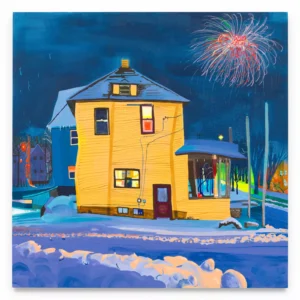
“I’m glad he’s single because I’m going to climb that like a tree.” Megan’s unforgettable line in Bridesmaids (2011) is pure comedic audacity, a burst of desire spoken without filter. At first glance, it may feel worlds away from Gabrielle Garland’s paintings, with their warped houses, bending perspectives, and unsettlingly vibrant palettes. Yet when we place the two together, an unexpected resonance emerges: both Megan’s declaration and Garland’s canvases push ordinary experience to the edge of distortion, exaggerating desire, domesticity, and presence until they verge on the surreal.
Garland’s work is deeply invested in how space itself can take on a psychological charge. A house in one of her paintings is never just a neutral shelter—it tilts, swells, and sways as if embodying the emotions or memories of those who live within it. Walls bend like flexible bodies, windows glow with uncanny intensity, and familiar American domestic architecture becomes animated, alive, even seductive in its strangeness. The humor of Megan’s line rests on a similar logic of exaggeration. No one literally climbs another human like a tree, but the hyperbolic image captures the urgency of physical attraction in a way that feels more vivid than polite understatement ever could.
If we look at Garland’s snowy yellow house beneath a burst of fireworks, the connection sharpens. The building’s crooked stance almost invites anthropomorphic interpretation: it leans, it stretches, it gazes back at the viewer with glowing eyes of lit windows. Like Megan’s metaphorical tree, it becomes more than an object—it’s a body, a character, something charged with desire and lived presence. The fireworks above echo the comedic outburst: explosive, fleeting, uncontainable. Just as Megan’s line interrupts the rhythm of conversation with wild energy, Garland interrupts the stability of architectural form with painterly elasticity.
Both the quote and the painting embrace a refusal to be subtle. Megan does not couch her attraction in romantic euphemism; Garland does not paint houses as they appear in real estate photos. Instead, both exaggerate the familiar until it becomes uncanny. This exaggeration is funny, strange, and liberating. It reveals that beneath the structures we take for granted—whether social etiquette or architectural geometry—there exists a pulsating undercurrent of desire, memory, and imagination.
By drawing these two together, we see Garland’s art as participating in a broader cultural gesture: the act of making the invisible visible through distortion. Megan’s blunt humor makes private lust public; Garland’s bent houses make the psychological weight of domestic life visible. Both operate through a comic elasticity that transforms everyday realities into something surreal, memorable, and undeniably human.
View this post on Instagram
Related Articles
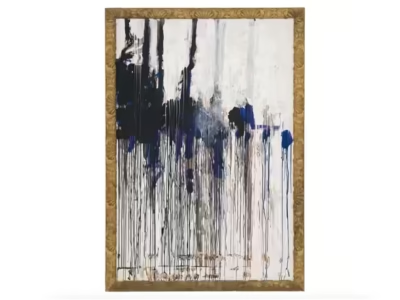
Winter Ran Down A Plywood Panel In Gaeta
Cy Twombly, Untitled (Winter Picture), 2004. Acrylic on plywood in the artist’s frame. Gagosian, Madison […]