DRIFT AUDIO
Listen to this story
Choose a voice, then press play.
All of General Mills’ U.S. cereals, including Lucky Charms and Trix, are now colored with turmeric, paprika, and fruit and vegetable juice instead of petroleum-based dyes.
Every box of cereal General Mills sells in the United States, from Lucky Charms to Trix to Cheerios and Cocoa Puffs, is now made without certified synthetic colors. The Minneapolis company confirmed the milestone on Wednesday, closing out a self-imposed deadline of summer 2026 with a matter of days to spare. Lucky Charms has been on shelves since 1964 and Trix since 1954, so a redesign of their signature colors touches cereal aisles most American shoppers have known their entire lives.
The shift touches some of the most recognizable colors in the American breakfast aisle. Lucky Charms’ rainbow of hearts, stars, horseshoes and clovers and Trix’s fruit-shaped puffs have both spent decades built around a handful of FDA-certified dyes. Those are now sourced from fruit and vegetable juice concentrates and from spice extracts, including turmeric and paprika, according to the company.
Bethany Quam, president of Big G Cereal at General Mills, tied the change to a broader reformulation push rather than treating it as an isolated fix. The milestone, she said, reflects the company “evolving with consumer needs” while keeping the taste and value people expect from the brands. General Mills also said the cereal conversion builds on a March 2026 milestone in which its entire K-12 school foods portfolio, including a reformulated Lucky Charms 25% Less Sugar Cereal, became free of certified colors ahead of its own deadline.
With cereal now fully converted, 90 percent of General Mills’ total U.S. retail portfolio is made without certified colors, up from 85 percent when the company first set its public timeline in June 2025. That leaves a defined, shrinking slice of the business still to go.
stir
The dyes being phased out are specific and well documented. Trix has historically relied on Red 40, Blue 1 and Yellow 6 for its fruit-flavored puffs, while Lucky Charms’ marshmallow shapes have drawn on Red 40, Yellow 5, Yellow 6 and Blue 1. All four are certified color additives, meaning the FDA batch-tests and approves them individually before they reach a production line, and all four are derived from petroleum.
In their place, General Mills has pointed to fruit and vegetable juice concentrates and spice-derived colorants like turmeric, which yields a golden yellow, and paprika, which leans orange to red. The company has not published a shape-by-shape or product-by-product breakdown of which natural source replaces which synthetic dye, so the exact formulation behind, say, a green clover or a purple horseshoe remains unconfirmed. Lucky Charms alone is built around eight distinct marshmallow shapes, each with its own color to match, which multiplies the reformulation problem well past swapping out a single ingredient.
Natural pigments are also generally less stable than their synthetic counterparts. They tend to fade faster under heat, light and long shelf storage, which is part of why a full cereal-aisle conversion has taken years of reformulation and taste testing rather than a single ingredient swap. That instability is one reason General Mills’ first attempt with Trix, roughly a decade ago, struggled to hold up once the cereal actually reached store shelves and kitchen tables.
There’s already a real-world preview of what the finished product looks like. In March, General Mills rolled out Lucky Charms Unicorn Cotton Candy and a Tropical Trix tie-in with Disney’s live-action “Moana,” both built from the outset with colors from natural sources rather than certified dyes. Both were framed at launch as an early example of the company’s reformulation work rather than a one-off novelty item, and both are still on shelves alongside the newly converted classic recipes.
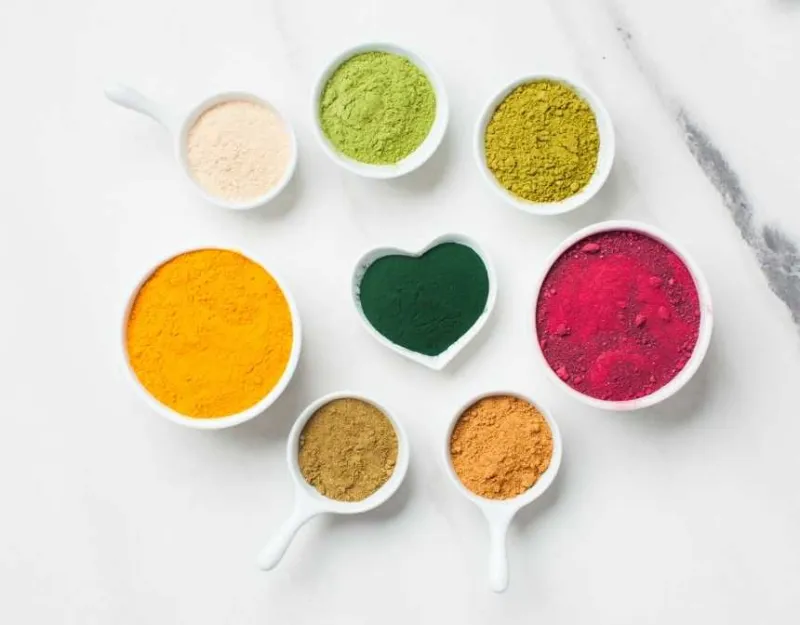
An assortment of colorful powdered superfoods and spices displayed in white bowls on a marble surface.
retro
General Mills has tried this before, and it didn’t stick. The company pulled artificial dyes from Trix around 2015, swapping its neon lineup for a muted mix of yellows and maroons drawn from natural sources. The backlash arrived fast: shoppers who grew up on Trix’s saturated colors said the cereal looked dull and unappetizing, food writers at the time panned the new palette as flat next to the neon original, and complaints piled up within weeks of the relaunch. General Mills quietly brought the original synthetic formula back roughly two years later.
That reversal is part of why this second attempt is being watched closely rather than assumed to be permanent. The company hasn’t said publicly what’s different about the science this time, but the surrounding environment plainly is. In 2015, dye removal was a brand-level marketing bet made with little outside pressure and an easy retreat available once sales data came back. In 2026, General Mills is operating under a signed legal settlement, a federal regulatory timeline and public commitments from two of its biggest retail customers, none of which existed a decade ago. Reversing course now would mean unwinding all of that at once, not just disappointing a marketing team.
attempt
The current timeline traces back to a legal fight, not a voluntary pledge. In mid-2025, the Texas Attorney General’s officeissued a civil investigative demand to General Mills as part of an inquiry into whether the company misrepresented cereals as “healthy” while they still contained synthetic dyes. Attorney General Ken Paxton’s office said the move was “an incredible win for the health of our children and all Americans.”
General Mills settled rather than fight the inquiry, agreeing to remove certified colors from all U.S. cereals and K-12 school foods by summer 2026 and from its entire U.S. retail portfolio by the end of 2027. WK Kellogg Co, maker of Froot Loops and Apple Jacks, signed a similar agreement with Paxton’s office roughly a month later, committing to a 2027 deadline for its own full retail lineup and an earlier cutoff for cereals served in schools. Paxton’s office has since said both companies met their school-cereal commitments ahead of the 2026-2027 academic year.
The Texas settlements gave the reformulation push something the industry’s earlier, more informal promises lacked: an enforceable deadline attached to a specific state’s consumer protection law, with a state attorney general publicly tracking compliance rather than a company self-reporting progress on its own schedule. Paxton’s office has also said it opened similar inquiries into other major food companies over the same alleged marketing practice, treating the General Mills settlement as a template rather than a one-off case.
huh
The Texas cases landed inside a wider federal push. In January 2025, the FDA revoked authorization for Red Dye No. 3 in food and ingested drugs, citing a legal requirement to ban additives shown to cause cancer in animal studies, nearly 35 years after the same dye was barred from cosmetics. Food manufacturers were given until January 2027 to comply.
That April, newly confirmed FDA Commissioner Marty Makary and HHS Secretary Robert F. Kennedy Jr. announced a broader plan to phase out the remaining petroleum-based dyes, Red 40, Yellow 5, Yellow 6, Blue 1, Blue 2 and Green 3, by the end of 2026, largely by securing voluntary commitments from food companies rather than issuing a formal rule. The agency also moved to revoke authorization for Citrus Red 2 and Orange B. The effort sits under the Trump administration’s “Make America Healthy Again” banner, which Kennedy has led since being sworn in as HHS secretary in February 2025.
General Mills was far from alone in responding. PepsiCo, Kraft Heinz, Nestlé, ConAgra, McCormick, J.M. Smucker and Hershey have all made some form of public commitment to reduce or eliminate synthetic dyes from their U.S. lineups over the past year and a half.
Public opinion has moved in the same direction as the regulatory pressure. Polling conducted for the AP-NORC Center for Public Affairs Research has found that roughly two-thirds of Americans support restricting or reformulating processed foods to remove ingredients like added dyes, and several states, including California and West Virginia, passed their own bans on synthetic dyes in school food before the federal government acted on cereal specifically.
The underlying health case remains genuinely contested rather than settled. Advocates for removing the dyes point to research linking them to hyperactivity and attention problems in some children, though the findings across that body of research have been mixed. The FDA’s own position is that its approved color additives are safe at approved levels and that most children show no adverse effects from them, while acknowledging that some children may be more sensitive than others. Critics of the federal approach, including the advocacy group Environmental Working Group, have also pointed out that an informal understanding with industry is neither a settlement nor a binding rule, meaning the 2026 dye phase-out goal ultimately rests on companies following through on a voluntary pledge rather than complying with a law.
rival
General Mills isn’t just responding to regulators. Its retail partners and its closest competitor have been setting their own, sometimes tighter, deadlines. Target announced in February that it would become one of the first national retailers to carry only cereals made without certified synthetic colors, with a cutoff at the end of May, a policy that applies to every brand on its shelves, national or private label, not just its own Good & Gather line.
Walmart‘s commitment is narrower in scope but still significant given its size: the retailer said in October 2025 that it would remove synthetic dyes and roughly 30 other ingredients from its own private-label brands, including Great Value and Marketside, by January 2027. That timeline covers Walmart’s store brands specifically rather than every cereal box on its shelves.
WK Kellogg, the other half of America’s cereal duopoly, announced its own accelerated timeline just three weeks before General Mills’ announcement, moving up its full portfolio deadline by a year to the end of 2026. That means Froot Loops and Apple Jacks will keep their familiar rainbow look through natural coloring, with production of reformulated recipes beginning later this year and boxes reaching shelves before year’s end. WK Kellogg has only existed as an independent company since October 2023, when it was spun off from what’s now Kellanova, and it was acquired by the Italian confectioner Ferrero in September 2025; its reformulation work has involved extensive consumer taste testing, the company said, to make sure the new recipes hold onto the specific rainbow of colors fans associate with Froot Loops. General Mills got there first on cereal specifically, but Kellogg’s newer, faster deadline for its full lineup means the two rivals are now converging on roughly the same finish line from different directions.
fin
General Mills’ own accounting puts the remaining work at 10 percent of its U.S. retail portfolio. The company has named some of what’s still in transition, including certain Betty Crocker cake mixes and Fruit Roll-Ups, with a target of converting the rest by the end of 2027, the same deadline set in its Texas settlement.
Beyond the reformulation itself, General Mills said it plans to launch more than twice as many new products this fiscal year aligned with shifting nutrition preferences, including options built around higher protein and fiber content, compared with what it introduced two years ago. That pivot toward protein and fiber echoes a broader shift already visible across the cereal aisle, as shoppers increasingly treat breakfast as a category for functional nutrition rather than just a sweet start to the day. The company has framed the dye removal as one piece of a larger effort to keep pace with how shoppers are reading ingredient labels, rather than a standalone response to any single investigation or regulation.
For now, the cereal aisle’s most scrutinized ingredient list has quietly gotten shorter. Whether shoppers notice, or care, the way they did the last time Trix tried this, is the open question General Mills is now waiting on the market to answer.
Related Articles
Pocket-sized Xbox Ctrl
Xbox Nano Controller. Announced 14 October 2026 by James Hunter. $49.99. Rechargeable battery. Programmable Action Button. Xbox Wireless and Bluetooth.