DRIFT AUDIO
Listen to this story
Choose a voice, then press play.
A 2018 case drop put a courier waybill on Impact plastic, sold out in hours, then returned for DHL’s fiftieth year with slings, pads, and 300 numbered kits.
Yellow reads as a warning hue until a company prints it on every van in the district. DHL did that for decades. Red wordmark, industrial yellow field, tape, arrows, waybill fields. By the time CASETiFY put the same system on an iPhone back, the logo was already public property. Fashion had borrowed it. Couriers still wore it. The collab’s job was smaller and stranger: shrink a global logistics livery until it fit in a pocket and still survived a two-metre drop.
There is no verified 2026 capsule under the working title Collide. The collision people are asking for is the 2018 through 2020 run. First tech capsule. Anniversary drops. A Roppongi boutique coda. That is the collection on the record.
stir
The phone case did not invent DHL as fashion. Vetements did the loud version first. In October 2015 the label opened a show with Gosha Rubchinskiy in a DHL-logo Tee that looked like depot kit. Two years later an official Vetements x DHL capsule (shirts, long sleeves, a skirt cut like a Tee worn backwards, barcodes aimed at Zurich) was shown at the Leipzig hub, among belts and air-cargo cans. The garment cost more than the uniform it copied. That was the point.
CASETiFY’s move was format, not discovery. A runway shirt is an evening. A case is every table the phone touches. By 2018 the Hong Kong and Los Angeles accessory brand already lived on customization plus drop-test copy. A collab works at that scale only if the borrowed graphic system survives being reduced to about five inches. DHL’s system is built for that kind of reduction. Tape. “This way up.” The lockup. The barcode as ornament. A stranger on a train can read it before they read the phone model.
Wes Ng, CASETiFY’s CEO and co-founder, later tied the pairing to a simple fact of the business: DHL was already how a lot of those cases left the building. The product and the pipe wore the same colors.
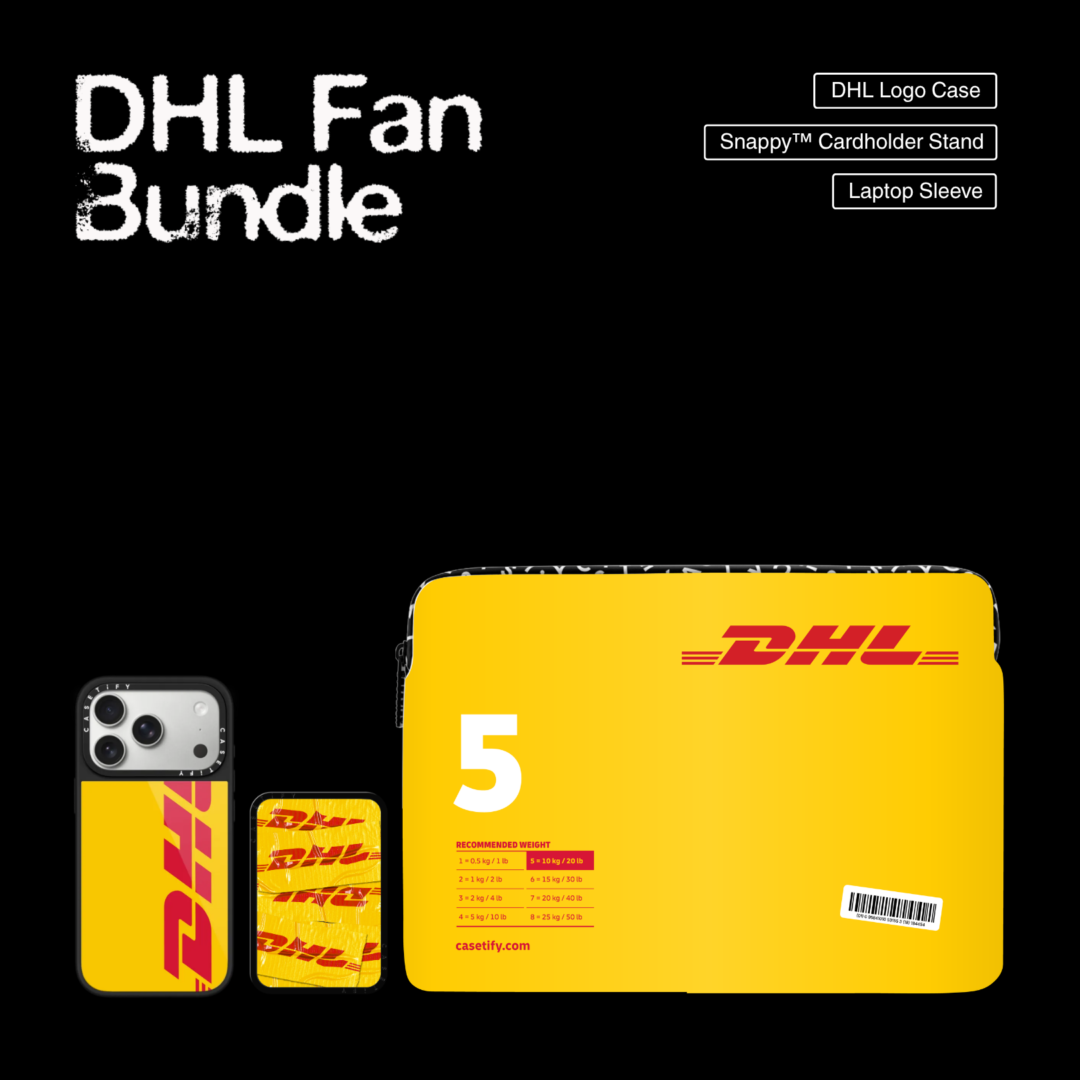
CASETiFY DHL Fan Bundle: Logo Case, Snappy Cardholder Stand, and weight-chart laptop sleeve.
stir
The first DHL x CASETiFY Tech Capsule Collection went up on 4 December 2018. Tight range: Impact cases and Apple Watch bands, about $45 to $50, worldwide ship on DHL Express. You ordered a DHL object. DHL brought it to the door. The loop was the joke and the logistics plan.
Named styles from that wave still map the whole partnership. This Way Up. Tape It Up. The Glitter Yellow. Express It. The last one used CASETiFY’s actual advantage. The waybill was not only printed. City, sender, receiver could be written in. Two people could own the same collab and not match.
CASETiFY said the first launch sold out inside twelve hours. A 14 December restock notice called the refill final and limited. Later anniversary materials rounded the 2018 story to a 72-hour sell-through. Either clock makes the same point. The audience did not need a lecture on why the logo worked. They needed it on an object they already replace when the phone changes.
Official 2019 co-lab still from the anniversary launch set: cases, bands, and earbud shells on DHL yellow.
flow
2019 marked fifty years since three founders in San Francisco turned overnight document runs into a company. Anniversary merch is often a mug. CASETiFY and DHL treated it as season two.
“50 Years of DHL” opened 24 October 2019 on CASETiFY.com/dhl, from $35, again exclusive to DHL Express. The line widened on purpose. iPhone and Samsung cases. Clear TPU Watch bands. AirPods cases. Phone slings. Wireless charging pads. Two custom waybill cases split the birthday: a 1969 vintage treatment with old package labels, and a 2019 modern form that looked like the slip you still sign on the stoop.
Three hundred numbered box sets sat above the open line. Each kit mixed one-of-one merch with cases and a sling. Some configurations were reported near $300. The box did branding work even if you never bought it. It told the rest of the SKUs they were a drop, not restock wallpaper.
Ng’s official line leaned on speed and the fact of packages reaching people. DHL’s Hong Kong and Macau comment, from Herbert Vongpusanachai, treated the logo as already global and the collab as a small proof that express freight helps e-commerce brands leave home. CASETiFY had used that network to grow. Printing the network on the product made the dependency visible.
The pairing also inducted DHL into CASETiFY’s then-new co-lab program, with a first retail pass at the CASETiFY STUDiO pop-up in Landmark Hong Kong. The yellow could be handled in a shop instead of only refreshed on a product page.
View this post on Instagram
extend
October was not the last morning. A second anniversary capsule followed in December 2019. Coverage framed it as another reunion, not a leftover bin. Graphics tightened around two devices: logo tape running across objects, and scanned waybills, the barcode used as both decoration and proof of transit.
That capsule also caught up with AirPods Pro. First Pro shells in the partnership, including a silicone case designed to look like express packaging. The object most likely to vanish into a coat became the object that looked already logged in a depot.
A January 2020 online continuation, sold as a look at DHL and technology’s next chapter, kept the shop open. Tokyo added a floor. On 30 January 2020, DHL Express and RESTIR put the new line on Roppongi. Tony Khan, then president of DHL Express Japan, said the quiet part: the red and yellow mark had become design among people who do not work on a ramp. RESTIR’s Hiroyuki Shimizu called an express company standing next to a tech-accessory brand an unusual, useful pairing.
DHL’s Japan note on the earlier anniversary drop is the figure that still gets repeated: a virtual waitlist above 100,000, then a sell-out on the first global online release.
The source graphic, at van scale. Stock photograph of a DHL Express vehicle in the red-on-yellow livery the cases reduced.
fin
Under the campaign language the list is ordinary CASETiFY inventory wearing extraordinary paint. Impact-grade phone cases for the Apple and Samsung sizes of those seasons. Clear TPU bands so the print floated on a wrist. AirPods, then Pro. A sling that admits the phone is the whole bag. A charging pad that stays on a nightstand and still wears depot colors.
The custom waybill remains the sharpest idea. A real waybill already has to name someone or the parcel fails. CASETiFY let the customer finish the form without letting them erase the carrier. Protection copy stayed house standard: military-grade construction, multi-foot drop claims. Yellow shows scuffs. The line asked to be used like a tool and photographed like a souvenir. Impact plastic was the truce.
Fashion has spent years mining workwear and municipal graphics. DHL was early because the uniform was already a worldwide ready-to-wear program. CASETiFY’s contribution was the last mass accessory that is both private and public. Closer than a tote. More visible than a sock. In 2026 a carrier mark on a phone is less irony than description. The handset is how you track the box. The case is how the box sits in the hand.
Most collabs borrow a mascot for a season. DHL lent an operating system: arrows, tape logic, form fields, flat color with no gradient. That is why people still type the two names together and expect yellow. They are asking for the closed loop again. Shipped by the logo on the shell. No new official capsule under Collide is on the public calendar. The 2018 through 2020 objects remain the catalog: sold fast, numbered in the high kits, and still readable when the phone on the table is three generations later.
A waybill is a contract. A case is a shell. For a few drops they were the same object.
Related Articles
Pocket-sized Xbox Ctrl
Xbox Nano Controller. Announced 14 October 2026 by James Hunter. $49.99. Rechargeable battery. Programmable Action Button. Xbox Wireless and Bluetooth.