DRIFT AUDIO
Listen to this story
Choose a voice, then press play.
A reactor meltdown, a tripoint exclusion zone and a trailer made almost entirely of backstory: Infinity Ward is using DMZ to tell Modern Warfare 4’s aftermath before anyone drops in.
The DMZ Worldbuilder trailer, which Call of Duty put online on Sunday, October 4, spends its running time on a place rather than a firefight. That place is Hajin, a tripoint region where the Korean Peninsula meets Russia, left uninhabitable by a nuclear meltdown and still holding military facilities stocked with chemical, biological and nuclear weapons. Operators are sent in to stop North Korean forces from securing those weapons, the job is deniable, and whatever gear a squad needs has to be scavenged on site. The narrator boils the arrangement down to one line: “While they hunt for weapons, you hunt them.”
Signal. What happened: Call of Duty released the DMZ Worldbuilder trailer for Modern Warfare 4 on Sunday, October 4, 2026, then published the first half of an official DMZ field guide the next day. Exact object: a cinematic trailer of just under two and a half minutes, plus “DMZ Deep Dive, Part 1: Tour of Duty”, a guide to Hajin’s points of interest, enemies, vehicles and base stations. When and where: both are live now on Call of Duty’s channels and callofduty.com, and DMZ ships inside the paid Modern Warfare 4 on October 23, 2026, for PlayStation 5, Xbox Series X|S, Nintendo Switch 2 and PC, rather than as a free-to-play add-on. Source: Activision‘s official DMZ deep dive and the trailer’s own caption on Call of Duty’s channels. Why it matters: Infinity Ward is presenting DMZ as a story-connected pillar of a premium rel rather than a free-to-play beta, and the trailer sells Hajin’s history before it shows any combat.
View this post on Instagram
The caption posted alongside the video reads like an instruction for a different kind of play: explore the world, follow the clues, work out what happened here and keep looking for what has not been found yet. It is an unusual promise for a mode built around looting and leaving, and everything Activision has published since suggests it is meant literally.
stir
DMZ is set after the campaign’s events, which makes Hajin less an arena than an aftermath. The campaign follows Private Park Hyun Jun, a South Korean recruit caught in a North Korean invasion, and Captain John Price, the former Task Force 141 leader now on the run after killing a U.S. general. DMZ arrives once the fighting has moved on. Hajin is an exclusion zone where South Korean and North Korean territory meet the Russian border, and the people sent into it are off-the-books operatives tasked with recovering abandoned technology and weapons from the wreckage of a reactor.
The setting carries weight. The war it imagines is a revival of one that has sat under armistice since 1953 without a formal ending, and Infinity Ward has said it consulted regional specialists, North Korean defectors and its own Korean employees while building it. The mode’s name, a holdover from its 2022 debut, now lands on a peninsula with a real demilitarized zone of its own, which gives the title a second meaning it did not have when the original Modern Warfare II version was set in the fictional country of Adal.
flow
Hajin holds more than 60 named locations, and the field guide walks through thirteen major ones. In the northwest sits the 14th Political Prison, a concrete-walled compound on a cleared plateau whose centerpiece is a Y-shaped fortress called the Citadel, a tangle of gantries, furnace rooms and cell blocks where a squad can easily be cut off from itself. Chang-san Air Base is carved into a granite hillside, and ground-penetrating radar suggests the tunnels beneath it cover more ground than the base above. Cheongun Village is split by border controls on the Russian frontier and dominated by the Heavenly Luck Casino, where the power is out and night vision is encouraged.
Out west and south, the ground is quieter but no friendlier. Deadtown is a farming township the military has emptied and commandeered, with two re-education centers at its core and a sewer network running beneath the older buildings. Imjin Farmland spreads across a flat floodplain of rice fields and waterways, with a vast mill that gives whoever holds it a view over everything. Mirae General Hospital, gutted by the recent fighting, sits near a train station, while the Cheonwang Peak Array, a telecommunications complex on a summit, has been turned into a barracks. Nearer the center, NuriGO Mall opens onto a lightless underground shopping district, The Grid fences off part of Hajin City behind razor wire around the tallest tower in town, and Wolves Stadium holds the ruins of a ballpark whose team is long gone. Then there is the Haneul Nuclear Reactor, where Reactor 02 has been breached and Reactor 01 is described as stable, for now.
What makes the geography read as a story is how legible it is. Fire stations, police stations and clinics are coded red, blue and green, and the architecture tells a player whether a stretch of ground once belonged to the North or the South. A door locked from the inside implies another way in, wooded areas hide underground entrances, and every key found in DMZ carries a grid location in its description. The map rewards the person who notices.
View this post on Instagram
show
Alongside the map tour, the guide tucks in four short pieces of fiction, filed as recon and field reports. One follows a squad clearing the 14th Political Prison and its Citadel while reinforcements arrive by helicopter. Another tracks Gorani, a Lieutenant who stalks farmland in ghillie camouflage and a water deer skull, and ends with his captured Dog Tag Case lighting up the tactical map for every operator in the zone. A third pits a squad against Bale, a Spetsnaz veteran embedded with North Korean forces as a trainer, outside Chang-san, and a fourth follows a lone sniper beneath NuriGO Mall, where robot dogs click through the dark corridors. They work as previews of what the systems are meant to generate.
The roster of hostiles supplies the cast. North Korean infantry runs from lightly equipped grunts to faceless armored soldiers across four tiers, backed by drone swarms, machine-gun drones, quadruped units that usually patrol underground, helicopter patrols and road convoys. Above them are Lieutenants and the roaming Commanders, among them a minigun-armored Colossus, a Deathstalker and the main North Korean battle tank. The list ends on an entry marked classified, a redaction Activision has not explained.
The world also pushes back. Every point of interest carries a Threat level, rated from Low to Extreme, that shows how violently the area will respond, and a hostile kill meter that fills too far dispatches a hunt squad and marks the player for death. Calming things down is possible: break contact, go quiet, retreat to rural cover.
range
Story reaches players mostly through DMZ Orders, the directives that onboard newcomers, carry the narrative and steer squads toward different corners of the zone. Dynamic Operations give a deployment a single clear goal, with supply drops that climb from common to uncommon to rare quality each time a squad completes one. Side Operations are the quieter option: recover a lost supply drop, repair a truck, climb a damaged radio tower to learn roughly where a Lieutenant is hiding. Hunting those Lieutenants is optional and risky. A kill can yield a key to a private loot room, but taking the Dog Tag Case broadcasts the player’s position.
People are part of the terrain too. Accepting the Hunt Operators operation sends a squad after a full team of rivals, killing other players without provocation builds a reputation as a Rogue, and an escalating bounty lets others buy intelligence on where a wanted player is hiding. The ping wheel includes a request for a truce, and proximity chat lets nearby squads talk, which keeps negotiation and betrayal on the table. None of it is mandatory. A squad can drop in with no mission at all and simply wander, which matches the three-part structure Infinity Ward has described as story missions, dynamic operations and free roam. Up to 20 squads of three share each match, and more of Modern Warfare 4’s post-launch narrative is slated to arrive through DMZ Orders as well.
camp
Between deployments, players return to the Forward Operating Base, a persistent hub that grows from a handful of starting stations into more than a dozen. Operators live there as Active Duty characters with their own trait trees, a stash holds loot between runs, a firing range in a wooded grove offers targets past 100 meters, and a 3D printer turns scavenged ingredients into gear. A gunsmith builds weapons from manuals found in the field, a vendor rotates stock daily, and a Boss Board sells intelligence on Lieutenants. Progression runs from level 1 to 70, Dog Tags climb through 18 tiers from Steel to Onyx III, and every deployment ends with an After Action Report grading the run from F to S++. Survival Kits, themed bundles of loot, can be opened to gear up or craft, and a Dog Tag Case displays the tags taken from defeated operators.
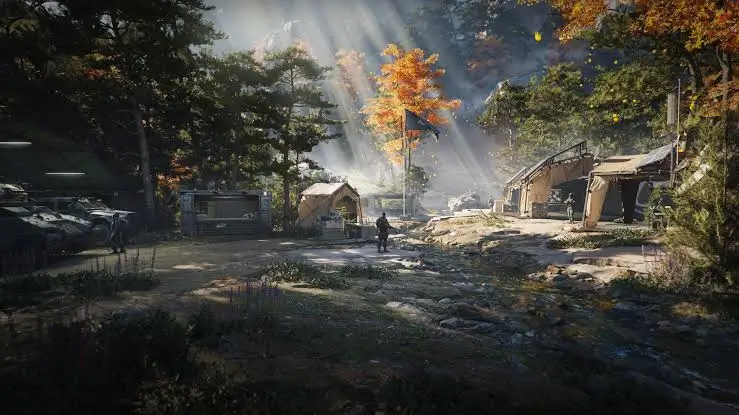
Dying costs a player the gear and valuables being carried, and the operator is lost too, though one can be recovered from the map for in-game cash. The stakes sit a long way from the 2022 version, which arrived on November 16 as a free-to-play beta inside Warzone 2.0 and left players making painful choices about what to keep because storage was so cramped. This time DMZ is part of the paid game, and the base is where that investment shows.
The 2022 mode did leave behind one lesson in how a Call of Duty community handles secrets. Building 21, a clandestine biological lab outside the main map, debuted on December 19, 2022, stayed open for just 24 hours, and later became reachable only with access cards that squads had to find and extract. Infinity Ward has teased a new Building 21-type map for Season 1 and an expansion of Hajin’s locations in Season 2.
extend
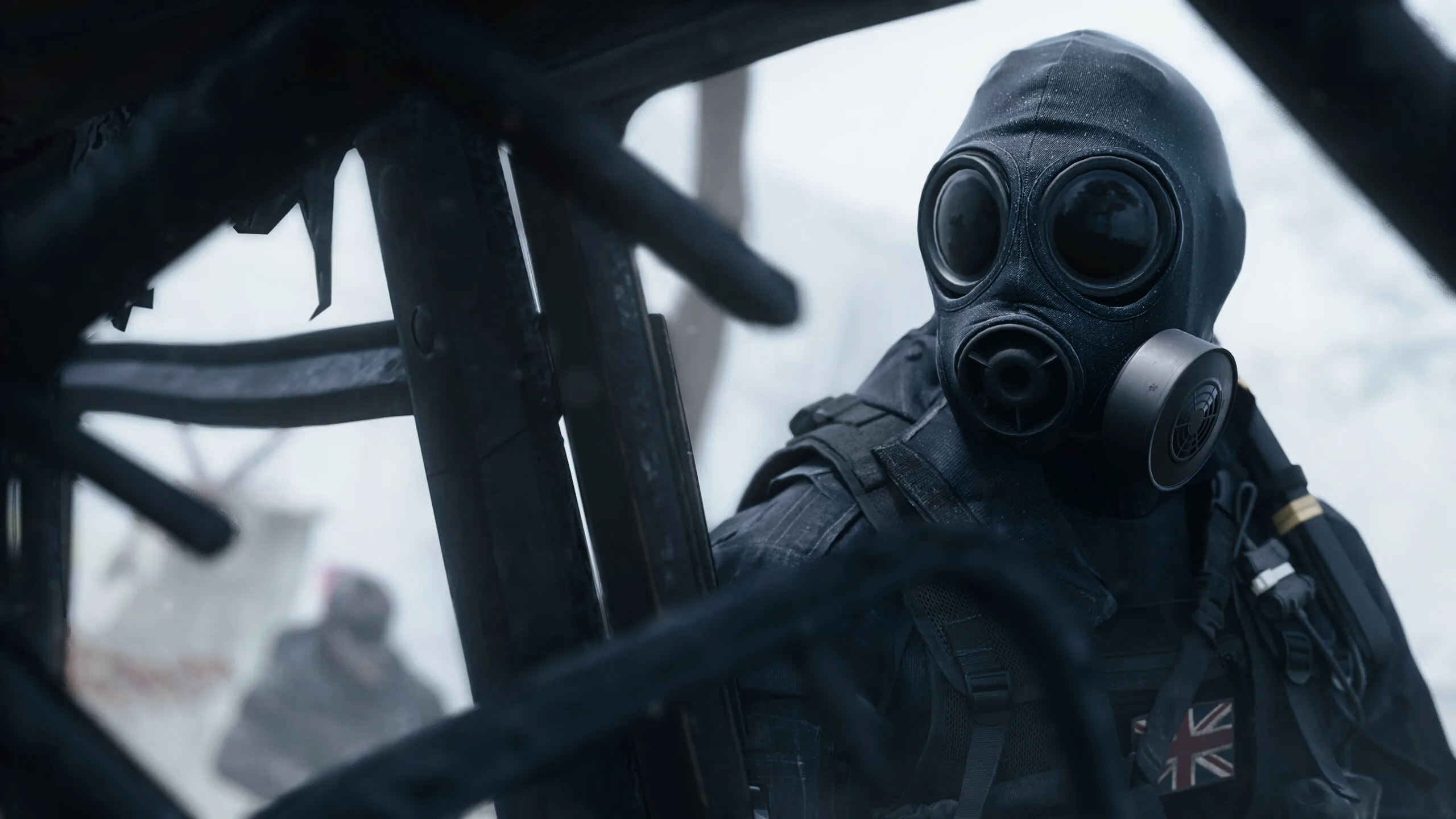
Weather is the map’s clock. Rain and snow intensify as a match goes on, fog cuts view, and a radiation storm timer on the HUD counts down to the zone getting worse. Anyone heading into the reactor needs a gas mask or hazmat protection, since exposure without it is likely to mean severe injury or death.
Transport carries the same lived-in detail. Vehicles need repairs and refueling at gas stations, a rule that does not apply in Warzone. The roster stretches from a family camper and a civilian sedan to a Soviet-designed Grizzly, an LTV with a mounted .50 cal, a radar flatbed with a UAV, and the Dreadnought, a tactical SUV badged by Aston Martin in the official vehicle list. Boats and helicopters round it out, including the Monarch, a twin-rotor heavy-lift aircraft that serves as the ride home and cannot be flown by a player. Stranger still, an automated civilian train keeps running through South Korean locations and a tram circles Hajin City on an elevated monorail, neither under player control, as though part of the country is still keeping its timetable.
Getting out is the last test. Exfil points are marked with green smoke, and a squad must hold the site until a helicopter lands, or leave by Fulton balloon or flare. The flare is loud enough to be seen from far away, and exfil sites double as ambush points for rival squads.
fin
Modern Warfare 4 launches on October 23, with DMZ arriving in the same package as the campaign. Digital pre-orders unlock campaign early access from October 16. DMZ is not free to play this time, and the second part of Activision’s field guide, covering every station inside the Forward Operating Base, was promised for later in the week of October 5.
Related Articles

Victoria Beckham Brings Her Runway Codes to the Dinner Table
A shell-shaped butter dish in a green box, hammered cutlery and rippled glass: Victoria Beckham’s […]