DRIFT AUDIO
Listen to this story
Choose a voice, then press play.
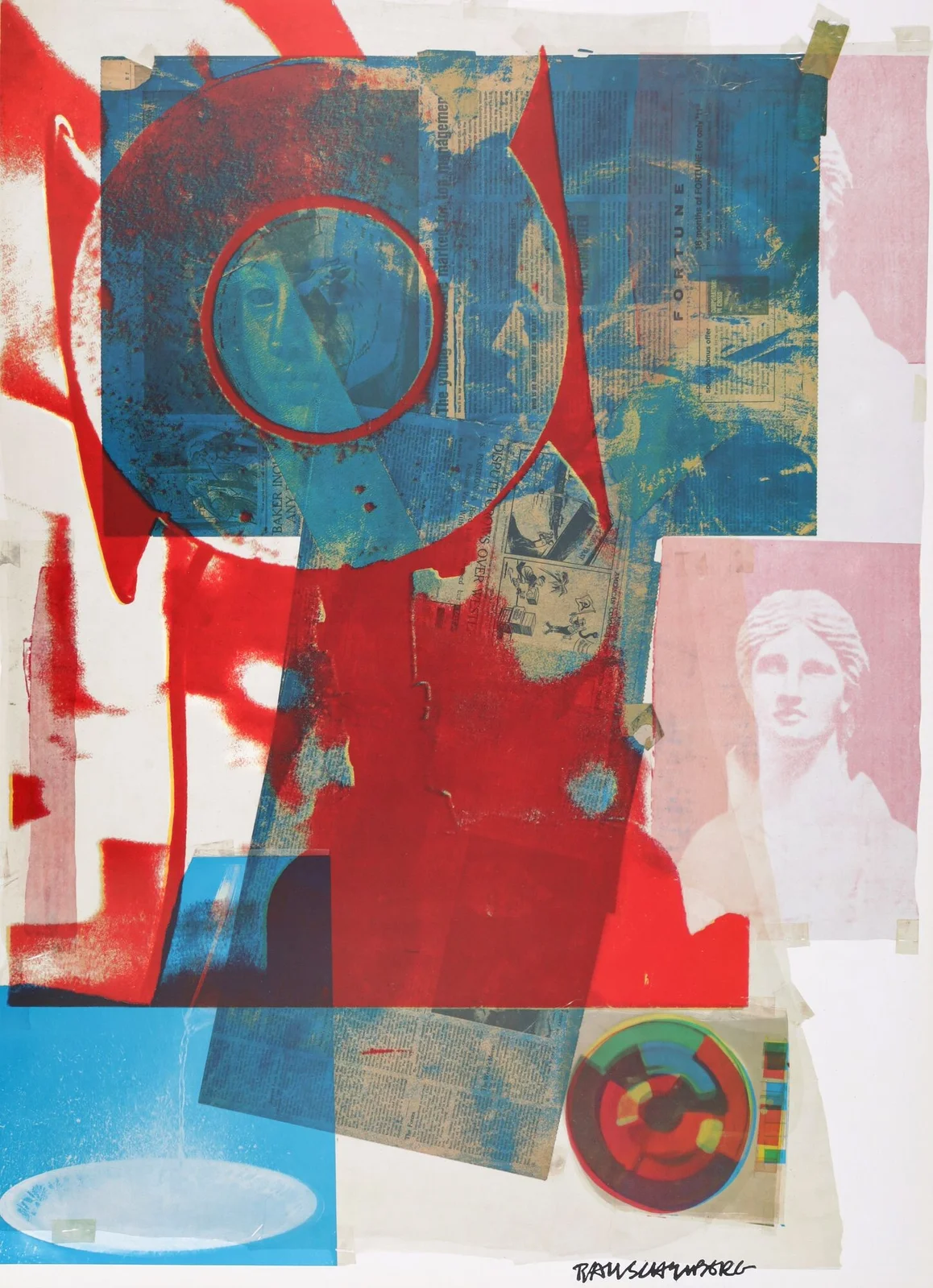
A 1979 impression of Robert Rauschenberg’s Quarry carries a 1968 story: a pilot workshop that handed a lithographers’ union press to working artists.
Robert Rauschenberg‘s Quarry (Local One) is a poster in the plainest sense: a multicolor offset lithograph on paper, 34.5 inches tall and 26 inches wide, with the artist’s name printed into the plate rather than added in pencil. The version now in circulation is a 1979 impression credited to London Arts of Detroit, Michigan, and it works from a composition Rauschenberg made in 1968. Its edition size is unrecorded, and it is unframed. What gives the sheet its weight is where the composition came from: a pilot workshop in which a New York lithographers’ local opened its presses to artists.
Signal. What happened: a 1979 impression of Robert Rauschenberg’s Quarry (Local One), the offset lithograph that grew out of a 1968 union print shop workshop, has surfaced for collectors. Exact object: Quarry (Local One), 1979 impression of the 1968 composition, offset lithograph on paper, signed in the plate, edition size unknown, 34 1/2 by 26 inches (87.6 by 66 cm), unframed, published by London Arts, Detroit, Michigan. When and where: the composition dates to 1968 and came out of the Quarry workshop at Local No. 1’s Lithographic Center, 113 University Place, New York, a pilot residency announced on February 15, 1968 by Experiments in Art and Technology and the union; this impression was published in Detroit in 1979. Source: the E.A.T. program history, Rauschenberg Foundation materials and National Gallery of Art print scholarship. Why it matters: the sheet is the view record of the workshop Rauschenberg inaugurated, a pilot that put artists beside union lithographers and their electronically controlled presses.
The title carries the history in two names. The Quarry was the workshop, and Local One was the union branch whose equipment it used. The sheet is catalogued under both names, sometimes reversed as Local Quarry One, so a search for the print can turn up either order.
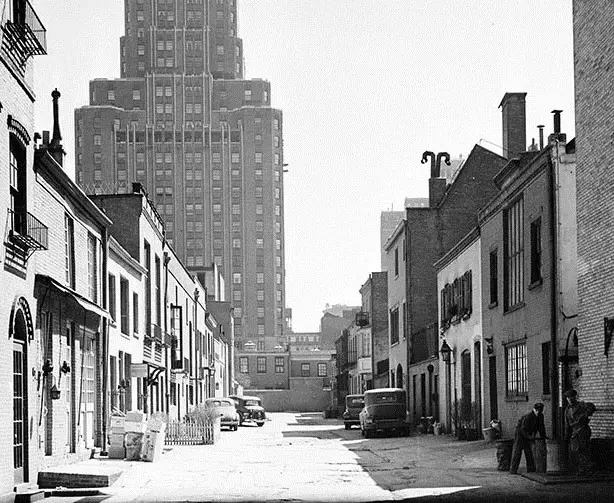
A black-and-white photograph looking down a narrow city street lined with brick buildings, leading toward a towering skyscraper in the distance.
stir
In 1968, E.A.T. organized an artist-in-residence project called The Quarry: MLA-ALA Exploratory Lithographic Workshop. E.A.T.’s own program history shows the Quarry image as a poster designed by Rauschenberg. The workshop was a pilot arrangement with Local No. 1 of the Amalgamated Lithographers of America, and it gave artists access to the union’s Lithographic Center at 113 University Place in New York. The center was no hobby studio. It held advanced multicolor machines fitted with cybernetic systems, electronic scanners, photoelectric timers and computers, the kind of equipment commercial printers used to turn out color work at volume.
The terms were generous. Local No. 1 agreed to supply all materials, personnel and incidental costs, while E.A.T. would advise on how best to use the equipment and select the artists. The union’s president, Edward Swayduck, and E.A.T. both thought that artists working beside engineers and journeymen lithographers might produce new concepts, art forms and commercial applications for lithography. The project was announced at a joint press conference at the Quarry on February 15, 1968, and the March 1968 issue of E.A.T. News invited artists with specific projects to submit them.
Rauschenberg inaugurated the project by making a print, and he was largely responsible for selecting and scheduling the artists who followed. Between April 1968 and May 1969, E.A.T. submitted more than 23 names, with preference going to younger, not necessarily well known artists thought to be inclined toward experimentation. The artists at work during the first year were Mel Bochner, Brice Marden and Marjorie Strider, besides Rauschenberg himself, and George Segal and Louise Nevelson later looked into working there. Several of the artists produced finished works.
flow
The workshop was one prong of a broader effort. E.A.T. was founded in September 1966 by the engineers Billy Klüverand Fred Waldhauer and the artists Rauschenberg and Robert Whitman, during preparations for the October 1966 performance series 9 Evenings: Theatre & Engineering. A not-for-profit service organization, it set out to continue the artist and engineer relationship forged during those performances, in the belief that collaboration between artists and scientists would benefit society as a whole. Its early activities included a lecture series, outreach to engineers, technical services and local groups, alongside the artist-in-residence programs that took in the Quarry.
Rauschenberg’s working relationship with Klüver went back further. Together they made Oracle (1962 to 1965), which incorporated transistor radio technology, and the responsive light installation Soundings, which dates to 1968, the same year as the Quarry.
E.A.T. ran a second residency that year, this time with industry. Planning for an artist to work at the Singer Central Research Laboratory in Denville, New Jersey, began in the summer of 1968, and the lab’s research managers chose Mel Bochner from four candidates. He started in September on a one-year contract, coming in about twice a week to learn the equipment and develop ideas such as color analysis by computer. He compiled technical notes for his own use and later readied them for publication as the Singer Notes. Between them, the union print shop and the corporate lab tested the same premise: place an artist beside equipment he is not yet fluent in and see what he makes.
show
Rauschenberg was not a natural convert to the lithographic stone. He was initially skeptical of the medium and was persuaded to work in it by Tatyana Grosman at her workshop, Universal Limited Art Editions, in West Islip, New York, where he made his first lithograph in 1962. The payoff came fast. Accident, from 1963, won first prize at the Ljubljana Graphic Biennial and put Rauschenberg, ULAE and American printmaking in the foreground as never before. Museum of Modern Art curators later counted his prints at nearly one thousand.
Quarry sits at the other end of the print world from those hand-pulled sheets. Offset lithography is a commercial process, and the equipment came from a trade union rather than an art atelier. In the years that followed, Rauschenberg moved between the two registers. At Gemini G.E.L. in Los Angeles he made the Stoned Moon series, thirty-four lithographs inspired by the Apollo 11 launch he witnessed in the summer of 1969, along with nineteen drawings and collages for an unpublished Stoned Moon Book. In a drawing dated October 28, 1969, he wrote that ideas can be cracks in the stone and recorded the poetic attribution “a print is the widow of the stone.” Cracked stones marked several lithographs in the series, among them Brake, Ghost, Horn, Marsh and Sack. Gemini was also where he tested variability: in the Hoarfrost Editions, printed and published there in 1974, he extended the idea that the impressions in an edition need not match. In 1970, he and Robert Petersen, whom he had met while working at Gemini, set up an experimental print shop in Captiva, Florida, called Untitled Press Inc.
length
The composition did not stay still after 1968. The impression in circulation comes from a 1979 publication by London Arts, a Detroit publisher that issued other Rauschenberg editions in the late 1970s. Like the original, it carries the artist’s name in the plate, so the signature is part of the printing rather than a pencil mark, and no edition number is recorded for it.
The 1968 original is better documented, and the documentation is inconsistent. It was co-printed and co-published by Quarry, Local One of the Amalgamated Lithographers of America and Color Lithographers Service, Inc., of New York. Edition figures vary: some catalogues give 500, unsigned and unnumbered, while others give 850, which one account breaks into 350 signed and numbered copies plus the 500 unsigned ones. Sheet sizes cluster around 34.5 by 26 inches, matching the 1979 impression.
Museums hold the 1968 sheet too. The Phillips Collection in Washington, D.C., has an impression listed at 33 3/4 by 25 1/2 inches, given in 2024 by Jill Denney in memory of her parents, George and Alice Denney.
year
Japan runs through Rauschenberg’s career in several registers. In 1964 he toured thirty cities in Europe and Asia as costume, set and lighting designer for the Merce Cunningham company, a tour that included a performance in Tokyo. In the early 1980s he began a run of collaborations with the Otsuka Ohmi Ceramics Company in Shigaraki, where the Japanese Clayworks combined ancient pottery traditions with new techniques: prefabricated ceramic panels carrying his own photographs of contemporary Japan alongside hand-painted passages. Images of works by Degas, Leonardo da Vinci, Millet and Jacques-Louis David turn up on those panels too, set face to face with modern Japan. Over about fifteen years he made several trips to Shigaraki, and some of the Clayworks were shown in 1982 and 1983 at Leo Castelli Gallery in New York.
He traveled through Japan, Sri Lanka and Thailand in 1983, and in Kyoto he discovered shikishi boards, handmade paper laminated to a thick support and edged with strips of gold paper. His engagement with Japan had begun in the mid-1960s, and a 1975 residency in India, where he worked with a paper mill at Mahatma Gandhi’s ashram in Ahmedabad, set the pattern for the material-driven trips that followed. The Rauschenberg Overseas Culture Interchange, pronounced “Rocky” after the artist’s pet tortoise, followed in 1984, and he funded it personally through 1991. It reached ten countries, with exhibitions that included Beijing and Lhasa in 1985, Tokyo in 1986 and Kuala Lumpur in 1990, and ROCI TIBET remains the only known solo exhibition by a Western artist in Tibet. ROCI JAPAN was its Tokyo chapter, and for it he made new works in 1984 using photographs he took in Japan and transferred onto canvas or fabric.
Those works, together with ceramics made in Shigaraki, were shown at the Setagaya Art Museum in Tokyo from November 22 to December 28, 1986. Most of the series dates to 1984, and in 1987 he added two more pieces: Wall-Eyed Carp / ROCI JAPAN, the largest work in the series and now at the National Gallery of Art in Washington, and a sculptural edition called Bamhue / ROCI JAPAN.
fin
Rauschenberg was born Milton Ernest Rauschenberg in Port Arthur, Texas, on October 22, 1925, and came to art after a brief period studying pharmacology and a stint in the U.S. Navy. He moved to New York in 1949 and enrolled at the Art Students League, and in 1953 he met Jasper Johns. He is best known for the Combines of 1954 to 1964, which blurred the line between painting and sculpture, and for the silkscreen paintings of the 1960s. In September 1970 he founded Change, Inc., a non-profit that helped artists with emergency expenses, and in 1976 the National Collection of Fine Arts, now the Smithsonian American Art Museum, organized a multi-city retrospective of his work.
In 1964 he won the International Grand Prize in Painting at the 32nd Venice Biennale, and in 1993 he received the National Medal of Arts. His auction record is a single painting. Buffalo II, a 1964 silkscreen painting incorporating an image of President John F. Kennedy, sold for $88,805,000, fees included, at Christie’s in New York on May 15, 2019. It came from the estate of the Chicago collectors Robert and Beatrice Mayer and beat his previous record, set by Johanson’s Painting (1961) at $18.6 million in 2015, by nearly a factor of five. His work is held by institutions including the Museum of Modern Art and Tate, and Japanese museums kept the connection alive: he was included in 2016 exhibitions at the Hiroshima City Museum of Contemporary Art and the Museum of Contemporary Art Tokyo. He died on May 12, 2008, in Captiva, Florida.
Related Articles
Robin Rhode, Edition of Five: Inside the 2017 C-Print Called David
A 2017 C-print by Robin Rhode, titled David, measures 185.8 x 227.8 cm in an […]