DRIFT AUDIO
Listen to this story
Choose a voice, then press play.
Alpine’s electric hot hatch just became a 290-crocodile fever dream — and it says more about where fashion is headed than any runway show this season
In This Story
- A Car That Eats You Whole
- 290 Crocodiles, One Obsessive Build
- The Film: Two Ambassadors, One Inside Joke
- Refining the Crocodile: Lacoste’s Real Strategy
- Alpine’s Side of the Trade: Borrowing Cultural Weight
- Gucci Racing and the Widening Circle
- Why Motorsport Became Fashion’s Favourite Runway
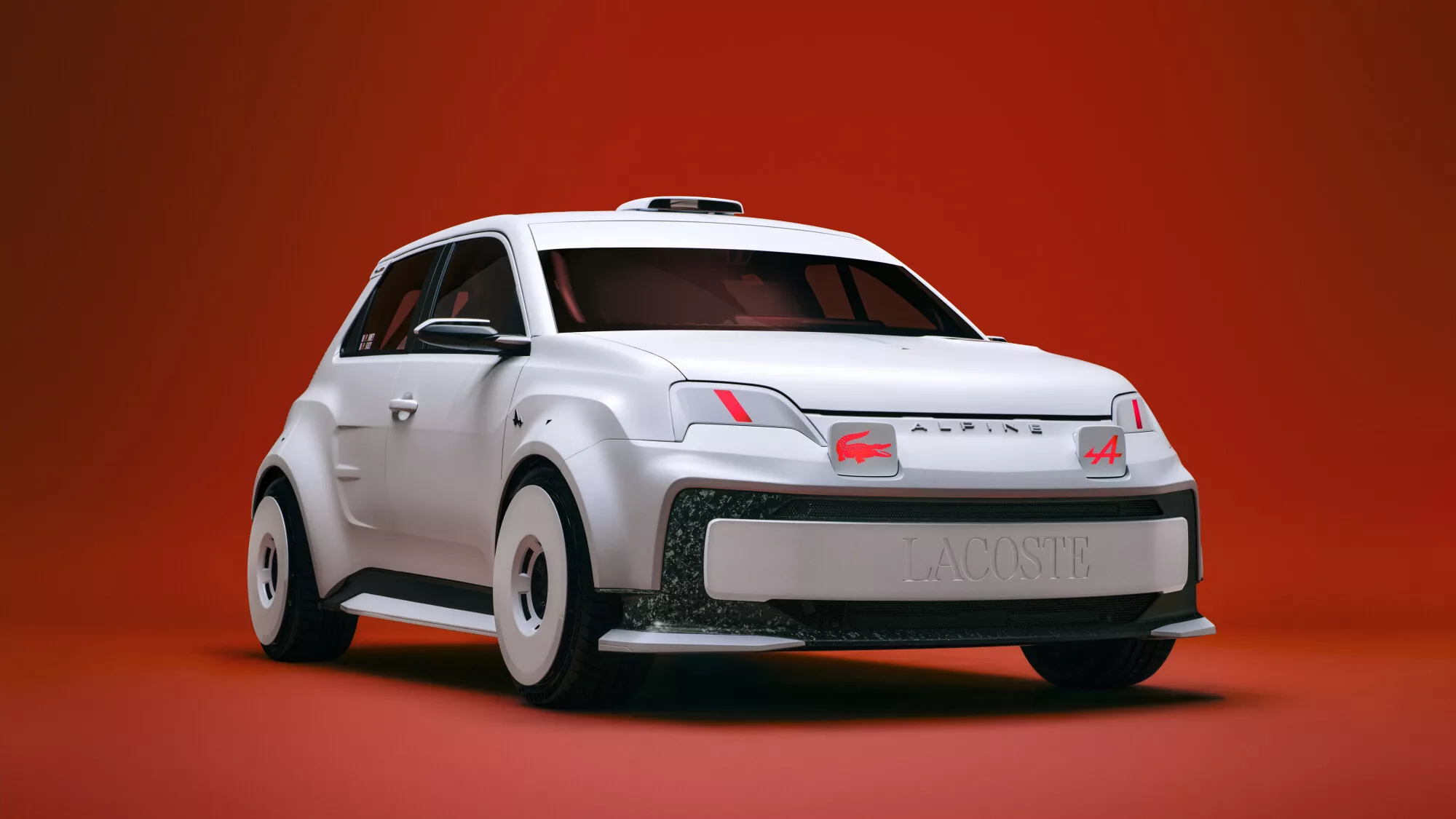
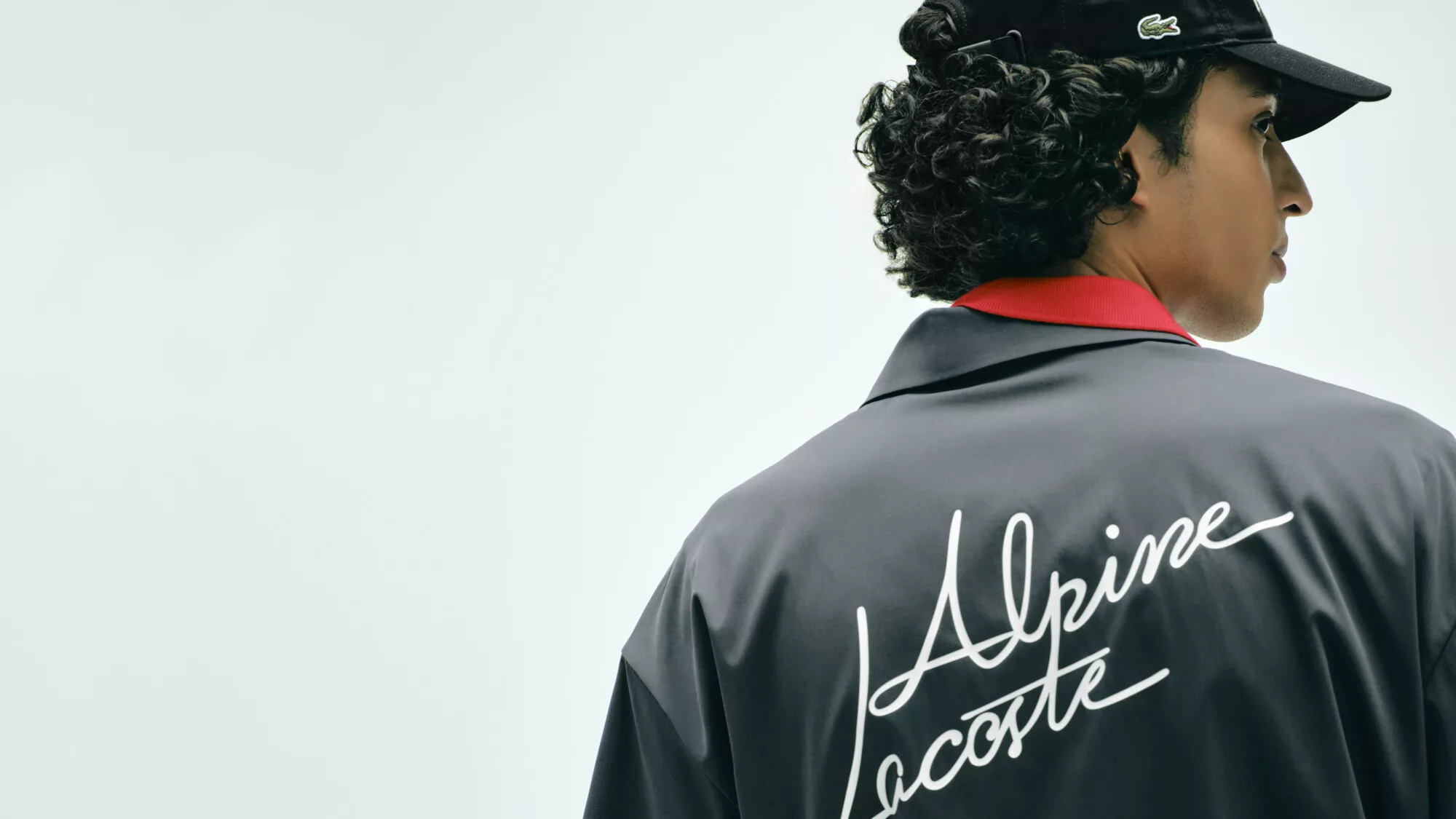
Somewhere outside Paris, a team of automotive engineers and a team of textile embroiderers spent months solving the same brief from two directions: how do you make a rally car feel like it belongs to a 93-year-old tennis and polo brand without turning it into a joke? The answer, unveiled on 29 June at the Musée des Archives nationales in Paris, is called Beware of the Crocodile – Alpine Lacoste A290 Rallye, and it is one of the strangest, most committed pieces of co-branding to come out of French luxury this year.
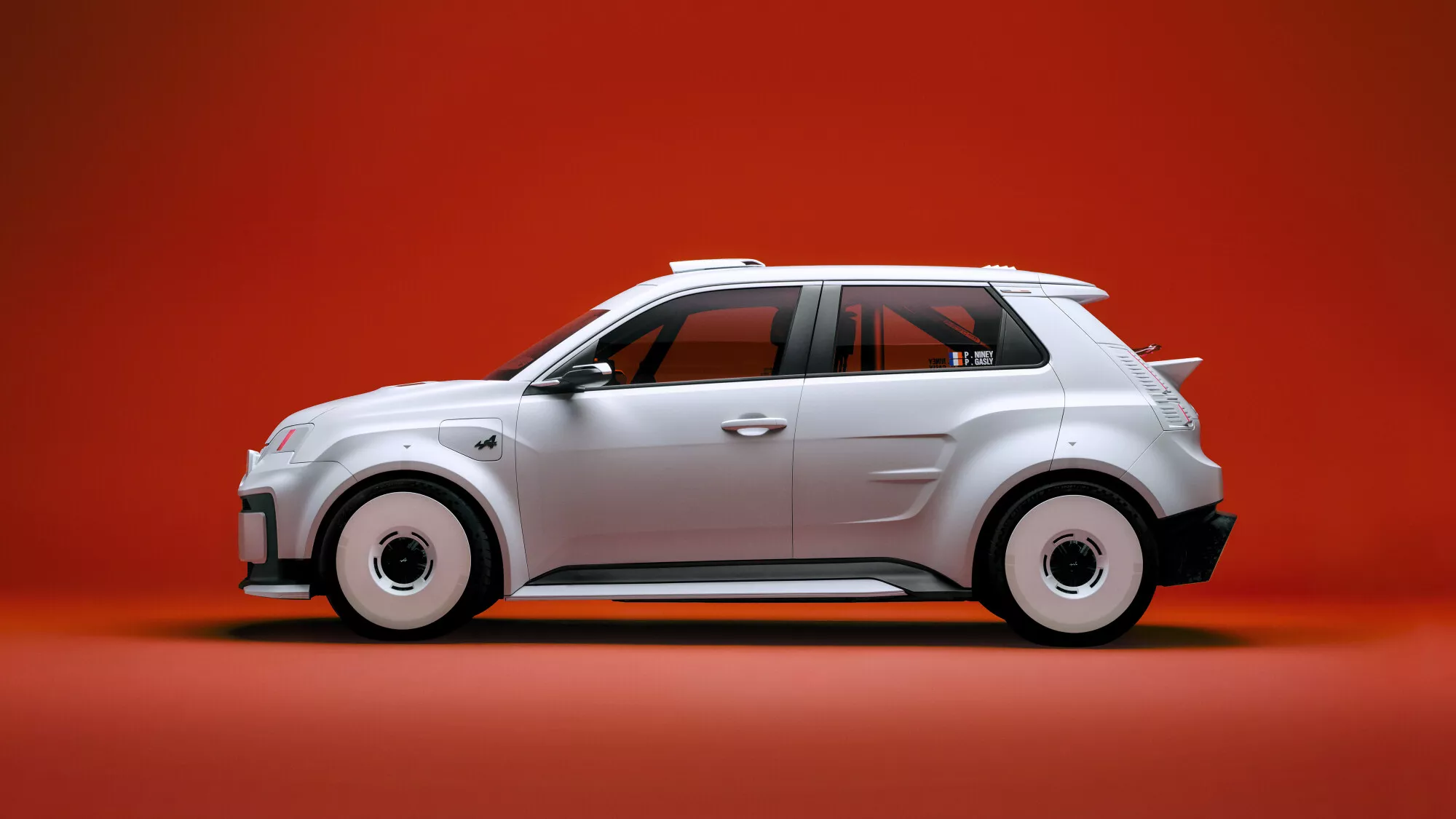
The base car is not a soft target for a fashion collaboration. The A290 Rallye is Alpine’s most extreme electric hatchback, a customer-racing homologation special built off the standard A290 that debuted in 2025. It runs a single front-mounted motor and a 52-kWh battery good for roughly 380 kilometres of range, puts out 220 horsepower and 300 Nm of torque, and hits 62 mph in 6.4 seconds — quicker still with the Overtake boost function engaged. Alpine fitted it with a ZF limited-slip differential, an upgraded transmission, and six-piston monoblock front brake calipers with 350mm discs, the kind of spec sheet built for stage rally competition rather than showroom bragging rights. This is the car underpinning the Alpine A290 Rally Trophy Series, which expands to a six-race format this year as part of the French Rally Championship. Lacoste didn’t pick a concept car or a design study to attach itself to. It picked the hardcore one — the one people actually race.
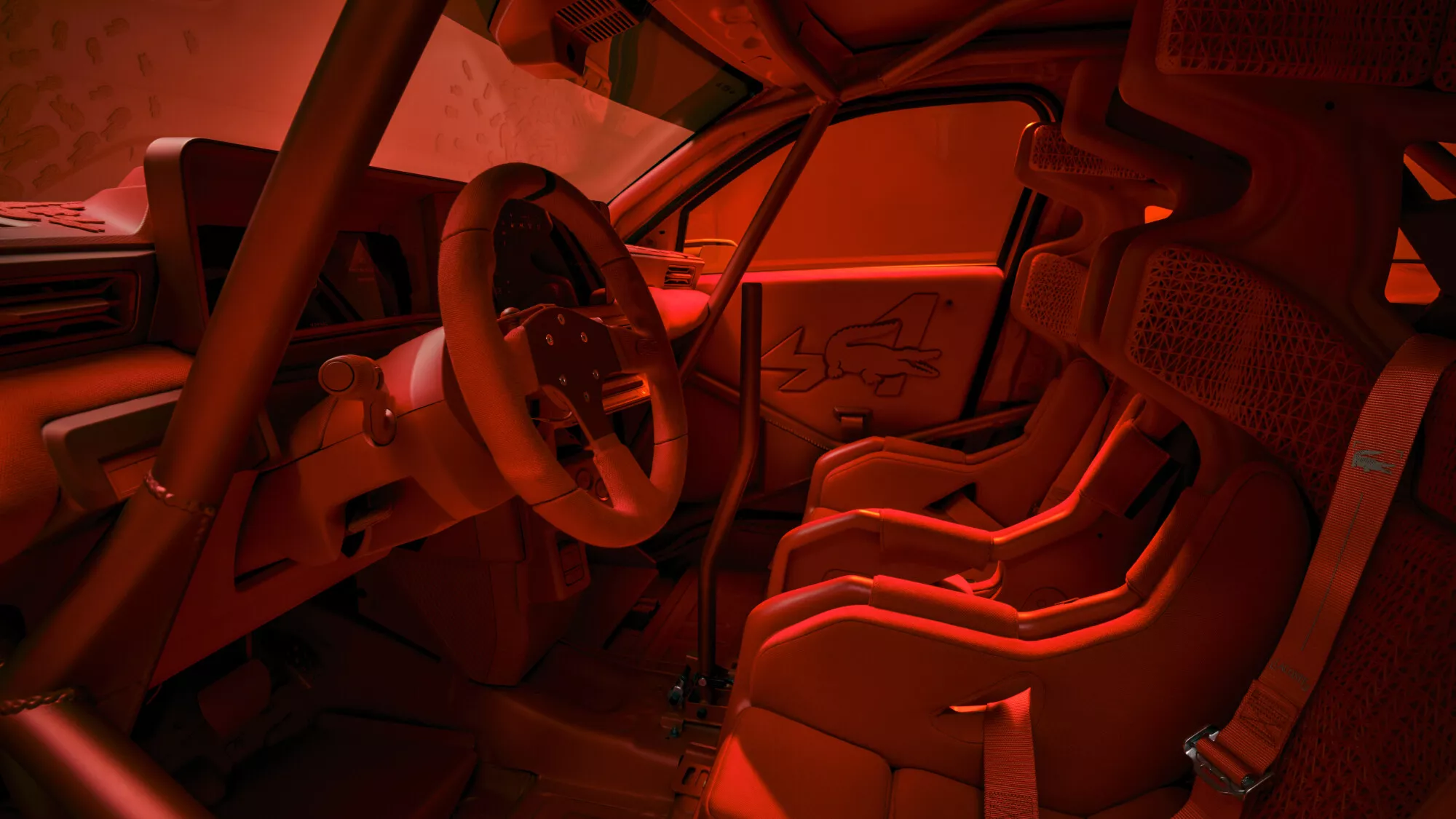
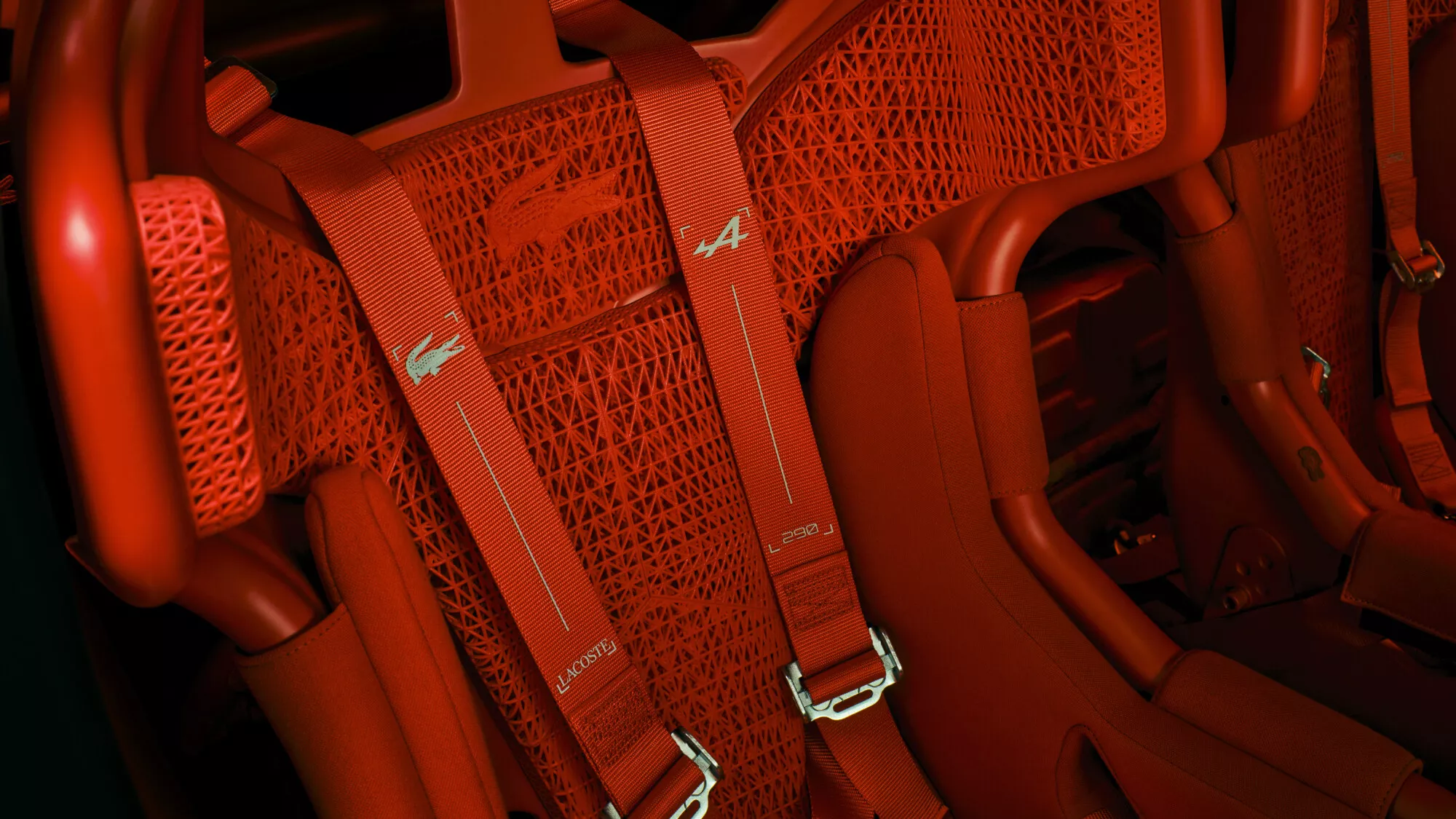
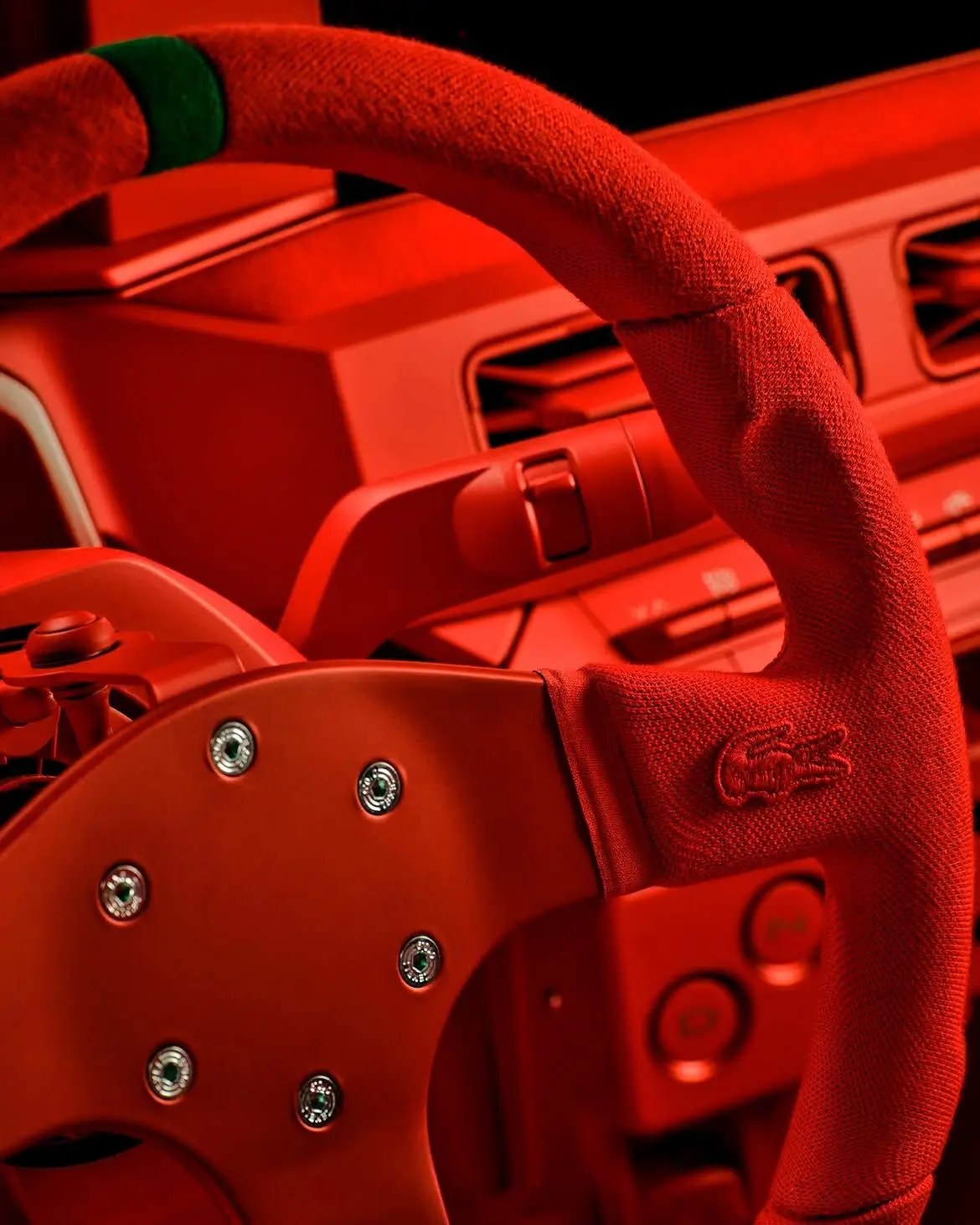
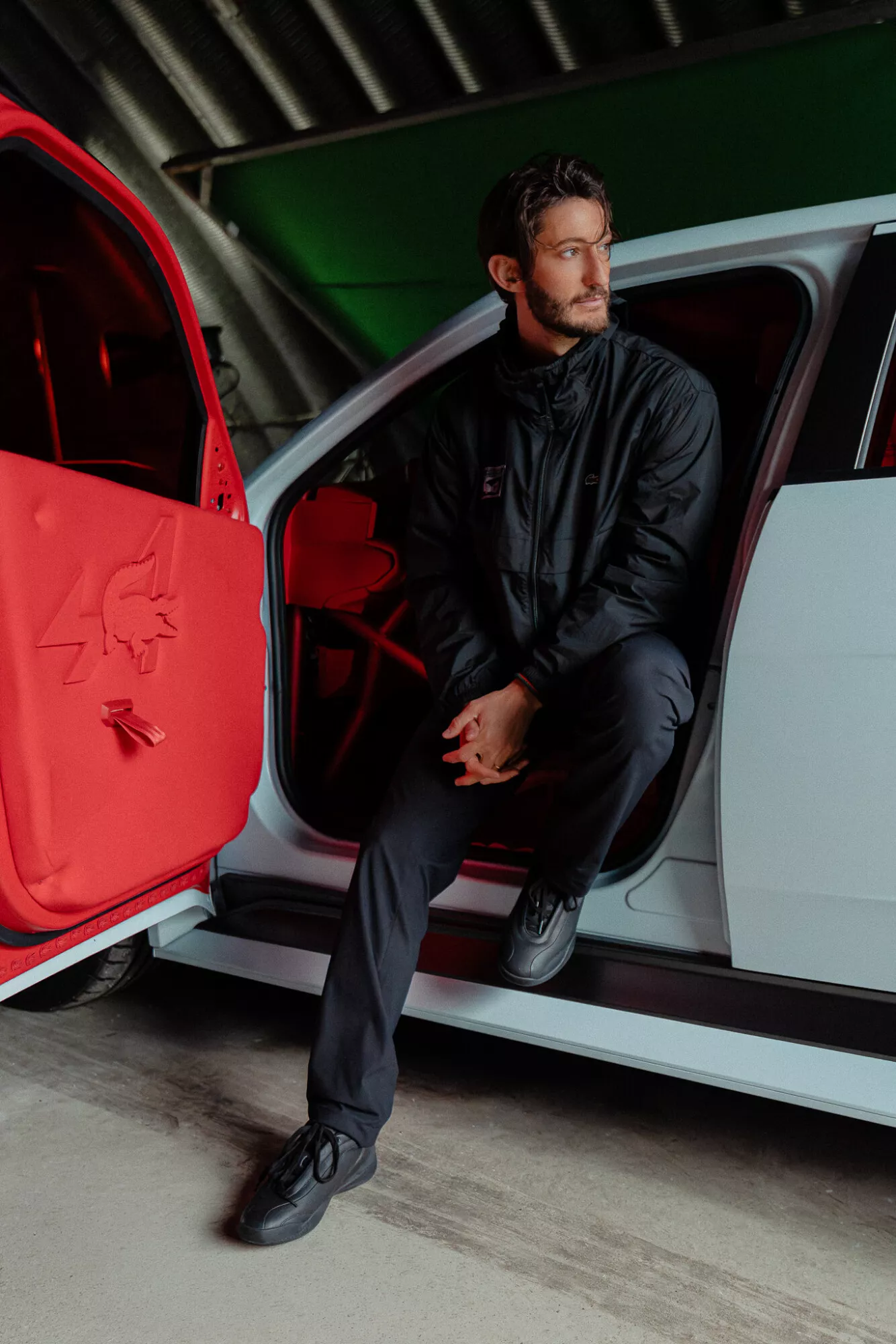
That matters, because the project’s internal codename, “Dans la gueule du Croco” (Inside the Crocodile’s Jaws), wasn’t just a marketing line. Lacoste’s design team built the entire concept around a single detail lifted from its own logo: the red of the crocodile’s tongue. That colour becomes the organizing idea for the whole cabin, finished almost entirely in a saturated red engineered so the driver’s seat genuinely feels like sitting inside the reptile’s open mouth. It’s a strange thing to want from a car interior, and a stranger thing to pull off with restraint — but the execution stays just this side of cartoonish rather than tipping into novelty.
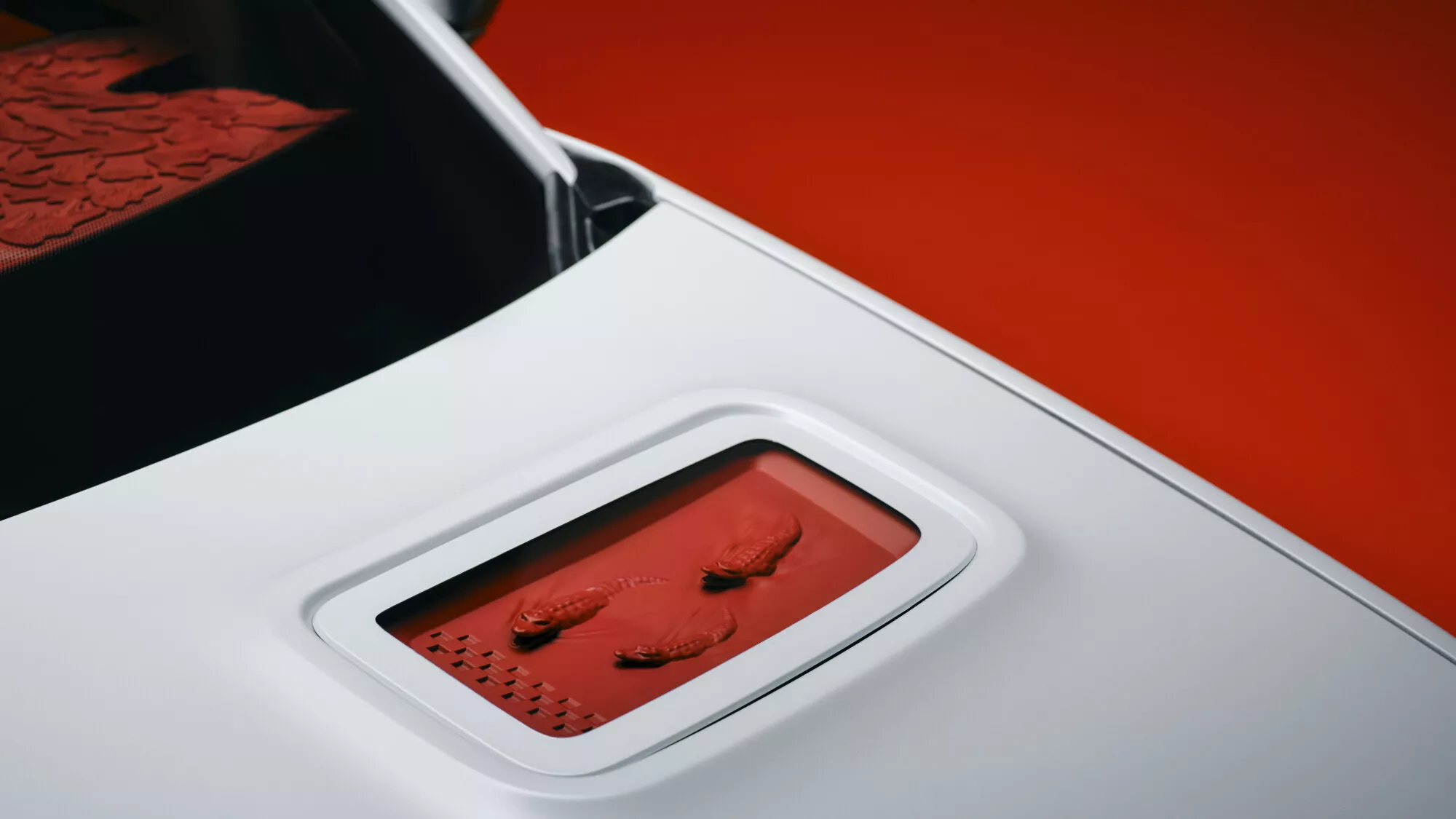
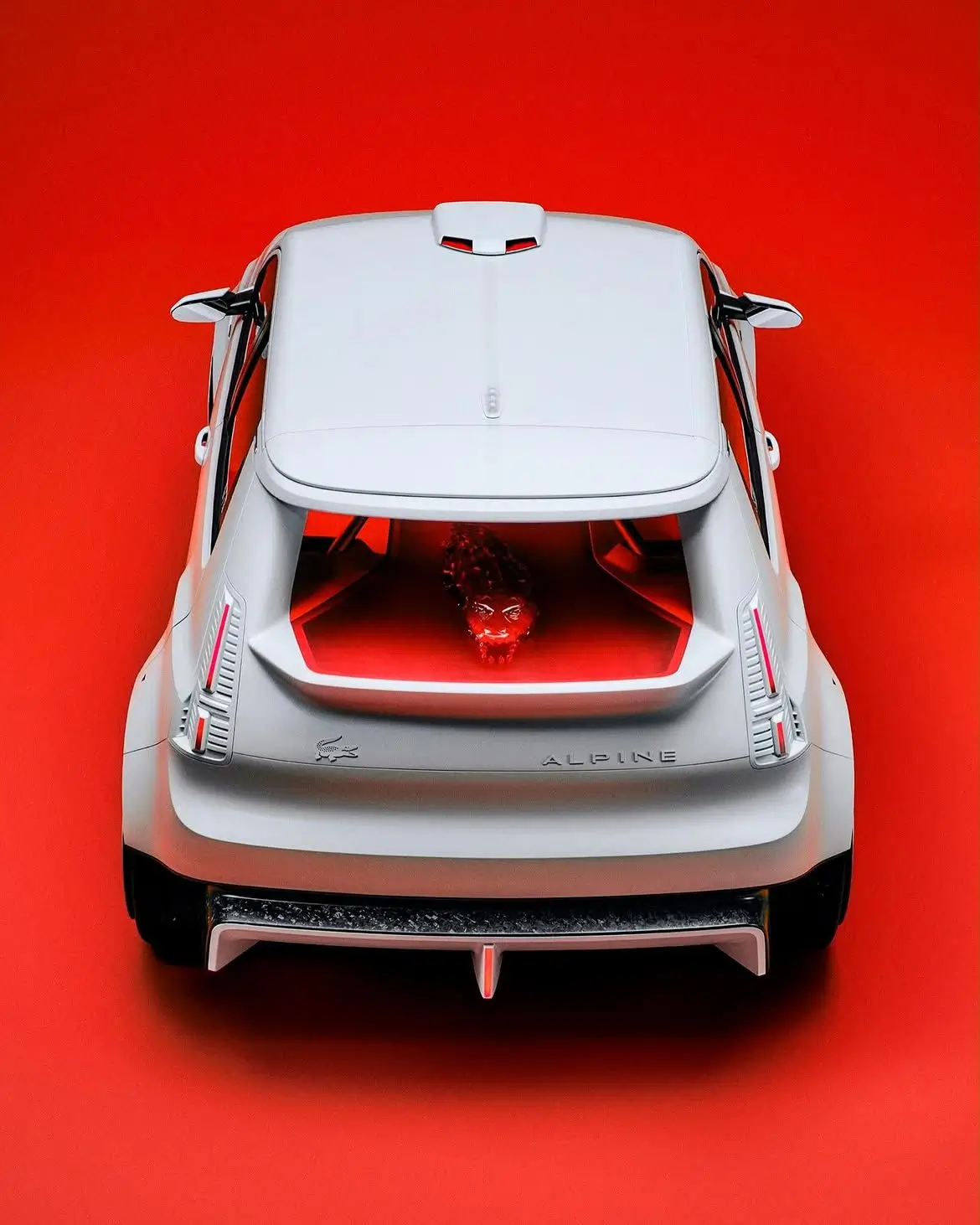
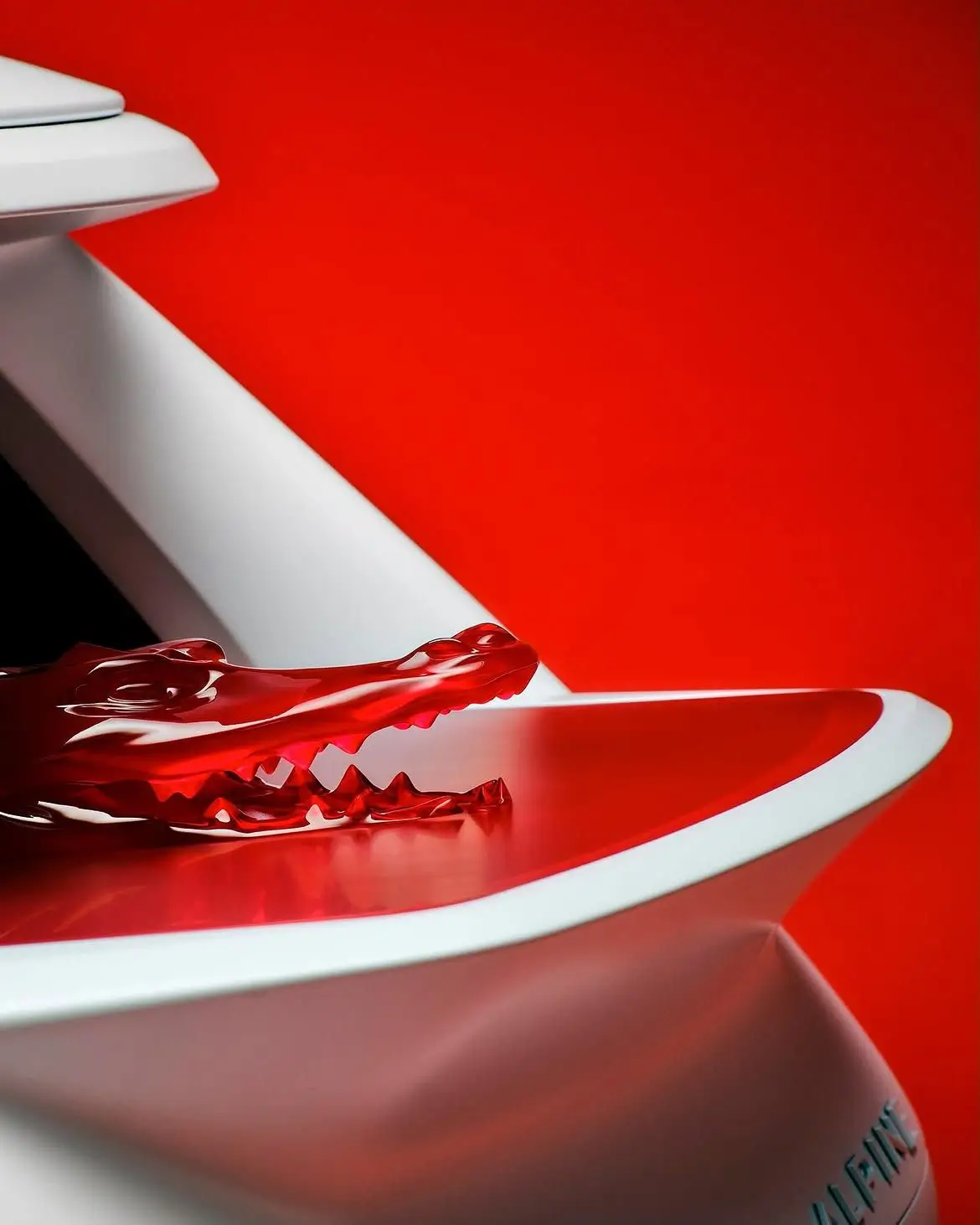
A crystal-red crocodile watches over the Alpine A290 Rallye’s rear deck — one of the collaboration’s most striking design signatures.
stir
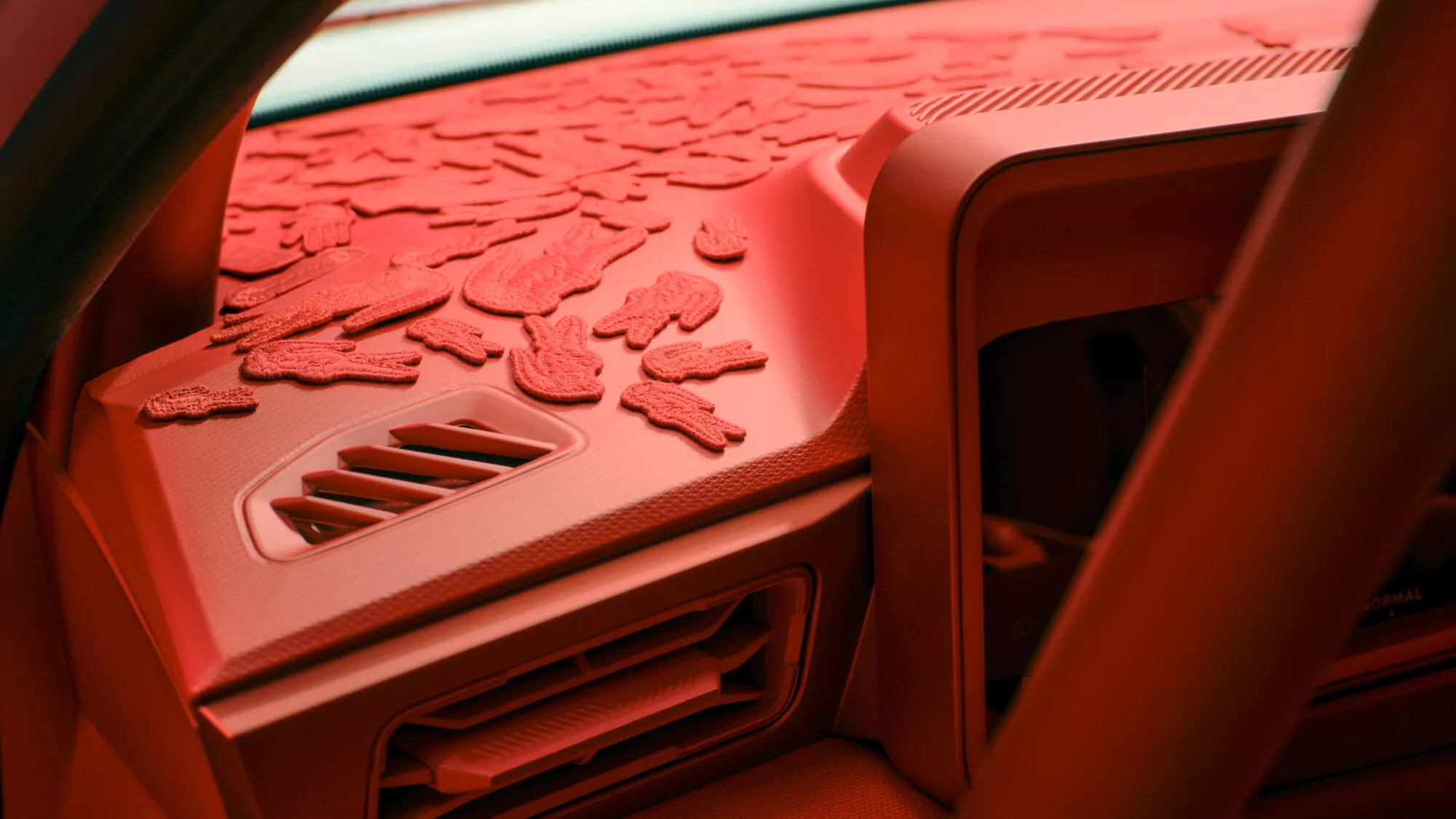
The number in the car’s internal count isn’t a coincidence: 290 crocodiles, tied directly to the A290 nameplate, are worked into the vehicle across the dashboard, the seat backs, the four-point racing harnesses, the steering wheel spokes, and the door panels. On the exterior, the rear window has been deleted entirely and replaced by a large red crocodile head that appears to emerge from the car’s ducktail spoiler, as if it’s surfacing from red water. It’s the single most aggressive design choice on the car, and also the one most clearly built to be photographed rather than driven past at speed.
The materials tell the more interesting story, though. Lacoste supplied its signature petit piqué cotton fabric — the same weave used in its polo shirts since 1933 — to wrap the bucket seats and door panels, both stamped with a co-branded Alpine x Lacoste logo. The embroidery on those seats was produced by Potencier, the atelier responsible for stitching the embroidered crocodile onto every Lacoste polo shirt sold globally. That’s a meaningful detail: rather than licensing the crocodile motif out to whichever supplier the automaker already uses, Lacoste routed the work through its own historic maker, so the crocodiles on the steering wheel are produced with the same technique and the same hands as the one on the shirt in your closet. Parts of the seat structure were also produced using 3D printing by ERPRO, shedding weight the way an actual rally build would, rather than adding decorative mass.
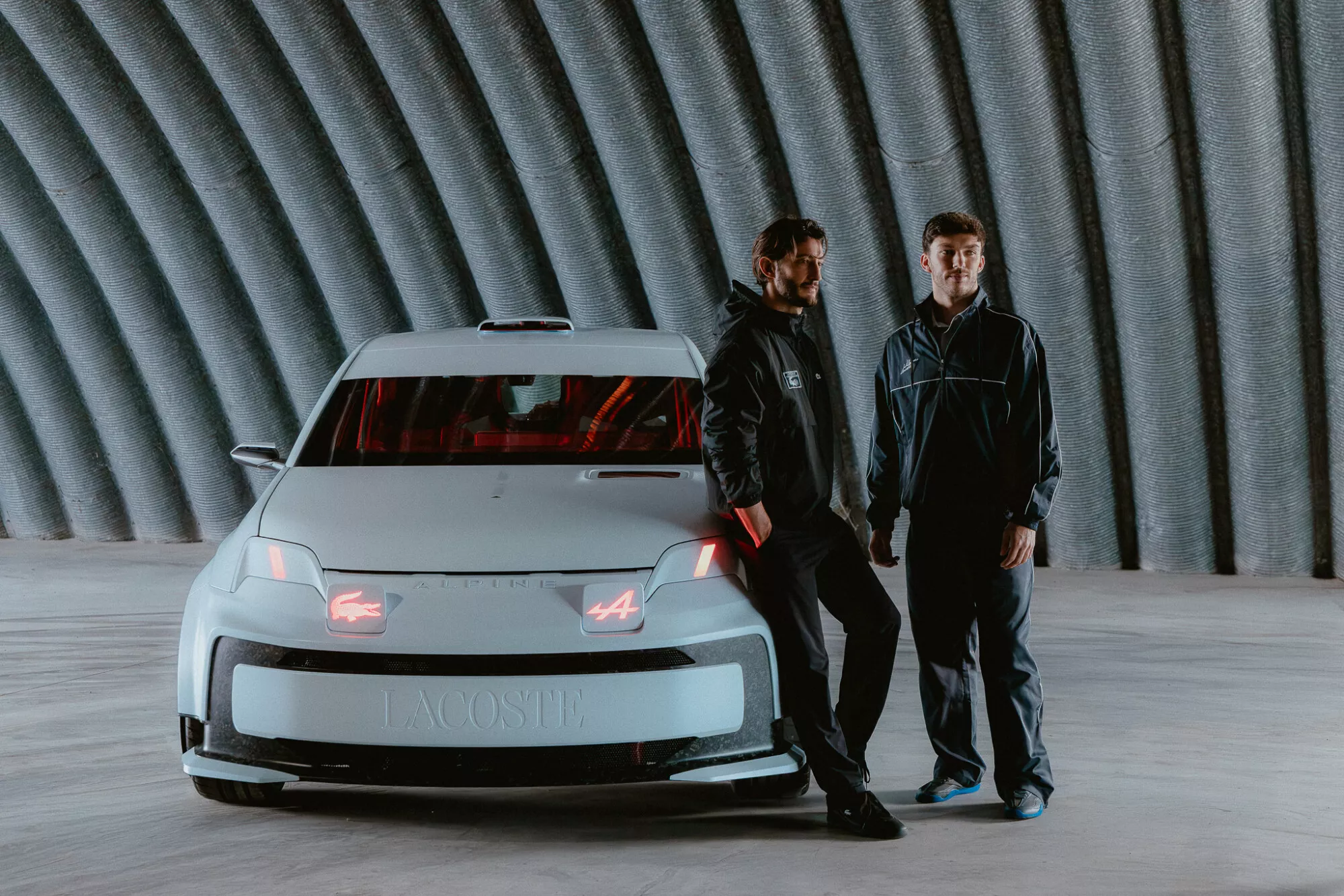
The exterior tells a calmer version of the same story. Where the cabin goes maximalist, the bodywork is finished in an icy, bluish-white intended to evoke Alpine landscapes — snow, ice, frost — with red accents limited mostly to the headlight detailing, where a sliver of colour nods back to the crocodile’s tongue one more time. Alpine’s design team, led by VP of Design Antony Villain, widened the car’s tracks, flared the wheel arches, added a roof-mounted air intake, and built out an aggressive rear diffuser and imposing spoiler with exposed carbon fibre trim — all standard A290 Rallye language, just pushed further and wrapped in the co-branded finish. Villain described the result as a car that “embodies the meeting of two French brands that share the same taste for movement, precision and boldness,” which is the kind of quote that sounds like boilerplate until you’ve actually seen the crocodile head hanging off the back of an EV rally car.
The one-off isn’t for sale. Alpine hasn’t disclosed what happens to it next, though its natural habitat — rally paddocks, Lacoste activations, the occasional concours lawn — seems obvious enough. For context on where it sits in the range, the standard A290 Rallye retails from €59,990 before VAT, well above the roughly $44,130 entry point for the civilian A290 and the sub-$30,000 pricing of the Renault 5 that underpins the whole platform.
flow
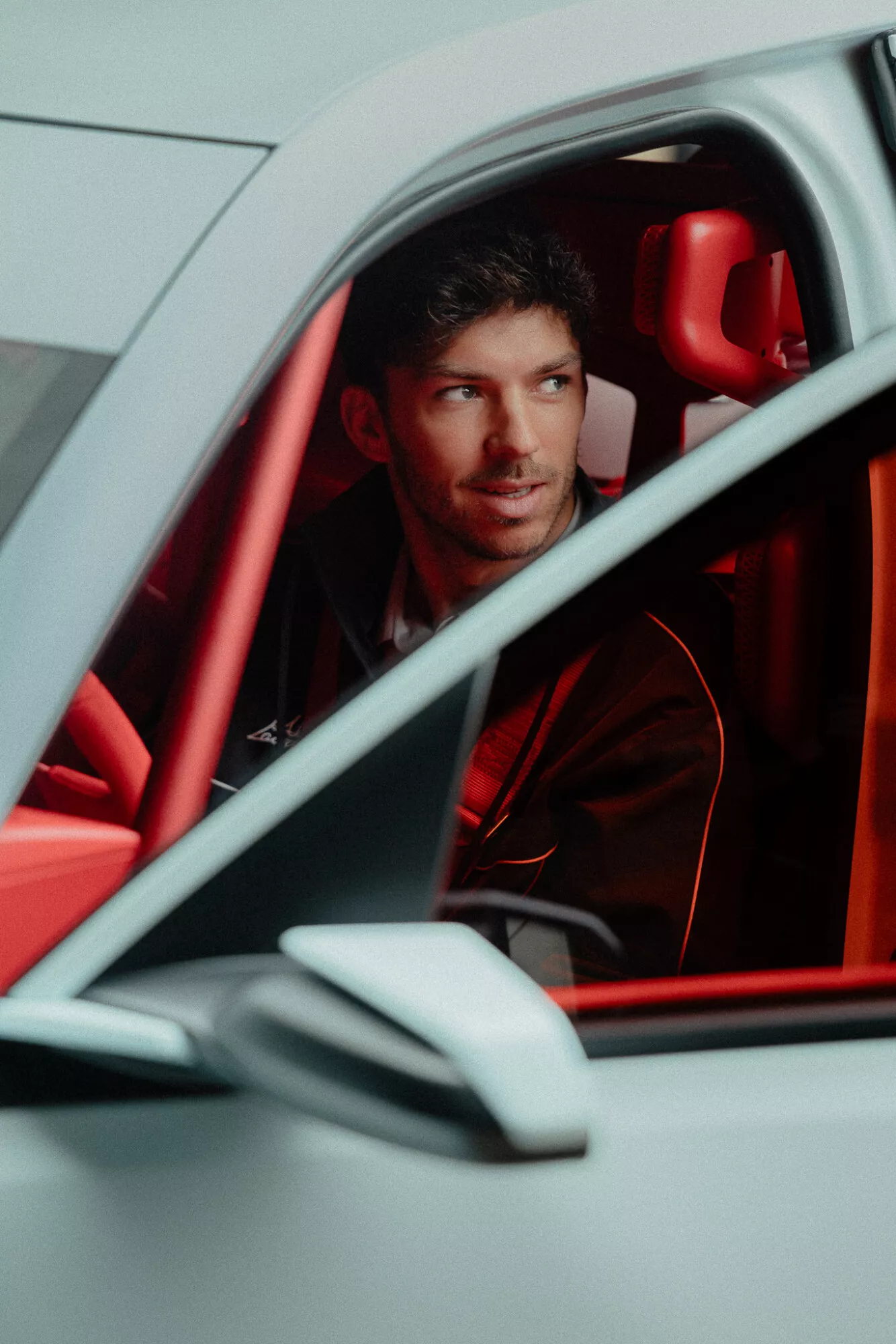
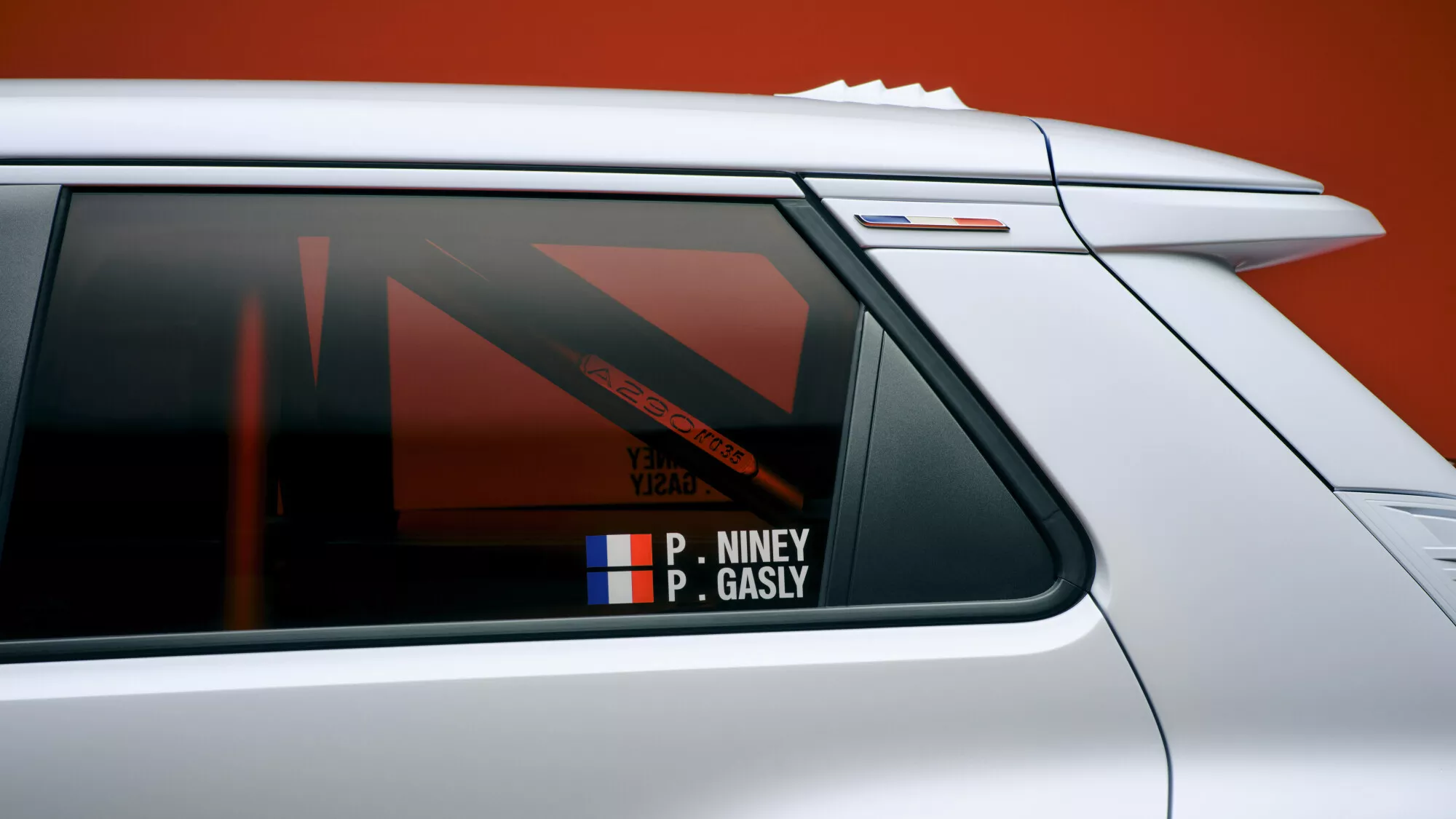
Lacoste and Alpine built the campaign around a short film called The Test, produced by Ninety Films — the production company founded by actor and director Pierre Niney, who is also a Lacoste ambassador. In it, [Pierre Niney] crosses paths with [Pierre Gasly], the Alpine Formula One driver and fellow Lacoste ambassador, and the two play exaggerated versions of themselves in an unplanned, comic encounter built around the one-off car. Both names appear printed on the rear passenger window alongside French flags, a small detail that reinforces the “two ambassadors, one car” premise running through the whole campaign.
The choice to route the story through two people who already represent Lacoste — rather than hiring outside talent for the moment — keeps the whole thing tighter than a typical co-branding push. It’s not an endorsement deal bolted onto a product drop; it’s two people who already wear the crocodile, one on a polo shirt and one on a racing suit, meeting in the middle. Gasly’s presence also does some quiet work connecting this project to Alpine’s broader motorsport identity: he’s currently racing for the BWT Alpine Formula One Team, sitting fifth in this year’s Constructors’ Championship standings, giving the collaboration a genuine athletic credibility that a pure lifestyle tie-in wouldn’t carry.
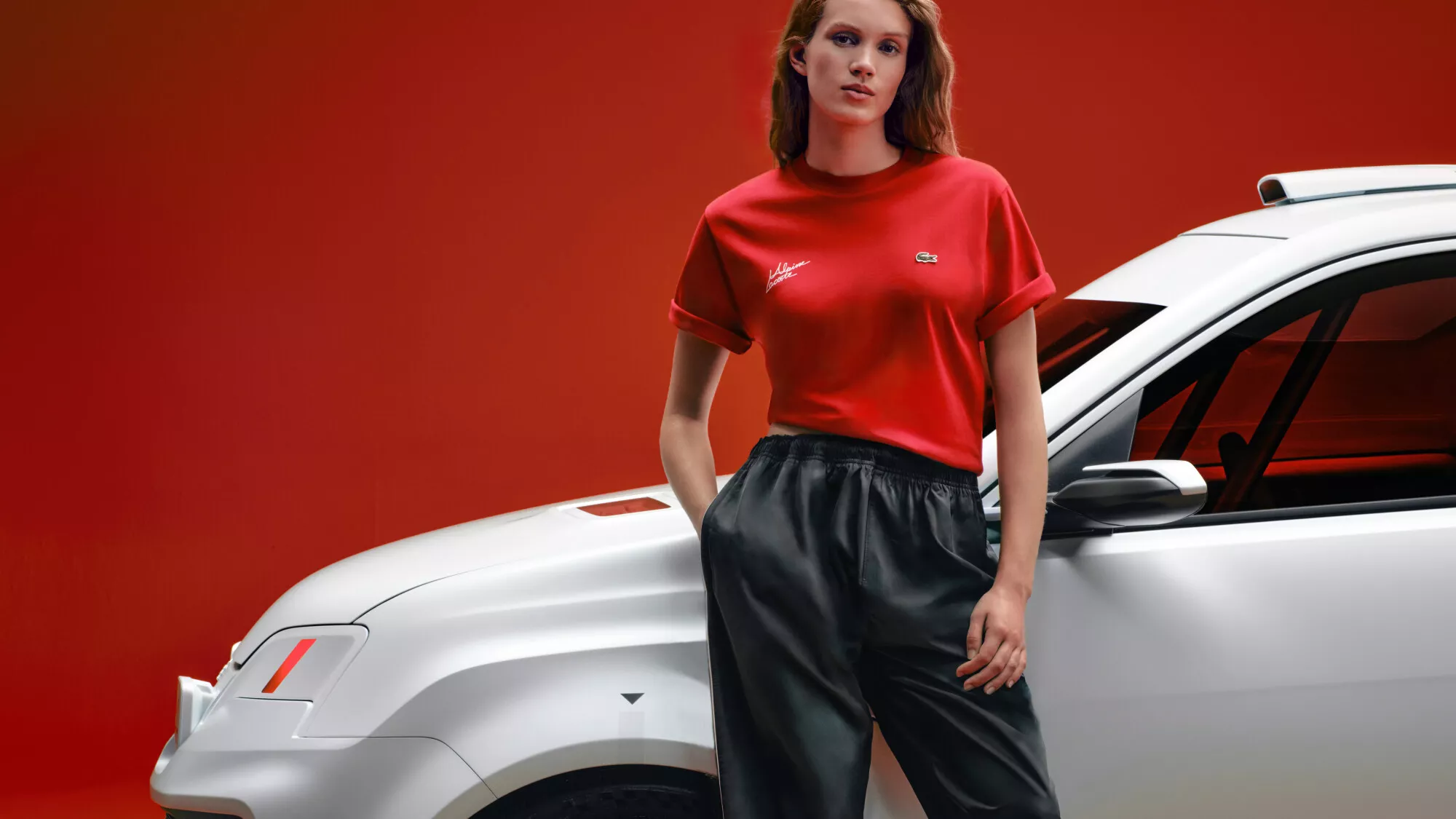
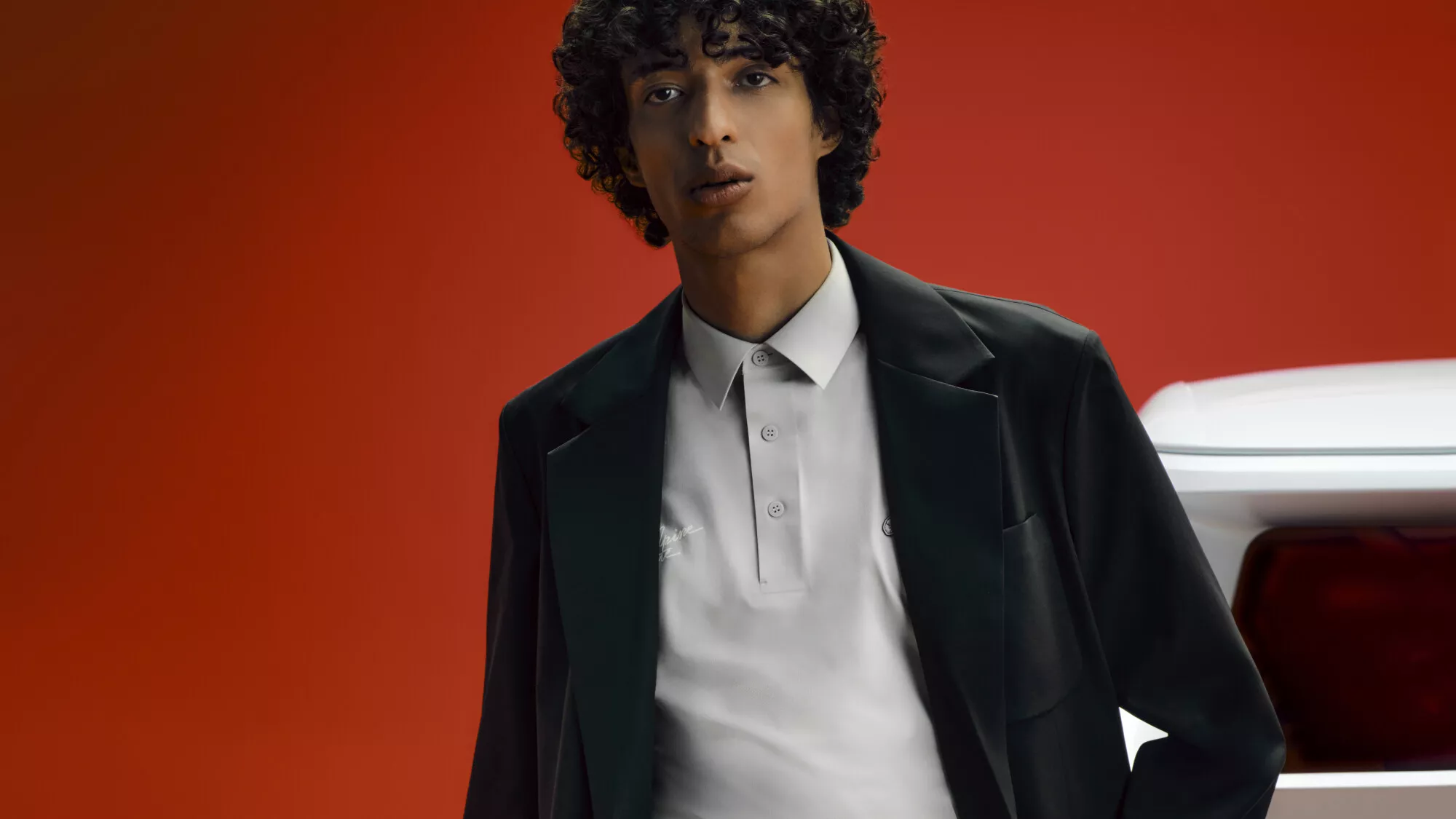
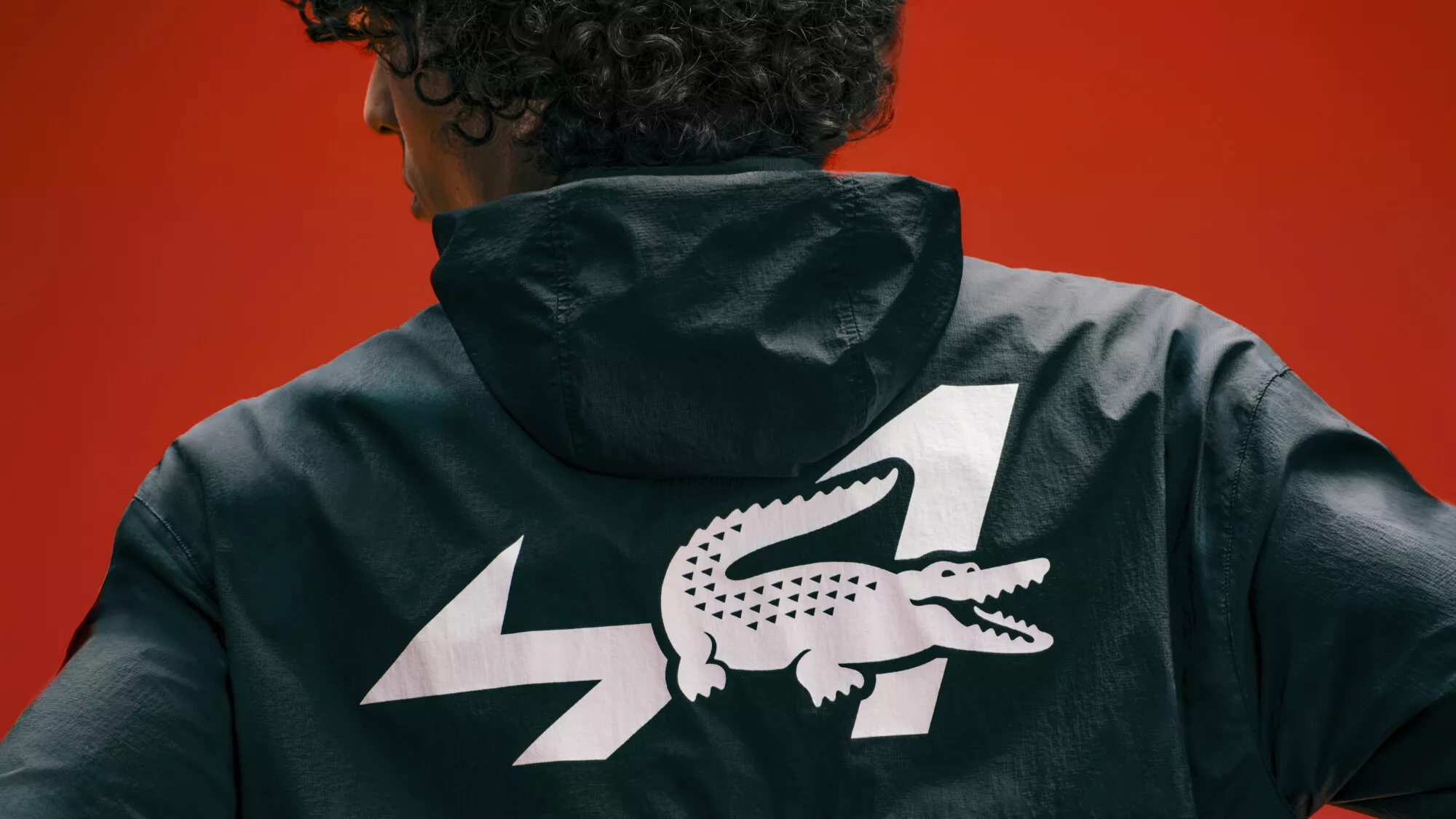
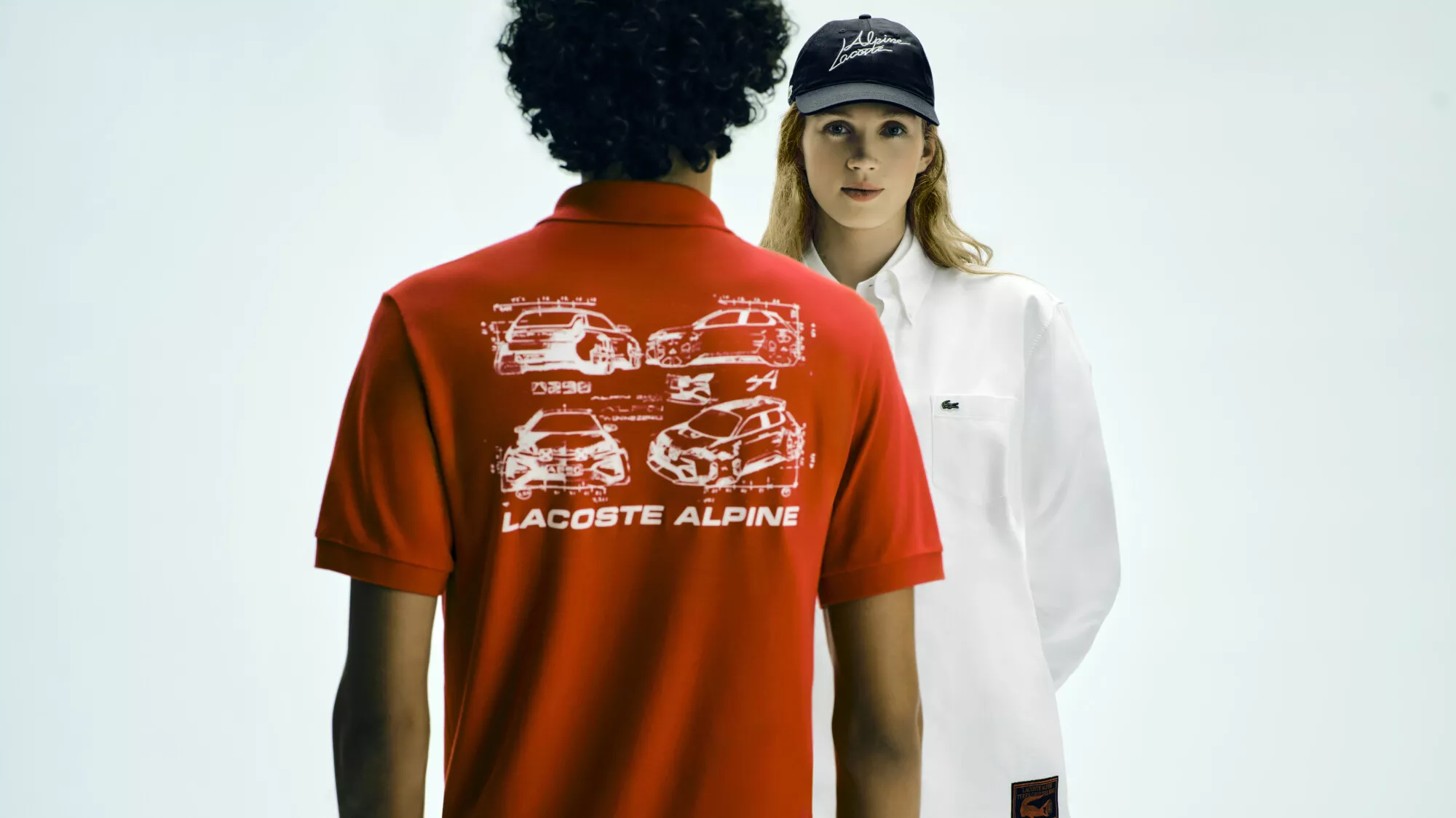
Alongside the car and the film, Lacoste and Alpine released a capsule apparel collection — polo shirts, T-shirts, and lightweight technical pieces and accessories carrying co-branded detailing pulled from the car’s design language. Lacoste has described the range as built around the idea that “form follows function, performance is emotion, and elegance accompanies movement,” language that, again, tracks suspiciously close to how a Formula One team might describe its own aerodynamics package.
fine
Strip away the red cabin and the embroidered reptiles, and what’s left is a legible piece of brand strategy. Lacoste’s entire project right now is refinement, not reinvention: taking the single most recognisable asset it owns — a 93-year-old crocodile logo, unchanged in silhouette since René Lacoste first stitched it onto a tennis shirt — and stretching it into contexts that have nothing to do with tennis or golf, without letting the mark get diluted or abstracted past recognition. A rally car is about as far from a country club as a Lacoste product can get, yet the execution keeps returning to the same fixed points: the exact red of the tongue, the exact embroidery technique from the exact atelier that’s always made the polo crocodiles, the petit piqué weave that’s defined the brand since its founding. Nothing about the collaboration reinvents what the crocodile looks like. It just asks how far that same fixed asset can travel before it stops feeling like Lacoste.
That’s a notably disciplined approach in a moment when most heritage brands chasing culture points reach instead for reinvention — a redesigned logo, a deconstructed silhouette, a collaborator brought in specifically to subvert the house codes. Lacoste’s version looks almost conservative by comparison: keep the crocodile exactly as it is, and place it somewhere nobody expected to find it. That tension between “instantly recognisable” and “somewhere new” shows up across the brand’s ambassador roster too, which already stretches from tennis and golf into Formula One through Gasly and into film through Niney.
culture
For Alpine, the calculus runs in the opposite direction. As a manufacturer, Alpine has genuine motorsport credibility — a Formula One team, a rally programme, seven decades of history tracing back to founder Jean Rédélé — but it remains, relative to the giants of the automotive world, a challenger brand still building a case for why people outside dedicated car culture should care. Fashion and lifestyle collaborations are Alpine’s fastest route to cultural desirability that doesn’t depend entirely on lap times. The Lacoste project follows a pattern the brand has been running for a while: [Alpine’s Formula One team] partnered with luxury skiwear label Perfect Moment on a capsule collection pairing technical ski jackets, suits, and knitwear with the team’s racing colour palette, complete with circuit-line graphics and wheel-bolt markings borrowed straight from the garage floor. That collection launched at the Abu Dhabi season finale, built on the idea that Formula One’s aesthetic language — precision, speed, technical fabric — translates naturally into alpine sportswear, given both brands share literal alpine roots.
The Lacoste project extends that same logic into a different register: rather than sportswear referencing motorsport, this is motorsport hardware referencing sportswear, right down to the seat fabric. Between the two collaborations, Alpine has effectively built a testing ground for how far its identity stretches outside the paddock, and the answer, so far, is quite far indeed.
huh
The clearest evidence that Alpine’s fashion strategy is scaling up rather than staying opportunistic arrived in May, when Alpine confirmed that Gucci will become title partner of its Formula One team from the 2027 season, racing as Gucci Racing Alpine Formula One Team. It’s a landmark deal: Gucci becomes the first luxury fashion house to hold a Formula One title partnership, in an arrangement reportedly worth between $50 million and $150 million across multiple years, and the team’s current blue-and-pink BWT livery will give way to Gucci’s black-and-gold palette, with what Alpine CEO Philippe Krief described as “a little blue” retained. Gucci president and CEO Francesca Bellettini has framed the partnership as extending well beyond logo placement, describing a “360 collaboration” spanning content, product, and experiential activations under a new Gucci Racing platform with its own dedicated interlocking-G logo.
The deal wasn’t built in isolation. Luca de Meo, who ran Renault Group — and by extension Alpine — for five years before becoming CEO of Gucci parent Kering last September, is widely credited as the connective figure, working alongside Alpine executive advisor Flavio Briatore, who has his own history steering a fashion-adjacent team: he ran Benetton’s Formula One outfit through its title-winning years in the 1990s. Bellettini has also pointed to Gucci’s earlier automotive history — a 1970 tie-up with AMC, plus later collaborations with Cadillac, Rolls-Royce, and Fiat — as evidence the house has circled this territory before, just never at Formula One’s current scale.
Positioned against Gucci Racing, the Lacoste A290 Rallye and the Perfect Moment capsule start to look less like isolated marketing stunts and more like a deliberate ladder Alpine has been building: mid-tier lifestyle capsule with Perfect Moment, hardcore one-off collector’s piece with Lacoste, full title partnership and livery overhaul with Gucci. Each step trades a little more cultural equity for a little more fashion-world legitimacy, and each partner brand gets something specific in return — Perfect Moment gets racing-grade technical storytelling, Lacoste gets an unexpected, headline-generating stage for its oldest asset, and Gucci gets an entirely new audience measured in the hundreds of millions that Formula One reaches each season.
why
None of this is happening in a vacuum. Formula One’s audience has grown younger, more global, and more fashion-literate over the past several years, accelerated by docuseries coverage and a wave of driver-as-influencer culture that turned paddock fits into their own content category. Luxury houses have noticed: Louis Vuitton signed on as an official Formula One partner across the LVMH portfolio two years ago, and sponsorship activity from Tommy Hilfiger, Hugo Boss, and other fashion-adjacent brands has multiplied across grids in recent seasons. Gucci’s arrival as a title partner — the first time any luxury house has held that position — reads as the clearest confirmation yet that motorsport has become one of fashion’s preferred stages for reaching audiences a runway show can’t touch.
What makes the Lacoste project distinct within that broader trend is its refusal to treat the car as a billboard. Plenty of fashion-motorsport tie-ins amount to a logo on a livery or a driver in a branded polo at a press conference. Beware of the Crocodile goes considerably further, building an entire concept — tincture material, embroidery technique, even the interior atmosphere — around a single detail lifted from a logo that hasn’t meaningfully changed since 1933. It’s a small, obsessive piece of design thinking wrapped around a genuinely fast electric rally car, and it argues, more persuasively than any sponsorship deck could, that the crocodile still has room to travel.
Related Articles
Under Rue de Castiglione, Liaigre Gives Hôtel Costes a Spa With No Hard Corners
A 20-meter lap pool, eight treatment rooms and not one sharp angle: Studio Liaigre’s spa […]