Into the Flames: The Wild Spirit and Transformative Power of Burning Man

July 2, 2025
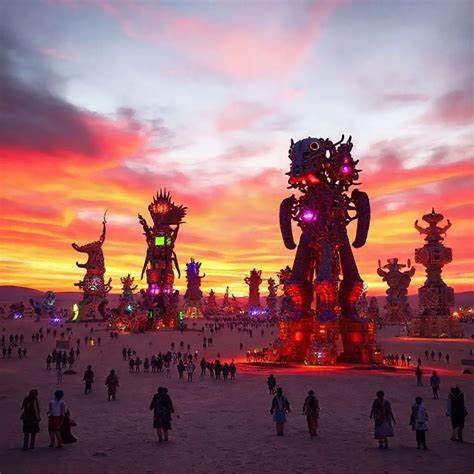
In 1986, two guys—Larry Harvey and Jerry James—dragged an 8-foot wooden man to San Francisco’s Baker Beach, lit it on fire, and unintentionally sparked a cultural wildfire. No permits. No press. Just a small group of freaks and weirdos standing around a bonfire, watching a man burn. That one chaotic act of radical self-expression would morph into one of the most iconic and subversive gatherings in modern history: Burning Man.
The idea was simple: build something ephemeral, watch it disappear in flames, and feel the primal catharsis that accompanies both creation and destruction. But what started as an intimate ritualistic burning grew year after year, moving from the edge of the Pacific Ocean to the Nevada desert’s inhospitable Black Rock Desert. There, on a vast alkaline flat known as the playa, a temporary city rises each year from dust and dreams before vanishing as if it never existed.
Burning Man’s ethos centers around ten principles articulated by Harvey himself, including radical inclusion, gifting, decommodification, radical self-reliance, radical self-expression, communal effort, civic responsibility, leaving no trace, participation, and immediacy. These ideas serve as the ideological scaffolding on which the event’s entire infrastructure is built.
At its core, Burning Man isn’t just a festival. It is a living, breathing experiment in community and creativity. Unlike typical festivals where spectators come to consume, Burning Man participants (or “Burners”) are the creators, performers, and inhabitants. There are no corporate sponsors, no vending stalls hawking cheap merchandise, and no headlining acts to center the experience. Every sculpture, installation, theme camp, and mutant vehicle is a gift to the collective — expressions of personal imagination transformed into public spectacle.
Throughout its history, the city has been an open-air laboratory of art and architecture. Monumental sculptures, from the towering “Temple” to the many smaller interactive pieces scattered across the playa, merge futurism with primal symbolism. The Temple, in particular, has become a spiritual epicenter. Originally created by David Best in 2000 as a tribute to a fallen friend, it stands as a sanctuary for grief, remembrance, and collective catharsis. Every year, Burners cover its walls with messages to lost loved ones before it, too, is set ablaze.
The city’s layout itself is a marvel of temporary urban design. Laid out as a giant semi-circular clock face, Black Rock City emerges from nothing each August. It accommodates up to 80,000 residents, complete with streets, neighborhoods, and plazas. The center of this ephemeral city is “The Man,” a towering effigy that symbolizes the event’s heartbeat. In a society obsessed with permanence and ownership, the deliberate transience of this city challenges notions of value and meaning.
Burning Man has always drawn artists, technologists, and dreamers. The event’s appeal to Silicon Valley figures is particularly noteworthy. Executives and engineers alike see it as an annual pilgrimage — a week to shed capitalist constraints and immerse themselves in radical creativity. Companies like Google famously attribute some of their early campus culture and “moonshot” projects to ideas sparked on the playa. But this has also led to accusations of gentrification and “commodification creep,” where luxury camps and exclusive plug-and-play experiences undermine the core principles of communal effort and decommodification.
Indeed, Burning Man faces a delicate dance between maintaining its utopian ideals and evolving alongside a changing world. Early Burners lament the increasing presence of “turnkey” camps — pre-assembled accommodations replete with chefs, air conditioning, and private security. Critics argue that this transforms participants into passive consumers rather than active co-creators, threatening the festival’s fundamental ethos.
Yet, in many ways, Burning Man mirrors society’s shifting tensions between access and exclusivity, DIY spirit and luxury, community and individualism. Its cultural contradictions reveal both the idealism and flaws of our era, inviting us to question not just the event itself but the very structures we inhabit.
Beyond its architectural and cultural commentary, Burning Man offers a profound exploration of impermanence. The desert is unforgiving; windstorms can wipe out entire camps, and artworks are swallowed by whiteouts. Survival requires intense preparation, radical self-reliance, and communal support. There is a Buddhist undercurrent in the cycle of creation and destruction — a visceral reminder that nothing lasts forever and that beauty can exist purely in the moment.
In recent years, the festival has also expanded globally through regional “burns,” echoing the original principles but tailored to local contexts. Events like AfrikaBurn in South Africa, Nowhere in Spain, and Midburn in Israel carry the torch, weaving local cultures into the fabric of the global Burner community. These events provide opportunities for more intimate gatherings while preserving the spirit of radical self-expression and participation.
As we move deeper into an era defined by digital interconnectedness and virtual experiences, Burning Man offers a poignant counterpoint. The event is an embodiment of analog living — a place where human connection, tangible art, and shared dust-caked experiences take precedence over screens and algorithms. Yet even here, technology plays a role. Drones capture aerial art formations, LED installations redefine nightscapes, and social media threads tie Burners together long after the final burn.
Literature and philosophy echo throughout the playa’s ethos. The burning of The Man can be seen as an act akin to the phoenix myth, the endless cycle of rebirth through fire. In many ways, each participant is asked to confront their own attachments, identities, and shadows, to “burn” parts of themselves they no longer need, emerging from the dust transformed.
Environmental consciousness is another layer that has evolved over time. While “Leave No Trace” remains a foundational principle, the sheer scale of the gathering raises questions about sustainability and ecological impact. Recent initiatives have aimed to reduce carbon footprints, encourage renewable energy use, and promote greater environmental stewardship among Burners.
The COVID-19 pandemic forced Burning Man into a reflective pause. In 2020 and 2021, Black Rock City did not rise from the dust. Instead, a virtual burn took place, offering an eerie yet fascinating experiment in digital community-building. While many missed the visceral immediacy of the physical event, it prompted deeper questions about what truly defines a community and how rituals can evolve when stripped of their physical settings.
When the event returned in 2022, it felt both like a reunion and a rebirth. New faces mingled with seasoned Burners, while new installations paid homage to those lost during the global crisis. Themes of impermanence and resilience echoed more deeply than ever, reaffirming Burning Man’s relevance in an increasingly uncertain world.
Music, though not centrally programmed, plays a vital role. From spontaneous acoustic jams in hidden camps to massive sound stages that rival Ibiza clubs, music underscores the festival’s electric energy. Unlike traditional music festivals, lineups are not advertised; instead, discovery is part of the magic. One might stumble upon a solo cellist performing at sunrise or an impromptu techno set under a starlit sky, creating unforgettable, unrepeatable experiences.
Fashion at Burning Man deserves its own chapter. It is an unspoken invitation to become a living sculpture. Costumes oscillate between futuristic cyberpunk armor and ethereal, dust-proof desert robes. Practicality meets fantasy in a visual feast where sequins, LEDs, and respirator masks coexist in surreal harmony. In this space, one’s wardrobe becomes a vehicle for self-expression as much as a tool for survival.
The future of Burning Man remains a topic of debate. Will it continue to embody the countercultural spirit, or will it morph into yet another luxury escape for the elite? The organization behind the event strives to stay true to its roots while navigating the complexities of scale and globalization. The challenge lies in balancing growth with authenticity — a challenge mirrored in many modern movements striving to remain pure in an increasingly commodified world.
Perhaps what keeps Burning Man alive, despite its tensions and contradictions, is its commitment to transformation. The burn is not just about a man of wood; it is about burning away pretense, ego, and the chains of everyday life. It invites each participant to engage fully, create freely, and let go fiercely. In a world where permanence is often equated with success and legacy, Burning Man’s celebration of transience is refreshingly rebellious.
As the wooden effigy crackles and topples into a sea of flames, thousands of eyes reflect the glow. In that moment, boundaries blur — between artist and audience, between self and other, between destruction and creation. The desert wind carries the sparks skyward, a fleeting constellation against the vast night. By dawn, only ashes and memories remain, but for many, that ephemeral magic lingers long after the dust is washed away.
In its own chaotic, beautiful way, Burning Man offers a glimpse of what society might look like if we dared to build it differently. A space where value is measured not in dollars but in connection and creativity; where art is not a commodity but a shared act of love and defiance; where, for a brief window each year, humanity remembers how to play, dream, and burn — together.
For all its contradictions and imperfections, Burning Man endures as a testament to the radical idea that another world is possible, if only for a week, if only in the dust. And perhaps that fleeting glimpse is enough to ignite fires that burn far beyond the Nevada desert.
Related Articles

France Just Banned Social Media for Kids Under 15, and the Fight Over Anonymity Is Only Getting Started
France becomes the first EU nation to bar under 15s from social platforms, and critics […]