DRIFT AUDIO
Listen to this story
Choose a voice, then press play.
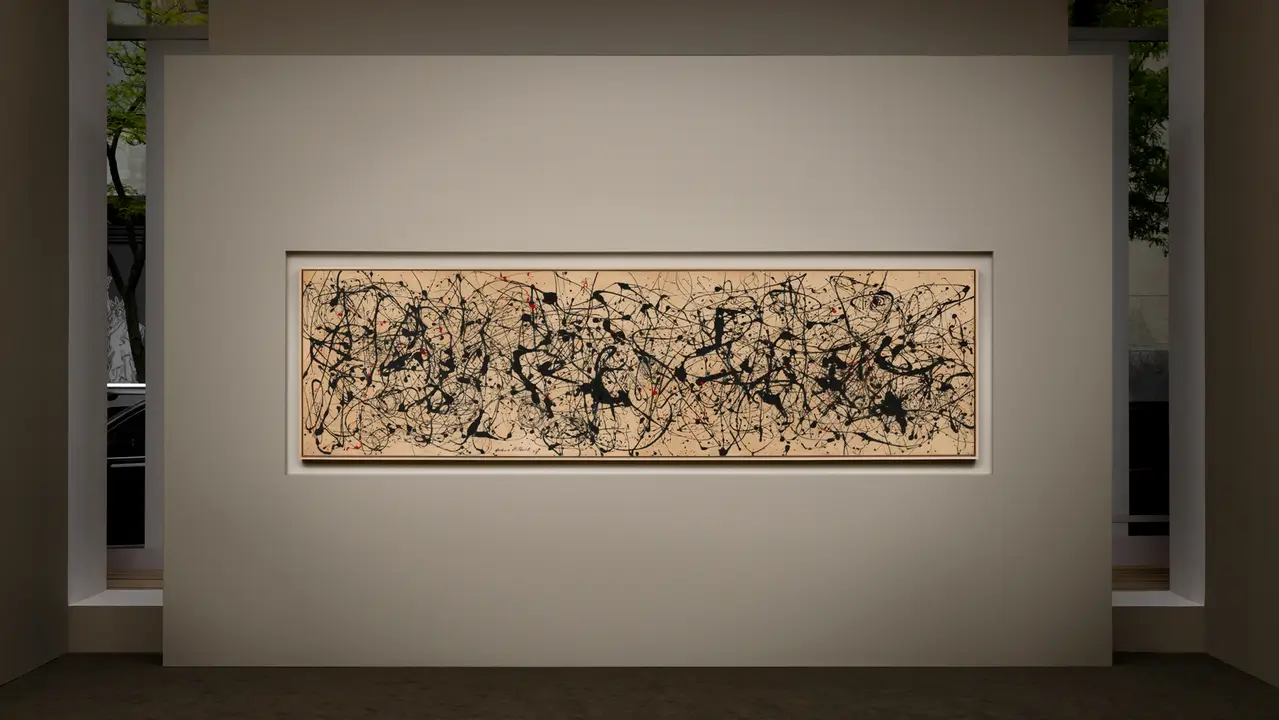
In a dramatic evening sale on May 18, 2026, at Christie’s Rockefeller Center headquarters in New York, Jackson Pollock’s monumental Number 7A, 1948 shattered auction records, hammering down at $157 million before fees pushed the final price to $181.2 million. The 11-foot-wide canvas, a landmark of Abstract Expressionism featuring swirling black drips punctuated by touches of red on raw canvas, tripled Pollock’s previous auction high of $61.2 million (set in 2021 for Number 17, 1951) and catapulted the artist into rarefied company. According to ARTnews, it now ranks as the fourth most expensive artwork ever sold at auction, behind Leonardo da Vinci’s Salvator Mundi ($450.3 million in 2017), Gustav Klimt’s Portrait of Elisabeth Lederer ($236.4 million in 2025), and Willem de Kooning’s Interchange (reported private sale around $300 million).
The sale, part of Christie’s 20th-century evening auction drawn from the collection of the late media magnate S.I. Newhouse, underscored the enduring power of postwar American art in a market hungry for blue-chip trophies. Bidding lasted roughly seven to ten minutes, with over 60 increments in a three-way contest involving phone bidders and room participants. Auctioneer Adrien Meyer conducted the war in near-whispers as increments climbed by the million. The winning bid came via Christie’s global president Alex Rotter; the buyer remains anonymous.
sig
Number 7A, 1948 stands as one of the largest drip paintings by Pollock still in private hands. Measuring approximately 3 meters wide, it exemplifies the artist’s revolutionary technique at its peak. Laid on unprimed canvas, the composition consists of poured, dripped, flicked, and pooled black enamel paint, creating lyrical, intertwined trails that dance across the surface with min narrative elements. Flecks of red add subtle accents. Christie’s described it as the moment Pollock “finally frees himself from the shackles of conventional easel painting and produces one of the first truly abstract paintings in the history of art.”
This work emerged during Pollock’s breakthrough period in Springs, Long Island, where he and his wife, artist Lee Krasner, settled in 1945. Working in a barn studio, Pollock laid canvases on the floor, circling them to pour industrial paints from cans—often using sticks, trowels, or even syringes. He rejected brushes and easels, embracing chance, gravity, and full-body movement. The result was “action painting,” a term coined by critic Harold Rosenberg, though Pollock himself disliked labels.
Art historians view 1948 as a pivotal year. Pollock had moved beyond his earlier Jungian-influenced, mythic figures (seen in works like The She-Wolf, 1943) into pure abstraction. Number 7A lacks any recognizable imagery, foregrounding process, rhythm, and the raw energy of creation. It draws from diverse sources: Navajo sand painting (which he experienced via demonstrations), Asian calligraphy, Mexican muralism (he assisted David Alfaro Siqueiros), and Surrealist automatism. Yet it feels quintessentially American—vast, restless, and democratic in its rejection of European tradition.
transition
The painting’s impeccable provenance enhanced its value. Originally gifted by Pollock to photographer Herbert Matter around 1949, it passed to collectors Kimiko and John Powers before entering the collection of S.I. (Si) Newhouse Jr. and his wife Victoria. Newhouse, the Condé Nast chairman who built a publishing empire, was among the 20th century’s most discerning collectors, appearing regularly on ARTnews’s Top 200 list. His holdings reportedly cost hundreds of millions; he was known for buying and occasionally selling masterpieces with surgical precision.
When a photo of Number 7A was shown to Newhouse, he reportedly studied it, exhaled, and said simply, “I’ll take it,” without needing to see the physical work—he had encountered it decades earlier. The painting last appeared publicly in 1977 at the Whitney Museum. Its rarity—few comparable large drip works remain outside museums—made it a unicorn in the market.
The broader Newhouse sale that night exceeded $1.1 billion, a rare feat (only the second time in auction history for a single evening). Constantin Brâncuși’s Danaïde (c. 1913) set a sculpture record at $107.6 million; Mark Rothko’s No. 15 (Two Greens and Red Stripe) reached $98.4 million; and Joan Miró’s Portrait of Madame K hit $53.5 million—all new artist highs.
guy
Paul Jackson Pollock was born on January 28, 1912, in Cody, Wyoming—the youngest of five sons in a struggling farming family. The family moved frequently through Arizona and California. Pollock’s early life was marked by instability; his father’s absences and the family’s economic woes contributed to a volatile personality. He dropped out of high school and moved to New York in 1929, studying at the Art Students League under Thomas Hart Benton, the Regionalist muralist whose rhythmic, muscular style left a lasting imprint despite Pollock’s later rejection of figuration.
The 1930s saw Pollock working for the WPA Federal Art Project, producing murals and easel paintings with dark, turbulent energy. He underwent Jungian psychotherapy, which influenced his exploration of the unconscious. By the early 1940s, Peggy Guggenheim gave him his first solo show at Art of This Century in 1943. Marriage to Lee Krasner in 1945 provided stability and critical partnership; she championed his work and managed his career.
Pollock’s “drip” breakthrough came around 1947. Life magazine’s 1949 feature “Is he the greatest living painter in the United States?” brought fame—and notoriety. Critics were divided: some hailed genius, others saw chaos. Pollock struggled with alcoholism throughout his life, a battle that contributed to his death at age 44 in a single-car crash on August 11, 1956, while driving drunk with two passengers (one survived).
Despite a short career, Pollock transformed modern art. His work shifted the center of the avant-garde from Paris to New York, embodying postwar American optimism, existential freedom, and raw individualism. Clement Greenberg championed him as the heir to Picasso and Matisse. Museums like MoMA hold icons such as Number 1A, 1948. His influence ripples through performance art, Color Field painting, and even street art.
stagger
This sale reflects the ultra-high-end art market’s resilience amid economic uncertainty. Post-pandemic, trophy works by dead masters command premiums for scarcity, provenance, and cultural cachet. Pollock’s auction record had lagged behind peers like de Kooning or Rothko partly because many top drip paintings are in institutions. Private sales reportedly reached $200 million earlier, but auctions provide transparent benchmarks.
The buyer’s anonymity fuels speculation—perhaps a tech billionaire, sovereign wealth fund, or Asian collector expanding holdings. Underbidders reportedly included Swiss dealer Iwan Wirth, possibly for Laurene Powell Jobs.
Broader trends show growing appetite for American postwar art. The same night’s billion-dollar total echoes Sotheby’s records. Yet critics note market concentration: a handful of artists dominate while mid-tier works struggle. Questions of value persist—can drips of paint truly be “worth” nine figures? Defenders point to innovation, historical importance, and emotional resonance. Skeptics call it speculative excess or “sidewalk trash” (a common online jab).
leg
Pollock’s technique democratized art-making—anyone could drip paint—yet required mastery of control amid chaos. His work inspired filmmakers (Pollock, 2000, starring Ed Harris), fashion, and design. It symbolized Cold War cultural diplomacy; some allege CIA promotion of Abstract Expressionism to counter Soviet realism (a theory with circumstantial evidence but debated).
Krasner’s role grew in recognition posthumously; she was a formidable artist in her own right. Pollock’s estate and authentication issues have been contentious, with fakes plaguing the market.
Number 7A, 1948 encapsulates the artist’s genius: energetic yet controlled, monumental yet intimate. In an era of digital overload, its physical scale and tactile chaos offer visceral escape. The record price affirms its status as a cornerstone of 20th-century art.
why
Beyond numbers, the auction highlights art’s role as both culture patrimony and asset class. Newhouse’s collection dispersal continues a pattern where great holdings fragment across generations. For Pollock, long an icon of rebellion, institutionalization via stratospheric prices feels ironic—yet fitting for an artist who upended conventions.
As the gavel fell, it wasn’t just paint on canvas changing hands—it was a piece of American myth, born in a barn on Long Island, now secured in another private sanctuary, its swirling blacks and reds continuing to pulse with untamed energy more than 75 years later.
This sale cements Pollock’s place among the immortals. Whether viewed as genius or gamble, Number 7A, 1948 proves that in art, as in life, the most radical gestures endure—and appreciate.
From the DRIFT archive: American Visionaries: Property from an Important Private Collection — Joan Mitchell, Untitled · The Rise of a Masterwork: Klimt’s Portrait and Its Historic $236.4M Sale
Related Articles
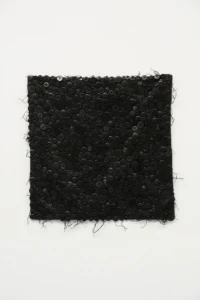
Joël Andrianomearisoa Finds More Than One Black in a Square of Buttons
In La Guerre des Boutons I, a field of ordinary fasteners turns a modest textile […]