DRIFT AUDIO
Listen to this story
Choose a voice, then press play.
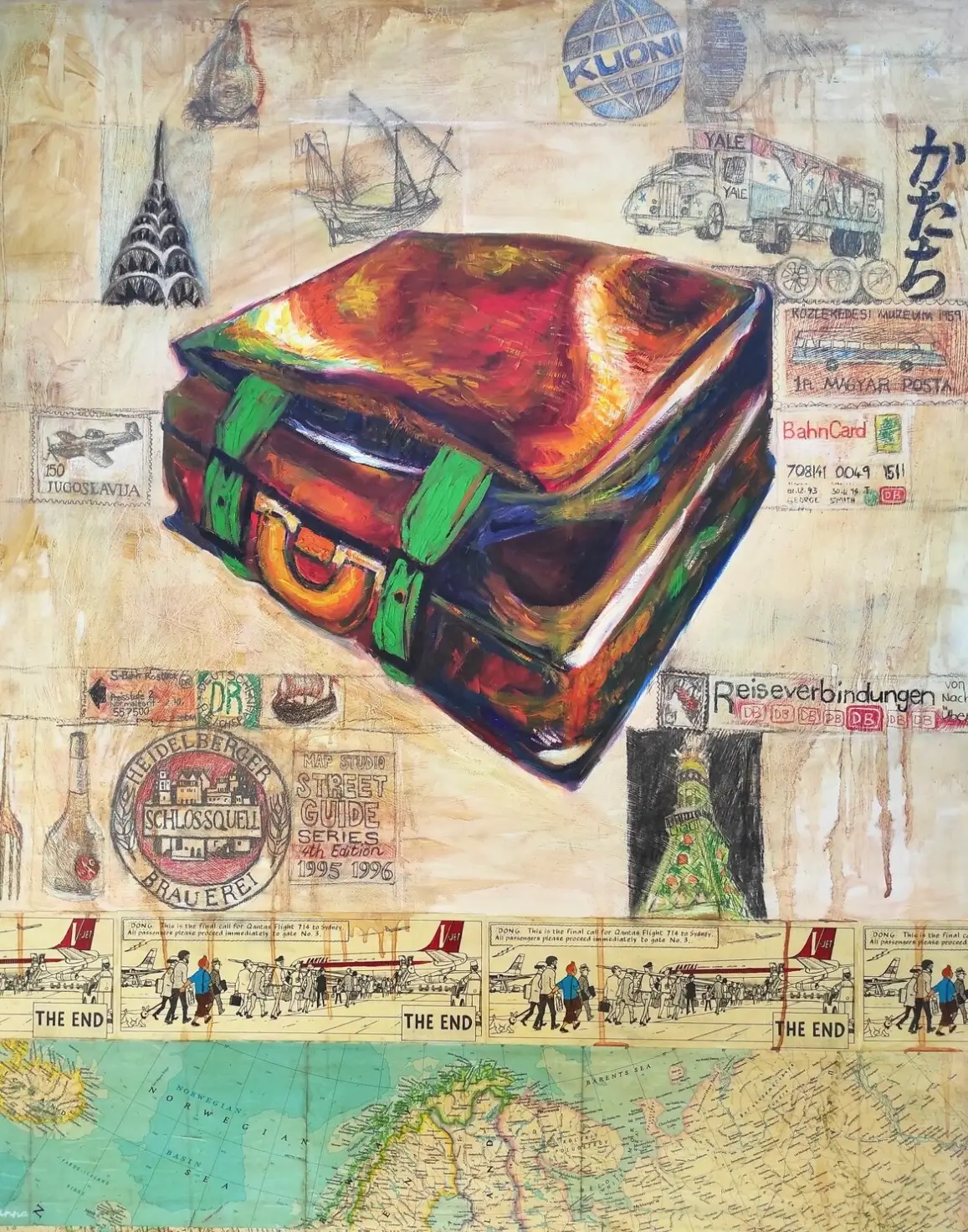
The painting belongs to a thematic cluster often grouped under “The Migrating Suitcase,” with companion pieces like Traveling to Do 2 and 3. It features a vibrant, central suitcase motif pulsing with energy, surrounded by collage elements that evoke memories, maps, tickets, fragments of landscapes, or personal ephemera. These layered materials—paper, possibly fabric or found objects affixed to the wood panel—interact with rich oil paints to create texture, depth, and narrative density. The wood support itself adds a grounded, tactile quality, contrasting the ethereal longing for movement.
stir
Janna Prinsloo (b. 1976, Pretoria) grew up in a family of artists, where creativity was not a hobby but a fundamental way of engaging with the world. This environment fostered an instinctive passion. She earned a BA (Honours) in Fine Arts from the University of Pretoria and has since built a career marked by national and international exhibitions, awards (including finalist placements in portrait and gallery competitions), and representation by galleries like StateoftheART and platforms such as Singulart and Saatchi Art.
Her preferred medium is oil on board (or wood), which allows for building luminous layers, scumbling, and impasto that give her surfaces a living quality. While much of her mature work centers on portraiture and figures in abstract tincture fields—exploring human emotions, optimism, hope, and inner worlds—Traveling to Do 1 leans more toward symbolic narrative and mixed media. It bridges her early experimentation with the introspective figure-based paintings that define her later output.
In 1997, South Africa was in the early years of its post-apartheid democracy. Nelson Mandela’s presidency (1994–1999) symbolized renewal, but the country grappled with inequality, reconciliation, and the excitement (and anxiety) of new possibilities. Young artists like Prinsloo navigated this liminal space: a desire to break free from past constraints while carrying personal and collective histories. The suitcase becomes a potent metaphor—not just for physical travel, but for emotional, cultural, and existential migration.
view
Though direct high-resolution images are limited in public view, descriptions and series context reveal a dynamic composition. The suitcase dominates as a focal point—perhaps open, overflowing with potential, or closed yet vibrant with patterned surfaces and collage overlays. Warm, energetic colors (oranges, yellows, blues evoking horizons and skies) likely dominate, creating a sense of pulsing anticipation. Collage fragments introduce real-world detritus: torn maps, stamps, handwritten notes, or textile scraps that ground the work in materiality and memory.
The wood panel (roughly 39 x 31 inches) provides rigidity and warmth, eliciting the artist to incise, varnish, or build relief. Oil paint adds luminosity and blending, while collage disrupts flatness, inviting the viewer to “read” layers like a traveler scanning a well-worn journal. This mixed-media approach was bold for a young artist in the late 1990s South African scene, which often balanced figurative traditions with emerging conceptual practices. Prinsloo’s technique here prefigures her later mastery of texture and depth, where surfaces invite prolonged looking.
scope
The artist’s own statement for the piece beautifully encapsulates its spirit: “In this piece, I poured my longing for adventure and discovery into every stroke. The vibrant suitcase pulses with energy, symbolizing the excitement of journeys yet to come. Surrounding collage elements echo memories and anticipation, inviting you to dream and explore. This artwork radiates the restless spirit of travel, ready to inspire wanderlust and vibrancy wherever it adorns your space.”
This resonates deeply. Suitcases symbolize transition: packing one’s life, leaving behind the familiar, embracing the unknown. In a South African context, they also evoke migration—internal (rural to urban), diasporic, or the psychological “baggage” of history. Prinsloo transforms this into something optimistic. The vibrant energy counters melancholy; it’s not loss but potential. Collage elements act as “echoes”—past experiences fueling future movement—aligning with her broader interest in innermost human feelings.
Compare to her later works like Adventure Awaits, Exploring Realms, or The Way Up Is Down, where figures navigate abstract spaces. Traveling to Do 1 lacks a prominent human figure yet implies one through the suitcase as proxy. The traveler is us, or the artist herself as a young woman stepping into adulthood and a new national era.
Within the know, it touches on existential themes: human beings as perpetual travelers through time, memory, and aspiration. It echoes Gaston Bachelard’s “poetics of space” (the suitcase as intimate container of vast dreams) or Deleuze and Guattari’s “lines of flight.” In art historical terms, it dialogues with surrealist collage (Max Ernst, Joseph Cornell’s boxes) and pop art’s day objects, but filtered through a personal, optimistic South African lens.
reason
For Prinsloo, raised in an artistic family, this work likely served as both catharsis and declaration. At 21, the world beckoned—travel, exhibitions, self-discovery. The collage may incorporate actual mementos from her life: family photos, travel brochures, or university sketches. This autobiographical layer adds intimacy.
Broader South African art in the 1990s often addressed identity, landscape, and politics (e.g., works by William Kentridge, Sue Williamson). Prinsloo’s piece is quieter, more interior—focusing on personal agency amid collective change. The suitcase becomes a vessel for hope: packing dreams for a democratic future, unpacking apartheid’s constraints.
Viewers today, especially in a globalized, post-pandemic world of renewed wanderlust and digital nomadism, find fresh relevance. The work inspires reflection on what we carry, what we leave, and the journeys—literal or metaphorical—we undertake.
flow
Prinsloo’s mixology of oil and collage is masterful even in this early piece. Oil provides fluidity and emotional resonance—glazes for depth, thick strokes for energy. Collage introduces chance and history: papers absorb or resist paint differently, creating unpredictable textures. On wood, the grain might subtly show through thinner areas, rooting the ephemeral in the solid.
This anticipates her later preference for board, enabling the “texture and depth” she prizes. Varnish (mentioned in related works) likely unifies elements, adding luminosity. The result is haptic—tempting touch—and optical, rewarding distance and closeness.
leg
As an early work (1997), Traveling to Do 1 marks the genesis of recurring motifs: movement, inner exploration, vibrant optimism. It contrasts her award-winning portraits yet shares the focus on human essence. The series “The Migrating Suitcase” (with variants in oil, collage, acrylic) shows evolution—later pieces perhaps more refined, but this one raw with youthful vigor.
Prinsloo continues producing prolifically, with works exploring time, aspiration, and emotion. Pieces like Exploring Outside of Time or Architect of the Unknown extend the journey theme into metaphysical realms. Her art consistently offers hope: “Artists have the opportunity to delve deep within themselves… presenting the viewer with something that will not just touch the cognitive, but will also touch the pithy of self.”
why
Traveling to Do 1 endures because it captures a universal impulse. In 100×80 cm of layered wood, paint, and paper, Prinsloo distills the human condition: we are always traveling—to new places, selves, understandings. The vibrant suitcase pulses as a beacon, collage fragments as even smaller pieces of where we’ve been, oil strokes as the fluid path ahead.
For collectors, it offers view richness and emotional uplift. For students of art, it exemplifies mixed-media storytelling. For anyone pausing before it, it whispers: pack lightly, dream boldly, go.
In an era of climate anxiety, digital overload, and uncertain futures, this 1997 painting from a young South African artist reminds us that the journey itself—filled with memory, anticipation, and vibrant energy—is the destination. It radiates wanderlust, inviting us to embrace the restless spirit within.
From the DRIFT archive: Francesco Clemente’s Portrait Commission: The Human Gaze, Reimagined for The Coral Collective
Related Articles
Joël Andrianomearisoa Finds More Than One Black in a Square of Buttons
In La Guerre des Boutons I, a field of ordinary fasteners turns a modest textile […]