Landscape with Stream by (c. 1986) Bob Ross

September 19, 2025
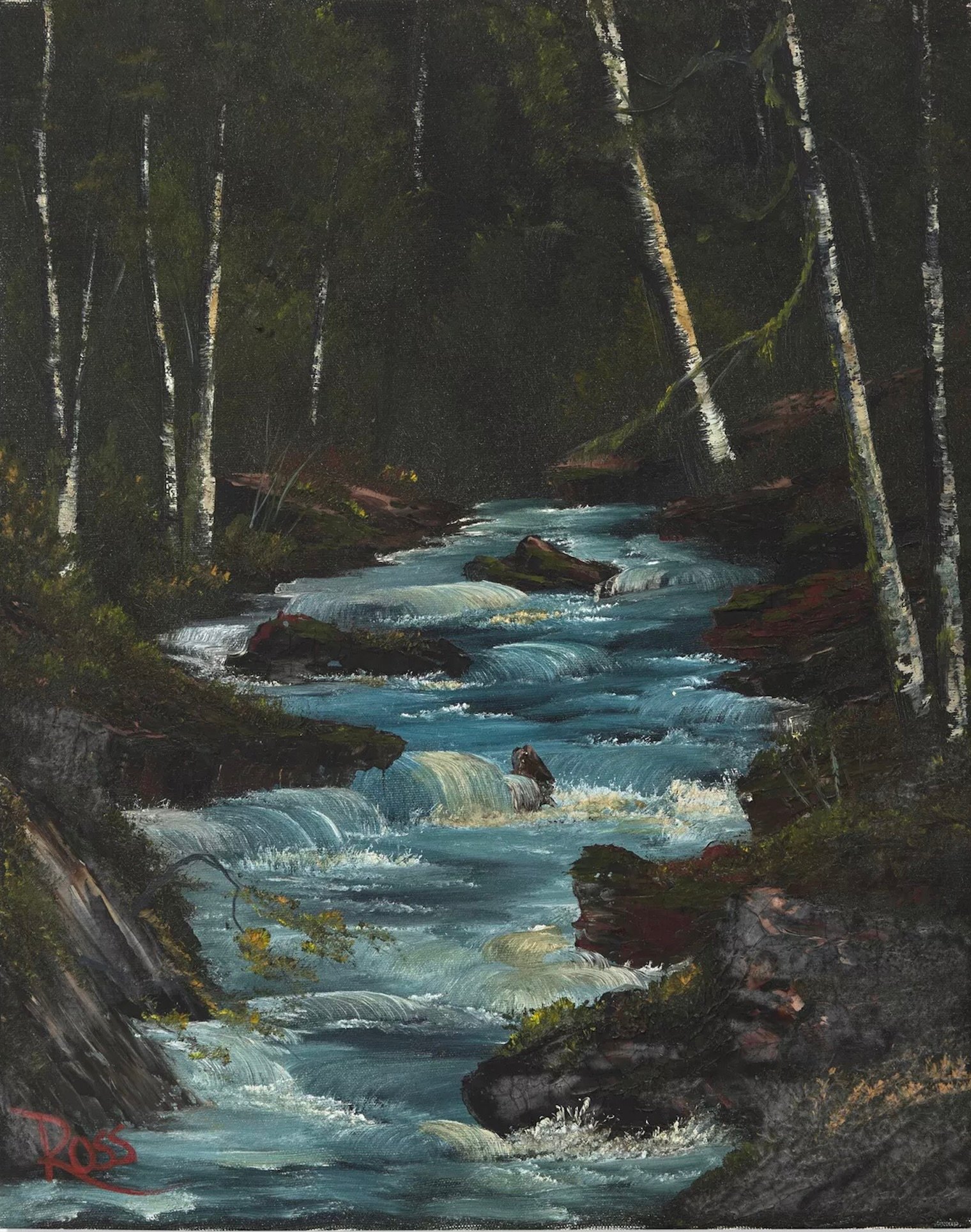
Bob Ross occupies a strange place in culture. He is adored but rarely written about with seriousness. He lives in internet loops, his voice soothing on Twitch marathons, his catchphrases stitched onto novelty mugs. Yet when you stand in front of one of his paintings—or even look closely at an image of one—you begin to sense how much is actually there. The woodland stream is not only a pastoral scene; it is a conversation between calm and movement, between permanence and passing time.
The Voice in the Woods
When Ross painted for television in the 1980s and ’90s, he wasn’t simply offering instruction. He was building a kind of refuge. Viewers tuned in for the technique, yes, but even more for the cadence of his reassurance: there are no mistakes, only “happy little accidents.” The woodland stream captures that ethos. The water flows easily, refusing to snag or freeze. It makes its own path, curving around obstacles, softening rocks as it goes.
The birch trees leaning into the composition echo the way Ross himself leaned toward his audience: gentle, attentive, encouraging. In the forest he paints, there are no predators, no decay, no looming apocalypse. Only rhythm. Only flow.
Why Streams Endure
Artists have always painted streams. Turner’s torrents, Friedrich’s rivers, the waterfalls of the Hudson River School—these were scenes of power, drama, the sublime. Ross belongs to that lineage but translates it into something quieter. His stream does not overwhelm; it soothes. Instead of awe, it offers reassurance.
There’s a reason streams remain universally compelling. They remind us of time’s passage, the way life moves forward whether or not we’re ready. They cleanse, they carry, they connect. Watching water move is one of the oldest forms of meditation. Ross manages to trap that feeling in pigment, giving us a pocket-sized eternity.
Technique Disguised as Ease
Much is made of Ross’s speed, his ability to conjure entire landscapes in under half an hour. What often goes unnoticed is the precision behind it. Look at the way the foam gathers at the foot of each miniature waterfall—those are strokes of pure instinct, dragged across the canvas with just enough pressure to suggest movement but not chaos. The rocks, scraped into existence with a palette knife, hold their place firmly but not stiffly.
This was his gift: to make difficulty look like ease, to hide training inside friendliness. Like a magician, he revealed the trick while performing it, and somehow the magic remained intact.
A Painting for the Present
Today, in an age of endless noise, the woodland stream feels almost prophetic. It whispers against the backdrop of climate dread and digital overwhelm. While news feeds shout, Ross’s water trickles on, unbothered. For many who rediscovered him through streaming platforms, the paintings act as counterweights to modern anxiety. They remind us that beauty can be simple, that peace can be painted, that the world—despite its fractures—still contains streams that flow unseen.
There’s irony, of course, in the way Ross has been folded into meme culture. His likeness circulates on t-shirts, his sayings parodied across platforms. But beneath the irony lies genuine affection. People return to him not only because he’s kitsch, but because he represents a promise of steadiness. His woodland stream is not satire. It is a place to rest.
Memory in Motion
The stream also has a way of stirring personal memories. Viewers see their childhood creeks, their camping trips, their grandparents’ backyards. Ross tapped into a collective nostalgia, painting not specific places but universal ones. The birches might be from Maine, or Alaska, or a local park. The water could be a remembered sound more than a geographic fact.
And that is why his work endures. It belongs to everyone. Where some artists insist on the singularity of vision, Ross offered a communal invitation: here is a forest, here is a river, here is calm. Take it with you.
Impression
To look at this painting is to be reminded of something simple but profound: calm is not the absence of movement, but its gentle rhythm. Ross’s stream tumbles and foams, yet nothing feels rushed. The forest is dense, yet never oppressive. It is balance, held in place by brushstrokes.
For all the noise around his image—the memes, the merchandise, the nostalgia—it is the paintings themselves that continue to speak. They tell us that beauty doesn’t need to be revolutionary to matter. That sometimes the most radical act is offering comfort. That a stream, painted decades ago, can still flow inside us today.
Related Articles
Chasing the Sort Sol: Inside Søren Solkær’s Six Year Pursuit of Europe’s Starling Clouds
A Danish portrait photographer spent six years following a bird nobody photographs on purpose, and […]