Lauren Betts to Reebok Basketball — Scale, Timing, and a Brand Finding Its Center Again

April 16, 2026
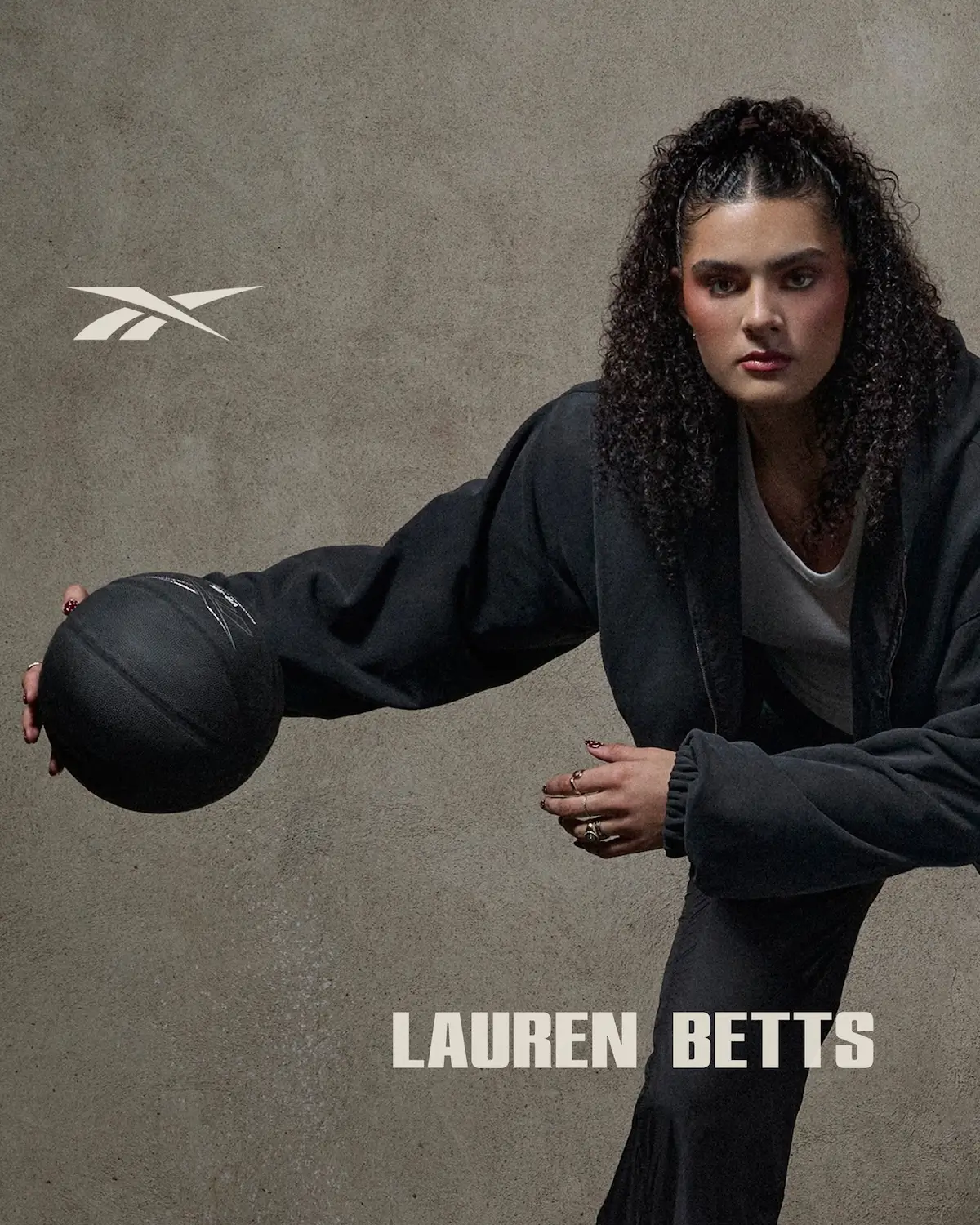
There are signings that read as surprise, and then there are those that feel like they were always going to land exactly where they do. Lauren Betts heading to Reebok Basketball belongs to the latter category. It doesn’t arrive with the chaos of speculation or the friction of competing narratives. It settles—cleanly—into place.
Betts enters the professional landscape with something more durable than hype. She carries continuity. A championship. A body of work that does not require projection. And a physical presence that translates without reinterpretation. At 6-foot-7, her size is the easiest shorthand, but it’s also the least interesting part of what she brings.
Her game operates through positioning, timing, and disruption. She seals space before it becomes available. She alters shots before they leave the hand. Around the rim, she is less a defender and more a condition—something opposing offenses have to solve before they even begin.
That matters for a brand trying to reestablish itself. Because what Reebok needs is not noise. It needs clarity.
stir
Betts being selected No. 4 by the Washington Mystics in the 2026 WNBA Draft didn’t carry the volatility that sometimes surrounds top prospects. There was no late movement, no reshuffling of expectations. Her placement felt fixed well before the moment arrived.
That kind of certainty is rare. It speaks to a player whose evaluation has already stabilized. Teams were not drafting for potential in the abstract—they were drafting for immediate contribution.
Betts is not a developmental arc waiting to be shaped. She is already structurally sound.
This is where the alignment with Reebok sharpens. The brand is not in a position where it needs to gamble on distant upside. It needs athletes who can exist in the present tense—who can validate the brand’s return to basketball without delay.
Betts offers that immediacy.
flow
It’s easy to reduce Betts to dimensions. The league has always had room for height, and height will always draw attention. But Betts’ value isn’t anchored in standing tall—it’s in how she uses that height as a tool rather than a crutch.
Her offensive game begins before the ball arrives. She establishes position early, forcing defenders into compromised angles. By the time she receives the pass, the possession is already tilted in her favor.
Defensively, her impact is even more pronounced. She doesn’t chase blocks for spectacle. She reshapes the geometry of the court. Drivers hesitate. Floaters come earlier than planned. Passing lanes shrink.
This is control, not chaos.
And that distinction matters for brand identity. Reebok has historically thrived when its athletes represented structure—players whose games felt deliberate rather than explosive for the sake of it. Betts fits within that lineage without needing to replicate it.
shh
To learn the significance of this signing, it helps to look at where Reebok currently sits within basketball culture. The brand is not attempting to outpace competitors through volume. It is not flooding the market with releases or chasing every available name.
Instead, it is moving selectively.
Reebok’s re-entry into basketball has been measured—almost restrained. The focus has been on reestablishing credibility rather than generating immediate dominance. That approach requires patience, but it also requires precision. Every move has to carry weight.
Betts is that kind of move.
She arrives with momentum already attached. The brand does not need to manufacture relevance around her. It needs only to provide a framework where that relevance can extend.
View this post on Instagram
moment
If Betts had entered the league a year earlier, the context would have been different. If she had stayed another year in college, the timing would have shifted again. Instead, this moment—post-championship, post-accolades, pre-professional breakout—creates a narrow window where both athlete and brand meet at the same stage of development.
This is not coincidence. It is alignment.
Betts is stepping into the WNBA with expectations that are already calibrated. She is not being introduced to the audience—she is being continued. That continuity allows Reebok to enter her narrative without disrupting it.
For a brand rebuilding its basketball presence, that is invaluable. It reduces friction. It allows the partnership to feel organic rather than imposed.
show
There is a particular kind of athlete who exists more as promise than proof. Their careers are framed around what they might become. Betts does not operate in that space.
She already has presence.
It’s visible in how she moves on the court, but also in how she is perceived off it. There is a steadiness to her trajectory. She does not require amplification to be noticed.
For Reebok, this shifts the dynamic of the partnership. The brand is not tasked with creating visibility. It is tasked with supporting and extending what is already there.
That distinction changes everything—from marketing to product development to long-term positioning.
impression
One of the most immediate questions surrounding Betts’ transition to the WNBA is how quickly her game will translate. The answer, based on her profile, is: quickly enough to matter.
Her strengths are not dependent on system-specific conditions. They are foundational. Size, positioning, defensive awareness—these are elements that carry across levels with minimal adjustment.
There will be adaptation, of course. The speed of the professional game introduces new variables. Opponents are stronger, more experienced, more precise. But Betts’ core skill set is built to withstand that transition.
This is where the partnership with Reebok gains additional significance. Early impact creates early visibility. Early visibility creates momentum. And momentum, once established, becomes self-sustaining.
strat
A common mistake brands make when signing emerging athletes is attempting to build an entire narrative around them too quickly. The pressure to define, to label, to position can distort the athlete’s natural progression.
Reebok’s current approach suggests a different strategy.
With Betts, the opportunity is to build with her rather than around her. To allow her career to unfold while providing consistent support—through product, through storytelling, through presence.
This kind of partnership requires restraint. It requires the brand to resist the urge to accelerate beyond what is necessary.
But if executed correctly, it creates something more durable than short-term attention. It creates alignment.
scope
Betts’ game lends itself to a particular kind of view representation. It is not about speed lines or exaggerated motion. It is about space—how it is created, controlled, and denied.
This opens up a distinct lane for Reebok in how it chooses to present her. The imagery can lean into structure. Into balance. Into the quiet authority of presence.
In a market often dominated by maximalism, that restraint becomes its own statement.
learn
Reebok’s history in basketball is well-documented, but history alone does not guarantee relevance. The current phase of the brand’s evolution is less about revisiting the past and more about redefining its place in the present.
That process requires anchors—athletes who can carry meaning without needing to reference what came before.
Betts is one of those anchors.
She represents a forward-looking identity. One that is grounded in performance but open to reinterpretation. One that does not rely on nostalgia to justify itself.
end
Some partnerships require explanation. This one does not.
Lauren Betts to Reebok Basketball feels correct because it is built on shared timing, shared needs, and a shared sense of direction.
Betts brings scale, control, and immediacy. Reebok brings focus, patience, and the space to build.
Together, they create something that does not need to announce itself loudly. It simply needs to hold.
And for now, that is more than enough.
Related Articles

Rose Byrne and Mary Bronstein Are Doing It Again, and This Time They Brought Jenna Ortega
A coach and her prodigy are about to become the most dangerous relationship in a […]