DRIFT AUDIO
Listen to this story
Choose a voice, then press play.
Set 43026 lands 1 September 2026. A white low-cut on a rocket, a moon plate printed with an outsole, a spaceman who dunks when the dial turns.
The finished object does not rest like a pair on a closet shelf. It climbs. A white Air Force 1, low-cut, tilts on a plume of brick exhaust. Under the heel the stand becomes a launch. Under that, a moon plate carries the AF1 outsole as a footprint, the waffle a real sole would leave on a gym floor now stamped into a grey crater.
LEGO numbered the set 43026 and named it Nike Air Force 1 x LEGO Set. Japan’s calendar puts it on Tuesday 1 September 2026. The same morning exists on the American shop page. Twelve years and older. One thousand ninety-three pieces. Locked together with the plume, the mass runs about twenty-six centimetres high, thirty-five wide, ten deep. Japan lists 15,980 yen. The US page lists 99.99 dollars. Those figures belong to the listing. The build belongs to the last.
Bruce Kilgore drew the living shoe in 1982. It was the first basketball model to carry Nike Air in the sole, a bag of pressure where other court shoes still trusted foam alone. The collar took a lesson from the Approach hiking boot, a wrap high enough to take a cut and still look like a tool. Quarters stacked in a clean map. The midsole read from the bench. The last left the gym. Streets kept it. Harlem later called some pairs Uptowns. Generations kept the panel map even when the leather changed hue and the factory changed country.
LEGO did not shrink that map. It translated it into studs.
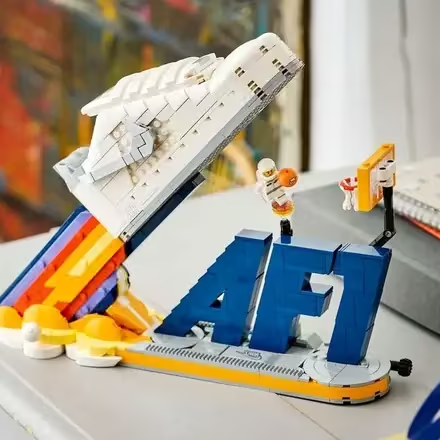
A Lego model of an AF1 shoe launching like a rocket, with tiny astronauts.
retro
Punch holes in the toe box, rebuilt as a grid of studs. Side panels that overlap the way Kilgore’s quarters overlap. Laces you assemble rather than thread through eyelets. AIR along the sidewall of the sole, the word that made the original more than cushioning. From a few feet the silhouette still says Force. From a hand’s distance it says brick, slope, tile.
A real Force is a system of tensions. Heel counter against collar. Overlay against underlay. Foxing against midsole. The brick version has to fake those tensions with geometry. Stacks stand in for skiving. Plates stand in for stitch lines. The punched toe, which on leather is a factory pattern of holes for flex and air, becomes a counted field. You can run a fingertip across it and feel the rhythm of the original perforation even though no air moves through plastic.
The name Air Force 1 was always a jet joke, presidential aircraft as a basketball punch line. Kilgore’s team was not designing a plane. They were designing a shoe that could take a season of cuts and still look like equipment. The name did the myth work. LEGO takes the joke past the runway and past the jet. The shoe does not rest on a pedestal. It leaves. Moon dust under the stand is printed with the same outsole geometry a real pair would print on tar. The model is the low-cut white most closets already know, not the high with the extra strap. Personality in this set is not a mid-cap strap. It is altitude.
There is a reason the low is the one they built. The high has theatre: strap, extra eyelet, more collar. The low is the sentence people finish without thinking. White low, grey sole, Swoosh. That sentence has been copied, faked, blessed, and resold more times than any Dunk colorway. Putting it in brick is a recognition test. If the stack fails, the whole partnership looks like a logo farm. If the stack holds, a person who has tied the leather pair will nod before they read the box.
The 2024 deal that pays for the set was framed as multi-year and global. Studs meeting Swoosh. Minifigures meeting sport marks. 2025 opened the footwear builds. Dunk came first. Air Max 95 followed in 2026. The Force is the third last asked to stand still in plastic. Official language talks about movement and free ideas. What sits on the table is a shoe that cannot take a step and an astronaut who cannot miss.
Kilgore’s hiking collar becomes a ridge of plates. The fat midsole becomes a stack. The perforated toe becomes a field of holes. Enough of the grammar survives. The Approach boot that lent the collar was a tool for uneven ground. The Force took that wrap onto parquet. LEGO takes the wrap onto a crater. Three surfaces. One collar idea.
flow
The orange Swoosh is not printed into the side forever. It is a part. On. Off. The flank of the shoe opens. You can look into the cavity, restack the interior, close the wall, put the mark back. That is the loop the Japanese brief insisted on. Building is not only the first afternoon. It is a habit. The Swoosh lives in the palm between sessions.
A real Swoosh is stitched or bonded and then argued over by decades of wear. This one is a clip of color you can misplace on a desk. Silver and orange swap. The white body stays. That small violence (taking the mark off the shoe that made the mark famous) is the most honest toy gesture in the set. It admits the Swoosh is a piece, not a religion.
On the plinth, AF1 lettering sits like a scoreboard. A dial hides in the letters. Turn it and a Classic Space minifigure completes a dunk that ignores gravity. The body is the 1978 astronaut grammar, planet-and-orbit heritage restyled with Nike printing, a spare head in the bag, tiny Force marks on tiny feet. Four years separate that figure’s first mould from Kilgore’s first pair. They share a tableau now. Zero-g slam over the letters that name a jet.
Classic Space is LEGO’s own mythology of leaving Earth. Printed visor. Air tanks. The walk that children learned before they learned the Swoosh. Putting that figure on a basketball dunk over an AF1 sign is a collision of two 1978-to-1982 memories. One is a Danish astronaut. One is an Oregon court shoe. Neither asked to meet. The dial forces the meeting.
The Builder app will rotate the digital twin on a phone if the paper steps blur. Zoom. Spin. Save the step. The decisions stay analog. Each stud is a choice you can undo. That is the difference between a replica statue and a set. A statue does not let you take the Swoosh home in your hand. A statue does not ask you to open the shoe like a hatch. A statue does not have a spaceman who will dunk again if you turn the wheel the other way.
White and grey do most of the talking. No neon cage to solve, no Dunk panel rainbow. The problem is recognition. Does this stack still read as the shoe that left 1982 and never came back to being only a basketball shoe? It does, if you accept that the sole is a slope and the lace is a tile and the Air unit is a printed boast rather than a bag of gas.
Open the side. The cavity is a small room. Restacking it is the closest the set comes to cobbling. You are not repairing a worn heel. You are remembering that a shoe is a hollow object, a structure around a foot that is not here.
View this post on Instagram
hum
Dunk builds taught the method: a shoe as architecture, a figure as punch line. B’Ball Head and trick-shot bodies made the first sets loud. The 95 brought the neon gradient into brick and asked the builder to solve a midsole that changes color as it rises, a cage that has to look like a skeleton and a graph at once. The Force is quieter cloth. Recognition is the whole exam.
Shh is harder. A Dunk can hide behind a color story. A 95 can hide behind neon. A white Force has nowhere to hide. If the toe box is wrong, the whole last is wrong. If the midsole stack is stingy, the shoe looks like a tennis model. LEGO spent 1,093 pieces on not being stingy.
LEGO Japan posted the set as a street-fashion icon rebuilt. The plume under the heel is the only slogan the object needs. A basketball shoe that became a street default is asked, in plastic, to leave the street entirely. Court to block to crater. That path is a joke and a history lesson. The Force did leave the court. It did not, in real life, leave the planet. The set finishes a sentence the culture started.
Display is part of the brief. Desk, shelf, bedside. Streetwear as home object. The moon plate makes that display a scene rather than a trophy. You are not showing a shoe. You are showing a departure. The spaceman keeps the scene from being solemn. Gravity is optional. The dunk is on a loop.
1 September. Two official pages, two currencies, one last. Japan and the United States share the morning. Stores that already sell bricks will sell this brick shoe. The leather Force will keep selling in parallel, indifferent to the plastic twin. That indifference is healthy. The set is not a replacement. It is a reading.
Turn the dial. The figure goes around again. The Swoosh waits on the table when it is off. The moon keeps the footprint even if the shoe never lands. Kilgore’s collar still reads. The plume under it is new. Forty-four years between the first Air bag and this stack of studs. The last did not stay on earth. The bricks make that official.
Related Articles
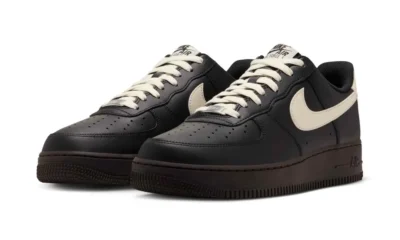
NIKE AIR FORCE 1 07 LOW “Black/Velvet Brown”
Air Force 1 07 Low. FJ4146-006. Black/Velvet Brown/Coconut Milk. 16 October 2026. ¥16,500. Leather that softens with wear.