DRIFT AUDIO
Listen to this story
Choose a voice, then press play.
the night the machines got a sense of humor
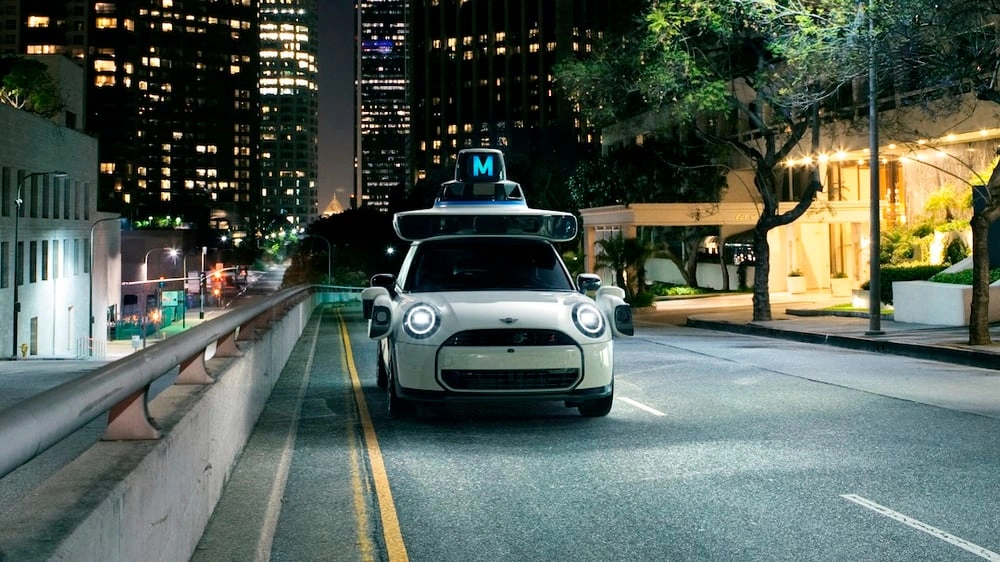
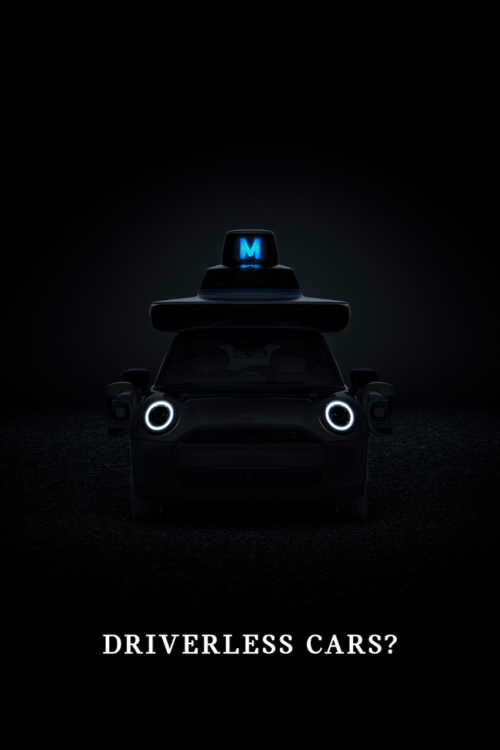
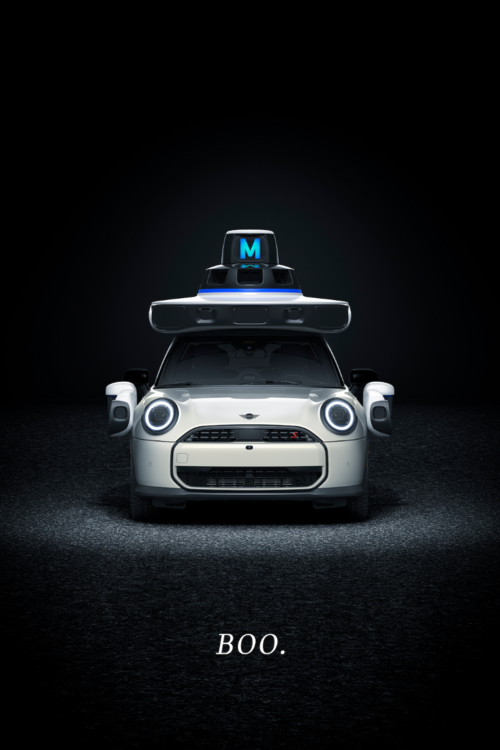
On Halloween 2025, something uncanny appeared on the roads of Los Angeles. Amid the witches, vampires, and AI-themed costumes parading through the city, a small white MINI Cooper rolled down the boulevard looking almost familiar—until you noticed its disguise. Its body was wrapped in the signature white-and-green livery of Waymo, the self-driving division of Alphabet. On its roof sat a faux sensor dome, blinking like a digital halo. The decals read “Autonomous Vehicle: Waymo Driver Active.” It glided silently through the crowd as if driven by an invisible ghost. In reality, it was a human-driven MINI, dressed up for Halloween as the very technology designed to make human drivers obsolete.
The stunt was both absurd and brilliant. At first glance, it was just a harmless prank—an elaborate costume on four wheels. But the more one looked, the more it seemed like social commentary, a rolling provocation aimed at Silicon Valley’s race toward automation. MINI’s skittish masquerade as Waymo wasn’t just a Halloween gag; it was an idea on wheels – a parody of self-driving tech.
haunted costume
From a distance, the transformation was impressively convincing. The car’s body wrap matched Waymo’s minimalist aesthetic down to the Pantone shade of green. The roof dome—a 3D-printed mock lidar sensor—rotated on a small motor, giving the illusion of scanning the environment. Around the windshield, mock sensors and decals hinted at radar arrays and depth cameras. At the rear, a vinyl slogan read: “Waymo Driver at Work—Please Do Not Distract.”
Inside, the driver wore a black morph suit, making them almost invisible from the outside. From certain angles, it looked like the MINI truly had no one behind the wheel. Every few blocks, the car would stop, flash its lights, and conjure a robotic voice through a speaker: “This vehicle is operating autonomously. Happy Halloween.” The pedestrians laughed, filmed, and posted. Hashtags like #MINIMasquerade and #HauntedWaymo started trending by nightfall.
The performance was more than prankish. It was design satire—an ephemeral piece of rolling street art that revealed the absurdity of our relationship with automation. Halloween, the one night dedicated to masks and masquerades, became the perfect mirror for our technological pretensions.
flow
In the modern economy of attention, brands talk to one another through irony, mimicry, and memes. MINI’s parody of Waymo functioned as cultural commentary within this corporate theater. On one hand, it was a mischievous nudge from a century-old automaker to the tech companies threatening to rewrite the future of transport. On the other, it was an act of affection—acknowledging that Waymo, for all its futuristic coldness, represents a dream that even traditional car enthusiasts can’t fully resist.
Waymo’s own social media team played along, reposting an image of the MINI with the caption: “Flattered. We couldn’t have done it with more style.” The exchange turned into a playful duel of tone: tech precision versus design charm, code versus character. For both brands, the tandem encounter was a win. For the audience, it was a reminder that the future of mobility isn’t just a question of technology—it’s a question of personality.
show
As darkness deepened, the MINI’s performance evolved from prank to spectacle. Crowds followed it down Melrose Avenue, laughing as the fake Waymo paused dramatically at crosswalks. A group of skateboarders rode alongside it, chanting “Show us your algorithm!” Someone tossed candy into the open window. The car stopped near a neon-lit café, its roof dome glowing like a UFO beacon. A woman dressed as a ghost approached and posed for a selfie beside it.
In that moment, technology, art, and community intersected. The MINI had become a mobile performance piece—street theatre that used humor to engage with one of the most complex conversations of our time. Instead of pamphlets or panel discussions, it delivered its critique through irony and joy. The Halloween crowd didn’t just witness a prank; they participated in a dialogue about automation, control, and identity.
the aftermath and the lingering echo
In the weeks that followed, automotive journalists dubbed it “the smartest Halloween costume of the year.” Urban commentators compared it to performance art by Banksy—an act of rebellion disguised as entertainment. MINI refused to confirm or deny official involvement, allowing the legend to grow organically. The Waymo MINI became a meme, then a myth, then a metaphor for the intersection of humanity and automation.
And like any good Halloween story, it lingered in the imagination. People began to speculate about what other cars might “dress up” as next year. A Tesla dressed as a taxi? A Rivian as a horse-drawn carriage? The concept sparked a new form of cultural satire—vehicles performing identity to comment on their own evolution.
Related Articles
Laika Spent Fifteen Years Building a Forest No One Can Walk Into
Travis Knight’s stop-motion adaptation of Colin Meloy’s Wildwood finally opens October 23, ending Laika’s longest […]