DRIFT AUDIO
Listen to this story
Choose a voice, then press play.
Fourteen years after her runway debut divided Paris, Rei Kawakubo turned a single collection into an art installation, and the fashion world followed her into the room.
Rei Kawakubo does not do interviews easily, and she does not pose for portraits if she can help it. That reticence has only sharpened the myth around the designer behind Comme des Garçons, the Tokyo label she built into one of the most closely watched names in fashion without ever softening her instincts to fit the market around her. Admirers have included Marc Jacobs, who during his own years at the front of fashion rarely missed a chance to wear the label’s more difficult menswear pieces, black kilts and pink polo dresses among them, as a kind of quiet tribute.

Portrait of Rei Kawakubo wearing oversized black sunglasses and a black leather jacket.
That admiration was not casual. By the early 2010s, Kawakubo had spent three decades proving that a designer could build a global business without giving up an inch of creative control, and 2012 gave her a new kind of stage to prove it again. Instead of sending her spring summer collection down a runway a second time for an encore audience, she turned it into a static installation at Les Docks, Cité de la Mode et du Design, the converted riverside warehouse on Paris’s Quai d’Austerlitz. The show was called White Drama, and it ran from April 13 to October 2012, presented alongside a parallel exhibition dedicated to Cristóbal Balenciaga, both curated by fashion historian Olivier Saillard.
stir
To understand why an exhibition mattered, it helps to remember how violently Paris first reacted to Kawakubo. Her 1981 Paris debut, built around torn and distressed black garments, unsettled critics used to a much narrower idea of femininity and shocked a fashion press that had rarely seen a collection question beauty itself so bluntly. Some called the look nihilistic. Others, less generously, reached for wartime imagery to describe her frayed knits and asymmetric hems. Kawakubo, for her part, has never framed her work as protest or theory. She has described her guiding obsession as newness itself, pursued not for entertainment but as a discipline, a refusal of laziness and of settling for what already exists.
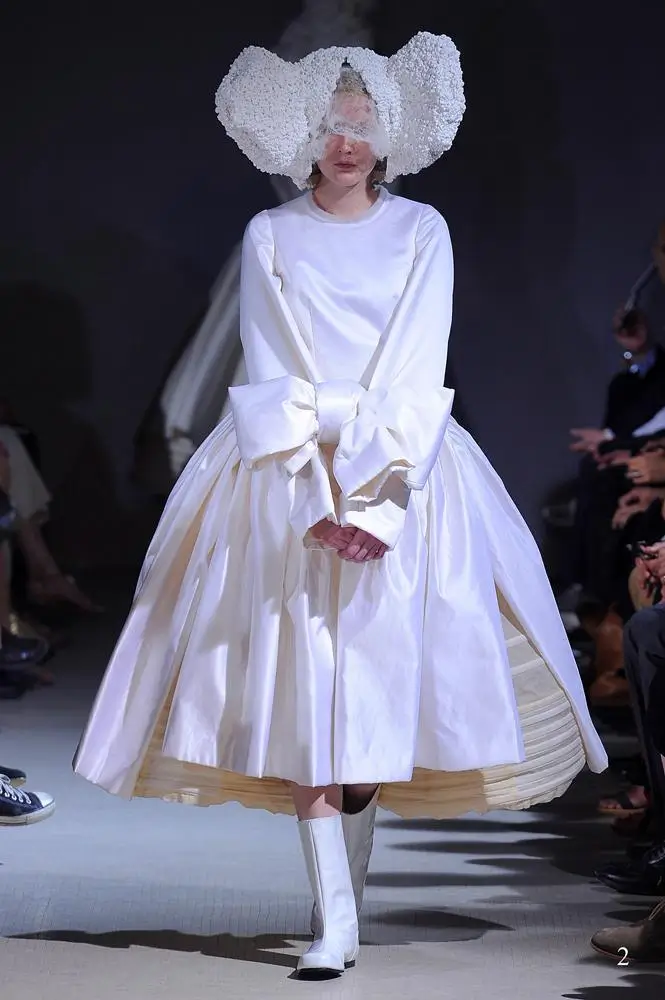
Comme des Garçons runway look featuring a voluminous white dress and sculptural cloud-like headpiece.
She returned to that idea often, where she connected her drive for novelty to a broader social responsibility that felt especially pointed that year, as Japan was still absorbing the aftermath of the previous year’s tsunami and Europe was mid crisis over sovereign debt. Every field needs people willing to build something new regardless of cost, she suggested, and she had chosen to carry that responsibility inside fashion specifically, believing that a single original garment, seen or worn, could ripple outward into how people felt and thought.
That conviction is easy to state and much harder to sustain across forty years without becoming either predictable or hollow. Kawakubo has managed both by refusing to explain her decisions in advance and by treating criticism as a sign she has not yet been understood, rather than a signal to adjust course.
huh
What makes Kawakubo unusual among designers of her generation is not just the work itself but how completely she has controlled its distribution. Rather than compromise her main line to fund expansion, she built parallel structures: Comme des Garçons Shirt, the more accessible Play line with its heart and eyes logo, a fragrance business she started almost as an anti perfume concept in 1994, and a scattering of short lived guerrilla stores that would open in an underused space for a matter of months before disappearing. In 2004 she and her husband Adrian Joffe opened Dover Street Market in London, a multi brand concept store built around rotating installations rather than conventional retail displays, a format the label has since exported to Tokyo, New York, Singapore, Beijing and Los Angeles.
Even her sportswear basics carry the imprint of that same instinct toward quiet subversion: a heart replaces the logos that usually anchor that category, deliberately understated where competitors reach for maximum visibility. The cumulative effect has been a business that behaves less like a fashion house chasing trend cycles and more like a cultural institution that occasionally sells clothes, which is part of why designers, DJs, artists and architects across several generations have treated the label as a kind of shorthand for taste rather than simply a wardrobe choice.
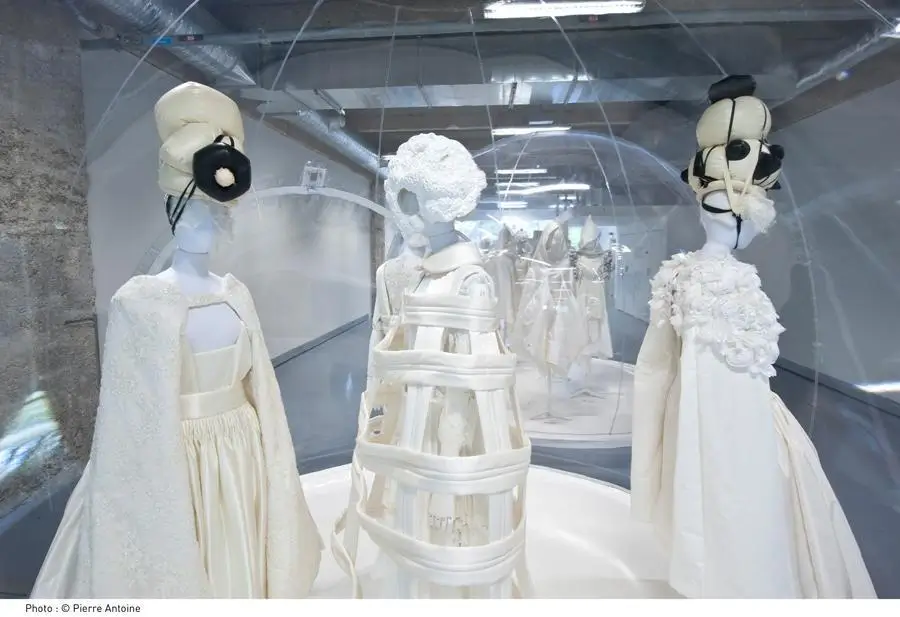
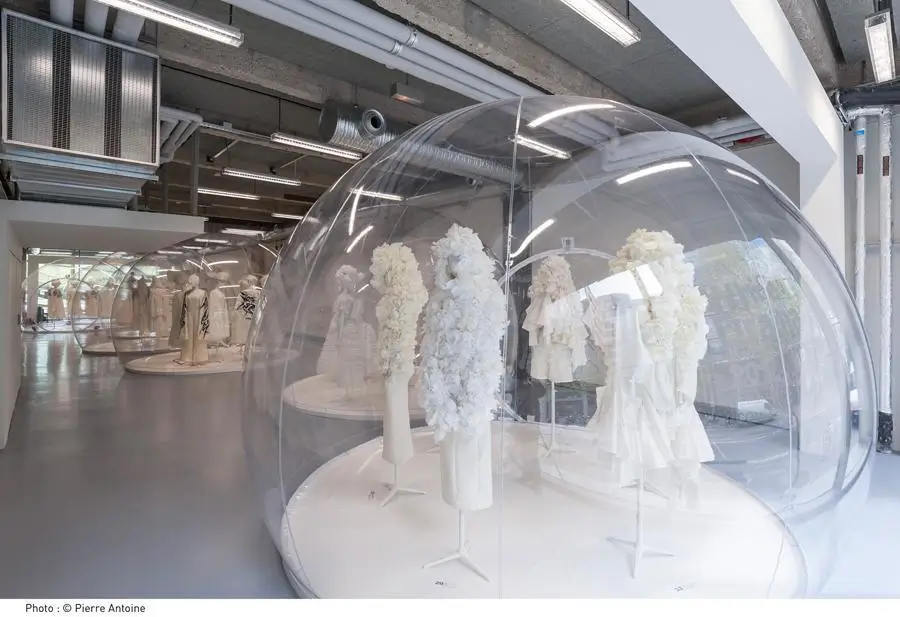
Comme des Garçons sculptural garments and headpieces displayed inside a transparent exhibition dome.
flow
The White Drama install itself was almost defiantly plain in its architecture: a raw, concrete feeling room containing six inflatable plastic domes, each holding a small cluster of garments from the spring summer 2012 runway show. There was no soundtrack built for drama, no choreography, none of the movement that Kawakubo has said she still believes is the ideal way to show a garment. When asked why she would trade a moving body for a static display, she pushed back gently on the idea that runways were becoming obsolete, insisting she still thought there was no better way to present clothing than on a body in motion. But she also said she found it worthwhile to take something built for one context and place it, unaltered, into an entirely different one, arguing that nothing in that shift interfered with presenting a genuinely new proposition to the viewer.
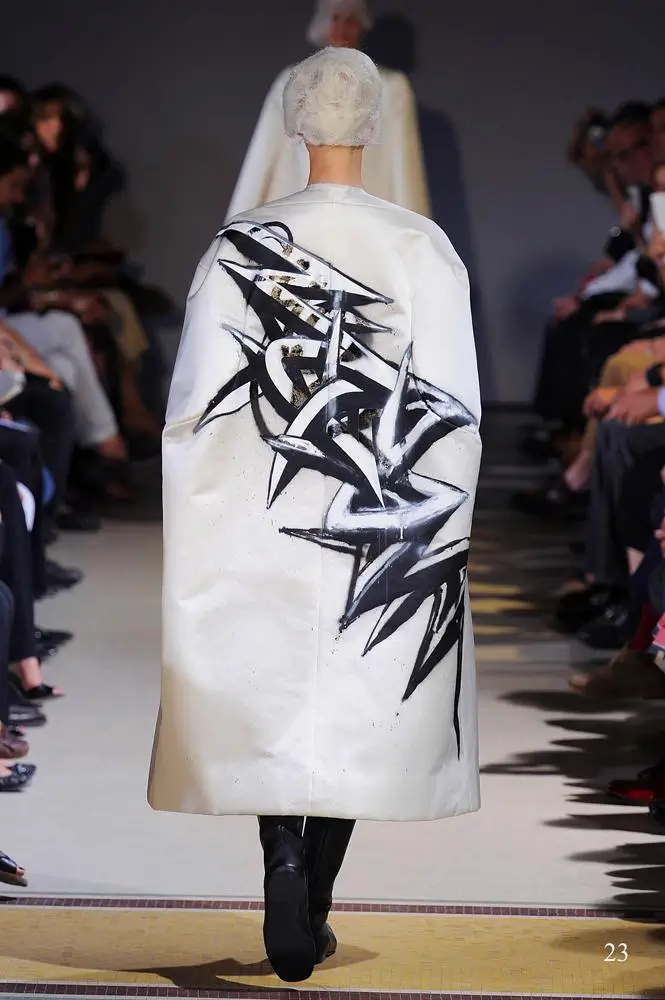
Comme des Garçons white runway coat featuring bold black abstract brushstroke graphics across the back.
That relocation is a fairly precise description of what visitors actually encountered. The garments, all in shades of white, drew on eighteenth century costume silhouettes and on Spanish religious folklore in equal measure: crinolines worn over dresses rather than hidden beneath them, guipure lace coiled back on itself to build volume rather than simply trim an edge, obi style bow belts, tall hats that recalled Holy Week processions in Seville, and veils layered like christening robes. One dress suggested the silky enclosure of an insect cocoon; another, hand painted, credited artist Enrico Isamu Oyama. The effect, according to accounts from critics who saw both the runway show and the later installation, was that garments built to move suddenly asked to be studied, their construction visible in a way a runway’s pace never allows.
Reviewers who caught the original runway presentation during Paris fashion week described it in similarly reverent terms, some ranking it among the strongest collections Kawakubo had shown in years precisely because it balanced her usual conceptual ambition with a level of visible craft, tailoring and volume control that felt unusually generous to the eye. Moving that same collection into a museum context six months later gave that craft a second life, letting viewers linger over stitching and construction details a runway audience would only glimpse for a few seconds as a model passed.
straddle
Kawakubo has said the White Drama collection maps loosely onto the major passages of a life: birth, marriage, death and a fourth, harder to name stage she has described as transcendence. The exhibition left it to visitors to decide which bubble, or which piece within a bubble, corresponded to which stage, an ambiguity that felt consistent with a designer who has spent her career resisting single readings of her own work. It was also, notably, the first time in her career that Kawakubo built an entire collection in white rather than the black she had built her reputation on, a decision she has connected to wanting ceremonial purity rather than the more familiar mourning associations white can also carry.
The choice of venue reinforced that ambiguity rather than resolving it. Rather than a runway audience of editors and buyers seated in rows, White Drama’s visitors moved through the space at their own pace, over nearly six months, alongside a Balenciaga exhibition surveying an entirely different era of French couture. Saillard’s pairing of the two shows in one building let visitors trace a line between the constructed, sculptural form Balenciaga pioneered decades earlier and the ways Kawakubo has continued, deconstructed and inverted that same vocabulary of volume and structure.
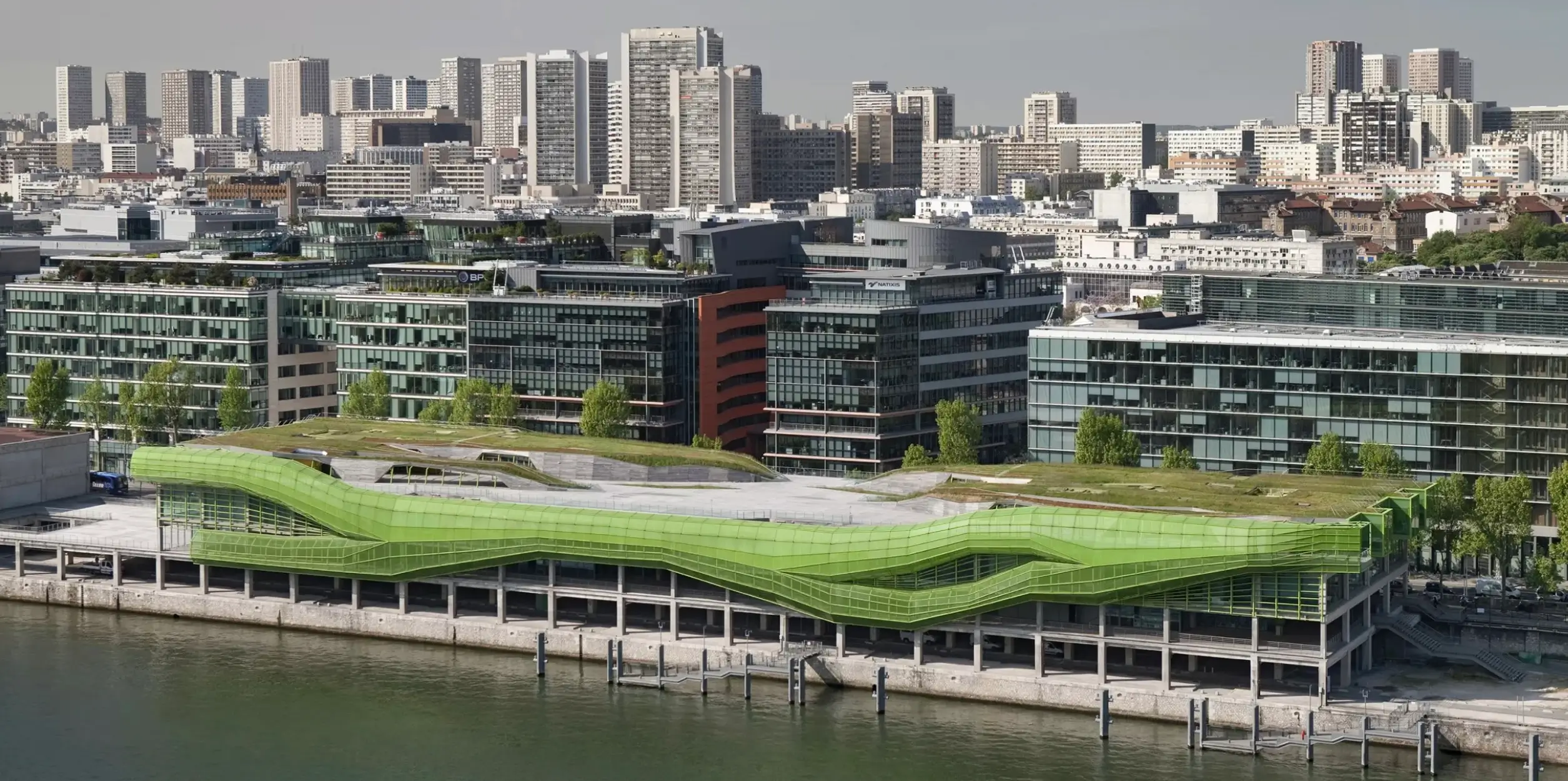
Jakob+MacFarlane – The Docks, City of Fashion & Design set against a dense modern city skyline.
scope
Kawakubo rarely lets an audience settle into comfort for long, and the season that followed White Drama proved the point. For that autumn winter collection, she has described starting from an attempt to design without designing, doing as little as possible, before the idea of working in two dimensions took hold and other, unrelated ideas folded themselves in alongside it. The result opened with almost clownish trapeze coats and oversized felt suits in saturated colors, their hems stitched and marked in ways that made models look like cutout paper silhouettes. Floral prints crept in gradually until they eventually swallowed the models’ faces entirely. Sixties style dresses appeared nested inside the still oversized coat dresses, a mise en abyme effect that briefly recalled Yves Saint Laurent’s famous Picasso dress, a nude pink body painted onto a long black gown, though any direct connection remains speculative at best.
That refusal to build a collection around one legible theme is, by Kawakubo’s own account, standard practice rather than an exception, and it is part of what has kept her label difficult to predict even for people who have followed it for decades. It is also, perhaps, the reason an installation like White Drama worked at all: a designer this resistant to single interpretations was always going to make an unusually rich subject for a room built for slow looking rather than a fifteen minute runway show.
fin
White Drama’s reach outlasted its six months on the Quai d’Austerlitz. When curator Andrew Bolton began assembling Rei Kawakubo Comme des Garçons Art of the In Between for New York’s Metropolitan Museum of Art in 2017, only the second solo retrospective the Costume Institute had ever given a living designer after Yves Saint Laurent, pieces from the White Drama collection were among those debated for inclusion alongside the 2005 Broken Bride collection, both of which explored similarly ceremonial, life stage themes. Kawakubo, by most accounts, resists looking backward at her own archive and has little patience for the word history applied to her own work, which made even a friendly retrospective a negotiation rather than a formality, according to people involved in organizing the show. That White Drama surfaced again five years later, in one of the only career surveys Kawakubo has allowed, says something about how completely the collection captured an idea she has returned to since: that a garment can carry the weight of a life event without needing narrative or explanation attached to it.
White Drama closed at the Docks in October 2012, having spent half a year turning a single Paris fashion week presentation into something closer to a museum survey, six bubbles at a time.
n
From the DRIFT archive: Inside the World’s Most Iconic Ski Experiences
Related Articles

Fragment and Mammut Bring the Barryvox Back in Glacier Blue
Hiroshi Fujiwara’s second Mammut avalanche beacon leaves the Barryvox S2’s rescue brain untouched and changes […]