DRIFT AUDIO
Listen to this story
Choose a voice, then press play.
Fat Convertible (2019) takes a car’s entire vocab of speed and status and inflates it until the joke turns serious.
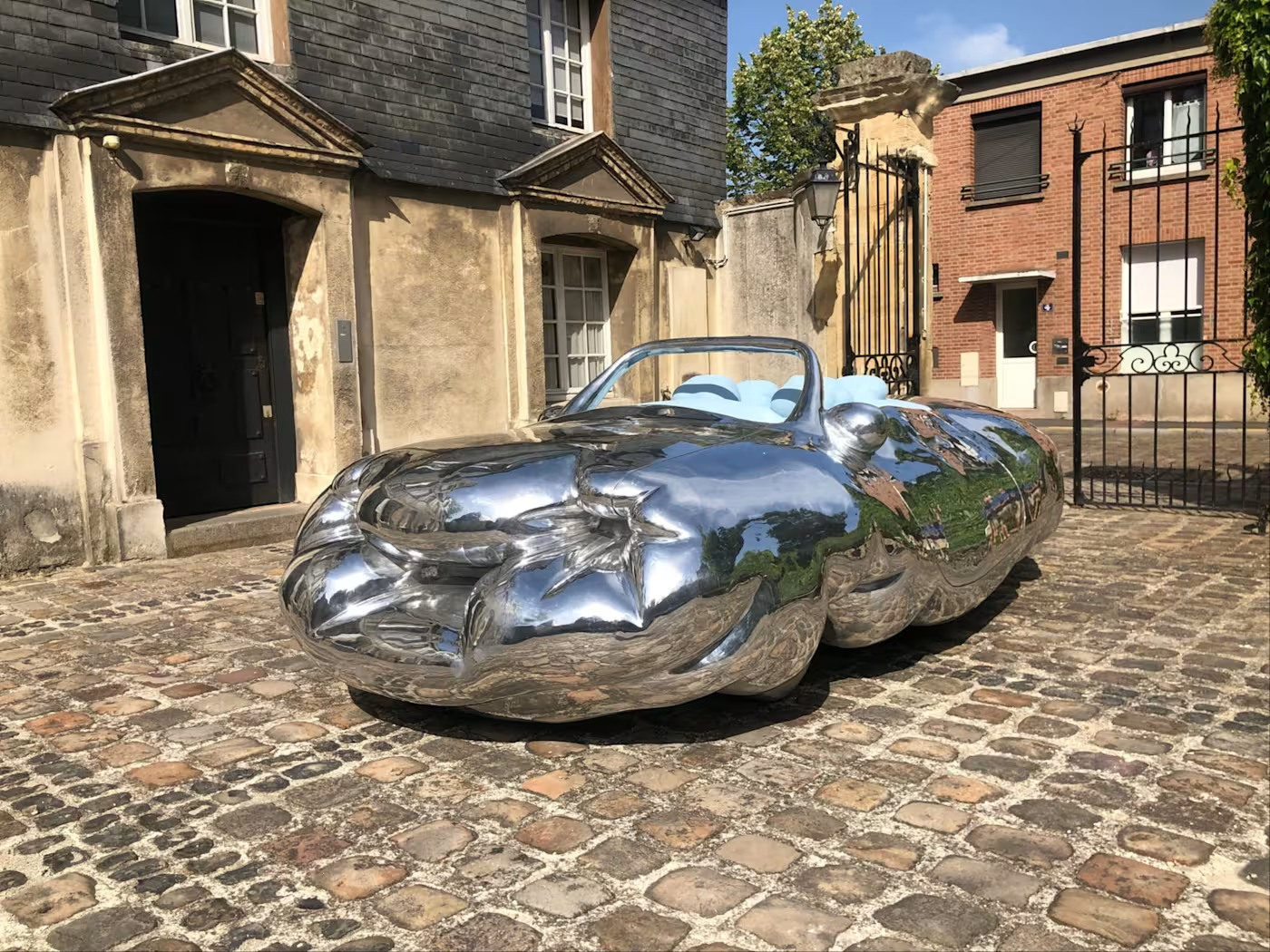
Erwin Wurm’s Fat Convertible has spent the past several years turning up in places built entirely on the idea it is shh making fun of. It has sat in a sculpture park in Braga, Portugal. It has shown at Galleria Poggiali in Florence. It has parked, in one memorable sighting, on the grounds of Albion Barn in Oxfordshire, where a visitor’s photo of the piece next to their partner became one of the more widely circulated images of the work online. And earlier this year it appeared outside the Berkeley Hotel in Knightsbridge, one of the most expensive postcodes in London, finished in gleaming chrome, parked among the actual haute cars that pull up to that particular curb every day. To the people walking past, it registers first as a joke: a convertible that looks like it swallowed another convertible. It takes a second look to notice the punchline is aimed directly at the street it is sitting on.
That is the trick Fat Convertible has been running since the concept first appeared in Wurm’s studio two decades ago, and it is why the piece keeps getting invited back into spaces defined by wealth, taste, and status. A bloated car outside a five star hotel is not really a gag about cars. It is a gag about what that hotel, and everyone parked in front of it, is trying to say about themselves.
stir
The version of Fat Convertible now circulating through galleries and sculpture parks, dated 2019, is a cast aluminium object finished in automotive paint, roughly a meter and a third tall and well over four meters long, built to the swollen proportions of a convertible that has been left to inflate past the point any real vehicle could hold together. That aluminium casting is a later stage of a process that began years earlier with an actual car. Wurm’s method for the original Fat Car works involved coating a real vehicle in polyurethane foam and styrofoam, sculpting the bloated form by hand, and finishing the surface in lacquer so it reads, from a few feet away, as a real car that has simply and impossibly gained weight. The 2019 aluminium edition takes that same swollen geometry and recasts it in a permanent, exhibition ready material, trading the soft studio process for something that can sit outdoors in a sculpture park without degrading.
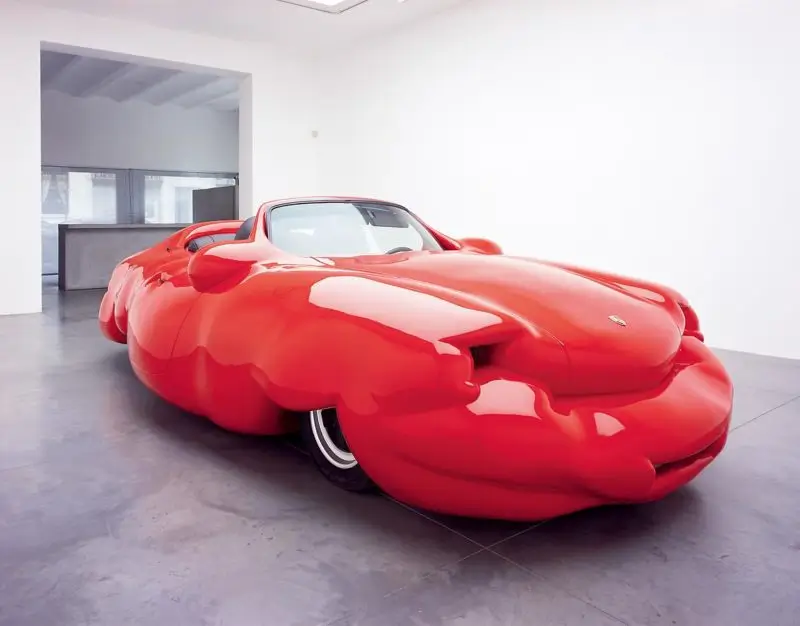
Erwin Wurm’s “Fat Convertible” transforms a classic sports car into a playful, inflated sculptural form.
Wurm has said the fat car idea began with an attempt to work direct with an automaker. Early development on the series involved designers at Opel, though the connect could not fully realize the shape Wurm was after, limited by the technical constraints of manufacturing a car body to those proportions. That failed connection is part of why the finished works read as handmade despite depicting an industrial object. The bulge is not a manufacturing defect rendered in metal. It is a sculptor’s decision, executed by hand on top of an actual chassis before the piece was ever translated into something as clean and permanent as cast aluminium.
Wurm has described the underly idea in fairly plain terms: he wanted to combine a biological system, the body, with an architecture or technical sys, the car, so that the object itself became more human. He has said that the moment he saw the finished fat car, he saw a face in it, and that everyone who looked at it saw the same thing, which is part of why the series reads less like an inanimate object and more like a character. A convertible with a face is a convertible you can accuse of something, and Wurm has spent two decades letting his cars stand accused.
argue
Fat Convertible belongs to a broader body of work usually referred to as the Fat Car series, which sits alongside Wurm’s equally well known Fat House, a nearly full scale model of a house rendered with the same bulging, overfilled logic. Wurm has been direct about what these objects are supposed to represent. In his own words, the car and the house were, for most of human history, the two objects people used to broadcast their well being, their wealth, and their social standing, before a phone in someone’s pocket took over that job. Inflating those two objects to the point of absurdity is Wurm’s way of holding up the entire status system built around them and asking the viewer to notice how strange it looks from a slight distance.
The works have been described by critics as a kind of sheathing of the serious inside the slapstick, a phrase that captures how Wurm’s practice actually operates. The pieces are funny before they are anything else. People stop, laugh, take a photo standing next to the swollen hood, and post it. But the joke only works because the object being mocked, a shiny show car, is one that real wealth and real status are built around convincing people to want. Wurm is not attacking the car. He is attacking the appetite the car exists to satisfy, and doing it through an object so immediately funny that almost nobody feels lectured while they are laughing at it.
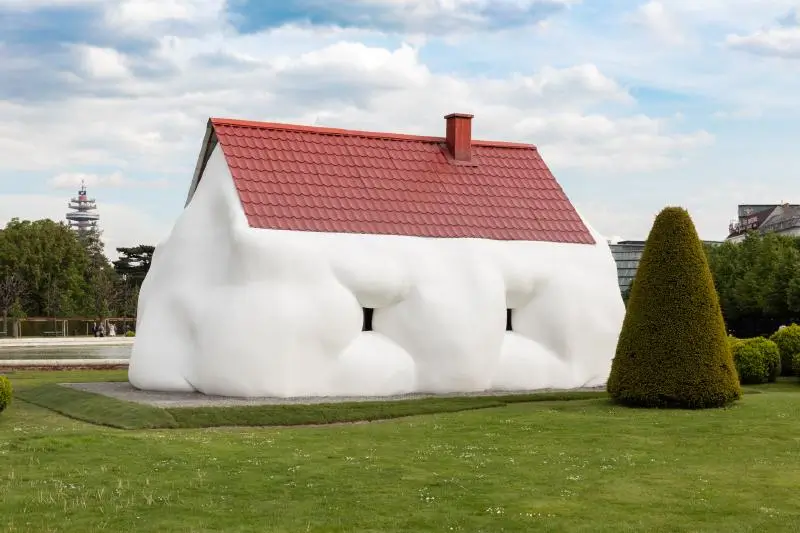
Erwin Wurm’s “Fat House” inflates a familiar home into a surreal architectural sculpture.
rely
Wurm was born in 1954 in Bruck an der Mur, a small town in Styria, Austria, the son of a detective who did not think much of artists as a career choice. He wanted to be a painter, and applied to study painting at the Mozarteum University in Salzburg in 1977. He was rejected, and redirected into the sculpture program instead, a pivot he has since called a genuine crisis at the time. He went on to study at the University of Applied Arts Vienna and the Academy of Fine Arts Vienna, and later spent nearly a decade, from 2002 to 2010, teaching sculpture and multimedia as a professor back at the University of Applied Arts Vienna, the same city where he now keeps a studio alongside homes in Limberg, on the Greek island of Hydra, and in New York.
Long before the Fat Cars made him widely recognizable, Wurm built his reputation on the One Minute Sculptures, a performance series he began in 1997 that is still one of the most cited bodies of work in his career. In these pieces, Wurm gives ordinary people brief, absurd instructions, inserting vegetables into their nostrils, wedging pencils behind their ears, holding an awkward pose against a wall for exactly sixty seconds, and photographs or films the result as the sculpture itself. The lineage back to Joseph Beuys and his expanded definition of what sculpture could be is direct and openly acknowledged. Wurm’s contribution was to strip that expanded definition of any remaining solemnity and hand it to whoever happened to be standing nearby.
That instinct, using humor as the delivery mechanism for something more uncomfortable, runs through nearly everything Wurm has made since, from a marble sausage sculpture reworking the view lang of classical monuments to a full scale house tilted at an impossible angle and jammed into the side of a museum. One of his most personal pieces, Narrow House, rebuilds his childhood home in Bruck an der Mur as a squeezed, compressed replica a viewer can barely walk through, a direct reference to the cramped postwar household he grew up in, shaped by the same lingering hardship and suspicion of outsiders that marked much of provincial Austria at the time. The Fat Cars sit at the opposite end of that same body of work, trading the compression of Narrow House for expansion, but both are working through the same basic question of how much a domestic object can be made to say about the people who live around it.
extend
Wurm’s standing in Austria’s own art establishment has grown considerably since those early rejected painting applications. He received the Grand Austrian State Prize in 2013, one of the country’s highest honors for a living artist, and followed it with the GNMH Award in 2021. In 2024, the Albertina Modern in Vienna staged a full 70th birthday retrospective of his work, pulling together five decades of material, from the earliest One Minute Sculptures photographs through the Fat Cars and Fat Houses, and giving Austrian audiences a rare chance to see the arc of the joke laid out in one building rather than encountered piecemeal across sculpture parks and gallery shows scattered around the world.
That institutional recognition sits somewhat awkwardly next to how the work actually circulates day to day, which is closer to a punchline shared on social media than a museum object encountered in hushed reverence. Wurm appears to be entirely comfortable with that gap. His gallery representation, split between Lehmann Maupin and Thaddaeus Ropac, two of the more prominent dealers working in contemporary sculpture, has kept the Fat Car editions moving steadily through commercial exhibitions and private sculpture parks over the past several years, placements that put the work in front of exactly the kind of collector base its subject matter is quietly critiquing. Whether that irony registers with the people writing checks for it, or whether it simply gets absorbed as another striking lawn ornament, is not really something the work resolves. Wurm has built an entire career out of leaving that particular question open.
why
Wurm made the first fat car more than twenty years ago, and the argument it was built around, that wealth and status inflate the objects people attach themselves to, has aged without much need for updating. What has changed is the culture weather the piece now sits in. A sculpture about bodies swollen past their natural proportions lands different in a year when the entire public conversation about weight has been reorganized around a new gen of drugs designed to shrink the body as fast and completely as possible. Wurm himself has pointed to that overlap without pretend it was his original intention, noting his long standing fascination with people who deliberate reshape their bodies to extremes in either direction, from bodybuilders chasing maximum size to public figures who altered their appearance repeatedly and dramatic over a career in the public eye.
Fat Convertible was never really about human bodies in a literal sense. It borrows the view lang of the overfed body and grafts it onto a machine, which is exactly what makes it legible regardless of which decade’s body anxieties happen to be dominating the conversation. In 2005, when the concept first appeared, the joke read mostly as a critique of consumer excess. Parked outside a five star hotel in 2026, in the middle of a culture moment obsessed with suctioning fat out of bodies as efficient as possible, the same swollen profile reads as something closer to a mirror. The car has not changed. The audience looking at it has.
n
From the DRIFT archive: The Art of the Can: Chaz Bojórquez’s Hand-Signed MTN Spray Paint Edition