DRIFT AUDIO
Listen to this story
Choose a voice, then press play.
A newly granted Motorola patent describes a smartwatch strap that pivots and unfolds into a handheld screen, then folds again into a desk stand.
Every smartwatch owner runs into the same wall eventually. The screen is small enough to glance at, but too small to actually read a paragraph on, scroll through a map on, or type a real reply on. So the phone comes back out of the pocket, the watch goes back to being a notification light with extra steps, and the two devices keep doing half a job each instead of one device doing the whole thing. Motorola’s newest patent takes a swing at closing that gap, and it does it in a way that is stranger and more mechanical than most smartwatch concepts tend to be.
View this post on Instagram
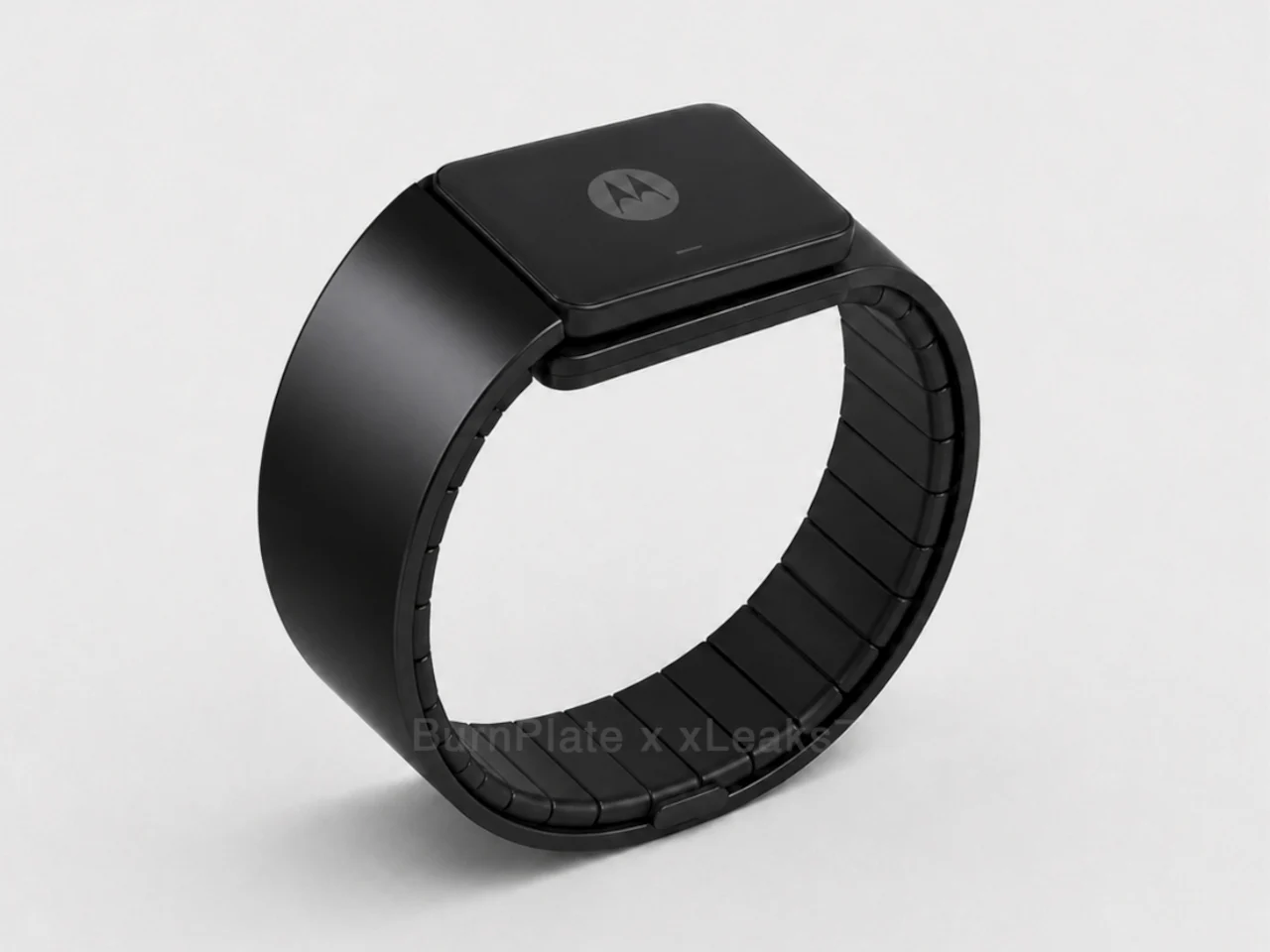
The filing, granted under the number US12,693,705 and titled “Pivoting wearable reconfigurable screen,” describes a device that starts life as an ordinary looking watch. Worn on the wrist, its flexible display curves around the band the way any smartwatch face does. Take it off, though, and the strap itself becomes the point. It pivots open, flattens out, and reassembles into a short, wide screen shaped more like a stubby smartphone than a watch face. The patent was surfaced through a collaboration between fitness app Burnplate and leaker David Kowalski, who publishes design leaks under the handle @xleaks7, and has since been picked up and independently confirmed by outlets including PhoneArena and Android Headlines.
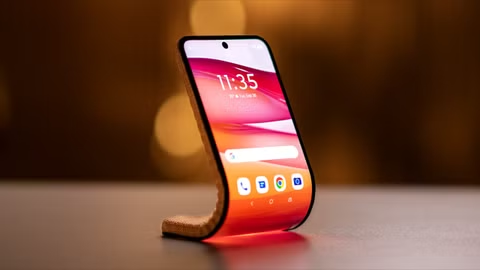
A flexible smartphone concept demonstrates a bendable wrap-around wrist 2024 OLED display that curves into its own stand, hinting at future adaptive mobile designs.
stir
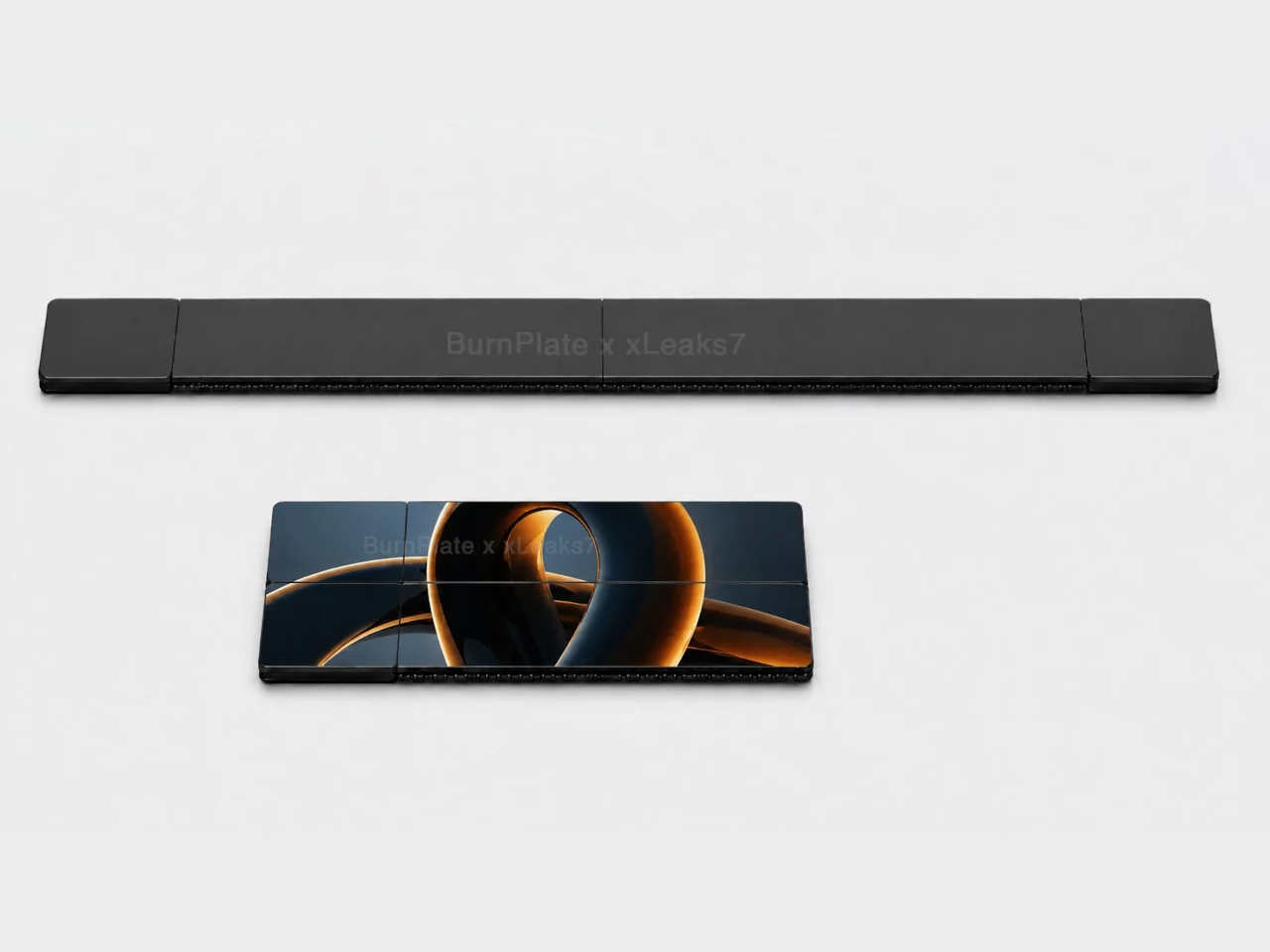
Strip away the novelty and the mechanism described in the filing is fairly specific. A flexible touchscreen runs the length of the strap, not just across the watch face. In wrist mode, that screen wraps into a loop, with a rectangular section sitting on top functioning as the visible watch display. When the wearer wants more room, one half of the band pivots away from the other, and the two sections come together side by side rather than end to end, forming a screen that is shorter and wider than a typical phone. Magnets or an interlocking mechanical coupling hold the two halves in alignment once they’re joined, and onboard sensors detect which configuration the device is currently in so the software can resize and reflow whatever is on screen accordingly.
That last detail matters more than it sounds like it should. A single continuous flexible panel that can be a loop, a flat rectangle or a folded shape only works if the operating system actually knows which shape it’s in at any given moment and adjusts the interface without the user having to tell it manually. The patent describes exactly that kind of position sensing as part of the core mechanism, not as an afterthought.
The filing also specifies where the actual electronics live. Rather than packing the processor, battery and wireless radios into a single watch body the way a normal smartwatch does, the patent places those components inside the strap ends themselves, distributed across the band rather than concentrated in one housing. That’s a meaningfully different engineering approach from a conventional watch, where the case does almost all of the structural and electronic work and the band is just a fastening mechanism. Here, the band effectively is the device.
flow
Most coverage of the patent has focused on the two obvious configurations, watch and handheld, but there’s a third shape described in the filing that’s easy to miss. Beyond flattening into a phone sized display, the bottom quarter of the unfolded screen can fold again into an “L,” letting the device stand upright on its own on a flat surface. PhoneArena’s writeup specifically calls out this desk stand mode as a distinct configuration from the flat handheld layout, turning what would otherwise be a screen you have to prop against something into a screen that props itself.
Put together, that gives the device three functional identities built from a single continuous piece of flexible display: a loop worn on the wrist for quick glances, a flat wide rectangle held in the hand for actual typing, reading or browsing, and a self standing tent shape for hands free viewing on a desk or nightstand. It is, in effect, trying to be three different product categories using one physical object, which is a more ambitious pitch than most convertible device patents attempt.
Burnplate’s writeup on the patent, produced in partnership with Kowalski’s leak, leaned specifically into the health and fitness angle of that third configuration. A watch face is fine for a single heart rate number or a step count, but genuinely useful health data, a full daily summary, a calorie trend line, a multi week workout chart, needs more room than a 40 millimeter display can offer. The pitch there isn’t a new screen size so much as a new default: instead of opening a companion phone app to actually understand the data a watch has been quietly collecting all day, the same device could unfold and show it directly.
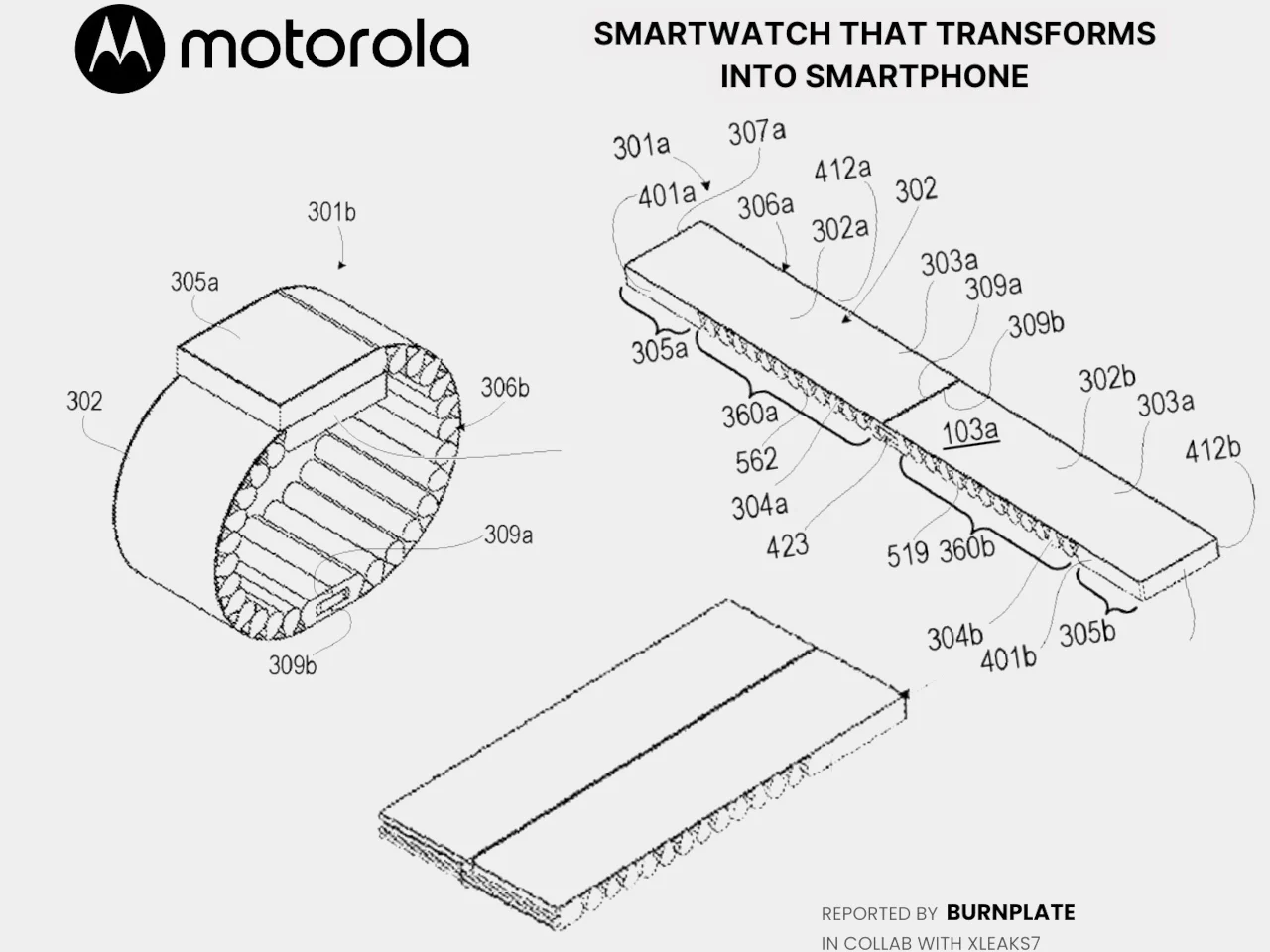
Patent illustrations outline Motorola’s vision for a flexible device that transitions between a wrist-worn smartwatch and a full-size smartphone.
mood
None of this comes out of nowhere. Motorola has been circling the idea of a device that moves fluidly between wrist and hand for at least a couple of years now. At MWC 2024, the company publicly demonstrated its Adaptive Display Concept, a single 6.9 inch flexible pOLED panel that could lie flat as a phone or wrap around the wrist as an oversized watch. It was a working prototype rather than a rendering, and it drew attention precisely because it looked like a slap bracelet crossed with a phone, wide and a little unwieldy on the arm but functional.
Since then, Motorola’s patent filings have kept circling variations on the same basic premise. A separate filing surfaced in late 2025 described a rollable version of the concept, extending and retracting a display rather than folding it, functioning as a compact watch face when rolled down and stretching out into a small phone screen when rolled up. Another patent that came to light in January 2026 outlined a “deformable” phone with a multi-link body capable of bending, twisting and holding several shapes, including a wrist wrap mode and a tent mode, with cameras and sensors used to detect which portion of the screen the user is actually looking at in order to save battery and manage which side of the display stays active. This newest patent, with its pivoting strap and three way transformation, reads like the most mechanically specific version of that same idea yet, less a loose sketch of a concept and more an actual engineering description of how the hinge and coupling would work.
It’s also worth noting that Motorola is far from alone in exploring this territory. Samsung, LG and various smaller manufacturers have spent years filing their own patents around rollable and dual screen wearables, and the broader foldable phone market itself, now several generations deep at companies like Samsung with its Galaxy Z line, has already normalized the idea that a screen’s physical size doesn’t have to be fixed at the point of manufacture. What sets Motorola’s recent run of filings apart isn’t the ambition, plenty of manufacturers share the ambition, but the specific commitment to wrist wearability as the starting point rather than an afterthought bolted onto a phone design.
huh
It’s worth being direct about what a granted patent actually signals, because it is not the same thing as a product roadmap. Motorola, like most large electronics manufacturers, files an enormous volume of patents every year, protecting ideas its research and development teams explore regardless of whether any individual concept ever gets built. By some counts the company held close to 24,000 patents at the time Google acquired its mobility division back in 2011, and the pace of filing has not slowed since. A granted patent confirms that the described mechanism is original enough to earn legal protection. It does not confirm manufacturing feasibility, battery life, cost, durability, or any intention to actually build the thing.
That gap between patent and product is especially wide for a device this mechanically complex. A flexible display that has to survive being worn, bent, pivoted, magnetically coupled and folded into a stand repeatedly is a genuinely hard engineering problem, on top of the software challenge of making an interface reflow cleanly across three different physical shapes without glitching, freezing, or losing the user’s place. Coverage from TechRepublic raises exactly this point, noting that daily use, not the patent filing itself, will ultimately decide whether a design like this deserves to leave the lab.
Android Headlines’ own coverage of the patent added a blunter version of the same skepticism, with the outlet’s head editor noting he had gone hands on with an earlier Motorola prototype at MWC and came away thinking the concept, while genuinely interesting, might not find a wide audience simply because of the friction involved. Needing to physically assemble a device, pivoting a strap, aligning magnets, waiting for sensors to register the new shape, before every extended use session is a real behavioral cost that a fixed shape phone or watch never asks of its owner. That kind of friction has killed plenty of clever hardware concepts before they ever reached a retail shelf, regardless of how sound the underlying engineering was.
wear
Even accounting for the very real odds that this specific patent never becomes a shelf product, it’s a useful signal for where the wearables category is trying to go. The industry has spent the better part of a decade treating smartwatches and phones as permanently separate devices with permanently separate screens, and the convertible foldable phone boom of the last several years has largely stayed in that same lane, folding a phone smaller rather than trying to make it wearable. What Motorola keeps returning to across multiple patents is a different bet entirely: that the boundary between “worn” and “held” doesn’t need to be a hardware boundary at all, just a software one, if the display itself is flexible enough to change shape on demand.
Either or not this particular pivoting strap mechanism ever ships, the pattern across Motorola’s recent filings, the 2024 Adaptive Display Concept prototype, the rollable variant, the deformable multi link body patent, and now this pivoting reconfigurable screen, points toward a company that has decided the next real leap in wearables isn’t a bigger battery or a sharper sensor. It’s a screen that stops being locked into one shape at all.
For now, that idea exists only on paper, in a patent office filing and a set of concept renders built around it. Motorola has not commented publicly on any plan to bring the pivoting design to market, and none of the outlets that surfaced the filing were able to get the company to confirm a timeline, a target price, or even a working prototype beyond the diagrams included in the patent itself. What is confirmed is that the idea keeps resurfacing across Motorola’s research pipeline in slightly different mechanical forms, which suggests the company is still actively chasing it rather than having shelved it after the 2024 demo. Whether that persistence eventually produces a shipping device or simply another few years of patent filings is, at this point, genuinely an open question.
n
From the DRIFT archive: Tactical Elegance: Inside Bramford London Aqua Blue Three-Pocket Watch Roll · PANTONE’s 2026 Color of the Year Takes Shape With Play-Doh and Post-It Editions
Related Articles

The White Violet That Refuses to Pick a Side: Inside Le Labo’s VIOLETTE 30
Le Labo’s first Classic Collection addition of 2026 is built on a flower the Victorians […]