DRIFT AUDIO
Listen to this story
Choose a voice, then press play.
Le Labo’s first Classic Collection addition of 2026 is built on a flower the Victorians could never agree on, and it wears that indecision openly.
Most perfume houses pick a flower because of what it smells like. Le Labo picked the violet for VIOLETTE 30 because nobody has ever been able to settle what it means. The brand’s own copy for the scent reads almost like a brief for a debate: across centuries the violet has stood for burning passion and wide-eyed innocence, for strength and delicacy, for wisdom and plain optimism, often in the same dictionary. Rather than resolve that, the New York house built a fragrance that treats the contradiction as the whole point, and then gave it a permanent place on its shelves.
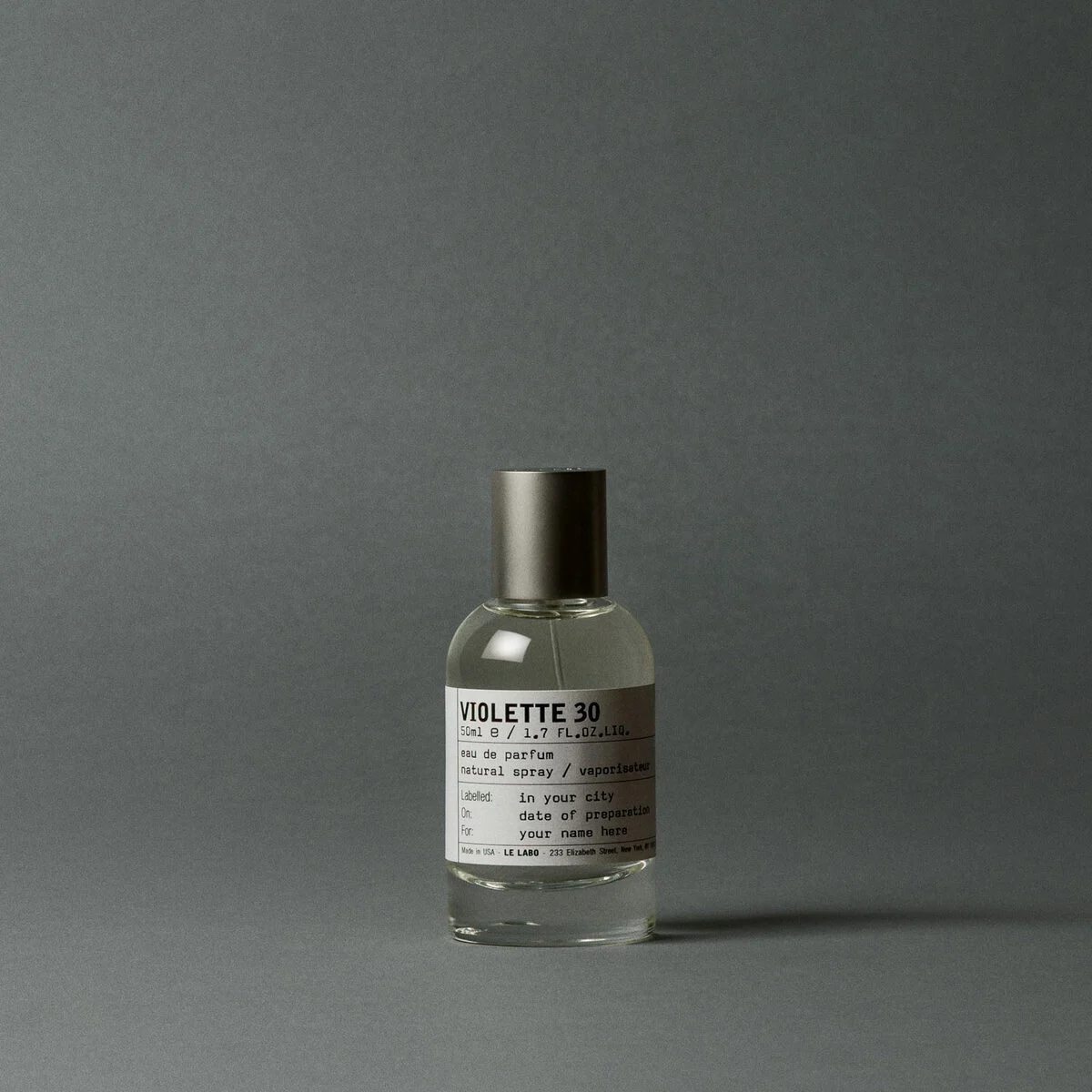
Signal. What happened: Le Labo added a new permanent scent, VIOLETTE 30, to its Classic Collection, its first new core fragrance of 2026. Exact object: VIOLETTE 30 Eau de Parfum, a genderless composition centered on white violet with green floral notes, white tea, cedarwood and a touch of guaiacwood, freshly blended and hand labeled at the point of sale. When and where: released February 2, 2026 across Le Labo stores and online, including all Le Labo boutiques in Japan, where it launched at ¥14,080 (15ml), ¥31,350 (50ml) and ¥45,650 (100ml), with a 1.5ml size sold online only. Source: Le Labo’s own product page and Japanese launch notice. Why it matters: Classic Collection additions are rare and permanent, and this one takes on a note Le Labo has long used in the background (including inside Santal 33) and moves it to the front of the label. Earlier: cover of Patta’s first fragrance with Marcus Elizabeth, a saffron, leather and incense extrait launched in Amsterdam this September, looked at the same move from the other side, a streetwear label entering perfume rather than a perfume house refining its core.
View this post on Instagram
style
The reference point Le Labo reaches for is floriography, the nineteenth century habit of sending messages through the choice and arrangement of flowers. It was a real publishing phenomenon. Dozens of flower dictionaries circulated through France, Britain and the United States, each assigning a sentiment to a bloom so that a posy could say what polite conversation could not. The trouble, then as now, was that the books disagreed with each other constantly.
The violet was one of the worst offenders. Depending on the volume, and on the color of the petals, it could signal faithfulness, modesty, candor or a love kept quiet. Purple and blue violets tended to carry loyalty and devotion. White violets were more often read as innocence or modesty, though some dictionaries pushed them toward a willingness to take a chance on happiness. The flower was also claimed well outside the parlor: Napoleon‘s supporters adopted it as a symbol during his exile, which is roughly as far from wide-eyed innocence as a meaning can get.
That spread is what Le Labo’s copy leans on. Instead of choosing one reading and dressing it up, the brand frames VIOLETTE 30 as a record of all of them sit in one stem. It is an unusually literary pitch for a house that normally keeps its descriptions to a few dry lines and lets the lab counter do the talking.
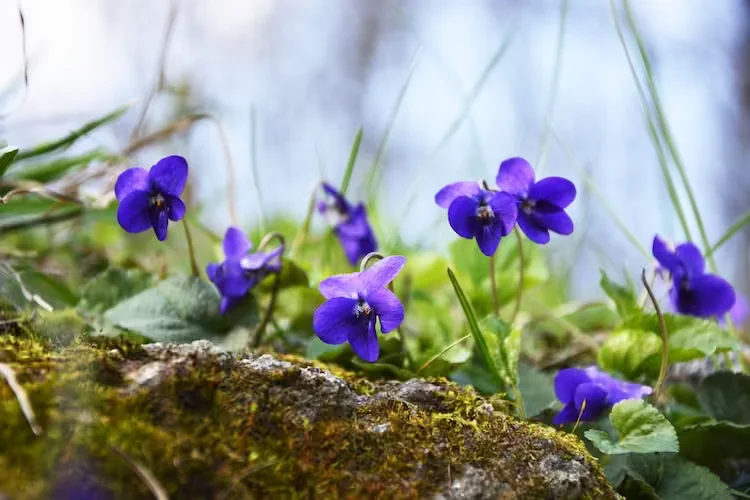
A close-up view of vibrant purple violet flowers blooming among green leaves and moss on a forest floor, with a softly blurred natural background.
why
The specific flower at the center of the scent is the white violet, which Le Labo describes as the rarer, shade seeking member of the family. That description tracks with the plant itself. Several white flowered violets, including the sweet white violet of eastern North American woodlands, grow in damp, shaded ground under trees rather than in open sun, and they are smaller and easier to miss than the familiar purple sweet violet.
There is a practical perfumery story underneath the poetic one, too. The violet has always been one of the hardest flowers to capture directly. Its blossoms yield so little usable material that true violet flower oil has been prohibitively scarce for well over a century, and perfumers instead work with violet leaf, which smells green and slightly cucumber sharp, and with ionones, the aroma molecules first synthesized in 1893 by the German chemists Ferdinand Tiemann and Paul Krüger. Almost every violet in modern perfume is an accord assembled from those pieces rather than a single extracted flower.
That makes a “white violet” note even more of a construction than most, and Le Labo does not claim otherwise. The house presents it as an idea as much as an ingredient: the bright, cool face of the violet, stripped of the candied powder that the note carries in vintage confections and old fashioned soaps. The green floral notes listed alongside it point in the same direction, toward stem and leaf rather than sugar.
flow
Le Labo names every fragrance with a single word and a number. The word is the dominant note, and the number is the count of materials in the formula, a convention that has been part of the brand’s identity since its first bottles. VIOLETTE 30 therefore points to a thirty ingredient composition, of which the brand publicly names five: white violet, green florals, white tea, cedarwood and guaiacwood.
The pairing with white tea is the most telling choice. White tea is the palest and least processed of the tea family, and as a perfume note it tends to read as clean, faintly floral and a little dry, a shh surface rather than a statement. Set beside a cool violet, it keeps the heart transparent instead of sweet. Beneath that sits cedarwood, a Le Labo staple that also anchors Santal 33, and a small amount of guaiacwood, whose oil brings a soft, smoky warmth. Canadian outlet VITA Dailydescribed the dry down as moving from green florals and white tea into warm cedar and smoky guaiac, which matches the brand’s order of notes.
The ingredient declaration on Le Labo’s product page offers a few more clues without giving the formula away. Juniperus virginiana oil, the botanical name for the Virginian cedar, is listed, along with familiar fragrance components such as linalool, geraniol and hydroxycitronellal. Longer note pyramids for the scent circulate on fan databases, adding things like aldehydes, saffron and incense, but Le Labo has not confirmed any of them, and the brand has not publicly credited a perfumer for the composition.
Le Labo’s global brand president and creative director, Deborah Royer, has framed the scent in the same spirit as the copy. Introducing the launch, she described it to 10 Magazine Germany as exploring “the space between precision and intuition,” a phrase that doubles as a fair summary of how the brand likes to describe its whole working method.
straddle
Le Labo was founded in New York in 2006 by Fabrice Penot and Eddie Roschi, two perfume industry veterans who had worked together at L’Oréal. Their pitch was slow perfumery: small labs instead of shop counters, fragrances mixed from concentrate in front of the customer, and bottles labeled by hand with the date, the location and a name. The brand’s own shorthand for its origin is that it was born in Grasse and raised in New York, a nod to the French perfume capital and to the Nolita shop where it started.
The Estée Lauder Companies acquired Le Labo in 2014, and the brand has since grown into a global chain of labs while keeping the rituals intact. VIOLETTE 30 follows them exactly. It is described as genderless, it is blended fresh at the counter, and it is labeled by hand at purchase, with customers able to add a short personal message to the label. Refills are avail for the full size bottles through Le Labo’s stand refill program.
The significance of the launch is where it lands in the catalog. Le Labo splits its perfumes into the Classic Collection, sold everywhere, and the City Exclusive Collection, scents tied to individual cities that are normally only available in those places, with a single window each year when full sizes are sold more widely. New Classic entries do not come often. VIOLETTE 30 now sits in that permanent lineup next to Santal 33, Another 13, Thé Matcha 26 and Rose 31.
There is a small irony in that company. Violet is not new to Le Labo at all. A violet accord is part of Santal 33, the brand’s best known scent and a fixture of city subways and bars for more than a decade. What VIOLETTE 30 does is bring that supporting material out of the background and put its name on the bottle.
fin
For a launch sold on contradiction, the reaction has been appropriately split. Some wearers describe a soft, woody violet that avoids the powdery candy effect the note is known for, closer to a pressed flower than a bouquet. Others, including a number of dedicated perfume critics, have argued the opposite of the brand’s pitch: that the scent sits so comfortably inside Le Labo’s established signature, with its cedar and musky woods, that it reads more like a close relative of Santal 33 than a departure. At least one account from the shop floor had a sales associate introducing it by comparing it to a blend of Santal 33 and Thé Matcha 26.
That tension is not really a problem for the brand. Le Labo’s core customers tend to come for exactly that house signature, and a Classic Collection scent that feels recognizably of the family is doing its job. The more interesting question is whether a violet this restrained reads as the flower at all on skin, or simply as a lighter, greener way into the Le Labo style.
What is clear is where it fits commercially. VIOLETTE 30 is a permanent line, not a seasonal rel, blended to order in every Le Labo lab worldwide, and it is now the only scent in the Classic Collection named for the violet, a flower that three different Victorian dictionaries could have told you meant three different things.
Related Articles
Miffy Gets Her Ceremony Best: United Arrows Dresses Dick Bruna’s Rabbit for KIDDY LAND’s 80th
A Miffy mascot in United Arrows’ formal-occasion wardrobe, and a pouch where she peeks out […]