DRIFT AUDIO
Listen to this story
Choose a voice, then press play.
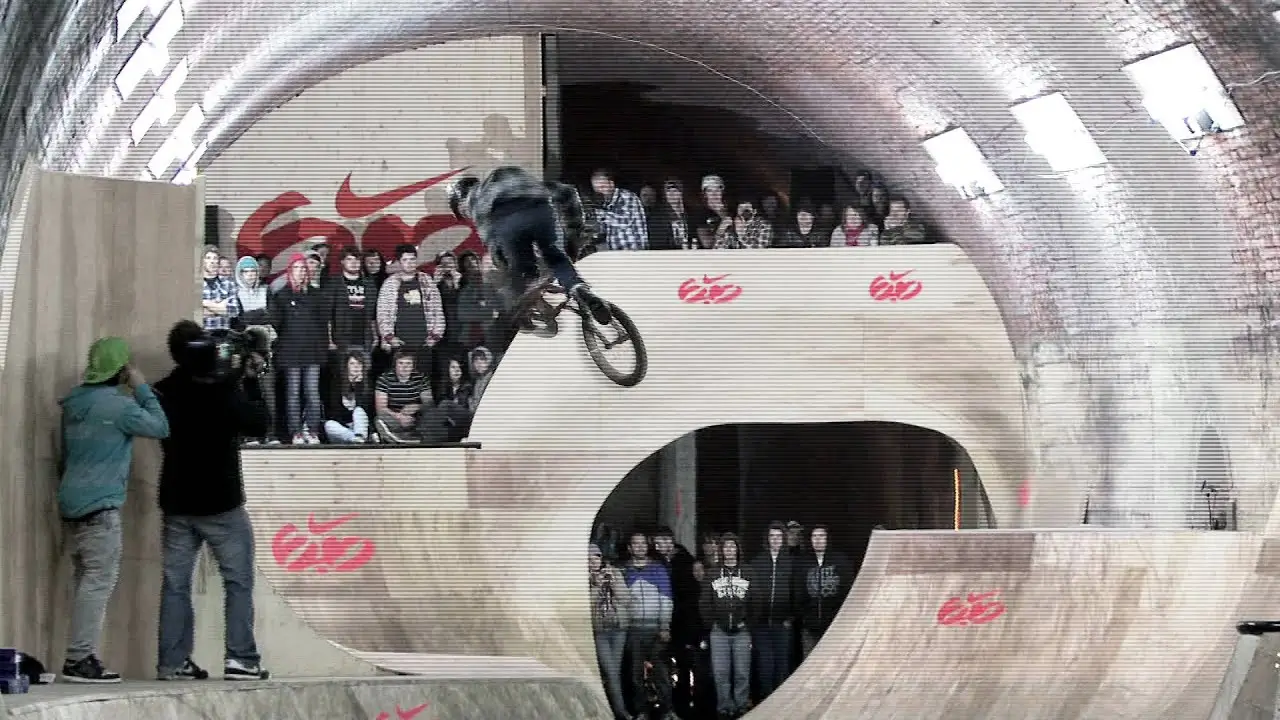
In 2009, Nike pulled off one of the boldest spatial experiments BMX culture had ever seen. Deep beneath the English countryside, inside an abandoned Victorian railway tunnel in Hampshire, the brand transformed a forgotten industrial relic into a fully rideable underground BMX paradise. Known as the Nike 6.0 Tunnel Jam, the project fused architecture, urban decay, technical ramp design, and elite riding into something that still feels almost mythological more than fifteen years later.
The location itself played an enormous role in shaping the legend. The Privett Tunnel, part of the former Meon Valley Railway southwest of London, had been abandoned for decades. Its curved brick ceilings, damp conditions, narrow passageways, and echo-heavy acoustics made it a deeply unconventional canvas. Where most brands would have seen structural limitations, Nike 6.0 saw atmosphere.
build
The project was led collaboratively by designer and creative producer Rich Holland alongside ramp specialists from 9c Ramps and Urb-Orbis, with BMX riders actively helping shape the rideability of the course. Over the span of three months, crews installed concrete and tarmac flooring before constructing a custom network of wooden ramps engineered specifically for the tunnel’s compressed geometry.
Instead of forcing a conventional skatepark into the space, the builders adapted to the tunnel’s architecture. Quarter pipes hugged the brick walls. Over-vert sections amplified the claustrophobic intensity. Pool-inspired transitions encouraged speed and flow despite the confined environment. Every feature interacted with the tunnel’s natural curves, moisture, and acoustics, turning environmental challenges into part of the riding experience itself.
The result was less like a traditional BMX park and more like an immersive installation. Artificial lights bounced across dripping masonry while wheels thundered through the narrow chamber. Riders weren’t simply performing tricks inside a venue—they were navigating a living piece of industrial history reimagined through action sports culture.
stir
The actual Tunnel Jam event carried an air of secrecy. Invitation-only and intentionally underground in both location and spirit, it brought together elite BMX riders for a session that blurred the line between contest and creative experiment. Spectators packed the edges of the tunnel while music and crowd noise ricocheted off centuries-old brick.
Among the standout names were Sebastian Keep, Dan Lacey, Jason Phelan, and Garrett Reynolds. Keep earned Best Rider honors for massive airs and technical pocket transfers that seemed impossible beneath the low tunnel ceiling. Lacey captured Best Line thanks to an aggressive over-vert Ruben wallride sequence, while Phelan landed Best Trick with a tailwhip into double peg grind combination that immediately entered BMX highlight history.
The event quickly transcended the jam itself because of the visuals Nike captured around it. Professionally filmed edits showcased the uniquely cinematic environment: water dripping from ceilings, tires echoing against timber ramps, silhouettes disappearing into darkness. Even today, clips from the Tunnel Jam continue circulating online as artifacts from an era when brands occasionally took enormous creative risks simply to push culture forward.
aftermath
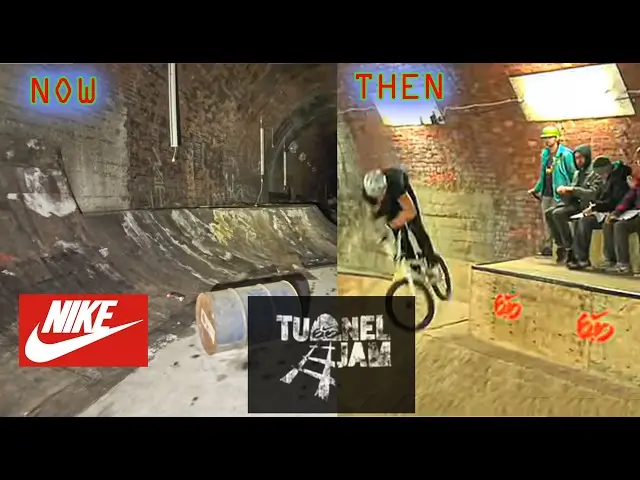
One of the most surprising aspects of the project came after the cameras stopped rolling. Rather than dismantling the installation immediately, Nike reportedly donated the entire park setup to the local BMX community, allowing riders to continue using the tunnel under controlled conditions. For several years, the Privett Tunnel became a semi-secret riding destination where grassroots sessions carried on the energy established during the original event.
But the tunnel’s atmosphere that made the project so iconic also ensured it would never last forever.
Heavy rainfall increased water seepage throughout the structure. Constant dampness weakened wooden supports, warped transitions, and destabilized key riding surfaces. Maintenance became increasingly difficult as flooding intensified. Eventually, the once world-class underground park deteriorated beyond safe use, and riders gradually abandoned the site.
Today, the remains of the Tunnel Jam exist as an eerie time capsule. Urban explorers entering the restricted tunnel encounter decayed ramps still clinging to curved brick walls, faded Nike branding, scattered remnants of BMX hardware, and puddles collecting beneath collapsing transitions. Graffiti and rot have layered themselves over what was once one of the most progressive BMX environments ever built.
why
What continues to make the Nike 6.0 Tunnel Jam significant is not simply the riding level or architectural novelty. It represented a moment when a global sportswear company fully embraced experimentation without chasing permanence. The project existed briefly, intensely, and almost recklessly. It prioritized atmosphere, subculture authenticity, and rider imagination over scalability or commercial longevity.
In today’s era of polished concrete plazas and algorithm-driven brand activations, the Tunnel Jam feels almost impossible by modern standards. It was dark, damp, difficult, risky, and deeply site-specific. That singularity is exactly why it endures in BMX memory.
For BMX historians, the Privett Tunnel has become something close to sacred ground—a place where progression, architecture, and storytelling collided beneath the earth for one fleeting period. The ramps may now decay in silence, but the mythology surrounding them continues growing through archived footage, rider recollections, and the haunting imagery of abandoned infrastructure reclaimed by time.
Nike did not merely build a skatepark underground. It temporarily transformed a forgotten railway tunnel into one of the most atmospheric action-sports spaces ever conceived. And even now, long after the lights shut off and the wood began to rot, the echo of that experiment still lingers beneath Hampshire’s soil.
From the DRIFT archive: Inside Scottie Pippen’s Chicago Mansion: A Legendary Athlete’s Sanctuary Reimagined for the Cameras of Architectural Digest · Beyond the Canvas: Mercer Labs and the Rise of Tech-Driven Mastery
Related Articles

Nike A’Two “Potion No. 22” Gives A’ja Wilson a Mismatched Horror Double Bill
Two shoes, two monsters: A’ja Wilson’s Halloween A’Two splits blood splatter and honeycomb across a […]