DRIFT AUDIO
Listen to this story
Choose a voice, then press play.
Nike ACG unveiled the Picklejus during UTMB week in Chamonix, its first trail shoe built entirely around GOATEK, a new in-house outsole platform.
Nike ACG‘s newest trail runner started as a listening exercise. According to Nike‘s own release, the ACG team spent three years talking with elite mountain athletes competing in Chamonix, the epicenter of big-mountain trail racing, before landing on the brief behind Picklejus. The name is a deliberate misspelling: Picklejus riffs on pickle juice, the near-mythical remedy ultrarunners reach for when cramps hit deep into a race. ACG unveiled the shoe during UTMB week, the annual Chamonix event built around the Ultra-Trail du Mont-Blanc and its broader World Series circuit, at a briefing that reportedly included fermenting pickle jars and a pickle-juice cocktail bar, according to Road Trail Run, which got an early look from Brenden McAleese, ACG’s Director of Footwear. Three needs kept surfacing in ACG’s athlete conversations: staying efficient on long climbs, staying protected on long descents, and staying confident as terrain shifts underfoot. Rather than optimize for one at the expense of the others, the team built Picklejus as what Nike calls a complete mountain-running system, the product of 10 research studies and 20 prototypes tested by more than 100 athletes. Nike describes the shoe as ACG’s pinnacle expression of big-mountain running innovation, aimed squarely at races that stretch past 100 miles through repeated climbs and descents rather than the shorter, flatter courses most trail shoes are tuned for.
scope
Picklejus runs on Nike’s first co-molded, dual-density supercritical foam platform built specifically for trail, combining two formulations of ZoomX in a single midsole. A softer core handles cushioning and impact protection, while a firmer perimeter ring adds stability and a plate-like effect without an actual plate, according to Nike. The two densities are molded together rather than glued, a first for ZoomX, which Nike says lets the foam behave as one integrated unit through transitions rather than two materials working against each other. Road Trail Run, previewing the shoe in Chamonix, measured the platform at a 38mm heel and 32mm forefoot stack, a 6mm drop, and a target weight of roughly 275 grams (9.7 ounces) in a men’s US10, putting Picklejus in the same supercritical-foam, high-stack, no-plate category as the Salomon Ultra Glide, the La Sportiva Prodigio Pro, and the Brooks Cascadia. Emily Farina, Senior Principal for Running Footwear at the Nike Sport Research Lab, said the shoe needed to solve for uphill and downhill efficiency at once, calling it a product of close partnership between the lab, ACG’s product teams, and its athletes.
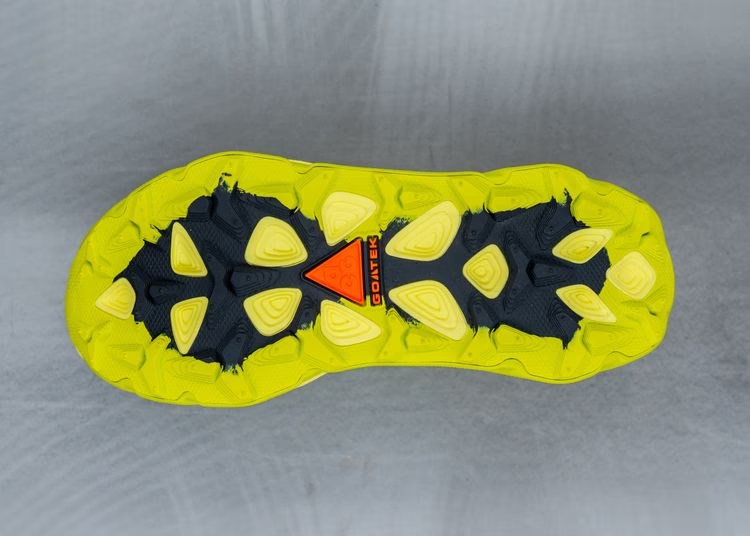
A close-up view of the Nike ACG Picklejus outsole featuring the new Goatek traction lugs.
track
The bigger story sits underfoot. GOATEK is ACG’s first proprietary trail-traction platform, and Nike is positioning it as a direct answer to years of runners saying its rubber compounds lagged behind specialists like Vibram, whose outsoles Nike has leaned on for shoes including the Ultrafly and its newer Kiger models. Nike says GOATEK delivers 45 percent more wet traction and 25 percent greater abrasion resistance than its previous all-terrain outsoles, a claim backed by five rounds of long-term wear-testing across more than 18,000 athlete miles in the mountains. The comparison point is the compound used on shoes like the Nike Trail Wildhorse 10, not Vibram’s own rubber, and Nike stops short of framing GOATEK as a direct MegaGrip replacement anywhere in its own materials. Still, the timing reads as pointed: Nike has repeatedly turned to Vibram for grip-critical models in recent years, including the Ultrafly and its newer Kiger releases, after its own compounds developed a reputation among trail runners for underperforming in wet conditions. Those numbers come from Nike’s own lab and haven’t yet been tested against Vibram’s MegaGrip on the same terrain, since Picklejus remains more than a year from release. Nike frames GOATEK as bigger than one shoe, describing the outsole as a platform designed to scale beyond the trail and inform performance footwear across the company. Shea Aquilano, a member of Nike’s All Conditions Racing Department, said the traction system frees her to focus on the terrain and the race itself rather than second-guessing her footing.
build
Above the midsole, Picklejus uses a trail-specific application of Nike’s Flyknit construction, with knit containment cables Nike says adapt to the foot for a secure, stable fit through changing terrain. The upper is built from hydrophobic yarns designed to repel water and shed weight when trails turn muddy or wet, paired with a gaiter-inspired cuff meant to lock the foot in place while keeping debris from working its way inside the shoe. It’s a different set of priorities than the version of Flyknit found on Nike’s road racers, where the technology is tuned mostly for weight savings; here, the knit is doing double duty as protection and drainage for efforts that can stretch past 100 miles in the mountains. Picklejus is also the first ACG footwear project developed through the Nike Sport Research Lab, which Nike describes as bringing athlete feedback, sport science, and lab testing together under one roof.
still
Nike unveiled Picklejus on August 27, 2026, roughly a year and a half before it reaches customers: the ACG Picklejus is scheduled for late 2027 at nike.com and select retailers, with pricing still unannounced. That gap is unusual even for a running shoe industry that has stretched its preview cycles longer in recent years, and outlets covering the reveal read it as ACG staking a claim to big-mountain ultrarunning credibility well ahead of a single retail sale. Multiple ACG athletes are expected to wear prototypes at UTMB itself across various race distances this year, giving the shoe real competitive mileage on the same mountains it was designed around before the design is finalized. For now, Picklejus stands as a statement of direction: ACG’s pinnacle mountain-running shoe, built to move athletes farther, faster, and with greater confidence over some of the most demanding terrain the sport has to offer, whether or not GOATEK ultimately proves it can out-grip the rubber it’s chasing.
Related Articles
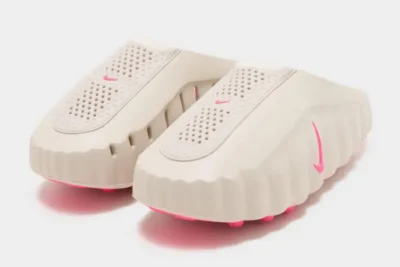
Nike’s Mind 001
A cream shade Nike has used only as a supporting tone on two women's Mind 001 pairs takes over the whole mule in January 2027, with pink nodes underfoot.