DRIFT AUDIO
Listen to this story
Choose a voice, then press play.
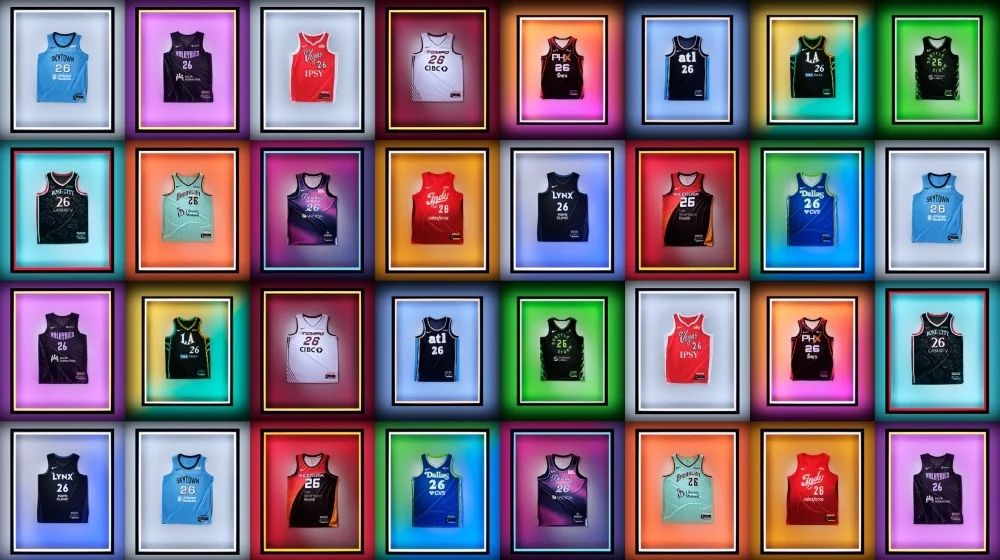
Nike and the WNBA are marking the league’s 30th season in bold fashion with the 2026 Rebel Edition uniforms. More than alternate jerseys, the collection transforms basketball uniforms into cultural storytelling devices rooted in city identity, player link, and historical reflection. Through close partnerships between Nike designers, WNBA athletes, coaches, and community voices connected to each franchise, every uniform becomes a visual narrative—turning the court into a living archive of resilience, rebellion, and self-expression.
Unveiled on May 8, 2026, alongside the opening day of the WNBA season, the Rebel Edition collection builds upon the league’s longstanding relationship with disruption and evolution. The concept honors the pioneers who helped shape women’s professional basketball since the WNBA’s founding in 1997 while simultaneously positioning the future of the sport within a more fashion-conscious, culturally connected framework. These jerseys are not simply performance garments—they are wearable identities.
View this post on Instagram
a know
Nike approached the Rebel Edition project with an emphasis on emotional authenticity rather than surface-level redesign. According to Katie West, Senior Manager and Designer for Basketball Apparel at Nike, each uniform was intended to sharpen and amplify the personality of the franchise it represents. Rather than forcing view consistency across the league, the collection embraces contrast, locality, and narrative specificity.
That know is viewable immediately across the collection. Urban infrastructure, indigenous symbolism, local histories, regional tincture palettes, and player-driven references all merge into uniforms that feel deeply rooted in place. The jerseys no longer function solely as team identifiers. They become visual maps of community memory.
This year’s rollout is also unprecedented in scope. All 15 WNBA teams—including expansion franchises Toronto Tempo and Portland Fire—received fully customized Rebel Edition systems. The development process reportedly stretched across years for some organizations, requiring research into local histories, consultation with community voices, and iterative collaboration with athletes themselves.
The result is a collection that feels less like a coordinated apparel launch and more like a league-wide design exhibition.
b ball
The Rebel Edition collection arrives at a moment when the WNBA’s cultural influence extends far beyond sports. Fashion, music, activism, and social identity increasingly intersect with the league’s visibility, and Nike clearly understands that uniforms now exist within the broader ecosystem of style communication.
This evolution matters because the WNBA has become one of the few professional sports leagues where personal expression remains central to athlete view. Tunnel fits, pregame styling, sneaker culture, and community activism all contribute to how players are perceived publicly. The Rebel Edition uniforms amplify that reality by allowing franchises themselves to participate in narrative dressing.
Nike’s use of Dri-FIT performance technology, strategic ventilation, lightweight construction, and reinforced seams ensures the uniforms maintain elite-level athletic function. Yet the garments simultaneously operate as collectible design objects capable of resonating beyond game day.
The accompanying Rebel Fanwear collection—including hoodies, shorts, and graphic T-shirts—extends that philosophy into daily wear, blurring the line between sports merchandise and contemporary streetwear.
resil
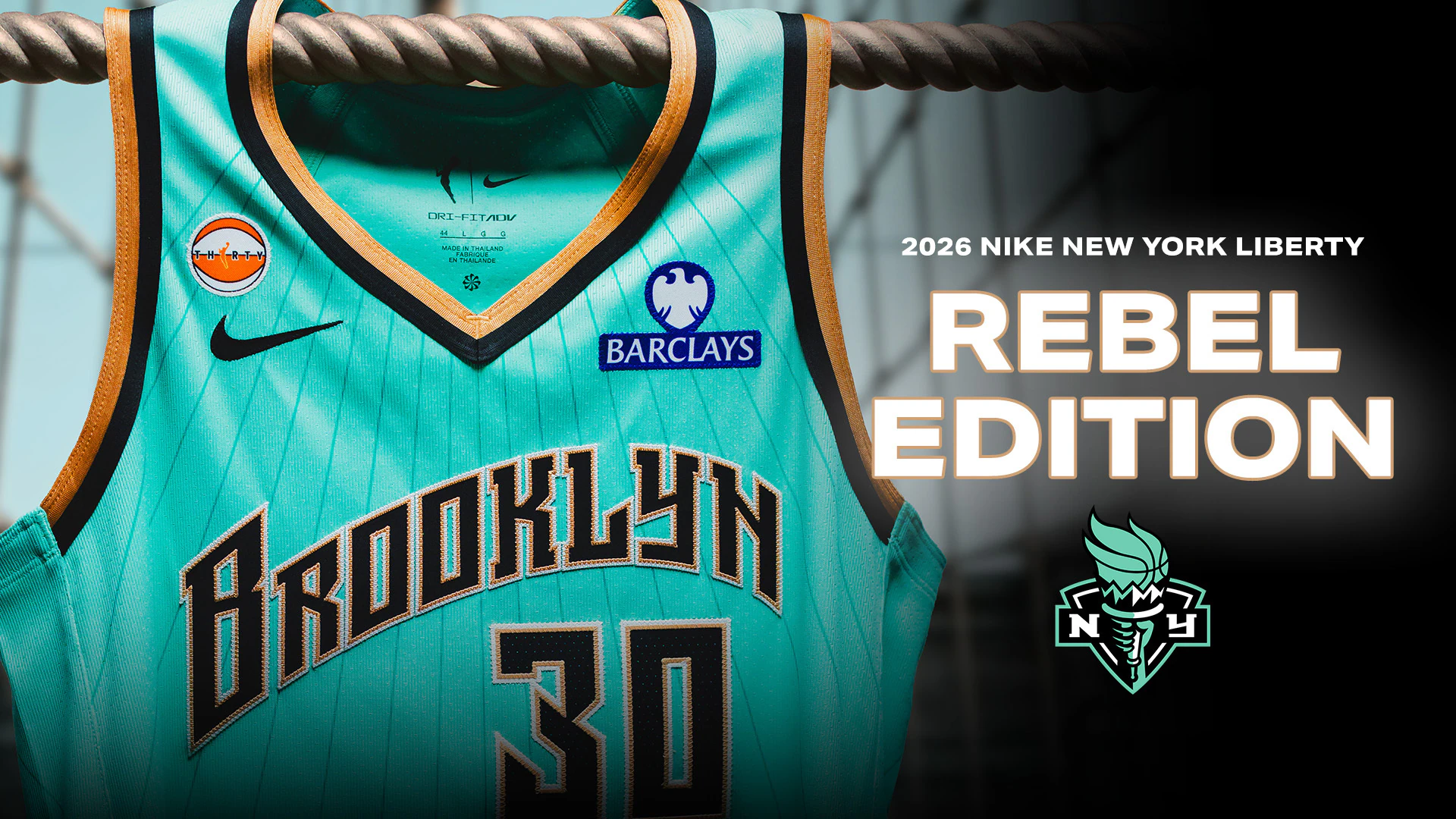
Among the standout uniforms in the collection is the New York Liberty’s Brooklyn Bridge-inspired design. The custom “BROOKLYN” wordmark stretches across the chest with structural lines echoing the steel geometry of the bridge itself. Turquoise, black, and gold tones reference both the East River and the industrial energy associated with the borough.
The design succeeds because it avoids cliché interpretations of New York. Rather than relying on skyline imagery or obvious metropolitan iconography, it channels infrastructure and endurance. The Brooklyn Bridge becomes a metaphor for connectivity, perseverance, and movement—qualities deeply associated with both the city and the Liberty’s evolving legacy.
It is a jersey that feels architectural rather than decorative.
seattle
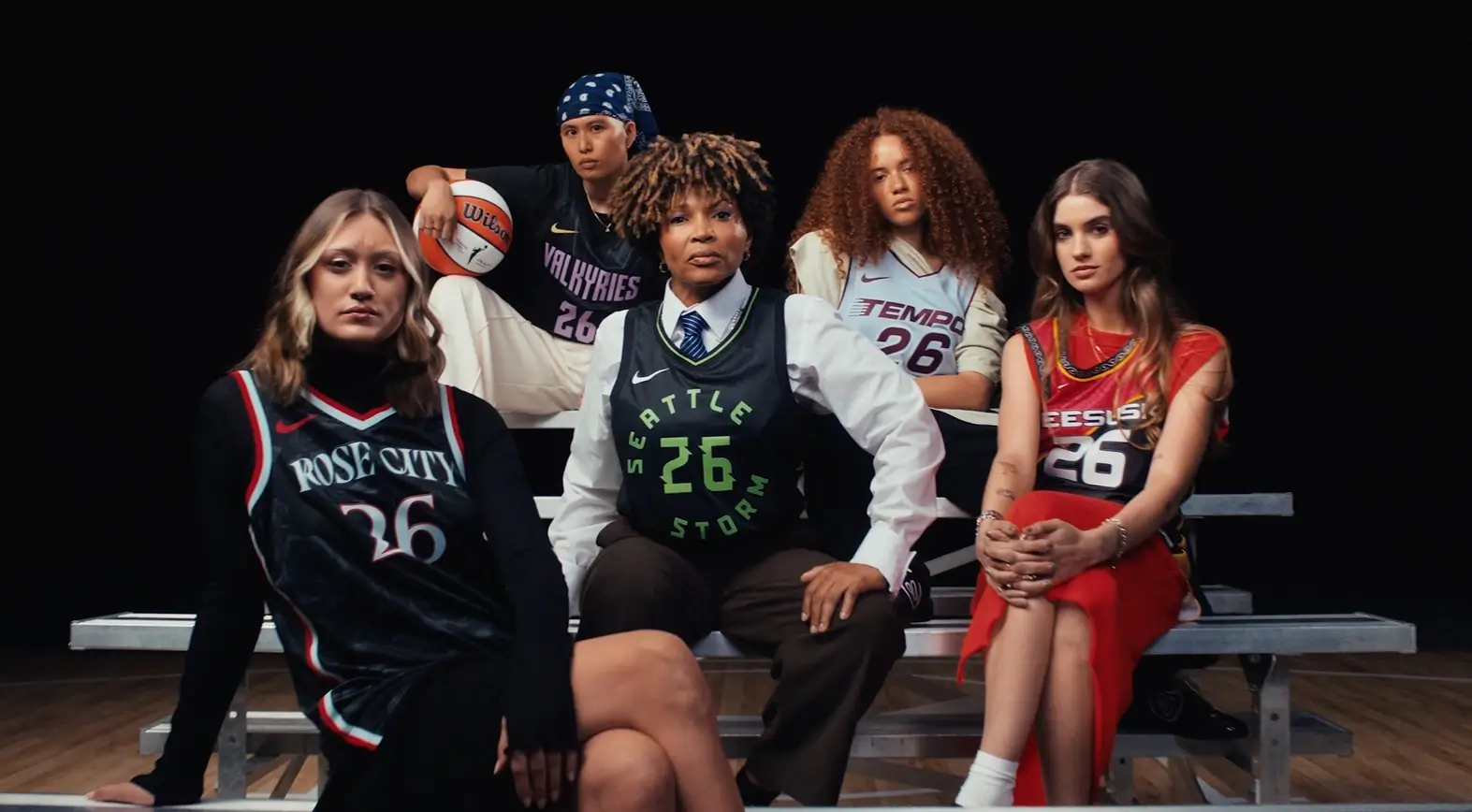
Seattle’s Rebel Edition uniform takes an entirely different approach, transforming weather itself into visual identity. The black base uniform incorporates lightning graphics layered with fog-inspired detailing, while the curved typography mimics rotating radar patterns.
This atmospheric approach reflects the Pacific Northwest’s emotional landscape as much as its climate. The design communicates calm intensity rather than chaos, mirroring the Storm’s reputation for disciplined dominance and resilience under pressure.
Importantly, the jersey avoids feeling gimmicky. Instead of literal storm imagery overwhelming the composition, Nike integrates those elements subtly into the typography and texture work, allowing the concept to feel immersive rather than costume-like.
refs
The Atlanta Dream’s uniform embraces peach-toned accents against a black foundation, drawing directly from Georgia’s state identity while framing strength and resilience through bold graphic contrasts. Player input from stars such as Rhyne Howard and Allisha Gray reportedly informed the emotional direction of the design.
Meanwhile, the Chicago Sky’s denim-inspired blue uniform references the city’s industrial workwear traditions and public transit infrastructure. Rather than glamorizing Chicago superficially, the design celebrates labor, movement, and the communities that sustain the city daily.
These choices highlight the Rebel Edition’s greatest strength: specificity. The collection resists generic sports branding by embracing highly localized storytelling.
extent
The introduction of Rebel Edition uniforms for expansion teams Toronto Tempo and Portland Fire carries additional symbolic importance. Unlike legacy franchises with decades of existing visual identity, these organizations are constructing mythology in real time.
Toronto’s design reportedly incorporates multicultural references reflective of the city’s layered cultural fabric, while Portland’s uniform channels the rebellious spirit historically associated with the Pacific Northwest and Rose City aesthetics.
These uniforms function as origin stories as much as athletic apparel. They establish emotional foundations for future fan communities while positioning the franchises immediately within the broader cultural conversation surrounding the league.
hx
One of the most significant aspects of the Rebel Edition collection is its treatment of indigenous and historical references. The Connecticut Sun’s “Path of the Sun” motifs honor Mohegan Tribe heritage through connective symbolism rather than extraction.
This collaborative methodology reflects a larger shift occurring across sportswear and branding industries, where communities increasingly demand accountability, consultation, and respectful representation when cultural symbols are used publicly.
Similarly, references to historical women’s basketball leagues—such as the Dallas Diamonds of the WBL era—connect the modern WNBA directly to overlooked histories of women’s professional sports.
By embedding these references into performance uniforms, Nike and the WNBA position the league as both contemporary and archival simultaneously.
emotive
For players, these uniforms represent more than aesthetic variation. Wearing garments tied directly to local identity and personal experience creates emotional investment that standard uniforms often cannot achieve.
The WNBA has long operated differently from many men’s professional leagues in this regard. Athletes within the league frequently serve as visible advocates for social causes, community leadership, and cultural discourse beyond basketball itself. The Rebel Edition uniforms reinforce that multidimensional view.
Fans similarly engage with the collection differently than conventional merchandise. Purchasing a jersey becomes participation in a story rather than simply supporting a team.
This emotional layer explains why the launch generated significant traction across social media platforms, with debates surrounding favorite designs quickly becoming part of the broader conversation around fashion, identity, and regional pride.
show
From a technical standpoint, the uniforms remain grounded in elite athletic performance. Nike engineered the jerseys using moisture-wicking Dri-FIT fabric, lightweight construction, strategic airflow placement, and reinforced durability zones to withstand professional gameplay intensity.
Yet the collection’s collectible value may ultimately become equally important. The 2026 Rebel Edition uniforms arrive during a period of explosive WNBA growth marked by increased attendance, merchandise sales, mainstream celebrity visibility, and heightened media attention.
As a result, these uniforms already feel historically significant—a visual snapshot of the league at a transformative culture peak.
impression
The Rebel Edition collection succeeds because it understands that modern sportswear is no longer only about competition. It is about narrative construction, identity performance, and emotional resonance.
The WNBA has increasingly positioned itself as a league where athletes are not separated from broader culture discourse but embedded directly within it. Nike’s Rebel Edition uniforms amplify that positioning beautifully by transforming every franchise into a storytelling platform.
The collection honors rebellion not as empty branding language, but as lived history. It acknowledges the women who fought for view, the cities that shaped these teams, and the players continuing to redefine what professional basketball can represent culturally.
In doing so, the 2026 Rebel Edition uniforms become more than alternate jerseys. They become symbols of a league actively shaping its own mythology—one stitched narrative at a time.
Related Articles
Victory Lap Radio Signs On in Black Patent With Its Own Nike Air Force 1 Mid
The tongue label reads like a station ident, the outsole carries the logo underfoot, and the whole Mid is cut in black patent for a Holiday 2026 broadcast.