DRIFT AUDIO
Listen to this story
Choose a voice, then press play.
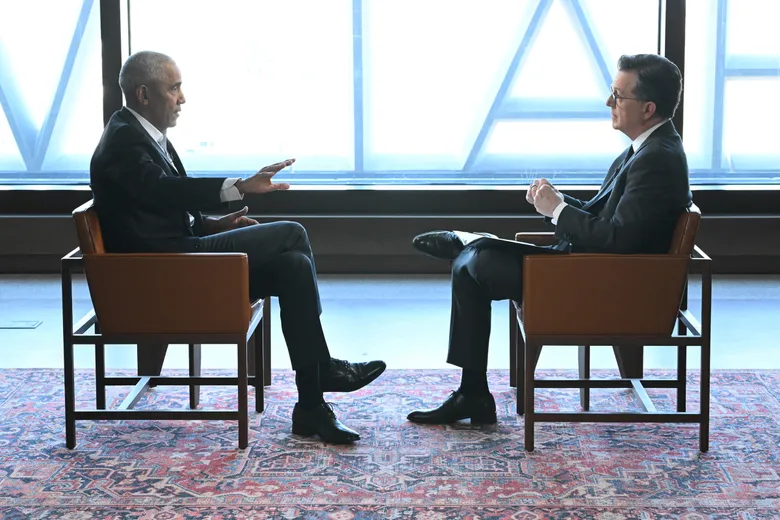
In one of the most culturally resonant late-night conversations of 2026, former President Barack Obama joined Stephen Colbert at the newly completed Obama Presidential Center for a wide-ranging interview that moved fluidly between comedy, democratic norms, media culture, extraterrestrials, and the evolving expectations surrounding modern leadership.
Aired on The Late Show with Stephen Colbert on May 5, 2026, the interview arrived at a transitional moment for both American politics and television. Colbert approaches the conclusion of his late-night tenure later this month, while Obama continues shaping his post-presidential identity through civic infrastructure, public commentary, and institutional legacy building. Their reunion in Chicago carried more emotional and symbolic weight than a standard celebrity sit-down. It became a reflection on continuity itself: the endurance of political storytelling, the fragility of democratic culture, and the role humor still conjures in public life.
stir
The decision to stage the interview inside the Obama Presidential Center transformed the segment into more than a television appearance. The Center, scheduled to open publicly on June 19, 2026, stands on Chicago’s South Side and represents Obama’s attempt to build a living civic institution rather than a static monument to a presidency. Featuring museum spaces, educational initiatives, and areas dedicated to community engagement, the project intentionally positions itself as future-facing.
For Obama, Chicago remains inseparable from his political identity. It is the city where he worked as a community organizer, where he began constructing his political worldview, and where his narrative of coalition-building first took shape. Returning there with Colbert allowed the former president to reconnect personal history with institutional ambition.
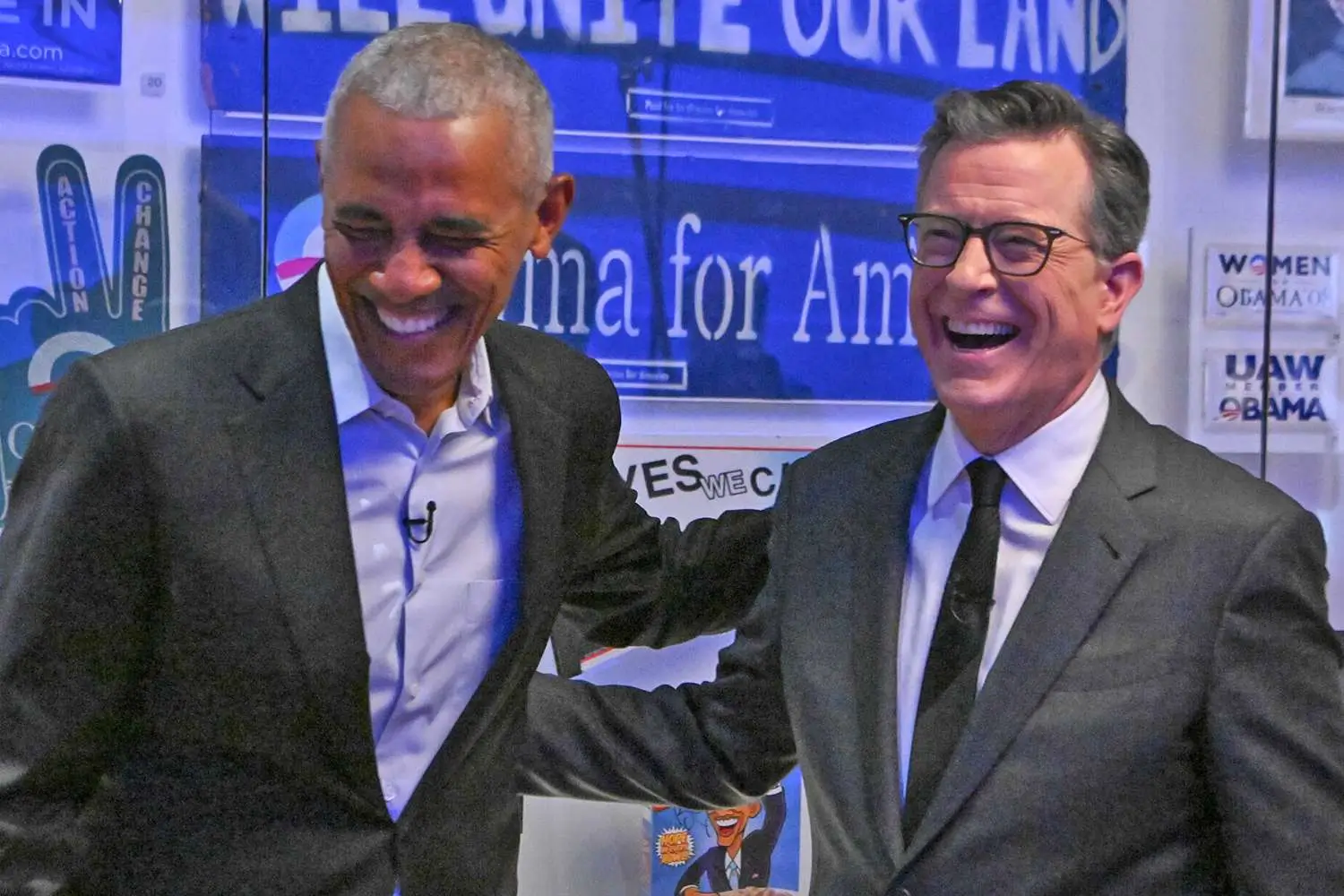
Colbert, meanwhile, approached the setting with the blend of theatricality and self-awareness that has defined his late-night career. Jokes about architecture, presidential aesthetics, and Obama’s post-White House lifestyle punctuated the evening. The pair even engaged in a skittish basketball sequence inside a mock Oval Office installation, reinforcing the informal chemistry that has characterized Obama’s television appearances for years.
The atmosphere mattered because it demonstrated how modern presidential legacy projects increasingly operate as cultural ecosystems. The Obama Presidential Center is not simply archival. It is performative, media-aware, and deeply conscious of civic symbolism. Hosting a nationally televised conversation there before the official opening effectively introduced the Center to the country through personality and narrative rather than institutional formality.
idea
The interview’s most viral exchange emerged from a joke that carried unmistakable political undertones. As Colbert referenced the conclusion of his show and joked about needing “a new gig,” Obama responded with characteristic composure and dry humor, complimenting the host’s appearance before suggesting that contemporary presidential standards may no longer be especially demanding.
“The bar has changed,” Obama remarked, adding that Colbert could likely “perform significantly better than some folks that we’ve seen.” When Colbert jokingly asked either this amounted to an endorsement, Obama calmly replied: “It was not.”
The exchange spread rapidly online because it encapsulated Obama’s public communication style at its sharpest: understated, indirect, humorous, yet unmistakably pointed. Rather than naming political figures directly, he relied on implication, allowing audiences to complete the sentence themselves. The moment functioned simultaneously as comedy and commentary.
In the broader context of 2026, the line resonated because it reflected widespread anxiety over political competence, institutional erosion, and leadership expectations. Obama’s phrasing implied that the threshold for acceptable governance has shifted downward in recent years, a sentiment shared by many observers across ideological lines.
The remark also highlighted the increasing overlap between entertainment culture and politics. Colbert’s comedic persona becoming hypothetically “presidential” no longer feels entirely absurd within an era shaped by celebrity politics, media-first campaigning, and personality-driven public discourse. Obama appeared acutely aware of that reality, using humor to critique it without escalating confrontation.
delicacy
While the interview generated headlines for its jokes, its most substantial sections centered on executive authority and democratic norms. Obama warned against the politicization of state institutions, particularly the criminal justice system and the military. He argued that democracies can survive poor policy decisions and even deeply contested elections, but they struggle to survive governments that weaponize institutional power against perceived enemies.
Obama emphasized that many presidential guardrails historically relied not on formal law but on tradition, restraint, and shared expectations regarding appropriate conduct. He suggested that some of those unwritten norms may now need formal legal codification to prevent future abuse.
Without directly naming current political figures, the comments were widely interpreted as responses to ongoing debates surrounding executive overreach, the independence of the Justice Department, and the politicization of federal institutions.
This section of the interview revealed Obama’s evolving post-presidential role. Rather than positioning himself as an day partisan combatant, he increasingly functions as a defender of procedural democracy and institutional legitimacy. His framing was not revolutionary or incendiary. Instead, it reflected a belief that democratic stability depends on preserving systems even during periods of intense political disagreement.
That perspective also reinforces how Obama’s public image has changed since leaving office. During his presidency, critics often accused him of excessive caution or proceduralism. In retrospect, however, many supporters now interpret those same qualities as evidence of restraint and institutional respect. The Colbert interview quietly leaned into that reassessment.
challenge
Obama also addressed concerns surrounding the future of the Democratic Party, particularly debates about ideological fragmentation and communication failures. He downplayed fears of catastrophic internal division, arguing that Democrats remain largely aligned on foundational principles. The challenge, he suggested, lies less in values than in presentation and execution.
One of his clearest observations involved language. Obama urged Democrats to speak more plainly and directly rather than relying on overly academic or hyper-specialized rhetoric. The comment echoed themes that have followed Democratic messaging discussions for years: accessibility, relatability, and emotional clarity matter just as much as policy sophistication.
The advice reflected Obama’s own political strengths. His campaigns succeeded not merely because of policy proposals but because they translated complex ideas into emotionally resonant narratives centered around hope, inclusion, and civic participation. In many ways, his comments served as both strategic guidance and implicit critique.
Importantly, Obama framed these concerns optimistically rather than catastrophically. He emphasized resilience, coalition-building, and long-term civic investment, particularly through younger gen connected to the Presidential Center’s educational mission.
This future-oriented framing distinguishes Obama from many contemporary political commentators. Even while acknowledging institutional stress, he consistently returns to themes of continuity, participation, and collective responsibility.
ponder
No Obama-Colbert interview would feel complete without a detour into absurdity, and the extraterrestrial discussion provided exactly that. Revisiting earlier comments Obama made regarding alien life, Colbert asked the former president whether he believed extraterrestrials exist. Obama responded that the sheer scale of the universe makes the possibility statistically plausible, though he rejected elaborate government cover-up theories.
“One of the things you learn as president,” Obama joked, “is the government is terrible at keeping secrets.” If alien spacecraft existed in secret facilities, he suggested, somebody would inevitably leak a photo or selfie.
The humor worked because it balanced skepticism with curiosity. Obama neither embraced conspiratorial thinking nor dismissed public fascination with the unknown. Instead, he framed wonder itself as intellectually healthy when paired with rationality and evidence.
In one of the interview’s funniest flourishes, Obama volunteered himself as Earth’s emissary in the event of alien first contact, prompting laughter from both Colbert and the audience.
The segment humanized the conversation while subtly reinforcing a broader point: serious leadership does not require the abandonment of imagination or humor. Obama’s ability to move comfortably between constitutional norms and extraterrestrial hypotheticals reflects the media fluency that has long distinguished him from many political contemporaries.
theory
The interview also carried significance because of where Colbert currently stands within television culture. As his run on The Late Show nears its conclusion, the appearance functioned partly as a farewell-era milestone. Colbert’s late-night tenure became deeply intertwined with the political turbulence of the Trump era and its aftermath, helping redefine political satire for streaming-era audiences.
Obama’s appearance effectively acknowledged that shared cultured history. Both men became defining communicators of liberal America during the 2010s and early 2020s, albeit through vastly different mediums. Seeing them together again inside a presidential legacy institution created a feeling of retrospective closure.
The broader media landscape has shifted dramatically since Obama first appeared on late-night television as a presidential candidate. Fragmented audiences, declining network ratings, social-media-driven clip culture, and economic pressures have transformed the role of late-night hosts.
Yet the interview’s viral success demonstrated that long-form conversation anchored in personality, intelligence, and mutual rapport still possesses culture power. Clips from the exchange rapidly circulated online, particularly the “bar has changed” quote.
extent
At its core, the Obama-Colbert conversation became an exploration of leadership itself: what it means, how expectations have shifted, and why institutional trust remains difficult to rebuild once damaged.
Obama repeatedly returned to themes that have defined his post-presidential identity: coalition-building, institutional respect, civic education, and optimism grounded in realism. Colbert’s role as interviewer mattered equally because he embodied the increasingly blurred line between journalism, satire, and political commentary.
Their chemistry reinforced something many viewers appear to miss in public discourse: civility without passivity. The conversation was critical without becoming hysterical, humorous without becoming nihilistic. Even the alien discussion carried a subtle insistence on rationality over paranoia.
For many viewers, the interview functioned less as entertainment than as reassurance. It reminded audiences of a political style rooted in composure, intellectual curiosity, and procedural respect. For critics, however, the conversation represented elite media self-congratulation and nostalgia-driven liberalism.
That polarization itself reflects the fractured culture environment Obama referenced indirectly throughout the evening.
fin
The lasting significance of the Obama-Colbert interview lies in how effectively it condensed multiple national conversations into a single televised exchange. It addressed democratic fragility, media transformation, political communication, celebrity culture, conspiracy thinking, and general legacy without losing entertainment value.
Obama’s suggestion that a late-night comedian could potentially outperform “some folks” as president was funny because it felt plausible inside contemporary American culture. But beneath the joke sat a serious proposition: leadership ultimately depends less on spectacle than on discipline, competence, and institutional responsibility.
In roughly forty minutes, Obama and Colbert transformed a talk-show appearance into something broader — a meditation on public standards themselves. At a time when political discourse often feels dominated by outrage cycles and algorithmic fragmentation, the interview offered an alternative rhythm: thoughtful, coltish, reflective, and unmistakably human.
From the DRIFT archive: The Hold-Up: Inside the Delayed Kendrick Lamar × South Park Comedy Project · Jodie Foster Narrates Morgan Neville’s Breakdown: 1975: A Cultural Autopsy of the Most Radical Year in American Cinema
Related Articles

Nike A’Two “Potion No. 22” Gives A’ja Wilson a Mismatched Horror Double Bill
Two shoes, two monsters: A’ja Wilson’s Halloween A’Two splits blood splatter and honeycomb across a […]