DRIFT AUDIO
Listen to this story
Choose a voice, then press play.
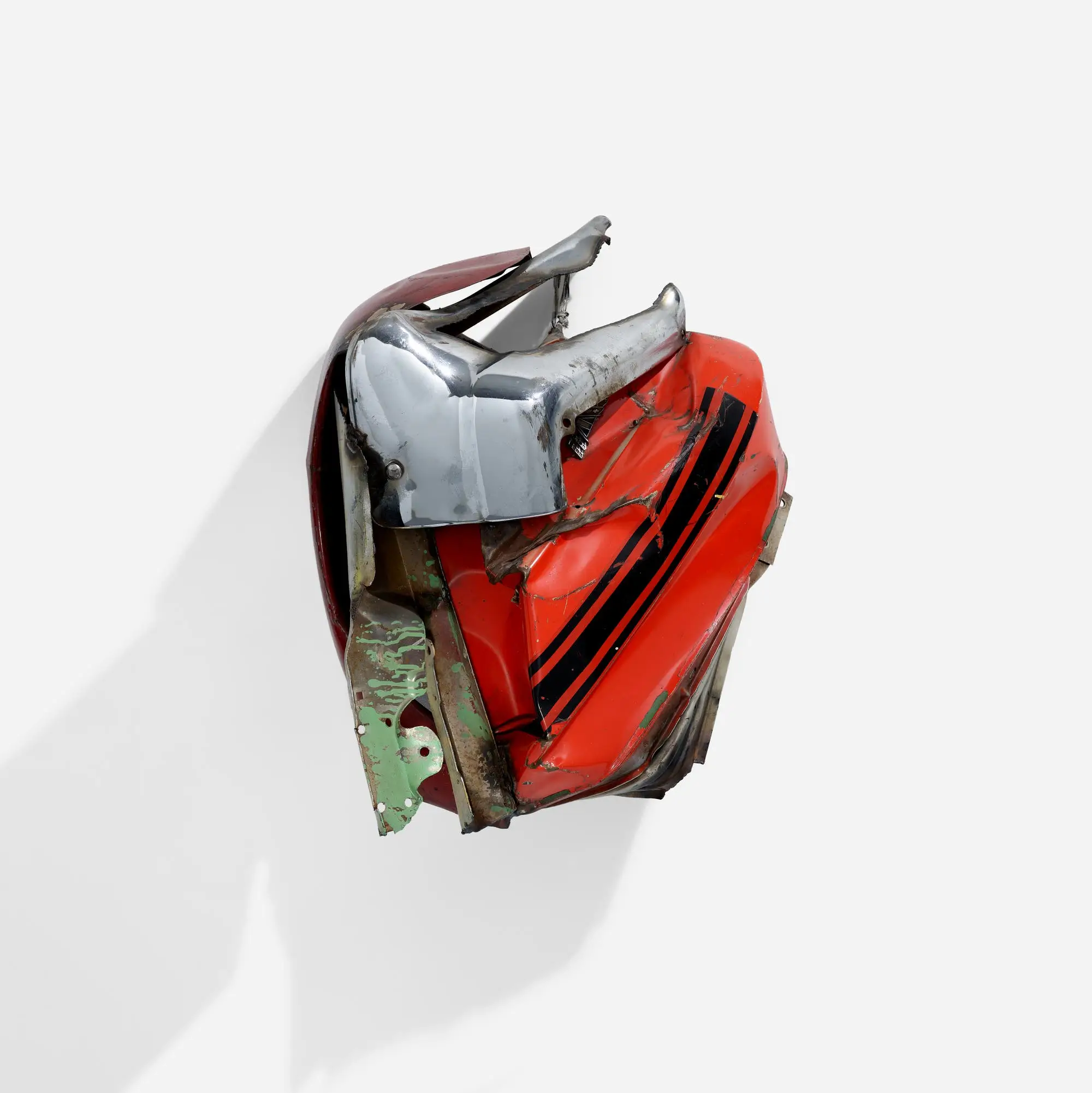
John Chamberlain’s Lucy Snaggletooth does not simply occupy the wall; it erupts from it like a compressed remnant of velocity suspended in permanent impresssion. Executed in 1976, the sculpture belongs to a mature period in Chamberlain’s practice when the artist had already fully transformed the discarded language of American automobiles into one of the most distinct sculptural vocabularies of the twentieth century. Constructed from painted and chromium-plated steel, the work condenses industrial debris into something strangely animate, carrying both the brutality of collision and the seductive elegance of abstraction simultaneously. Against the stark neutrality of the background, the sculpture appears almost isolated from time itself — neither fully object nor relic, but a charged accumulation of pressure, memory, and transformed material.
scope
The composition is immediately dominated by its saturated red automotive paneling, interrupted by sharply angled black racing stripes that still retain the view residue of speed culture. These stripes are important because they preserve the psychological memory of motion even after the car’s functional identity has been destroyed. Chamberlain was never interested in the automobile as an object of nostalgia alone; rather, he knows the car body as a ready-made surface already embedded with American aspiration, industrial optimism, and consumer mythology. In Lucy Snaggletooth, those associations survive in fragments. The glossy paint continues to suggest acceleration, customization, and show, while the sculpture’s violently compacted structure transforms those same symbols into evidence of collapse and compression.
idea
The chrome-plated steel amplifies this tension further. Certain surfaces catch and distort surrounding light with almost liquid reflectivity, creating moments where the work feels less like welded scrap and more like folded fabric or molten metal frozen mid-movement. These reflective passages prevent the sculpture from becoming static. Instead, the piece changes continuously according to angle, backdrop, and environmental light, animating its crushed geometry through optical instability. Chamberlain understood this capacity intuitively. His sculptures are never inert masses; they behave like gestural marks translated into steel, preserving the improvisational energy of Abstract Expressionist painting within physical space.
flow
What makes Lucy Snaggletooth especially compelling is the way destruction reorganizes form into a new compositional logic. Bent chrome edges fold over collapsed red panels while exposed seams, punctures, and warped corners create abrupt directional shifts across the surface. The eye continuously moves between tension and release, density and openness, reflection and shadow. Even the patches of oxidized green metal along the lower portion of the sculpture contribute to this layered sense of time, suggesting that the object contains multiple histories simultaneously — manufacture, use, damage, abandonment, and artistic reinvention.
Rather than concealing violence, Chamberlain aestheticizes it without romanticizing it. The sculpture acknowledges force while refusing narrative specificity. There is no singular crash, no identifiable tragedy, no literal story embedded in the metal. Instead, impact becomes purely formal energy. This distinction mattered deeply to Chamberlain, who consistently rejected simplistic readings of his work as commentary on automobile accidents. The crushed steel interested him because of what it could become compositionally, not because of what it previously represented.
transition
Chamberlain’s transformation of industrial debris into sculptural language emerged from a uniquely American artistic trajectory. Born in 1927 and educated partly at Black Mountain College during the mid-1950s, he absorbed ideas surrounding improvisation, openness, rhythm, and process from poets and experimental thinkers associated with the institution. These influences would later manifest physically in his handling of metal, where intuition and responsiveness became central to construction.
His pivotal breakthrough occurred in 1957 when he began experimenting with discarded automobile parts. Unlike traditional sculptors who approached metal as neutral material to be shaped from scratch, Chamberlain recognized that car panels already possessed curvature, paint, industrial finish, and embedded culture meaning. A crushed fender carried gesture before the artist even touched it. By selecting, compressing, welding, and repositioning these fragments, he effectively performed collage in three dimensions. His process resembled improvisational composition more than engineering.
show
The title itself — Lucy Snaggletooth — subtly shifts the sculpture away from industrial anonymity and toward personality. Chamberlain often assigned skittish, eccentric titles that encouraged viewers to perceive emotional or bodily associations within abstract form. Here, the work begins to resemble a damaged face, a twisted torso, or some partially mechanical creature caught mid-expression. The protruding chrome sections suggest teeth or jaws, while the folded red steel behaves almost like muscle or skin compressed under pressure.
This anthropomorphic quality is central to why Chamberlain’s sculptures remain emotionally resonant despite their industrial origins. The works are abstract, yet they feel strangely alive. They possess posture, gesture, and attitude. Lucy Snaggletooth snarls and collapses simultaneously, embodying aggression and vulnerability at once. That ambiguity gives the sculpture psychological depth beyond material experimentation alone.
punchline
There is also a distinctly American quality embedded within the work’s material vocabulary. The automobile represented mobility, freedom, expansion, and consumer identity throughout postwar America, and Chamberlain’s use of automotive fragments inevitably carried those associations into the gallery space. Yet his sculptures do not function as straightforward critiques of consumerism. Instead, they transform industrial excess into something unexpectedly lyrical.
In Lucy Snaggletooth, the remains of American manufacturing become painterly rather than mechanical. The folds resemble brushstrokes. The crushed surfaces behave like layered pigment. The sculpture effectively translates the all-over energy of painters like Willem de Kooning or Franz Kline into three-dimensional space, eliciting steel to function with the spontaneity and rhythm of paint.
arch
Although the work initially appears chaotic, prolonged viewing reveals remarkable structural precision. Chamberlain possessed an extraordinary instinct for balance — understanding exactly when density required openness, when reflective surfaces needed interruption, and when compression demanded release. Every folded plane feels intuitively placed despite the apparent violence of the material.
This is where the sculpture transcends assemblage and enters something closer to orchestration. The disparate fragments no longer behave as individual scraps; they operate collectively as a unified visual rhythm. Chamberlain often described his process in terms of “fit,” waiting for pieces to lock together in a way that felt inevitable rather than forced. Lucy Snaggletooth embodies that philosophy completely. Nothing appears decorative or excessive. Even the most jagged protrusions feel compositionally necessary.
fin
Perhaps the most remarkable aspect of Lucy Snaggletooth is that it never fully settles into stillness. Despite being physically static, the work retains the sensation of ongoing movement. The racing stripes continue pulling the eye diagonally across the surface, the chrome reflections shift constantly with surrounding light, and the compressed folds imply unresolved force trapped within the steel itself. The sculpture behaves less like an object and more like frozen momentum.
That enduring dynamism explains why Chamberlain’s work continues to feel contemporary decades after its creation. The sculptures resist becoming historical artifacts because they remain physically active in perception. They continue unfolding visually the longer one stands before them. In Lucy Snaggletooth, wreckage becomes rhythm, industrial collapse becomes composition, and discarded material becomes something unexpectedly alive.
From the DRIFT archive: Andy Warhol’s Superman (1981): A Diamond-Dust Resurrection of the American Myth
Related Articles

Where the Face Should Be, Rafael Silveira Paints Open Sky
A pink shirt, shoulder-length hair, then no face at all: in “Surprise,” Rafael Silveira lets flowers and a clear blue sky stand in for the person.