DRIFT AUDIO
Listen to this story
Choose a voice, then press play.
Under Pierpaolo Piccioli’s direction, Balenciaga’s 55th couture show paired exceptional couture craftsman with a rare sense of pleasure and lasting emotion resonance.
In This Story
- A Courtyard Instead of a Cathedral
- Fourteen Months in the Making
- The Atelier as the Actual Subject
- What Was Actually on the Runway
- Craft Over Spectacle
- Feathers, Gigi Hadid, and the Closing Moment
- Who Showed Up to Watch
- Why Humanity, Not History, Is the Real Headline
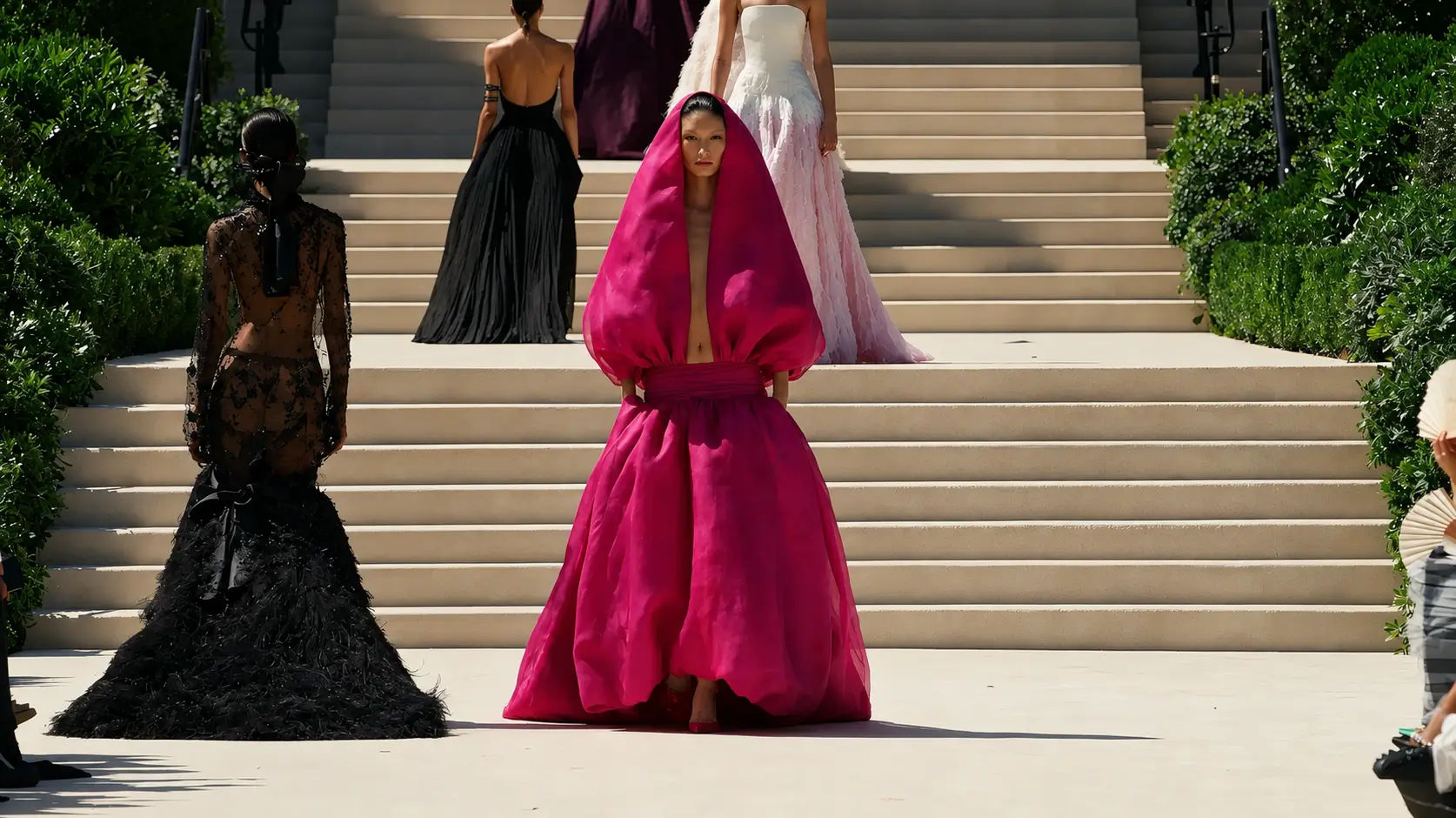
Balenciaga’s couture shows usually happen inside its restored salons at 10 Avenue George V, the address Cristóbal Balenciaga himself worked from before he closed the house in 1968. Pierpaolo Piccioli did not use that room for his debut. Instead, guests were sent out to the Cité Internationale Universitaire de Paris, a sprawling, hedge lined campus in the 14th arrondissement built after the First World War as an experiment in international goodwill, now home to roughly 12,000 students from around the world. Models circled a garden courtyard under a blazing midday sun, seats wrapped around clipped hedges, no grand staircase, no marble, no chandeliers.
View this post on Instagram
It was, by most accounts from people who were actually there, a genuinely uncomfortable place to sit for a couture show. Hot, glaring, nowhere to hide from the sun. And that discomfort seems to have been at least partly the point. Piccioli did not need borrowed grandeur for his first outing at the house. He wanted the setting to get out of the way of the clothes, and by most reviews, that is exactly what happened once the first model appeared.
from
Piccioli joined Balenciaga as creative director in May of 2025, arriving after a long and widely celebrated run at Valentino, where he served as co-creative director from 2008 and sole creative director from 2016 until 2024. That is not a small transition. Valentino’s identity under Piccioli had become almost synonymous with his own romantic, color driven sensibility. Balenciaga is a different animal entirely: colder, more architectural, built on the legacy of a founder famous for treating the body as a sculptural problem rather than a canvas for decoration.
This couture show, staged during Paris Couture Week and marking the house’s 55th couture presentation since Cristóbal Balenciaga founded it in 1917, was the first real test of how those two sensibilities would meet. In an interview given ahead of the show, Piccioli described the pull of couture in almost reverent terms, saying he had learned early on that a couturier has to work as a sculptor for shapes, a painter for color, and something closer to a philosopher for how people actually feel inside the clothes. He also made clear that none of that could stay abstract. It had to become personal, instinctive, something he reacts to rather than plans out entirely in advance.
View this post on Instagram
That instinct, according to Piccioli, started with a very specific question: what actually made Cristóbal Balenciaga’s own working method unique. Not his silhouettes as fixed shapes to copy, but his restless, continuous conversation with the body itself, the negative space between fabric and skin, and an obsession with garments that only make sense when viewed from every angle rather than flattened into a single photograph.
amb
If there is one theme running through nearly every account of this show, it is how much Piccioli foregrounded the people who actually built the clothes. Before the show, he gave a preview tour of Balenciaga’s couture atelier, walking press past a tortoise backed dress form where seamstresses were hand molding leather panels straight onto the frame. For the collection’s cashmere coats and dresses, the house scanned real human bodies, then hand shaped leather panels from those scans and sewed them in as hidden internal structure, essentially building a second, invisible garment underneath the visible one.
Materials mattered just as much as method. Neo-Gazar, the house’s own modern reworking of a stiff, sculptural fabric Cristóbal Balenciaga originally developed in 1958, showed up both as the outer shell of certain pieces and as internal support for others. AmSilk, a lab grown silk alternative, made its haute couture debut here, and despite being a genuinely new material, it was still cut, fitted, and finished entirely by hand rather than treated as some kind of shortcut. One gown alone was covered in roughly 24,150 individually hand shredded gazar petals, the kind of number that only means anything once you try to picture the actual hours behind it.
Piccioli has said he could not have staged a show like this without Balenciaga’s atelier, which he has noted is considerably younger, on average, than the one he worked with for years at Valentino. He has spoken about the couturier’s atelier less as a resource to manage and more as a community to actually get to know, individually, before asking anyone to execute a single stitch of his vision. In his show notes, he credited each maker by name against their corresponding look, and, continuing a tradition from his Valentino years, closed the show by taking his bow alongside the entire couture studio, all dressed in their white workroom coats.
That emphasis on the atelier as a community rather than a workforce is not a new talking point for Piccioli, but it does land differently at a house with Balenciaga’s specific reputation. Cristóbal Balenciaga was famous in his own lifetime for an almost obsessive, solitary perfectionism, the kind of founder mythology that tends to erase the people actually cutting and sewing behind him. Piccioli’s insistence on naming names and sharing the bow reads, intentionally or not, as a quiet correction to that history, one that argues the craft itself was always a collective act even when the credit rarely was.
Sourcing also became part of the story this season. Reporting around the show noted that some of the same body scanning technology used to hand mold the internal leather structures had been adapted from techniques Piccioli explored earlier in his tenure at the house, refined here into something considerably more precise. The effect, according to accounts from people who saw the garments up close, was a kind of invisible engineering that only became apparent once a coat was turned inside out, or a dress form was examined from behind rather than from the runway’s usual single viewing angle.
huh
The opening exit set the tone immediately: oversized beige palazzo trousers, a silk white t-shirt cut away from the body, and a neon coral balloon jacket embroidered with satin feathers. The balloon silhouette itself is pure Cristóbal Balenciaga, a shape the founder introduced back in 1953, and Piccioli worked it through the collection in jackets and oversized skirts, treating it less as a museum reference and more as a shape still worth arguing with.
Elsewhere, a Balenciaga Fall/Winter 1950 couture dress originally made for the socialite Hattie Carnegie was reworked into a black evening gown in silk chiffon, and the house’s iconic cape silhouette reappeared as a two piece cut from silk taffeta. Piccioli also revisited the sack dress, another Cristóbal Balenciaga signature, adapting it for a distinctly contemporary wearer, alongside a silk and wool t-shirt dress carrying the same relaxed spirit, and a slouchy, vibrant yellow sequin gown that stood out against an otherwise more restrained color story.
Tincture turned out to be one of the clearest points where Piccioli’s own sensible broke through Balenciaga’s usual austerity, even though mention has always technical been part of the house’s history too. So did his use of crisp, oversized shirting and silk racerback tank tops layered under evening skirts, an unexpected but effective collision of casual and formal registers that felt distinctly like him. Low scoop necklines, hooded capes, and drop waist trousers pushed the focus back toward the body itself, which multiple reviewers pointed to as the moments where his presence at the house felt most obvious. Womenswear was the sole focus this season. There was very little in the way of conventional daywear, aside from a handful of floor sweeping chinos and the occasional couture tee, and Piccioli did not apologize for that omission. As he put it plainly, you have to dream about couture, and he wanted to deliver a dream about this specific house.
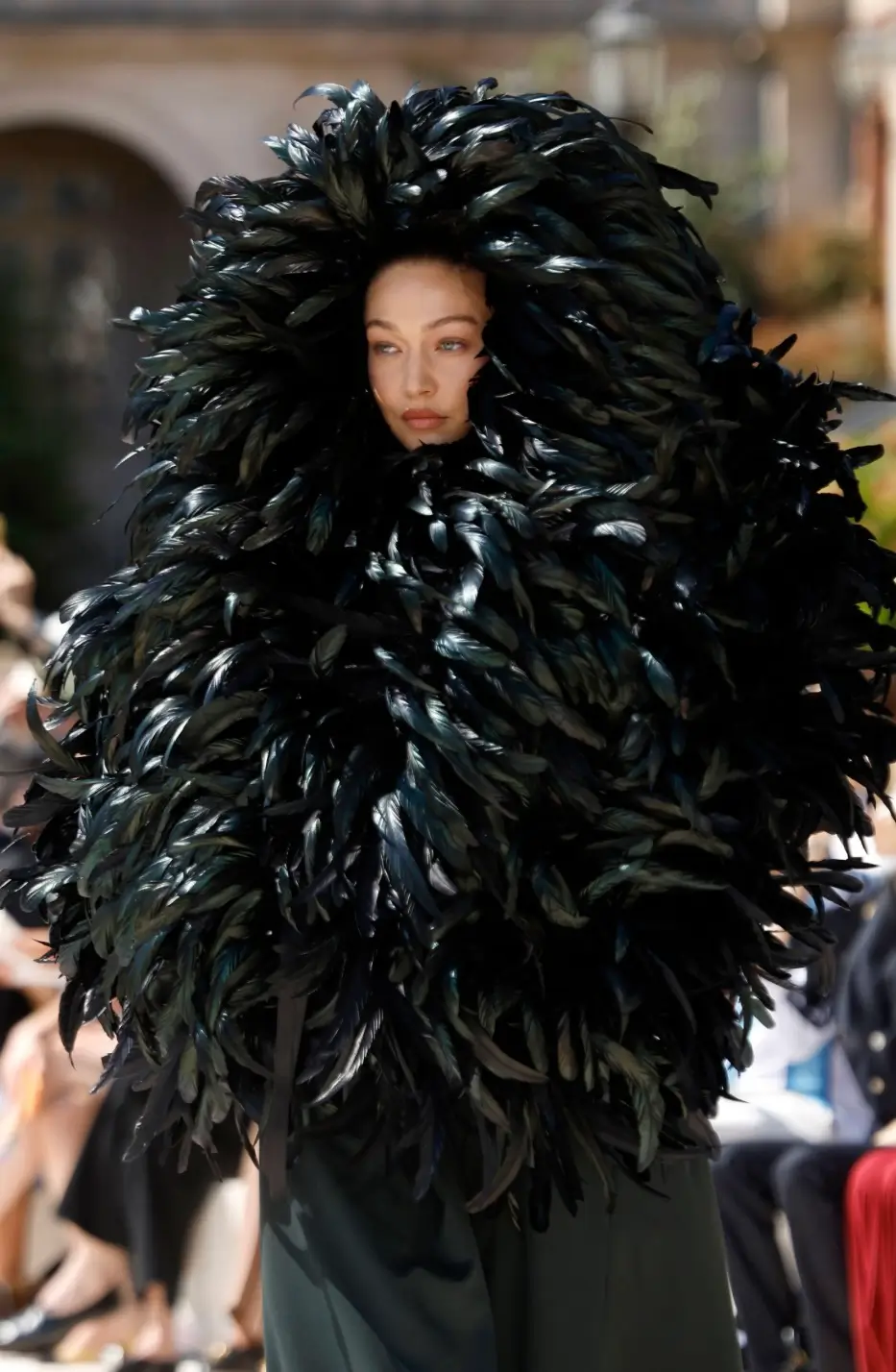
A dramatic black feathered couture look envelops Gigi Hadid in layered texture and sculpture volume, transforming traditional plumage into a striking statement of haute couture craft.
straddle
Feathers have followed Piccioli through much of his career, particularly during his Valentino years, where ostrich plumes turned up as spherical cage like headpieces, oversized sunglasses trims, and full length dusters. At Balenciaga, he reworked the material into the fringe of lime green wool coats, into what one reviewer described as a thneed like baby pink gown, and into an extra large, egg shaped, sleeveless garment worn by Gigi Hadid.
The show built toward a parade of feathery, topiary shaped gowns stacked in volume, closing with Hadid in a dramatic, face framing hood built from a mass of hand set black rooster feathers, developed in collide with milliner Philip Treacy. The look itself was adapted from a 1967 Balenciaga silhouette built around a voluminous mass of fabric surrounding the face, reinterpreted here almost entirely in feather rather than cloth. In his show notes, Piccioli described feathers as a kind of metaphor in their own right: weightless and delicate, yet carrying real tensile strength, an idea he said the collaboration with Treacy pushed into genuinely sculptural territory, blurring the line between millinery and garment entirely.
British vocalist Anohni, a frequent collaborator of Piccioli’s during his years at Valentino, provided the show’s live vocal accompaniment, adding an emotional undercurrent that several reviewers singled out as central to how the collection actually landed in the room. According to accounts from the show, clients, influencers, and celebrity guests rose to their feet clapping once the finale reached its end, and stayed standing as Piccioli came out for his bow surrounded by the atelier staff.
the who
The front row reflected how much Balenciaga’s audience has shifted since Piccioli’s arrival. Guests included Lily Collins, Demi Moore, Rachel Sennott, Anna Wintour, and Teyana Taylor, a lineup that skews toward actors, writers, and culture figures rather than the more provocation driven crowd associated with the house’s prior era.
That shift in crowd is not incidental. It tracks with what most critics agree happened on the runway itself: a genuine handover from the ironic, disruptive language Balenciaga became known for over the last decade toward something warmer, more personal, and considerably more optimistic about what couture is actually for.
fin
It would be easy to write this show up purely as a history lesson: sack dresses, balloon jackets, Neo-Gazar, a founder’s archive respectfully revisited. That framing is not wrong, but by most accounts it misses the part of the show that actually mattered most.
In a statement released after the show, the house described Balenciaga’s meaning as a methodology rather than a fixed look, calling the process of creation itself an expression of humanity and human invention, and framing Piccioli’s debut as a tribute to that idea specifically. What might read as austere from photographs alone, the house argued, actually conceals a kind of physical lightness, built around the idea of air as a third dimension moving between fabric and body.
Piccioli has made a similar point in his own words, describing his approach to the atelier as fundamentally relational rather than hierarchical. He has said plainly that the only way to arrive at real beauty is to actually know the people making it with you, involving them in a shared vision rather than simply handing down instructions to be executed. That is a notably different creative philosophy than the myth of the solitary genius designer, and it appears to be one Piccioli means literally rather than as a nice line for a program note.
There is also something worth noting in how deliberately joyful this show reads compared to what couture week often produces. Multiple reviews used words like dreamy and pleasure to describe the experience of watching it, not qualities usually associated with a discipline that can tip toward the cold or the merely technical. Piccioli himself has said you have to dream about couture, and on the evidence of this debut, that dream is less about nostalgia for Cristóbal Balenciaga’s era and more about proving that rigor and warmth are not actually opposites. The question that follows him now, one raised by several critics covering the show, is what happens to a house built for almost a decade on irony and provocation once that language is replaced with sincerity. Piccioli’s answer, at least for one afternoon in a hedge lined Paris courtyard, appeared to be that people were more than ready for it.
Related Articles
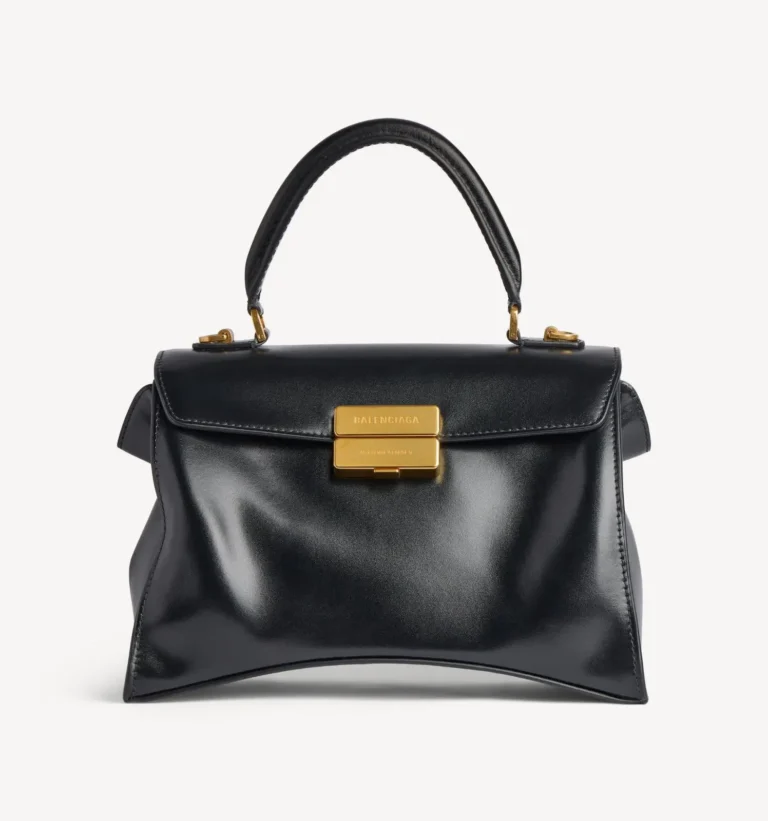
Every Balenciaga Hourglass Avenue Bag Carries Its Own Return Address
Balenciaga’s newest handbag softens a signature curve into something built for daily use, and stamps […]